Overview & Specs
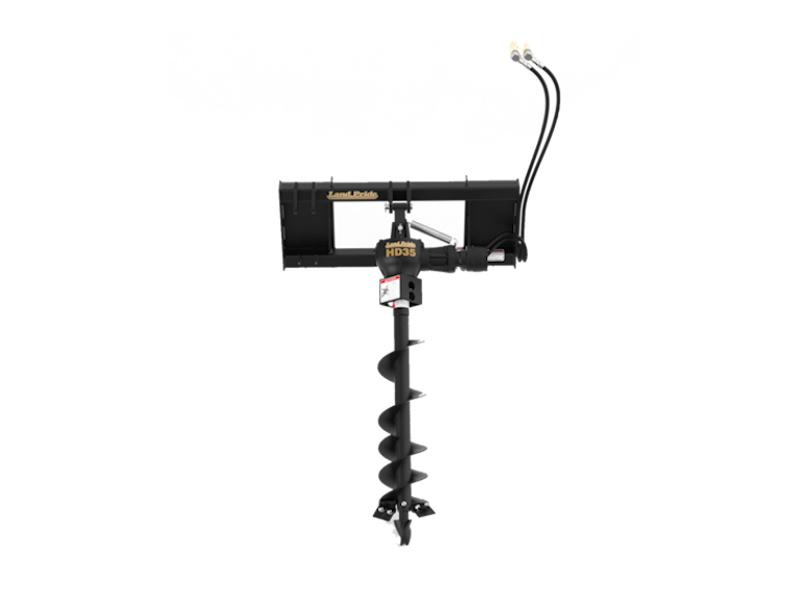
The Land Pride HD35 is a hydraulic post-hole digger to assess when a compatible carrier and a recurring workload justify a higher-flow digging package. It offers a different hydraulic match from the HD25, but “bigger” is not a complete selection rule. The carrier must deliver the permitted conditions, the auger must suit the material, and the mounting arrangement must let the operator reach the intended holes.
This guide uses the North American HD35 in Land Pride operator manual 317-076M dated January 3, 2024. It focuses on planning a complete system for Canadian fencing, planting and property projects. It does not claim measured production, current prices or suitability for an unspecified loader.
On This Page
ToggleThe hydraulic envelope is bounded at both ends
The HD35 is rated for 10–25 US gpm, equivalent to 37.9–94.6 L/min, at 1,500–3,500 psi. These are attachment requirements to compare with the intended circuit. A carrier’s advertised total hydraulic output may not describe what is available through that circuit under the proposed operating conditions.
Do not assume that a loader marketed as high-flow is automatically the best match. Its available flow may exceed the HD35 range, or its selectable arrangement may need specific setup. Likewise, a carrier that barely meets a nominal lower figure still needs an appropriate circuit, return path, controls and duty capability.
Before ordering, ask for the actual documented supply conditions and the approved installation arrangement. Where those cannot be established, leave the match unresolved. Couplers that connect physically are not enough evidence to commit the attachment to work.
Read the torque rating with its condition
| HD35 specification | Decision it informs |
|---|---|
| 10–25 US gpm | Which attachment circuits are candidates. |
| 1,500–3,500 psi | Whether the circuit’s operating conditions are compatible. |
| 1,605 lb-ft at 2,500 psi | A pressure-qualified torque comparison. |
| 93 rpm maximum auger speed | A model specification, not a guaranteed working speed on every carrier. |
| 3.18:1 gearbox ratio | Identification of the documented drive arrangement. |
The torque figure should not be quoted without its 2,500-psi condition. Nor should it be treated as a promise that the auger will keep turning through any material. Cutting-tool condition, material, geometry and the complete hydraulic installation remain part of the result.
For comparison, the same manual gives the HD25 a lower flow range and a different pressure-qualified torque figure. That establishes a meaningful model distinction, but not a universal productivity ratio. Twice the published turning effort would not mean twice as many finished holes in a project dominated by positioning and cleanup.
Think in completed installations, not spinning augers
A repeat-work project contains more than drilling. The carrier travels between marks, positions the tool, handles spoil and leaves a hole ready for the next operation. If a team follows with posts or planting stock, their pace and access can determine how much useful progress the digging attachment delivers.
Use a simple job log during a representative demonstration. Separate travel, positioning, drilling, withdrawal and any finishing work. Record the chosen auger and ground conditions. This creates a useful basis for comparing systems without pretending that a short easy-soil demonstration is a production test.
A larger hydraulic package is most persuasive when the identified bottleneck is something it can actually improve. If most time is spent navigating gates or moving materials, a different work layout may matter more than another drive head.
Mount selection changes reach and the operator’s view
The documented HD35 arrangements include Category I/II three-point mounting, a bucket mount and a skid/loader mount. They should be compared as separate working packages. Each changes how the carrier approaches a mark, what the operator can see and how the attachment moves through its permitted range.
The skid/loader arrangement can place the auger centrally or offset 18 inches to the right in the specified mounting system. That can be relevant to line of sight and access. It does not create unlimited reach around obstacles or remove the need to verify stability, clearance and the actual mount configuration.
A bucket-mounted arrangement keeps the bucket in the system, which changes the total installed package and hose route. A three-point version moves the task behind the tractor. Neither should be selected only because its purchase price is lower; compare the sequence at the actual work locations.
Include hose movement and protection in that comparison. The route must suit the full approved travel of the chosen mount. Installation details that appear minor on a stationary attachment can become important when the carrier positions it repeatedly.
Large augers make spoil management part of selection
The manual documents dirt and rock auger choices from 6 to 18 inches, plus a 24-inch tree auger. The correct selection begins with the required excavation and material, not with the largest diameter the model offers. A tree-auger option does not establish the appropriate planting method for every stock type and site.
Consider two ideal cylindrical holes of equal depth, one 12 inches in diameter and one 24 inches. The larger has four times the volume. This is simple geometry, but it has a practical consequence: the worksite must accommodate a different quantity of displaced material and subsequent installation work.
Actual spoil can occupy a different loose volume, and real holes are not perfect cylinders. Use the relationship to understand scale, not as a precise hauling estimate. It explains why a bigger hole can create a handling problem even when the drive head has adequate capability.
Depth requires clearance to withdraw the tool
The documented dirt and tree augers are 48 inches long; rock augers are 45 inches. Specified extensions are available for applicable arrangements. These component dimensions should not be added together and advertised as guaranteed digging depth.
The carrier needs enough movement to position and withdraw the full assembly appropriately. Mount geometry, overhead space and transport clearance can become restrictive. If deeper work is central to the purchase, demonstrate the proposed complete configuration rather than evaluating the drive head with a shorter auger.
Also consider where the carrier will stand. A hole near an existing fence or landscaped edge may require an approach that is quite different from an open-yard demonstration. Reach on paper is only useful if the carrier can occupy a suitable working position.
Hydraulic drive and downforce are different choices
A hydraulic motor turns the auger. How the tool is positioned and loaded depends on the mount and carrier. Loader-mounted arrangements and a three-point arrangement with the specified optional down-pressure equipment should not be treated as mechanically identical just because both use the HD35 head.
This distinction helps when comparing quotations. One package may include everything needed for its intended operating method, while another lists only the head and a basic mount. Identify the complete arrangement and its required controls before deciding which is better value.
The manual provides a reverse function for a particular obstruction-clearing situation. It also distinguishes that action from normal material withdrawal. Follow the exact operating procedure; reverse is a useful capability, not a universal remedy for every difficult hole or an instruction to reverse whenever the auger is raised.
Three ways a Canadian buyer might use the HD35
A farm with a suitable existing loader circuit
Here the initial advantage may be that the hydraulic infrastructure already exists. Verify it rather than assuming it, then assess mount fit and cutter selection. The complete incremental purchase can be more attractive than a comparison that assumes every buyer must install a new circuit.
A property manager doing repeated projects
The useful focus is repeatability: predictable setup, documented compatibility, a clear operating routine and readily identified wear parts. A mixed group of operators benefits from consistent equipment records and handover. A powerful drive head does not compensate for uncertainty about which controls or augers belong to the package.
An owner with only a small one-time job
A substantial hydraulic package may be difficult to justify for a short project, particularly if the carrier needs additional work. Compare a complete hire or contracted-work quotation. Owning the attachment can still have personal value, but that preference should be separated from a claimed financial saving.
Compare mechanical drive without ignoring setup cost
The Land Pride PD25 provides a mechanical-drive reference. A PTO package asks different questions about the tractor, driveline and operating routine. It may suit an owner whose tractor is already ready for that arrangement, while the HD35 may suit another carrier and work pattern.
The PD15 is useful context for a smaller mechanical system. Neither comparison should be reduced to bare implement price or horsepower. Include the selected auger, mount, controls, setup and any carrier changes required to obtain the desired working system.
Aglist’s hydraulic-controls guide helps separate control arrangements from available hydraulic power. That distinction remains important even with a carrier that appears powerful enough on a brochure cover.
Inspect a used HD35 as a system
First identify the drive head, mounting arrangement and included auger. The manual’s weights with a 6-inch auger differ by mount: 235 lb three-point, 268 lb skid/loader and 170 lb bucket-mounted. Do not apply one figure to an unknown package with a larger cutter and extra components.
Examine the mechanical condition with the equipment isolated and appropriately supported. Look for damage or repairs that need competent assessment, mounting wear and cutter condition. Identify replacement teeth and pilot components for the actual auger. These checks establish the condition of this unit; they are not a claim about common HD35 failures.
Hydraulic inspection needs equally careful attention. Have hoses, connections, leakage and operation assessed using suitable procedures. Never feel for a pressurized leak. An unloaded cold demonstration cannot establish every aspect of performance during representative work, so arrange an appropriate condition assessment before assigning full working value.
Ask what circuit previously powered it and retain any setup records, while recognizing that the next carrier still requires its own compatibility check. Previous successful use is useful history, not transferable approval for a different installation.
Define acceptance before paying
A practical purchase record should identify the carrier and available circuit, exact mount, auger type and diameter, required controls, hose arrangement, fitted accessories and applicable manuals. Add the specific project conditions used to assess the package.
Separate a condition inspection from a performance demonstration. The first asks whether the equipment is sound and complete. The second asks whether the chosen system does the intended work under appropriate conditions. Both matter, and success in one does not automatically answer the other.
For ownership planning, obtain local quotes for known wear items and identified repairs rather than adopting an invented hourly maintenance figure. Track actual completed jobs and interruptions after purchase. That record will show whether the attachment is serving the reason it was bought and which changes to the work routine would be useful.
Frequently asked questions
Is any high-flow loader suitable?
No. The HD35 has a published upper as well as lower flow limit. Establish the approved circuit conditions and complete compatibility.
Will the torque figure predict drilling time?
No. Retain its pressure condition, and assess the whole job, including material, cutter, positioning and finishing.
Does the offset mount increase safe working reach everywhere?
No. It changes the specified mounting position. Clearance, carrier position and operating limits still determine where the tool can be used.
Can I choose by the smallest listed weight?
No. That figure belongs to a particular package. Account for the actual mount, auger and other attached equipment.
What is the best reason to choose HD35 over HD25?
A verified carrier and workload that justify the HD35’s documented hydraulic match and capabilities. A larger model number alone is not that justification.
Primary source
Specifications and configuration distinctions were checked against Land Pride manual 317-076M, January 3, 2024. Project scenarios and buying methods are editorial analysis, not field tests or guarantees of output.
Share your experience
Help other Canadian buyers — leave a quick review for the
Land Pride HD35
There are no reviews yet. Be the first one to write one.