
Overview & Specs
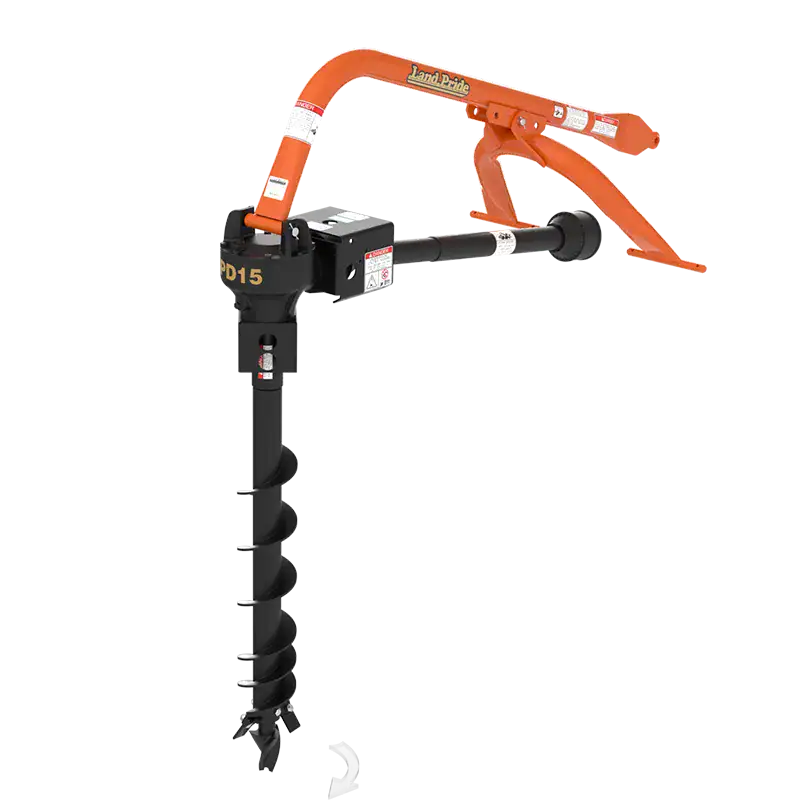
The Land Pride PD15 is a tractor-mounted post-hole digger for a defined drilling job on a compatible tractor. Its appeal is straightforward: an owner with recurring fence or landscaping work can use an existing power unit instead of arranging separate equipment for every hole. The important qualification is that auger size, soil, access and tractor geometry must fit the work together.
Before shopping, prepare a hole schedule. Record the required diameter and depth, number of locations, access route and known ground conditions. The design of the fence or structure establishes the hole requirement; the auger you happen to own should not dictate it. This guide does not prescribe footing dimensions or a universal frost-depth allowance.
On This Page
ToggleThe PD15 configuration in the manufacturer’s manual
Land Pride’s September 17, 2024 manual lists a 20–40 tractor-hp range, Category 1 attachment and 161 lb without an auger. Its PD15 dirt-auger options are 48 inches long in 6-, 9- and 12-inch diameters. Most importantly, the stated maximum PTO speed is 300 rpm. Use the exact manual for the supplied machine and equipment.
That last number is easy to miss when most nearby implements advertise 540-rpm operation. A tractor’s nominal PTO capability does not mean every connected implement should be run at its full nominal shaft speed. The operating limit belongs to the particular implement.
Confirm how the actual tractor achieves the required operating conditions with its controls and documentation. Do not copy an engine-throttle position from a different tractor, and do not use a shaft adapter to make an unsuitable connection appear compatible.
Auger length is not a guaranteed finished-hole depth
A 48-inch auger describes a component dimension. Actual usable drilling depth depends on the installed geometry, clearance, soil and the permitted operating arrangement. It should not be advertised as a promise that every tractor-and-PD15 combination produces a four-foot finished hole.
Measure the intended hole requirement independently. Then establish whether the complete package can reach and withdraw appropriately at the actual site. A low obstruction above the tractor or a confined approach can be as important as the depth below ground.
For Canadian projects, keep engineering and installation requirements separate from equipment selection. Fence posts, decks, signs and other structures can have different design requirements. Obtain the applicable project specification rather than treating an auger length as a construction recommendation.
If the required depth is beyond the verified arrangement, choose a suitable alternative. Improvised extensions or changes to the linkage are not a sound way to resolve a mismatch discovered after purchase.
Diameter changes the amount of soil substantially
At the same depth, the volume of a cylindrical hole increases with the square of its diameter. Doubling diameter therefore increases the idealized volume fourfold. That is why moving from a small post hole to a much larger hole is not a small change in workload.
For an illustrative comparison at 36 inches deep, a 6-inch-diameter cylinder has a volume of about 0.59 cubic feet. A 12-inch-diameter cylinder at the same depth is about 2.36 cubic feet. These calculations describe ideal geometry, not measured PD15 output, actual spoil volume or recommended hole dimensions.
The larger hole also creates more material to manage around the location. Include that handling in the project plan. A fast drilling operation may not shorten the overall job much if spoil removal and post installation dominate the day.
Use the required hole size to choose the auger, rather than selecting the largest available option to maximize apparent versatility. An oversized hole can change material quantities and installation work without improving the design.
Power, down pressure and the ground are different questions
A tractor can have enough power to drive the assembly while the auger still struggles to penetrate a particular layer. More engine output does not automatically create the correct downward force or make an unsuitable auger appropriate for that ground.
The PD15 product page identifies an optional down-pressure arrangement. Assess the exact approved kit and tractor requirements if that feature is needed. It is not permission to add people, loose ballast or improvised force to the digger.
Describe the soil and any known hard layers when arranging a trial. A demonstration in easy previously disturbed ground may not answer a question about the actual fence line. Conversely, one difficult hole should not be treated as evidence that every location requires a larger machine.
If the site contains uncertain buried material or services, resolve that uncertainty before drilling. The project needs the appropriate locate and site-assessment process for its location. A powered auger is not a tool for discovering what might be hidden below the surface.
Accessory descriptions need careful checking
The manufacturer’s web FAQ and the cited manual do not agree on every extension and adapter statement. The FAQ says extensions are unavailable for PD15, while the manual’s accessory table includes extensions and an adapter. That discrepancy is a reason to verify the exact serial number and approved assembly before ordering those accessories.
This guide therefore does not approve an extension or adapter combination. Keep the basic documented digger and dirt-auger choice separate from any proposed accessory until the manufacturer or an authorized supplier confirms the exact parts and application.
The product page also describes rock-auger options separately from the standard dirt augers. A different cutting tool may address a different ground condition, but its label does not establish that every rock or obstruction can be drilled. Obtain a task-specific recommendation within the approved equipment range.
Put the complete accessory list on the quotation. A photograph showing a stand, alignment handle or another option should not be taken as evidence that it is included in the base price.
Tractor geometry determines whether the job is convenient
Check the three-point arrangement, lifting movement, driveline and available clearance with the actual tractor. Category 1 identifies part of the connection; it does not describe the full working envelope of a post-hole digger.
The long boom and auger require room to position, lift and park. A combination that fits an open field may be awkward near a fence corner, shelterbelt or outbuilding. Map the tractor’s approach to the difficult holes, not just the easiest section of the line.
Do not assume a general three-point quick hitch is suitable because other attachments use one. Confirm the PD15-specific mounting instructions. The Aglist quick-hitch guide is useful background on why a category label cannot replace a complete fitment check.
Inspect the proposed storage arrangement too. A stable approved stand and a practical connection area can make occasional use much easier. If the digger is difficult to park and reconnect, ownership may be less convenient than the drilling demonstration suggests.
Estimate a fencing day from the whole cycle
Drilling time is only one part of each hole. The tractor must align, drill, withdraw and move; the location may then need inspection, spoil handling and installation work. A productivity claim that times only the auger in easy soil can be misleading.
Suppose a hypothetical project has 30 holes. If drilling takes three minutes per hole and positioning plus withdrawal takes another three, the machine cycle totals three hours. Add an assumed hour for setup and interruptions and the equipment portion reaches four hours, before post installation. These are invented planning inputs, not a PD15 rate.
If ten holes encounter conditions that add six minutes each, the day gains another hour. The example shows why representative ground matters more than an impressive demonstration on a single easy hole.
For a purchase comparison, record the actual cycle under permitted conditions. Compare rental or contractor quotations against the same number, size and accessibility of holes. A quotation for drilling alone is not equivalent to a complete installed fence.
Seasonal planning for Canadian properties
Choose the working window around the site and project requirements. Frozen or saturated ground can change whether the planned operation is practical. Do not assume that owning the digger makes every date in the calendar a suitable drilling day.
Where installation is time-sensitive, identify an alternative before the project starts. A contractor or a different approved machine may be a better contingency than attempting to force the original setup through unsuitable conditions.
For recurring small repairs, ownership may provide useful flexibility. For one large project followed by little use, the storage, service and setup burden deserves more weight. The number of holes over several years is often more informative than the urgency of the first weekend.
Used PD15: inspect the supplied assembly
Confirm the model and serial identification, then inventory the auger, driveline, shielding, pins and any accessories. The bare digger’s listed weight excludes the auger, so the offered package should be described by its actual components rather than one incomplete figure.
Inspect the boom, yoke, gearbox mounting and hitch for deformation, cracks or undocumented repairs. Check the auger flighting, cutting components and connection for wear or damage with the equipment properly secured. These are general inspection priorities, not allegations of a recurring PD15 fault.
Have the driveline and protection arrangement assessed by a competent person. Missing guards or an incorrect replacement shear component are not cosmetic issues to defer until after the first job. Price restoration before judging the used offer.
Ask why any modifications were made. A seller’s explanation that an alteration helped in hard ground does not establish that it is approved or suitable for your tractor. Prefer a documented complete configuration that can be maintained with the correct parts.
What a useful demonstration should establish
The trial should use an inspected site, a compatible package and a trained operator. It should show positioning and withdrawal as well as penetration. Keep everyone clear of the rotating assembly and follow the manufacturer’s procedures throughout.
Never judge the machine by allowing a helper to push, guide or add weight to a rotating auger. The manual expressly prohibits those practices. A purchase demonstration that depends on them is not evidence of a workable ownership routine.
After the machine is safely stopped, assess whether the hole meets the intended dimensional requirement and whether the spoil-handling plan is practical. A hole produced quickly but in the wrong position or with unsuitable dimensions is not a completed project task.
Document the tractor, auger and ground conditions with the result. That record helps prevent a successful demonstration of one setup from being generalized to a different auger, accessory or site.
Frequently asked questions
Should it run at 540 PTO rpm?
Not according to the cited PD15 manual, which specifies a maximum of 300 rpm. Confirm the correct tractor settings from the applicable documentation.
Does the 48-inch auger guarantee a 48-inch hole?
No. Component length and usable finished depth are different. Verify the complete installed geometry and site requirements.
Can spare tractor power replace a down-pressure kit?
No. Rotational power and the permitted force applied to the auger are separate aspects of the system.
Should I order an extension from a generic listing?
No. The manufacturer’s sources contain conflicting accessory statements. Resolve the exact serial-specific approval before purchasing or fitting one.
When is ownership most compelling?
When repeated suitable drilling work, a compatible tractor, manageable access and practical storage justify the complete package. For an isolated difficult project, compare a properly scoped drilling service before buying.
Share your experience
Help other Canadian buyers — leave a quick review for the
Land Pride PD15
There are no reviews yet. Be the first one to write one.