Overview & Specs
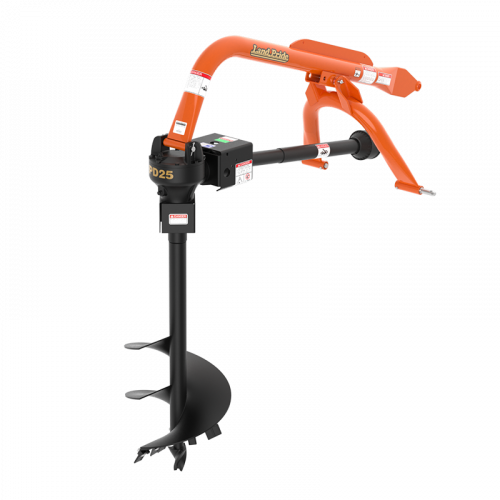
The Land Pride PD25 is a three-point, PTO-driven post-hole digger for tractors in the manufacturer’s 25–55 hp range. Its main buying advantage over a smaller basic digger is the documented range of auger duties and sizes, together with a heavier driveline arrangement and an optional radial-pin clutch. That breadth is useful only when the tractor, drilling conditions and required holes justify it.
For a Canadian acreage owner planning fencing, landscaping or repeated installation work, the first decision is the hole specification and the ground to be drilled. A larger digger does not decide the correct diameter or depth for the project, and an available rock auger does not guarantee progress through every obstruction. Match the work before buying the drive head and accessories.
This guide uses Land Pride’s North American operator manual 317-048M, dated September 17, 2024. It distinguishes the PD25 from the PD10, PD15 and PD35 covered in the same document. Check the serial number and fitted components on a used machine; a family name on a listing is not enough to identify its configuration.
On This Page
ToggleThe specifications that change the buying decision
| Item | Documented PD25 specification | Why it matters |
|---|---|---|
| Tractor horsepower range | 25–55 hp | Preserve this as a tractor range rather than calling it PTO horsepower. |
| Weight without auger | 186 lb (84.4 kg) | The installed auger and accessories add to the carried package. |
| Three-point hitch | Category I and II | Complete geometry and clearance still need verification. |
| Gearbox ratio | 3.18:1 | This is a reduction ratio, not permission to use the tractor’s full nominal PTO speed. |
| Maximum PTO speed | 300 rpm | The operating ceiling is lower than the nominal tractor PTO designation. |
| Standard driveline | Category III shear-bolt type | Use the specified protection arrangement and replacement hardware. |
| Optional protection | Category III radial-pin clutch | The manual recommends this option for augers 15 inches and larger. |
Do not confuse the driveline’s Category III description with the three-point hitch categories. They describe different components. A tractor buyer who sees “Cat. III” in an attachment listing should establish whether the listing is discussing the shaft or the hitch before drawing conclusions about fit.
Choose the auger around the finished hole
The specification table lists 48-inch dirt and tree augers. For the PD25, the dirt-auger diameters are 6, 9, 12, 15 and 18 inches, while the tree-auger entry is 24 inches. Rock augers are listed at 45 inches long in diameters from 6 through 18 inches. These are documented equipment choices, not a claim that each choice is appropriate for every site or tractor within the power range.
Begin with the project’s required hole dimensions and installation method. A post, plant or other installation can have requirements beyond simply fitting inside a hole. Establish those requirements separately. This guide does not assign a universal Canadian footing depth or treat auger length as a substitute for project design.
Then describe the expected ground and how uncertainty will be handled. Known soil from previous work is different from an untested line containing possible fill, roots or stones. If an obstruction would force a change in location that the project cannot accept, include an alternative method or specialist assistance in the plan.
Finally, verify the exact auger assembly and connection supplied with the digger. A seller’s statement that an auger “fits the shaft” does not establish suitable duty, length or clearance. Check its identification, condition and approved pairing. Keep that information with the purchase record so replacement teeth or other parts can be selected correctly later.
Why diameter changes the job so much
A larger diameter increases the cross-sectional area of the hole rapidly. For a simple comparison, doubling diameter from 9 to 18 inches multiplies circular area by four, because area is proportional to diameter squared. At the same depth, an ideal cylindrical hole would therefore involve four times the volume.
This is a geometry example, not a prediction that drilling takes exactly four times as long or requires exactly four times as much power. Ground, auger design, spoil removal and the operator’s working sequence affect performance. The calculation is useful because it prevents treating a large diameter as a small incremental change.
It also explains why the manual’s recommendation for the radial-pin clutch on augers 15 inches and larger deserves attention. Choose the complete configuration around the intended auger rather than buying the cheapest drive package and considering protection afterward. A used digger advertised with several large augers needs a particularly clear inventory of what driveline is actually fitted.
Consider spoil handling as part of the project. A hole may be drilled successfully while the surrounding work area becomes inconvenient for setting posts or moving materials. Decide where displaced material can remain and whether additional cleanup is needed. The digger performs one stage of installation; it does not complete the entire project.
A nominal 540-rpm tractor PTO is not the operating target
The manual lists a 540-rpm tractor PTO requirement and separately states a maximum power-take-off speed of 300 rpm. Its operating and troubleshooting sections reinforce the 300-rpm ceiling. These statements must be read together: the nominal tractor shaft designation does not authorize running this digger at 540 rpm.
Establish how the actual tractor displays or determines PTO speed and follow the applicable operating instructions. Do not convert this guide into a universal engine-throttle setting. Tractors differ, and a marked engine speed associated with nominal PTO operation is not automatically the setting required for this attachment.
The practical purchase question is whether the operator can maintain appropriate control of the tractor and digger at the required operating condition. A brief demonstration at an unknown shaft speed is not enough. Ask for the demonstrated configuration and operating procedure to be identified rather than judging only whether the auger turns.
Aglist’s PTO and engine horsepower guide explains another distinction that often becomes mixed into this decision. Power ratings, shaft speed and the implement’s permitted operating range are separate checks. Passing one does not replace the others.
Three-point fit is a movement check
The PD25’s 186-pound figure excludes the auger. Assess the complete carried equipment, including accessories, against the tractor’s guidance. The location of that weight and the machine’s stability matter as well as whether the hitch can raise it in a stationary demonstration.
The connection must also allow the intended movement without driveline bottoming, excessive joint angles or interference. The manual includes setup and clearance procedures because a connected machine is not necessarily a correctly fitted one. Have the driveline length and guarding assessed for the exact tractor and attachment arrangement.
A change of tractor can require a new assessment even when both tractors fall within the stated horsepower range. Likewise, a shaft previously shortened for another tractor should not be accepted merely because it connects. Its condition, length and permitted overlap need to suit the current combination.
Do not infer quick-hitch compatibility from the Category I or II designation. The digger’s mounting arrangement must follow its own instructions. If a used package includes an adapter, establish why it is present and whether it belongs in the approved setup rather than treating additional hardware as an automatic convenience.
Down pressure is an option with conditions
The manual lists a hydraulic down-pressure kit. Its role is to assist penetration through an approved arrangement; it is not a guarantee that the machine can drill every hard patch. The operating guidance warns that excessive down pressure can slow or stall the auger.
Before adding the kit, separate a penetration problem from worn cutting parts, unsuitable auger choice, an obstruction or an incorrect operating condition. Buying an accessory without identifying the cause can leave the original problem in place. The troubleshooting section is a diagnostic starting point, not evidence that any particular fault is common.
Assess the complete hydraulic installation required by the kit, including its specified return arrangement. Do not assume that a spare pair of couplers makes every installation correct. The tractor’s hydraulic system and the accessory instructions must agree on the connections and operation.
For intermittent work, compare the complete cost and setup burden of the kit with hiring suitable equipment for the difficult portion of the project. The sensible answer may differ between a property with repeated known drilling work and one with a single uncertain fence line.
Extensions do not turn length into guaranteed depth
The PD25 specification table lists 7- and 14-inch extensions. Their presence in the range does not mean that every tractor can safely carry, position and withdraw every extended assembly. The longer combination changes clearance and the lift needed to remove the auger from the hole.
The manual specifically discusses driveline damage associated with excessive lift angles when using extensions. Verify the permitted configuration and working sequence before purchase. Do not add the extension length to the nominal auger length and advertise the sum as an assured hole depth.
A useful pre-purchase demonstration checks the intended assembly on the actual tractor through the prescribed clearance procedure. It should not involve deliberately forcing the driveline to its limit. Where the required depth cannot be achieved with a verified combination, choose another method rather than improvising around the machine’s geometry.
Planning recurring work on a Canadian acreage
Map the locations, access route and installation sequence before committing to equipment. Complete the applicable buried-service locating arrangements and identify other site hazards before drilling. A line that is convenient for a tractor may not be the correct or available location for the installation.
Do not promise an installation date solely because the digger is available. Ground conditions and access may change the workable window. Frozen or otherwise difficult ground should trigger a reassessment of the method and equipment, not an assumption that a larger PTO digger eliminates the issue.
Count setup, positioning, spoil handling and the installation work that follows drilling. For a small number of holes, those stages may dominate the day. For repeated work in known conditions, the convenience of an owned and correctly matched digger may be more valuable than a theoretical drilling-speed advantage.
Keep a fallback plan for holes that cannot be completed as expected. Decide in advance when to stop and reassess, whom to contact and whether a different tool can reach the site. This is more useful than relying on an unsupported holes-per-hour promise.
Inspecting a used PD25
Start with identification and the complete inventory: drive unit, augers, driveline, guards, protection device, optional stand and any down-pressure equipment. A photograph of the boom alone cannot establish the value of a usable package. Missing components and mismatched augers can change both suitability and restoration cost.
Examine the boom, yoke and connections for distortion, damage or repairs requiring explanation. Inspect the gearbox for condition and signs of leakage, and verify maintenance requirements from the applicable manual. These are inspection priorities, not claims of a model-specific failure pattern.
Check the auger’s straightness, flighting, pilot and teeth. Replaceable cutting parts are useful only if the remaining assembly is sound and the correct parts can be identified. Inspect each auger in a multi-auger sale rather than valuing the package by the number of pieces alone.
Identify the protection device and confirm that any replacement shear hardware matches the manufacturer’s requirement. A stronger substitute is not an upgrade to the designed protection system. The PD15 guide offers context for a smaller family member, but its configuration should not be used to identify every PD25 component.
Finally, assess how the digger will be parked and connected. The optional storage stand can be part of a practical ownership setup, but verify the correct stand and its condition. A stable, accessible storage arrangement reduces the temptation to improvise supports when reconnecting a seasonal implement.
Frequently asked questions
Is 186 pounds the complete working weight?
No. The specification explicitly excludes the auger. Include the actual auger and accessories when assessing the complete combination.
Can it operate at 540 rpm?
The cited manual states a maximum PTO speed of 300 rpm. The nominal 540-rpm tractor PTO requirement does not override that operating limit.
Is the optional radial-pin clutch a friction slip clutch?
The manual identifies a radial-pin clutch. Do not substitute a generic friction-clutch description or maintenance procedure for the device actually supplied.
Does a rock auger guarantee drilling through rock?
No. An available tool category is not a guarantee for every formation or obstruction. Define the site conditions and retain an alternative when the verified equipment cannot perform the work.
Should I choose the PD25 instead of a smaller digger?
Choose it when its documented tractor range, auger choices and complete configuration match the recurring job. Extra capacity is not useful if the tractor geometry, access or project requirements point to another method.
Source and scope
Model facts were checked against Land Pride operator manual 317-048M, September 17, 2024, particularly the PD25 specification table, setup, operating and troubleshooting sections. The diameter example is a geometric comparison, not a performance test. This guide makes no claim about current Canadian stock, prices or warranty eligibility for a particular machine.
Share your experience
Help other Canadian buyers — leave a quick review for the
Land Pride PD25
There are no reviews yet. Be the first one to write one.