
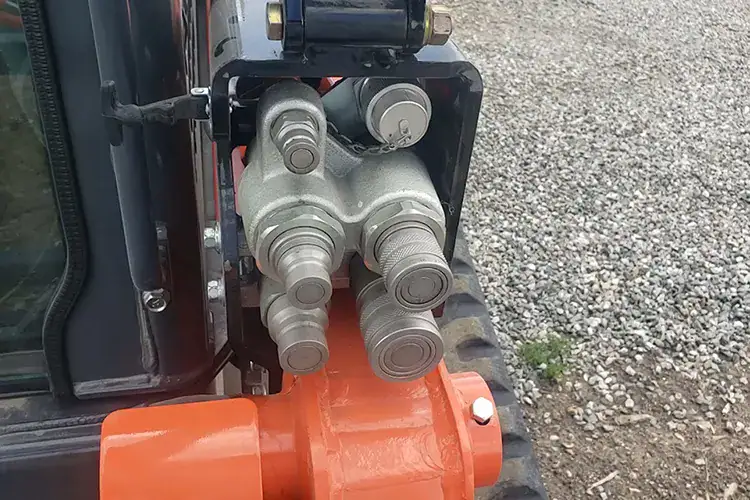

Choose a skid steer’s hydraulic package around the attachments you actually need to run. Standard flow is often sufficient for a well-matched attachment; high flow becomes valuable when an identified tool requires more hydraulic output. Neither package is automatically the better purchase for every Canadian farm, acreage or contracting business.
The mistake is treating “high flow” as a universal compatibility label. Two machines can both have a high-flow option and still deliver different flow and pressure. Two attachments that look similar can have different motors and operating limits. A quick-attach plate can fit while the hydraulic and electrical requirements remain unresolved.
This guide shows how to compare standard and high flow, read the relevant numbers, screen a proposed combination and build a buying plan. It also separates hydraulic attachment performance from lifting capacity, so that an impressive gpm figure does not distract from the rest of the machine.
Standard flow versus high flow: quick comparison
| Question | Standard flow | High flow |
|---|---|---|
| What does it describe? | The machine’s base auxiliary hydraulic output | An additional hydraulic configuration with greater output; specifications vary |
| Is it a universal gpm value? | No | No |
| How should you select it? | Match the exact attachment’s approved requirements | Match the exact attachment’s approved requirements and confirm the option is installed |
| Does it determine lifting capacity? | No; use the appropriate loader and attachment ratings | No; additional auxiliary flow is not a new load rating |
| What is the common buying mistake? | Assuming every useful powered attachment needs an upgrade | Assuming more flow can be sent to any attachment |
What gpm and hydraulic pressure tell you
Flow is the volume of hydraulic oil supplied over time, commonly listed as gallons per minute or litres per minute. Pressure describes a different part of the hydraulic system. Both belong on the compatibility sheet, together with the attachment manufacturer’s requirements.
For Canadian comparisons, check the units carefully. Manufacturer specifications often use US gallons even when the buyer thinks in metric. One US gpm is approximately 3.785 L/min. A figure of 20 US gpm therefore converts to roughly 75.7 L/min, not 20 L/min. Label the units in your notes rather than copying a bare number.
Do not read a published maximum pressure as a statement that an attachment always operates at that pressure. Similarly, do not assume that a peak specification describes the output available in every working condition. Ask for the applicable specifications and operating instructions for both pieces of equipment.
In practice, your shopping document needs more than “high flow: yes.” It needs the actual flow range and pressure information for the proposed configuration, the attachment’s approved limits, and confirmation that the combination is supported.
Why there is no single high-flow threshold
Compare two published examples. Bobcat lists the S64-2 at 17.6 US gpm standard flow and 26.9 US gpm optional high flow. The S76-2 lists 23.3 and 30.3 US gpm respectively. The label alone hides a meaningful difference.
A hypothetical tool requiring 28–32 US gpm would not pass a simple flow-range check on the first machine’s 26.9 gpm high-flow specification. The second machine’s 30.3 gpm figure falls within that example range, but pressure, controls, carrier approval and the other requirements still need checking. Passing one line of a compatibility sheet is not the same as approving the combination.
The same principle applies across manufacturers. Compare the numbers and configurations instead of declaring that all machines above a particular gpm figure belong to an interchangeable category.
Which attachments need high flow?
Start with the attachment model and motor option, not its broad category. Bobcat’s hydraulic options guide lists standard-flow and high-flow versions within categories such as snow blowers, rotary cutters and soil conditioners. That makes a blanket rule such as “a snow blower always needs high flow” unreliable.
For a passive bucket or ordinary pallet forks, there is no attachment motor to power through the auxiliary hydraulic connections. Bobcat explicitly distinguishes these non-hydraulic tools from hydraulic attachments. Buying a high-flow package solely to improve ordinary fork capacity confuses two different systems.
| Attachment you are considering | What to establish before choosing a loader |
|---|---|
| Bucket or ordinary pallet forks | Mounting compatibility, approved load and handling geometry; identify any extra powered functions separately |
| Grapple or auger | Exact model, approved hydraulic requirements and carrier compatibility |
| Snow blower | Motor option, flow range, pressure, controls and any drainage requirement |
| Cutter, mulcher or planer | Complete manufacturer-approved carrier specification, including any required protective equipment |
| Rental attachment | The actual rental unit’s requirements, rather than a generic category description |
This is a purchase-screening table, not a compatibility chart. The equipment supplier must identify the approved setup for the actual attachment and machine.
Can a high-flow loader run a standard-flow attachment?
Often a properly equipped machine offers a suitable standard-flow mode, but the machine’s capability and the selected setting are separate questions. Bobcat’s attachment-matching guide describes the ability to use a standard-flow range on its optional high-flow packages. Check the instructions for the exact loader and tool.
Do not conclude that a lower-flow attachment can safely receive the machine’s maximum output. Land Pride gives a concrete counterexample in its SBL25 low-flow motor FAQ: it rejects using 30 gpm with that low-flow motor because damage can result.
When a fleet shares attachments, record the approved setting with each machine-and-tool pairing. Include the operator instructions and any required configuration information in the handover. The fact that an attachment worked on one loader does not establish how it should be configured on another.
Can a standard-flow loader run a high-flow attachment?
Not merely because the hoses connect. If the attachment requires a minimum output beyond the machine’s supported capability, the combination fails that requirement. Find an attachment variant approved for the loader or choose an appropriate carrier.
There is a useful distinction between selecting a smaller compatible tool and trying to operate an incompatible tool below its approved range. The former can be a sensible business decision. The latter is not a reliable substitute for matching equipment.
For a rental, provide the rental company with the machine model, serial number and hydraulic configuration before booking. Ask it to identify the exact attachment and confirm the combination. This prevents a delivery-day discovery that the attachment needs a package your loader does not have.
Flow is only one part of attachment compatibility
Pressure and the exact motor option
Request the attachment’s operating requirements and maximum permitted values. Two tools with similar names or working widths may have different hydraulic components. Treat a missing specification as an unresolved question, not as permission to assume that a typical figure applies.
Drainage and hydraulic connections
Some attachments have drainage requirements beyond the main supply and return connections. Check the exact manual and have the supplier confirm that the loader provides the required arrangement. Land Pride’s snow-blower operating manual, for example, includes case-drain connection instructions. Follow the applicable manual rather than improvising a hose arrangement.
Electrical controls
Identify how the attachment’s additional functions are controlled and what connections the loader supports. Write down any approved harness or control kit included in the quote. “Fits a skid steer” is too vague to settle electrical compatibility.
Carrier approval, dimensions and visibility
Hydraulic matching does not establish the suitability of the attachment’s weight, working dimensions or intended application. Confirm the manufacturer’s carrier requirements and any required guarding. Then assess whether the complete setup fits the jobsite and gives the operator the visibility needed for the task.
High flow and continuous flow are different questions
High flow describes a hydraulic output configuration. Continuous-flow functionality concerns how an attachment is supplied during operation. One label should not be used as a substitute for checking the other.
Caterpillar’s continuous-flow attachment guide discusses tools such as trenchers and planers, including the existence of different flow requirements within attachment categories. For a buyer, the practical step is to ask the dealer to demonstrate both the approved output setting and the control method for the intended tool.
Do that during the equipment handover, not for the first time at a remote jobsite. Keep a copy of the instructions with the equipment records, especially if more than one person operates the loader.
Choosing a snow blower for a Canadian winter
Start with the job you need to complete: the area to clear, the route through it, where the snow can go and whether the work is occasional or contracted. These details help define the attachment specification and the value of additional capability.
Next, request the blower’s exact model and motor option. Compare its approved hydraulic requirements with the loader you own or intend to buy. Ask the supplier to include the required controls and connections in the quote. Do not let a matching width or a photograph of a similar machine stand in for that confirmation.
Finally, compare the whole working arrangement. Include access, operator visibility, the cab equipment you require and local service support. A high-flow specification does not answer whether the machine can work comfortably along your route or whether the attachment can be supported promptly during your busy season.
For a farm clearing its own yard, occasional rental may deserve a place in the comparison. For a contractor with committed work, availability and compatibility may be more important than the lowest attachment purchase price. The same snow blower can therefore make sense for one buyer and be a poor investment for another.
Does high flow make a skid steer lift more?
An auxiliary flow upgrade is not a new rated operating capacity. Loader lifting ratings, attachment ratings and hydraulic attachment requirements need separate checks.
If your real problem is handling a heavier pallet or reaching over a truck side, compare the approved lifting setup and geometry. If your problem is powering a specified hydraulic tool, compare the hydraulic package. A buyer can otherwise pay for an upgrade that does not address the original limitation.
Read Skid Steer ROC and Tipping Load Explained for the lifting side of the decision. For machine research, Aglist’s Bobcat S650, Bobcat S770 and John Deere 330 P-Tier pages are starting points; verify the actual generation and hydraulic options in each offer.
Is high flow worth the extra cost?
Build the comparison around useful work, not resale assumptions or a general belief that more equipment is always better. Identify the attachment that requires the option, the number of jobs you expect to complete and the alternatives available locally.
Consider three purchase plans:
- Standard-flow ownership: buy compatible tools for routine work and use rental or contracted services for the exceptional task.
- High-flow ownership: buy the machine package and attachment that meet a recurring, well-defined requirement.
- Delay the attachment purchase: verify local rental compatibility and use real working experience to refine the specification before buying.
Request comparable quotes in Canadian dollars. Include the hydraulic package, attachment, controls, approved connection equipment, delivery and any required machine equipment. Keep those costs separate from financing so that the comparison is understandable.
A simple planning example
Suppose the complete additional package costs C$8,000 more than your alternative, and your own documented comparison indicates C$200 of net benefit each day it is actually used. Dividing 8,000 by 200 gives 40 productive days. Those numbers are hypothetical, not current market prices or a return forecast.
The useful next step is to challenge the assumptions. Is the work already available? Does the daily benefit include the additional operating and maintenance costs? How many of those days are realistic each year? What happens if the attachment sits unused? A calculation built on your own quotes and workload is more useful than a generic claim that high flow “pays for itself.”
Can you add high flow to a used loader later?
Do not assume every loader can be upgraded economically, or that the same process applies to every generation. Have the dealer confirm the supported options for the exact serial number and provide a complete written quote before buying on the expectation of a later conversion.
Caterpillar’s standard-to-high-flow SEA kit listing illustrates how model-specific this question can be: its description refers to dealer-enabled functionality and associated identification decals. It does not establish that an unrelated machine can be converted with a switch or a generic pump.
Compare the confirmed upgrade cost and availability with a machine already equipped for the intended work. If the seller cannot document the fitted hydraulic package, treat it as unverified until the dealer identifies it.
Used-loader and used-attachment buying checklist
- Record both serial numbers and exact model names, including generation and motor option.
- Obtain the applicable manuals and hydraulic requirements.
- Confirm the loader’s installed package through documentation and dealer verification.
- Check the complete compatibility requirements, not only mounting plate and hose ends.
- Arrange a qualified inspection and a supervised working demonstration within approved limits.
- Identify required controls, connection equipment and guarding before agreeing on the package price.
- Request service records and have condition-related work costed separately.
- Keep the approved setup and operator instructions with the equipment records.
A brief demonstration that the attachment moves is not the same as confirming a supported combination in suitable working condition. Ask the inspecting technician what was checked and what remains unknown.
A compatibility worksheet to take to the dealer
| Item | Your record |
|---|---|
| Loader | Model, serial number, generation and installed hydraulic package |
| Attachment | Exact model, serial number and motor option |
| Hydraulic requirements | Approved flow range, pressure and required connections |
| Controls | Required functions, connections and approved kits |
| Carrier requirements | Approved machine configuration and application-specific equipment |
| Jobsite fit | Working width, access, visibility and intended task |
| Commercial comparison | Complete dated quote, delivery, support and alternatives |
| Confirmation | Supplier’s written approval and applicable manuals |
Frequently asked questions
How many gpm is considered high flow?
There is no single figure that establishes compatibility across all loaders. Use the manufacturer’s specification for the exact model and package, then compare it with the attachment’s approved requirements.
Will high flow make every attachment faster?
No. Some attachments do not use auxiliary hydraulics, while powered tools have defined operating limits. More available flow is useful only when the approved attachment and working setup can use it.
Can I use a standard-flow tool on a high-flow machine?
Only with an approved configuration and appropriate setting. Confirm the standard-flow mode and attachment requirements; do not simply supply the maximum available output.
Does a snow blower always need high flow?
No. Manufacturers offer different blower configurations. The exact motor option and approved hydraulic range determine the match.
Are a case drain and the main return connection interchangeable?
Do not assume they are. Use the attachment’s connection instructions and have the supplier confirm the required loader arrangement. This is a compatibility item to resolve before operation.
What if the seller only says “high flow equipped”?
Request serial-number-based confirmation, specifications and a demonstration of the fitted functions. A decal or an advertisement description alone is insufficient for selecting an attachment.
What should I buy first, the loader or the attachment?
Specify the job and the compatible combination first. If you already own one side, let its documented capabilities constrain the other. If buying both, request a complete approved package and compare it with realistic alternatives.
