Overview & Specs
The John Deere 3025E makes sense to investigate when the main requirement is a compact tractor for loader chores and appropriately sized rear implements, with straightforward hydrostatic travel controls. The number on the hood should not be used to size a mower, tiller or snowblower: the power available at the rear PTO is a separate, lower rating. That distinction is particularly important on this model.
For a Canadian acreage, the decision is often between a tractor equipped around lawn care and one equipped around material movement, rough cutting and general property work. The 3025E belongs in the second discussion. This guide uses the Canadian product information checked on September 30, 2026; an older used example needs its own serial-specific documentation.
On This Page
Toggle3025E specifications: keep the rating labels attached
| Item | Canadian product-page specification |
|---|---|
| Gross engine output | 18.2 kW / 24.4 hp |
| PTO output | 13 kW / 17.4 hp |
| Engine | Three-cylinder, naturally aspirated Yanmar diesel, approximately 1.64 L |
| Transmission | Two-range hydrostatic, Twin Touch pedals |
| Implement hydraulic flow | 20.2 L/min / 5.3 US gpm |
| Hitch | Category 1; 615 kg / 1,356 lb at 24 inches behind the link arms |
| Approximate shipping weight | 1,181 kg / 2,603 lb, open station |
Source: John Deere Canada’s detailed 3025E specifications. Deere’s broader family pages contain different power figures, so this table consistently uses the model-specific sheet. Shipping weight is not a ready-to-work loader-and-ballast weight. The hitch figure is a rear-lift measurement, not a front-loader rating.
Why this is an implement decision before it is an acreage decision
Two properties of the same size can ask very different things of a tractor. One may contain a large lawn and a short gravel approach. Another may have rough vegetation, several material-storage areas and a long drive. Assigning either property a tractor purely from an acreage bracket overlooks the work that determines power, access and attachment requirements.
Write the first three implements into the purchase plan. For a rotary cutter or tiller, obtain the manufacturer’s tractor requirements, including the stated type of horsepower, hitch arrangement, implement mass and any ballast instructions. For a blade or box scraper, drawbar work and ground conditions matter as well as the ability to lift the tool. A Category 1 connection describes an interface; it does not certify that every Category 1 implement suits this tractor.
Aglist’s tractor-size guide provides the wider framework. For the 3025E specifically, the useful question is whether the desired tools fit its documented working envelope. If the implement you already own requires more PTO output than the applicable tractor rating, a low purchase price will not make the combination appropriate.
Engine power and PTO power answer different questions
Engine output describes the power source. PTO output describes power available to a shaft-driven implement under the stated rating conditions. A listing that simply says “25 horsepower” is incomplete for implement selection. Check whether an attachment brochure calls for engine horsepower or PTO horsepower before comparing the number.
Consider a hypothetical attachment specified for at least 20 PTO hp. The rating in the table would not meet that minimum. Reducing travel speed is not a way to rewrite the manufacturer’s compatibility requirement. A different tool or tractor would need investigation. This example illustrates the screening process; it is not a specification for a real mower or tiller.
Even when the published minimum is met, working conditions affect the result. Vegetation density, moisture, cutting height, soil condition and the finish expected all belong in the assessment. Establish suitability from the actual implement documentation and an appropriate demonstration. Avoid buying a particular cutting width from a universal “horsepower per foot” shortcut.
Hydrostatic control is useful when the work keeps changing direction
The pedal arrangement lets the operator vary ground travel within the selected range, which makes the tractor worth trying for jobs involving repeated approach and withdrawal. Think of collecting loose material, placing it around a property and manoeuvring into an implement-storage area. The benefit to assess is controlled positioning, not an assumption that the tractor will complete every job faster than a geared alternative.
During a demonstration, use the footwear normally worn for work and allow time to become familiar with the controls. Compare a slow approach, a controlled stop and a return manoeuvre under the provider’s procedures. Notice whether the pedal position and seat adjustment work for the regular operators. Ease of use is something to evaluate from the seat, not a feature that should be accepted solely from a brochure.
Keep engine speed and travel speed separate when discussing PTO work. The implement requires its specified shaft speed, while the appropriate ground speed depends on the work. Range selection and operating technique must follow the manual; the travel pedal should not be treated as an automotive accelerator or a substitute for choosing an appropriate range.
The 300E loader: useful numbers, with important boundaries
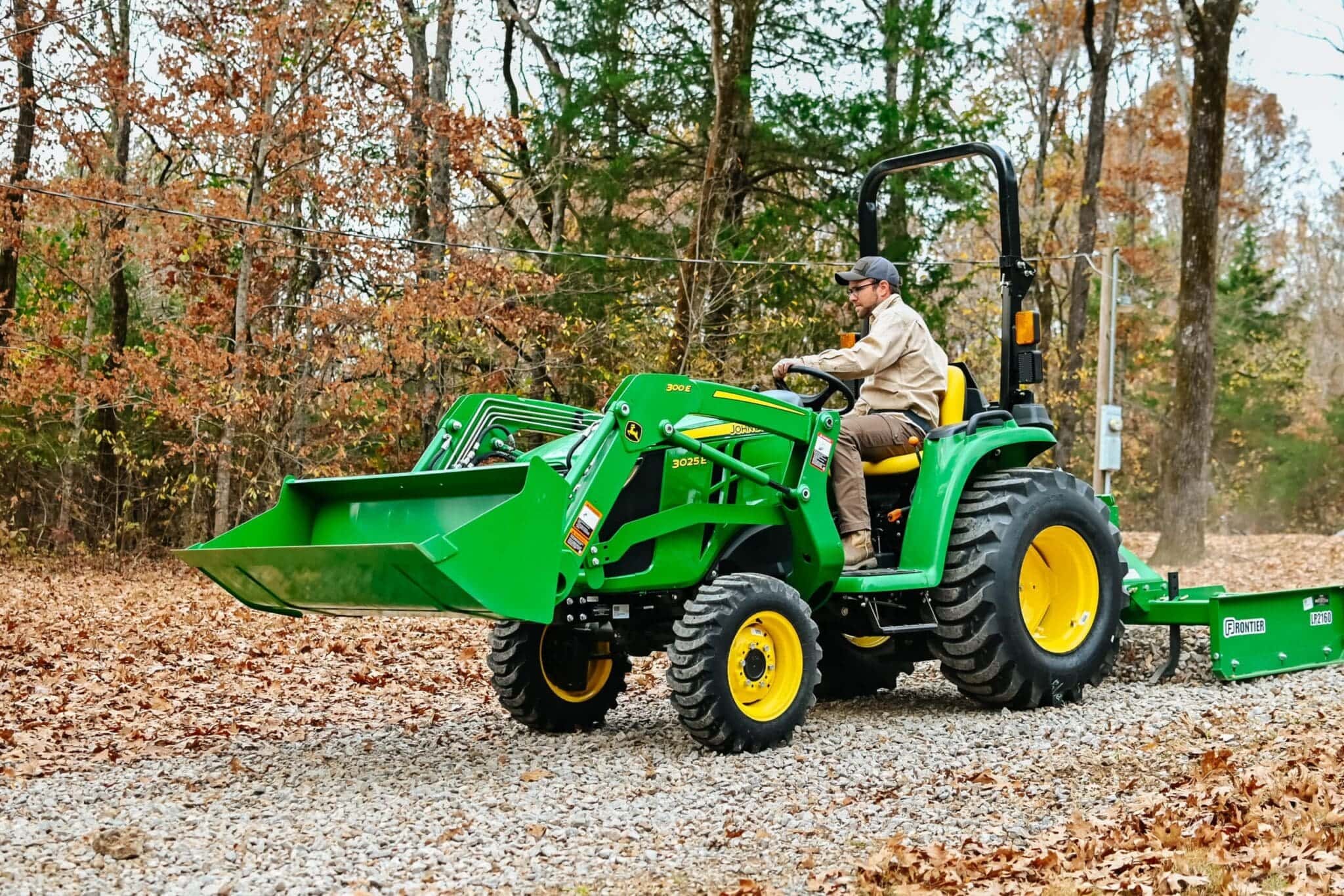
Deere lists the 3025E among the tractors for the 300E loader. Its published full-height lift figures are 539 kg at the pivot and 384 kg measured 500 mm ahead of the pivot. Those are different measurement positions, not interchangeable payload promises.
For a prospective pallet task, record the complete load, attachment mass, load centre and placement height. Obtain the approved information for the actual loader, carrier and fork combination. A front-loader pivot rating does not establish the permissible goods weight on unspecified forks. Rear ballast and the tractor configuration also need to match the loader instructions.
For a bucket, use the material rather than the bucket’s appearance to think about load. A bucket of bedding and a bucket of wet gravel are different tasks. Select the attachment for the work and establish an appropriate loading method. Do not regard the point where the hydraulics stop lifting as a capacity test.
Loading height requires the same care. Measure the receiving trailer or container and examine bucket clearance and reach at discharge. The highest position of the attachment pivot is not the same measurement as clearance below a tipped bucket. A short on-site geometry check can prevent buying a loader arrangement that works around the yard but cannot load the intended receiver.
Choose the mowing arrangement deliberately
If most tractor hours will be spent on a maintained lawn, compare the complete mowing arrangement before committing to the 3025E. A rear mower changes how the machine turns around trees, reverses near obstacles and stores between jobs. A machine selected around an integrated mower can present a different ownership proposition even when its engine rating looks similar.
The John Deere 2025R is a useful model to investigate in that comparison. Establish the exact compatible deck and other attachments for each candidate; do not assume that an attachment from one Deere family transfers to another. The sub-compact versus compact guide helps frame the differences in work priorities.
A property with extensive finish mowing and occasional loader work may also justify pricing a separate mower alongside the tractor. That is not automatically more expensive or more convenient: compare the actual equipment, storage space and time spent changing configurations. The right arrangement follows the weekly routine, not the desire to make one machine perform every possible job.
Canadian winter work: choose where the snow will go
Before selecting a snow attachment, mark the route and storage areas. Pushing works differently from carrying or blowing snow, and the space available can shrink as the season progresses. A long approach with limited storage may lead to a different attachment choice from a small yard with ample room at the sides.
For a PTO snowblower, verify the exact implement’s power requirement, hitch, driveline and mounting arrangement. For a front attachment, establish the complete mounting and drive system rather than assuming that loader compatibility establishes snowblower compatibility. Aglist’s tractor snowblower fitment guide identifies the questions to bring to that discussion.
Evaluate the open-station work environment honestly: exposure, visibility, clothing, lighting and the operator’s ability to work for the expected duration. A canopy, weather enclosure and engineered cab are different products. Any proposed enclosure needs documented compatibility and should not be treated as a safety-structure or climate-control equivalent without evidence.
Service information must match the serial number
Deere’s 3E filter reference separates models and serial ranges, listing DPF entries for specified 3032E and 3038E machines rather than applying that entry to every 3E tractor. Shared family-page text should not become a claim that every engine has identical exhaust equipment.
Use the identification plate to obtain the correct operator’s manual and maintenance information. For a used machine, reconcile the records with the actual tractor and installed equipment. A folder of receipts for “a 3 Series” is less useful than dated work tied to the machine’s serial number and hours.
Have a qualified inspection address the loader mounts and pivots, front axle, hitch, tyres, hydraulic connections, controls and evidence of repairs. These are general compact-tractor inspection priorities, not a list of alleged 3025E defects. A clean appearance should complement, rather than replace, maintenance records and an appropriate operating assessment.
Compare complete packages, not monthly payments
Request a quotation that identifies the tractor, loader, bucket or forks, required ballast, tyres, rear implements and necessary hydraulic connections. Keep finance terms separate from equipment price. A lower monthly payment can reflect a different deposit, term or equipment list, so it is not a reliable comparison by itself.
The Kubota L2502 is another compact to examine against the same tasks. Compare documented PTO requirements, loader geometry, rear-implement suitability and the local support arrangement. Avoid assuming that similar gross horsepower means the same attachment capability.
Include transport and storage before deciding. The completed package includes more than the tractor’s shipping weight: loader, attachment, ballast and other carried equipment matter. Check the whole transport combination and the actual shed opening. After purchase, keep an hour and task log so maintenance planning and future equipment decisions can use your own evidence.
3025E questions worth resolving
Can it run any implement advertised for a 25-hp tractor?
No. Establish whether the implement requirement refers to engine or PTO power, then check the remaining compatibility conditions. The hood number is not sufficient evidence.
Does the rear hitch rating describe loader capacity?
No. The rear hitch and front loader are separate systems with different measurement positions and operating requirements.
Is it the obvious step up from a 2025R?
Only if its equipment arrangement better fits the work. Compare mowing, loader use, implement changes, storage and access rather than treating a higher family number as a universal upgrade.
What should a used-machine seller supply?
Serial identification, the installed equipment list, service records and access for a suitable inspection. Verify included implements individually rather than valuing an entire package from photographs.
Who should consider more tractor?
A buyer whose essential implement, handling or loading requirement exceeds the applicable documentation for this configuration. Conversely, if the complete task list fits, extra engine output alone may not be the most useful place to spend the remaining budget.
Share your experience
Help other Canadian buyers — leave a quick review for the
John Deere 3025E
There are no reviews yet. Be the first one to write one.