Overview & Specs
John Deere 2025R Reviews, Specs & Ratings
On This Page
ToggleOverview & Specs
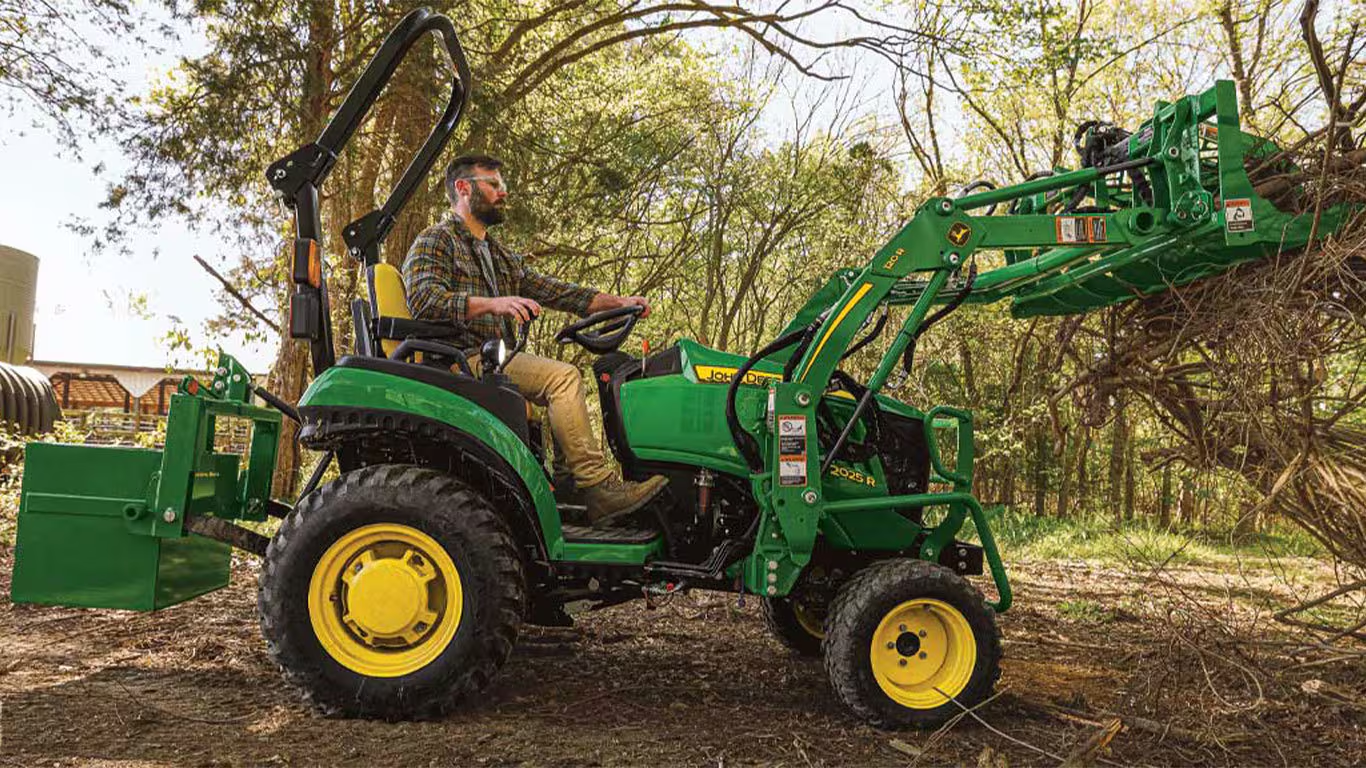
The John Deere 2025R is the entry point into John Deere’s 2 Family compact tractor lineup — a step up from the sub-compact 1 Family into the compact tractor class. With 23.9 gross horsepower from its Yanmar 3-cylinder diesel engine, the 120R Quik-Park loader delivering 840 lb lift capacity (meaningfully more than the same loader on the 1025R), AutoConnect mid-mount mower compatibility, and the option of factory-installed Mauser cab for year-round Canadian operation, the 2025R is engineered for acreage owners and small-property operators who need more capability than the 1 Family delivers without stepping into the larger 3 or 4 Family compact tractors.
The 2025R sits at an important inflection point in the John Deere compact lineup. It shares the same Yanmar engine displacement as the 1025R but adds EPA Tier 4 Final emissions compliance with DPF (diesel particulate filter) — a meaningful change versus the emissions-free 1023E/1025R. It uses the same 120R loader but delivers higher lift capacity through stronger hydraulics. It supports the 260B backhoe with 8’8″ reach for genuine excavation capability. And it offers the factory-installed Mauser cab option for serious year-round operation in Canadian climates.
For Canadian buyers stepping up from the 1 Family or cross-shopping the Kubota L02 Series, the 2025R represents John Deere’s most-popular 2 Family choice. It’s the model most often selected by acreage owners who’ve identified that the 1025R is borderline-sufficient for their needs and want growth headroom without committing to the larger 2032R or 2038R.
On Aglist, this page goes beyond John Deere’s brochure to help Canadian buyers understand exactly when the 2025R is the right choice over the 1025R, when stepping up to the 2032R makes more sense, and how the 2025R compares to the Kubota L2502 — the closest Kubota equivalent.
Aglist advantage: Use the 2025R Reviews & Ratings section below to compare real Canadian owner feedback on loader performance, the 1025R vs 2025R step-up decision, cold-weather operation with the Mauser cab, and how the 2025R competes with Kubota L Series compact tractors.
Quick Specs
- Equipment type: Compact utility tractor
- Family: John Deere 2 Family
- Model: 2025R
- Engine: Yanmar 3-cylinder liquid-cooled diesel
- Engine gross horsepower: 23.9 HP
- Engine PTO horsepower: 18.6 HP
- Fuel system: Indirect injection (IDI) — DPF required
- Emissions tier: EPA Tier 4 Final compliant
- Transmission: Hydrostatic (Twin Touch pedals) with 2-range high-low
- Drive system: 4WD standard (MFWD)
- Brakes: Wet disc
- PTO type: Fully independent PTO
- Rear PTO speed: 540 RPM
- Mid PTO speed: 2,100 RPM
- 3-point hitch category: Category 1
- Compatible front loader: John Deere 120R Quik-Park (or mechanical self-leveling option)
- 120R lift capacity at pin (full height): 840 lb
- Compatible mid-mount mowers: 54″ AutoConnect or 60″ AutoConnect drive-over decks
- Compatible backhoe: 260B (8’8″ reach)
- iMatch Quick-Hitch: Compatible
- Operating weight: Approx. 1,870 lb
- Cab option: Factory-installed Mauser cab available
- ROPS: Folding 2-post (standard)
- eThrottle: Optional
- Cold-start aid: Glow plugs (operation down to 0°F / –18°C without block heater)
Reviews & Ratings on Aglist
Factory specifications tell you what the John Deere 2025R is engineered to do. Real owner reviews tell you whether the step up from the 1 Family is worth it — and whether the 2025R delivers value vs the L2502 or step-up 2032R.
What 2025R buyers consistently want to know:
- Is the step up from the 1025R to the 2025R worth the price premium for typical acreage use?
- How does the DPF system actually behave in real Canadian operation (regeneration cycles, cold-weather DPF management)?
- Does the 120R loader on the 2025R really deliver 840 lb lift, or is real-world capacity lower?
- How does the Mauser cab compare to the R1 cab on the 1025R for cold-climate work?
- Real-world fuel consumption with the DPF system?
- 2025R vs Kubota L2502 — would owners pick green or orange again?
- How does the 260B backhoe perform on the 2025R vs the 1025R?
This is where real Canadian owner experience matters most. The 2025R bridges the sub-compact 1 Family and the larger 2032R compact tractor, with active cross-shop between all three models. Owner reviews help future buyers understand whether they should stay with the 1025R, step up to the 2025R, or commit to the larger 2032R.
What Makes the 2025R Different
Three engineering decisions define the 2025R within the John Deere compact tractor lineup.
Same HP as 1025R, Significantly More Loader Capacity
The 2025R rates at the same 23.9 gross HP as the 1025R — but delivers meaningfully more real-world capability. The key difference: the 2025R’s hydraulic system enables the 120R Quik-Park loader to lift 840 lb at the pivot pin versus only 758 lb on the 1025R. That’s an 11% increase in lift capacity from the same physical loader.
The 2025R also has the option of a mechanical self-leveling (MSL) loader, which automatically maintains bucket angle as the boom raises — meaningful for pallet handling, material transport, and any work where maintaining bucket orientation matters. The MSL option is not available on the 1 Family tractors.
For operators who specifically need loader capacity above what the 1025R delivers but don’t want to step up to larger 3 or 4 Family tractors, the 2025R is the right answer.
DPF Tier 4 Final Emissions
This is the most-significant engineering change versus the 1 Family — the 2025R crosses the EPA Tier 4 Final emissions threshold and requires a diesel particulate filter (DPF). Unlike the 1023E and 1025R (which avoid emissions aftertreatment by staying under 25 HP gross), the 2025R uses indirect fuel injection with active DPF regeneration.
Practical implications:
- DPF regeneration cycles during sustained operation (largely automatic)
- Slightly higher fuel consumption than the 1025R (DPF regeneration uses fuel)
- Additional electronic complexity for emissions monitoring
- DPF replacement eventually required (typically 5,000-6,000 hours)
- More complex diagnostic codes if the emissions system has issues
- No DEF required (only DPF — the 2025R sits below the SCR/DEF threshold)
For buyers who specifically chose the 1025R because of its no-DPF advantage, the 2025R’s DPF system is a meaningful step backward in ownership simplicity. The trade-off: better capability from the 2025R’s stronger hydraulics and chassis. Many Canadian buyers cross-shopping the 1025R and 2025R explicitly choose the 1025R because of the no-DPF advantage — even though they could afford the 2025R.
Factory Mauser Cab Option
The 2025R is the entry point in the John Deere compact lineup for the factory-installed Mauser cab — a more substantial cab than the dealer-installed R1 cab available on the 1025R. The Mauser cab features:
- Full sealed enclosure
- Factory-installed heating system
- Optional air conditioning
- Better sound insulation than aftermarket alternatives
- Designed and matched to the 2025R chassis
- Compatible with most 2025R implements including AutoConnect mower
For serious year-round Canadian operation — particularly in Saskatchewan, Alberta, and Manitoba prairie conditions — the Mauser cab is essentially required. Adds approximately $9,000-13,000 CAD over the open-station base price.
Engine, DPF & Emissions
The 2025R is powered by a Yanmar 3-cylinder liquid-cooled diesel engine with indirect fuel injection (IDI).
Key engine specifications:
- Type: 3-cylinder, vertical, liquid-cooled, 4-stroke diesel
- Manufacturer: Yanmar (built for John Deere)
- Gross horsepower: 23.9 HP
- PTO horsepower: 18.6 HP
- Fuel system: Indirect injection (IDI) with pre-combustion chamber
- Cold-start: Glow plugs (operation down to 0°F / –18°C without block heater)
- Emissions: EPA Tier 4 Final with DPF (no DEF required)
The IDI fuel system uses a pre-combustion chamber design — smoother and quieter operation than direct injection alternatives (used on the larger 2032R). The engine is well-matched to the 2025R’s intended use case: extended residential and acreage operation with emphasis on operator comfort and refined feel.
About the DPF on the 2025R:
The diesel particulate filter is a passive component that periodically goes through “regeneration” — a higher-temperature cycle that burns accumulated soot. On the 2025R:
- Regeneration is largely automatic and happens during sustained engine load
- Problems occur primarily with very short-duration use (under 20-30 minutes per session)
- For typical acreage use (loader work, mowing, tillage sessions), DPF management is rarely a daily concern
- The Mauser cab improves cold-weather DPF function by maintaining engine load and operating temperature
Fuel consumption typical range: 0.7-1.1 gallons per hour during mixed acreage use. Slightly higher than the 1025R due to DPF regeneration energy requirements, but still excellent for the size class.
120R Quik-Park Loader (Higher Capacity Configuration)
The 2025R is most commonly purchased with the John Deere 120R Quik-Park front loader — the same physical loader used on the 1025R but with higher real lift capacity due to the 2025R’s stronger hydraulic system.
120R on the 2025R specifications:
- Lift capacity at pivot pin (full height): 840 lb
- Quik-Park tool-less removal: Approximately one minute, no tools required
- Optional mechanical self-leveling (MSL): Maintains bucket angle automatically as boom raises
- Compatible with John Deere implement attachments
The mechanical self-leveling option is a meaningful capability addition unavailable on the 1 Family. With MSL:
- Bucket maintains its set angle throughout boom range
- Material stays in bucket during lifting (less spillage)
- Pallet handling becomes substantially more precise
- Loading higher trucks and trailers is easier
For operators who specifically need loader capacity above 758 lb (the 1025R’s specification) or want the MSL convenience, the 2025R’s 120R loader is the right choice. For typical residential acreage use, the difference between 758 lb (1025R) and 840 lb (2025R) is meaningful but not always decisive — many buyers stay with the 1025R and accept the slight capacity limitation.
Note: when paired with the Mauser cab and the MSL loader, a special relocation bracket (BXX10507) is required to prevent interference between the cab and the MSL loader mast — confirm this is included in your configuration.
AutoConnect Mid-Mount Mower System
The 2025R retains full AutoConnect mower system compatibility. The same 54D and 60D drive-over decks used on the 1023E and 1025R work on the 2025R.
The AutoConnect process is the same: drive over the deck, engage the locking mechanism, lock the gauge wheels, start mowing. Total time under 60 seconds.
Loader, mid-mower, and a variety of rear hitch implements can be attached to the tractor at the same time — a notable productivity advantage. The optional premium independent mid lift system operates independent of the rear 3-point hitch, giving the operator flexibility to leave the mid-mower attached while completing other tasks.
Real-world mowing capability with 18.6 PTO HP:
- 2-5 acres of residential turf: Excellent in 1.5-2.5 hours with the 60″ deck
- 5-8 acres of mixed turf: Capable continuous use, comfortable
- Heavy/wet grass conditions: Strong performance — the 2025R has noticeable PTO headroom vs the 1025R
- Manicured lawn quality: Strong with proper deck setup
The 2025R’s slightly higher PTO HP (18.6 vs 18.3 on the 1025R) is a minor numerical difference, but the stronger hydraulics and more refined engine management deliver measurable real-world improvements in heavy mowing conditions.
260B Backhoe Capability
The 2025R is compatible with the John Deere 260B backhoe featuring 8’8″ reach — meaningfully more capable than the same backhoe on the 1 Family tractors due to the 2025R’s stronger hydraulic system.
260B backhoe key specifications:
- Digging depth: Approximately 6 feet
- Reach: 8’8″
- Subframe-mounted
- Hydraulic thumb available as option
- Reversible operator seating for backhoe operation
- Removable in approximately 5 minutes, no tools required
Important: Like the 1025R, the R1/Mauser cab on the 2025R is NOT compatible with the 260B backhoe. Cab-equipped 2025R tractors cannot accept the backhoe without cab removal. Open-station 2025R tractors accept the backhoe without modification.
For dedicated TLB capability, the Kubota BX23S delivers more integrated factory TLB performance. For occasional backhoe use on a more-capable compact tractor, the 2025R + 260B works well.
Transmission & Drive
The 2025R uses hydrostatic transmission with Twin Touch foot pedals and 2-range high-low gear selection — same control system as the 1 Family.
Key transmission features:
- Twin Touch pedals: Side-by-side forward/reverse pedals
- High/low range: Stop to shift
- 4WD standard (MFWD): No 2WD option
- Fully independent PTO: Hydraulically clutched
- All tasks performable in two ranges: Less shifting throughout the day
- Transaxle oil cooler: Improved hydraulic cooling
Hydrostatic Power Steering is standard.
One pump supplies charge pressure and implement flow through a flow divider that splits hydraulic flow to various circuits. The 2025R’s hydraulic system delivers the additional loader capacity vs the 1 Family through stronger pressure capability and more refined flow management.
3-Point Hitch & PTO
The 2025R features a Category 1 3-point hitch — full Cat 1 (vs limited Cat 1 on the 1 Family).
Key features:
- Lift capacity at 24″ behind link arms: Higher than 1 Family (confirm exact spec with dealer for your year/configuration)
- Position control: Standard
- iMatch Quick-Hitch compatible: Yes with new implement attachment memory allowing seven customizable setups for rapid changes
- Fully independent PTO with hydraulic clutching
The implement attachment memory is a 2025R-specific feature — the tractor remembers up to seven implement configurations, allowing fast switching between common setups (mower, rotary cutter, tiller, etc.).
Practical PTO capability with 18.6 PTO HP:
- 54″ or 60″ mid-mount mower (AutoConnect): Excellent
- 5-foot rotary cutter (rear): Strong continuous use
- 6-foot rotary cutter (rear): Capable in light grass; at upper limit in heavy conditions
- 48-inch tiller (rear): Strong in moderate-to-heavy soil
- Snow blower (front-mounted): Strong performance
- Post hole digger (12-inch auger): Strong performance
Operator Comfort & The Mauser Cab Option
The 2025R operator station is significantly upgraded versus the 1 Family:
- Redesigned operator’s station with improved ergonomics
- Slanted hood design for superior front visibility
- Tilt steering wheel
- Standard LED headlights and fender lights
- Optional rear-mounted light
- eThrottle option for hand-throttle convenience
- Updated automotive-style instrument panel
- Updated seat design with improved back support
- Operator presence safety system — engine shuts down if operator leaves seat with transmission, mid PTO, or rear PTO engaged
- Strategically located fuel tank to prevent spills
- Built-in storage and 12-V outlet
- Folding ROPS standard
The Mauser cab option transforms the 2025R for serious Canadian year-round operation:
- Factory-installed (not dealer-installed like R1 cabs on 1 Family)
- Full sealed enclosure
- Heated cab with optional A/C
- Better sound insulation than aftermarket alternatives
- Improved visibility through redesigned cab geometry
- Designed and engineered specifically for the 2025R chassis
Cab adds approximately $9,000-13,000 CAD over the open-station price.
Best Applications for the 2025R
The John Deere 2025R fits a specific operational profile.
Best fit for the 2025R:
- Acreage owners (3-15 acres) stepping up from the 1 Family with specific capability needs
- Buyers requiring 840 lb loader lift for regular material handling above 1025R limits
- Operations wanting the Mauser cab for serious year-round prairie operation
- Operators valuing the mechanical self-leveling loader option
- Buyers comfortable with DPF management in exchange for better capability
- First-time compact tractor buyers who’ve identified specific capability needs above sub-compact class
Best fit with Mauser cab option:
- Year-round operation in cold provinces (essentially required)
- Snow removal as a major use case
- Operations where weather-independent productivity matters
- Buyers who plan multi-hour daily use
Less suitable for:
- Buyers prioritizing the no-DPF advantage (stay with 1025R)
- Smaller properties where the 1025R’s capability is sufficient
- Operations needing more than the 2025R’s 23.9 HP (step up to 2032R or larger)
- Buyers who do significant backhoe work AND want a cab (cab incompatible with 260B)
- Operations where the L2502’s lower price and no-DPF advantage matters more than the AutoConnect mower system
The honest assessment: the 2025R is the right answer specifically when (1) you need more loader capacity than the 1025R delivers, AND (2) you accept the DPF complexity trade-off. For buyers who simply want a step-up John Deere compact without specific 2025R features, the 2032R typically represents better value per dollar.
2025R vs 1025R vs 2032R
The 2025R’s most-common cross-shop is within the John Deere lineup.
| Feature | 1025R | 2025R | 2032R |
|---|---|---|---|
| Family | 1 Family | 2 Family | 2 Family |
| Engine | Yanmar 3-cyl IDI | Yanmar 3-cyl IDI | Yanmar 3-cyl Direct Injection |
| Gross HP | 23.9 | 23.9 | ~31.4 |
| PTO HP | 18.3 | 18.6 | ~24.5 |
| DPF/DEF | No / No | DPF / No | DPF / No |
| Loader | 120R (758 lb lift) | 120R (840 lb lift) or MSL | 220R (1,120 lb lift) |
| Mechanical Self-Leveling | No | Optional | Standard option |
| Cab Option | R1 (dealer) | Mauser (factory) | Mauser (factory) |
| AutoConnect Mower | 54″/60″ | 54″/60″ | 54″/60″/62″ |
| Approx CAD price (with loader) | $24,000–$29,000 | $30,000–$36,000 | $36,000–$42,000 |
Choose the 1025R if: You want no-DPF simplicity, smaller property (1-5 acres), 758 lb loader is sufficient, you want the lowest 1 Family entry to the John Deere compact lineup.
Choose the 2025R if: You need 840 lb loader capacity, you want the Mauser cab for serious year-round use, you specifically need the MSL loader option, you accept DPF complexity for the additional capability.
Choose the 2032R if: You need 31.4 HP capability with the larger 220R loader (1,120 lb lift), you do heavier 3-point implement work, property is 10+ acres with regular sustained work, the price premium is acceptable.
The 1025R vs 2025R decision turns mostly on DPF tolerance and loader capacity needs. Many John Deere buyers specifically choose the 1025R because of the no-DPF advantage, even though they could afford the 2025R. The 2025R wins when 840+ lb loader lift is genuinely required.
The 2025R vs 2032R decision turns on horsepower needs. The 2032R’s additional 7.5 HP and 220R loader represent meaningful step-up capability for buyers with larger properties or heavier work patterns.
2025R vs Kubota L2502: The Compact Cross-Shop
For Canadian buyers cross-shopping entry-level compact tractors, the 2025R and Kubota L2502 represent the two most-popular options from the major brands.
| Feature | John Deere 2025R | Kubota L2502 |
|---|---|---|
| Engine | Yanmar 3-cyl IDI | Kubota 3-cyl mechanical |
| Gross HP | 23.9 | 24.8 |
| PTO HP | 18.6 | 20.5 |
| DPF Required | Yes | No |
| Loader | 120R (840 lb lift) | LA526 (1,446 lb lift) |
| Mower Compatibility | AutoConnect 54″/60″ mid-mount | None (rear-mounted only) |
| 3-Point Lift | Full Cat 1 | 1,918 lb at lift point |
| Cab | Mauser cab (factory) | Dealer-installed cab |
| AutoConnect | Yes | No |
| Approx CAD Price (with loader) | $30,000–$36,000 | $28,000–$34,000 |
Where the 2025R wins:
- AutoConnect mower system (no Kubota equivalent on the L2502)
- Mauser factory cab (more substantial than Kubota’s L2502 dealer cab)
- Mechanical self-leveling loader option
- John Deere brand and dealer ecosystem
Where the Kubota L2502 wins:
- No DPF required — mechanical injection avoids emissions complexity entirely
- Significantly higher loader capacity — 1,446 lb (LA526) vs 840 lb (120R) — 72% more
- Higher 3-point lift capacity — 1,918 lb vs Cat 1 standard
- More PTO HP — 20.5 vs 18.6
- Typically $1,000-3,000 CAD less than 2025R
- Stronger backhoe option (BH77 vs 260B with cab compatibility limitations)
The honest verdict: the L2502’s no-DPF advantage and significantly higher loader capacity are major real-world differences. For buyers prioritizing emissions simplicity and serious loader capability, the L2502 wins decisively. For buyers prioritizing the AutoConnect mower system convenience and John Deere brand ecosystem, the 2025R wins. The two tractors fit meaningfully different operational profiles despite being in the same general size class. Cross-shop carefully based on whether mowing convenience or loader capacity matters more to your work.
Cold Weather Operation in Canada
The 2025R’s combination of DPF and the Mauser cab option creates specific cold-weather considerations.
Reliable cold-start temperature range: Down to 0°F (–18°C) without block heater per John Deere’s published specifications. Below that, a block heater becomes essentially required. The IDI fuel system performs reliably with proper glow-plug preheat.
Cold-weather considerations specific to the 2025R:
- DPF regeneration in cold weather: Extended low-load cold operation can delay regeneration cycles. The Mauser cab helps maintain engine operating temperature, supporting more reliable regeneration
- No DEF system — the 2025R doesn’t use DEF, so DEF freezing isn’t a concern
- Block heater available as dealer-installed option (recommended for prairie use)
- Mauser cab essentially required for serious year-round prairie operation
- Air intake heater is available on the 2025R (standard on the larger 2032R)
Recommended cold-weather setup for prairie operation:
- 5W-40 full synthetic engine oil (October-April)
- Winter-blend diesel with anti-gel additive
- Block heater plugged in 3-4 hours before start at –20°C and below
- Battery load-tested in fall, replaced if 3+ years old
- Mauser cab strongly recommended for year-round prairie operation
For complete prairie winter operation guidance, see our prairie winter equipment operation guide.
Maintenance & Long-Term Ownership
The 2025R has a moderately complex maintenance profile due to the DPF system.
Routine maintenance intervals:
- Engine oil and filter: Every 200 hours or annually
- Hydraulic/transmission filter: Every 400 hours
- Air filter: Every 200 hours
- Fuel filter: Every 400 hours
- Coolant: Every 2 years
- DPF inspection: Annually (replacement typically 5,000-6,000 hours)
- Greasing of pivot points: Every 50 hours
Typical annual maintenance cost: $400-700 for owner-performed service; $900-1,500 for dealer service. Higher than the 1025R due to DPF and emissions diagnostics.
Long-term reliability:
- Same proven Yanmar engine platform as 1 Family
- 6,000-10,000+ hour service lives common with regular maintenance
- DPF typically requires replacement at 5,000-6,000 hours
- Resale value strong — 2025R is among John Deere’s bestselling compact tractors
Frequently Asked Questions
Where can I read John Deere 2025R reviews and ratings?
On Aglist, the Reviews & Ratings section helps Canadian buyers compare owner feedback, real operating experience, and long-term ownership impressions before choosing the 2025R.
How much horsepower does the John Deere 2025R have?
John Deere lists the 2025R at 23.9 gross HP with 18.6 PTO HP.
Does the John Deere 2025R have a DPF?
Yes. The 2025R uses indirect fuel injection (IDI) with active DPF (diesel particulate filter) regeneration for EPA Tier 4 Final emissions compliance. It does NOT require DEF (diesel exhaust fluid) — DEF is required only at higher HP classes. If you specifically want a John Deere compact tractor without DPF, the 1025R is the alternative (with no DPF and no DEF).
What’s the difference between the 2025R and 1025R?
Same engine displacement and gross HP (23.9), but the 2025R requires DPF (1025R doesn’t), has higher loader lift capacity (840 lb vs 758 lb on the same 120R loader), offers mechanical self-leveling loader option, supports factory Mauser cab (1025R uses dealer R1 cab), and includes implement attachment memory feature. The 2025R typically costs $5,000-7,000 CAD more than the 1025R. Many buyers specifically prefer the 1025R because of the no-DPF advantage.
What’s the difference between the 2025R and 2032R?
The 2032R has approximately 31.4 HP (vs 23.9), uses direct fuel injection (vs IDI), supports the larger 220R loader with 1,120 lb lift (vs 120R with 840 lb on the 2025R), and offers stronger 3-point lift capability. The 2032R typically costs $6,000-8,000 CAD more than the 2025R.
What loader does the 2025R use?
The John Deere 120R Quik-Park loader — the same physical loader as on the 1025R, but with 840 lb lift capacity at the pivot pin (vs 758 lb on the 1025R) due to the 2025R’s stronger hydraulic system. Optional mechanical self-leveling configuration available (not available on the 1025R).
Can I add a backhoe to the 2025R?
Yes — the John Deere 260B backhoe is compatible with 8’8″ reach. Important: the Mauser cab is NOT compatible with the 260B backhoe. Cab-equipped 2025R tractors cannot accept the backhoe without cab removal.
What’s the Mauser cab?
The Mauser cab is a factory-installed cab option for the 2025R (and larger 2 Family tractors) — more substantial than the dealer-installed R1 cab used on 1 Family tractors. Features full sealed enclosure, heating system, optional A/C, and better sound insulation than aftermarket alternatives.
Does the 2025R have the AutoConnect mower system?
Yes — full AutoConnect compatibility with 54″ (54D) and 60″ (60D) drive-over decks. The 2025R also supports loader, mid-mower, and rear hitch implements attached simultaneously.
Is the 2025R better than the Kubota L2502?
This depends on what matters most to you. The L2502 wins on no-DPF simplicity, significantly higher loader capacity (1,446 lb vs 840 lb), higher 3-point lift, and slightly more PTO HP. The 2025R wins on AutoConnect mower convenience, Mauser factory cab, MSL loader option, and John Deere ecosystem. Cross-shop both — the choice depends on whether mowing convenience or loader capacity matters more to your work.
What’s the typical price of a 2025R in Canada?
As of 2026, a John Deere 2025R with the 120R loader typically lists in the $30,000–$36,000 CAD range from Canadian John Deere dealers. Adding the Mauser cab adds $9,000–$13,000 CAD. Adding a 60D AutoConnect mower deck adds approximately $4,000–$5,500 CAD. Adding the 260B backhoe adds approximately $7,500–$10,000 CAD. Confirm current pricing directly with your local John Deere Canada dealer.
How long does a John Deere 2025R last?
With proper maintenance, the 2025R is designed for 6,000-10,000+ hour service lives. The DPF typically requires replacement at 5,000-6,000 hours, but the underlying Yanmar engine continues running well beyond that with routine maintenance.
Does the 2025R work in –30°C prairie winters?
Yes — with proper preparation (5W-40 synthetic oil, winter-blend diesel, healthy battery, block heater plugged in for 3-4 hours before start). The Mauser cab is essentially required for serious year-round prairie operation. The main cold-weather consideration is allowing sustained operating periods to support DPF regeneration cycles.
Should I buy the 2025R or step up to a 2032R?
For most acreage operators, the 2025R is sufficient. Step up to the 2032R specifically if you need 31+ HP, the 220R loader’s 1,120 lb capacity, or sustained heavier 3-point implement work. The 2032R adds approximately $6,000-8,000 CAD over the 2025R.
Reviews & Ratings on Aglist
Share your experience
Similar Equipment
- John Deere 1025R — sub-compact alternative without DPF
- John Deere 1023E — budget sub-compact
- Kubota L2502 — primary competitor without DPF
- Kubota BX2680 — Kubota flagship sub-compact
Note: We try our best to keep specs and information accurate, but some details can be missing or different depending on the source. Before you buy, service, or repair equipment, please double-check key specs with the manufacturer, the owner’s manual, or your dealer.
About reviews: Reviews on Aglist are written by real users. We moderate them for spam and abuse, but opinions and claims are still personal—so use them as guidance, not as a guarantee.
Share your experience
Help other Canadian buyers — leave a quick review for the
John Deere 2025R
There are no reviews yet. Be the first one to write one.