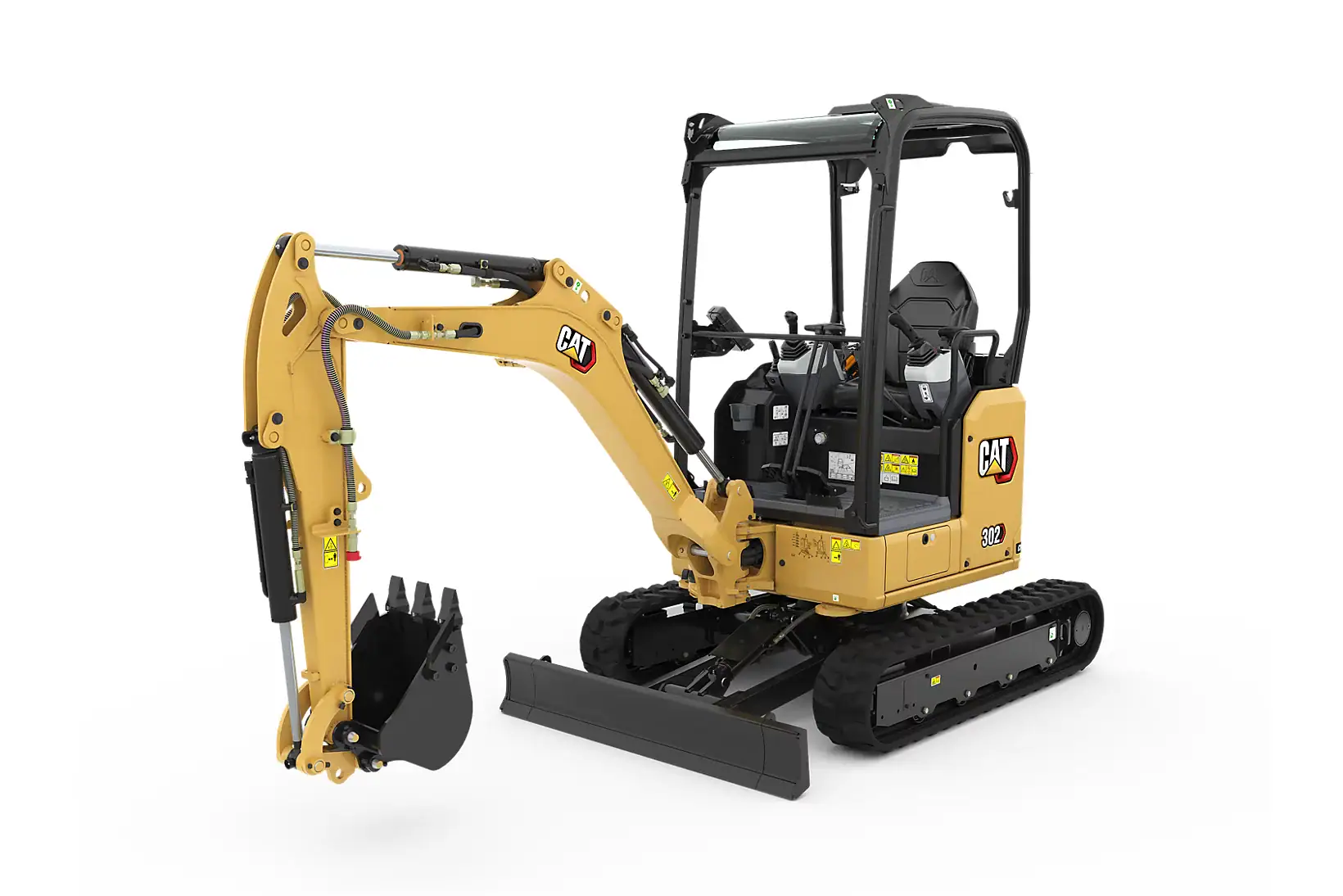
Overview & Specs
The Cat 302 CR is worth evaluating when a buyer wants a small excavator but needs to make a serious decision about the operator environment. A Canadian contractor working planned summer jobs may assess a canopy machine differently from someone who regularly faces rain, wind and cold shoulder-season days. The question is whether the complete configuration supports the work schedule while still fitting the sites and transport arrangement.
Cab choice, undercarriage, stick and attachments all affect that answer. Comparing a lightly equipped machine with an enclosed, heavily equipped example under the same model name can hide important differences. This guide focuses on Caterpillar’s documented North American 302 CR specifications and a practical way to evaluate a particular new or used package.
On This Page
ToggleCat 302 CR specification overview
Figures below are drawn from the official Cat 302 CR product page. Minimum and maximum weights describe configurations, not a guaranteed weight for every machine.
| Item | Specification |
|---|---|
| Engine; net output | C1.1; 15.7 kW / 21 hp |
| Canopy operating weight, minimum–maximum | 1,918–2,081 kg |
| Cab operating weight, minimum–maximum | 2,057–2,262 kg |
| Depth, standard / long stick | 2,370 / 2,570 mm |
| Ground reach, standard / long stick | 4,040 / 4,210 mm |
| Expandable track width, retracted / expanded | 1,090 / 1,400 mm |
| Tail-swing radius | 750 mm |
| Primary auxiliary flow | 33 L/min |
The expandable undercarriage is optional. Cab heating and air conditioning are listed as optional equipment; establish what the offered machine actually includes. Do not combine the lightest configuration’s weight with another configuration’s equipment list.
Cab or canopy: decide from the working calendar
Start with the months and conditions in which the excavator will earn its keep. For a property owner who can postpone a project, exposure to poor weather may be an inconvenience. For a contractor with coordinated deliveries and other trades booked, the operator environment can have a larger scheduling value.
An enclosed cab still needs to work properly. Inspect window condition, seals, latches, wipers, ventilation and the installed heating or cooling system. A cab that fogs up or has damaged glazing may not provide the practical benefit assumed in a price comparison. Test these functions during a proper demonstration instead of accepting “cab machine” as a complete specification.
Visibility deserves equal attention. Sit in the machine with the intended working equipment positioned for representative tasks, following the demonstrator’s instructions. Check the view of the bucket and surrounding work area. Consider clothing and footwear normally used on the job, entry and exit, and whether controls are comfortable during repeated movements.
For canopy buyers, the relevant question is not whether a cab is universally better. It is whether shelter is worth the additional cost and configuration consequences for your schedule. Compare complete quotations and the work each package allows you to undertake reliably.
Why the weight range matters to a small contractor
A model name can make two sale machines look interchangeable when their equipment packages differ. The cab, tracks, undercarriage and installed tools all belong in the comparison. Ask for an itemized description and reconcile it with the applicable weight information.
Do not treat the difference between published minimum and maximum figures as unused attachment capacity. Those figures describe particular configurations. They are not a margin available for arbitrary tools, nor do they establish a trailer’s remaining payload.
A practical transport worksheet begins with the actual machine and identifies the source of its weight. It then lists separately carried tools, securing equipment and other cargo, avoiding items already included. Compare the resulting load and distribution with the complete vehicle-and-trailer ratings and applicable requirements. If a package is close to a transport limit, an actual weighing assessment is more useful than optimistic catalogue arithmetic.
Access: the 302 CR needs its own measurements
Do not assume that a small increase in model designation has no effect on access. Use the offered machine’s dimensions, including its installed undercarriage, blade and working equipment. Inspect the route at ground level and above it, and include turns, overhangs and parked obstacles.
The variable-width figures apply to the matching expandable setup. A fixed-base example does not acquire that capability because the brochure contains a retracted-width line. Establish the configuration before agreeing to an access-dependent job or purchase.
Separate passage width from operating room. Once at the work area, the excavator needs a suitable position for digging, rear rotation and material discharge. The operating instructions govern the approved setup. A compact-radius rear reduces one geometric concern but does not eliminate the need for clearance around the machine.
Digging depth: useful reach versus a single maximum
The standard and long sticks should be compared against the required work shape. Mark the depth and horizontal distance on the appropriate working-range drawing together. Maximum ground reach and maximum depth occur at different positions; they cannot be joined into an imaginary rectangle of full capability.
A small contractor might regularly handle shallow landscaping and only occasionally quote a deeper installation. In that case, choosing an arm solely for the occasional deepest point may compromise the more common work or still fail to solve the deeper job. Compare the actual digging cycle, matching force figures and load information before deciding.
Another contractor may have a repeatable reach constraint at several sites. A longer stick could be valuable even where the excavation is relatively shallow. The relevant benefit is access to the required working area from a suitable machine position, not a headline depth claim.
Ask a demonstration operator to show a complete representative cycle with the intended bucket. Watch whether the bucket can fill, curl, clear and discharge without repeated changes of position. That reveals much more than lowering the teeth to the maximum point in an empty demonstration area.
Build the attachment package from real jobs
List the jobs for which attachments are already needed, then distinguish them from possible future work. This prevents an appealing tool catalogue from absorbing the budget before the core machine is ready to earn. A correctly matched digging and finishing arrangement may be more useful initially than several specialist tools.
For each bucket, record width, mass, mount and intended use. For each hydraulic tool, add acceptable flow, pressure, return requirements and controls. The auxiliary-flow figure is a screening value, not an approval for every attachment with compatible couplings.
Couplers and additional equipment can change the geometry and load carried at the front. Assess the complete arrangement with the manufacturer’s applicable information. A tool’s physical fit does not establish its suitability, and an older attachment advertised for “two-tonne excavators” still needs a specific compatibility check.
Also price the supporting work: installation, any required hydraulic equipment, storage and transport. A low tool price can be misleading when the machine needs additional provisions to operate it properly. Put those costs into the quotation before comparing packages.
Can the 302 CR serve as an only excavator?
It depends on the work mix. For a business concentrated on small, access-sensitive projects, an appropriately configured compact machine may cover much of the regular schedule. If larger open excavations or heavy material handling dominate, the same machine may be better as a specialist alongside hired or owned larger equipment.
Use last year’s jobs or a realistic first-year schedule to test this. Mark each job as suitable, suitable with supporting equipment, or better assigned elsewhere. Then review how much revenue and time fall into each group. This gives a stronger basis for a purchase than assuming every job can be made to fit the machine.
Include spoil movement in that review. A machine can excavate effectively while the overall job remains slow because material must travel away from the digging position. A suitable carrier, loader or haulage arrangement may be the more valuable next investment than changing the excavator.
Comparisons that help rather than confuse
The Bobcat E20 and Bobcat E26 are useful entries when building a wider shopping list. Review the John Deere compact excavator buyer’s guide for another way to organize the size decision. Verify the exact generation and configuration of any alternative before using its specifications.
Make a comparison sheet with the same columns for every offer: working equipment, operator enclosure, access dimensions, transport load, hydraulic provisions, condition and support. A cheaper canopy machine and a cab machine with a different arm are not a like-for-like price comparison until those differences are recognized.
Do not use engine horsepower as the deciding column. The useful result depends on geometry, hydraulic performance, tool match and the conditions of the task. A representative demonstration gives those factors a chance to show themselves.
Cold-season planning without assumptions
Begin with the correct operating and maintenance manual for the serial number. Establish the required fluids, starting procedure, warm-up guidance and inspection schedule for the expected conditions. Do not transfer advice from another Cat model or assume that an advertised cold-weather accessory is installed.
For a contractor, check where the machine will be parked, how maintenance will be completed and whether the work site remains accessible when conditions change. Include the time needed to prepare the machine and attachments in the job schedule. The cab may improve the operator environment, but it does not make every ground condition suitable for excavation.
For occasional ownership, storage discipline matters. Keep records of service and repairs, identify the attachments, and address visible damage before the machine is needed urgently. A small equipment log can prevent the next project from beginning with an unknown warning light or an untested tool.
Used 302 CR inspection priorities
Start with identity: serial number, year documentation, configuration and included equipment. Check that the machine being demonstrated is the one described in the quotation. Inspect any modifications and ask for supporting documentation, particularly where hydraulic tools or operator-enclosure work are involved.
Have the undercarriage, linkage wear, hydraulic system and structure assessed by a competent inspector. Observe operation from cold and after warm-up, and record irregularities for diagnosis. These checks are not a list of claimed model defects; they establish the condition of the individual machine.
On a cab example, pay particular attention to the equipment that justifies the enclosure premium. Test the installed climate and visibility functions. Obtain repair estimates for defects before assuming they are minor, since several seemingly small issues can alter the package’s value.
Finish with a written delivery checklist: agreed attachments, keys or access provisions, manuals, service documents and known repairs. An excavator that arrives with an unexpected coupler or missing tool creates a compatibility problem at the moment it is supposed to begin work.
A decision method for two competing quotations
First reject configurations that fail the measured access or transport requirements. Next reject packages that cannot perform the recurring task with the intended attachment. Only then compare the cost of operator shelter, condition, support and optional equipment.
This order prevents a comfortable cab or attractive price from distracting from a fundamental mismatch. Where both machines pass, use a similar demonstration and realistic ownership costs to decide. Record the reason for selecting each option so that later accessory purchases continue to support the original work plan.
Frequently asked questions
Does every Cat 302 CR have a heated cab?
No. Cab and climate equipment must be confirmed on the offered machine. Test the installed functions rather than relying on the model name or a general brochure photograph.
Can it fit wherever a smaller Cat mini excavator fits?
Do not assume that. Measure the actual machine and route, including the full operating setup after entry. Small differences can decide an access-sensitive purchase.
Is the lowest listed weight suitable for selecting a trailer?
Only as an initial reference. Establish the actual configuration and total carried load, then assess the complete transport combination.
What makes a 302 CR package good value?
It solves the regular work with compatible tools, appropriate operator shelter and a manageable support plan. Equipment you do not use should not outweigh condition and suitability when judging value.
Should a first-time contractor buy all the hydraulic tools immediately?
Start with tools linked to confirmed work. Price the complete compatible installation, then add specialist equipment when demand is established. This preserves funds for transport, service and the core attachments that will actually be used.
Share your experience
Help other Canadian buyers — leave a quick review for the
Cat 302 CR
There are no reviews yet. Be the first one to write one.