Overview & Specs
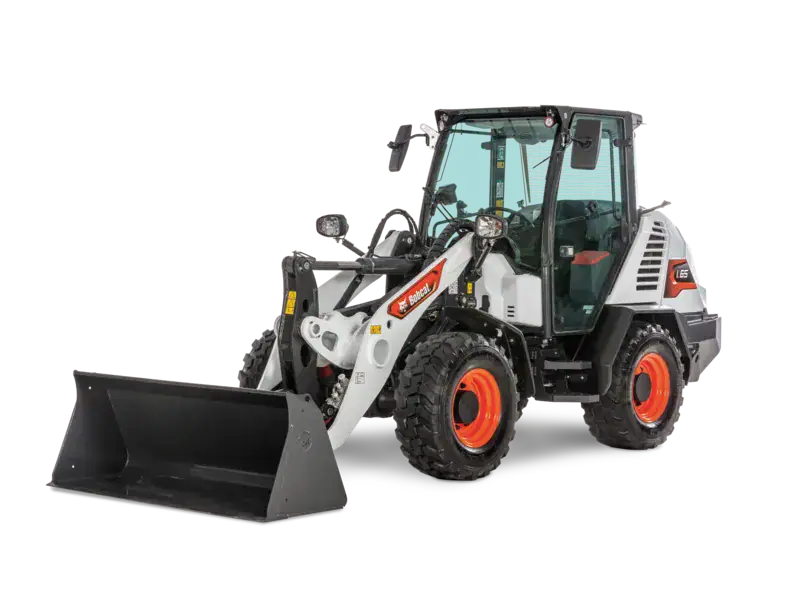
The Bobcat L65 is a compact wheel loader to investigate when repeated material movement has become a substantial part of the working day. Its purchase case is different from that of a small loader bought mainly to pass a narrow gate. The L65 needs a route and work area that accommodate its larger package, and it should repay that requirement through a useful match to recurring bucket, fork or attachment tasks.
For a Canadian farmyard, landscaping yard or property operation, begin by separating bulk-material cycles from pallet handling. Bobcat publishes different ratings for the two attachments and for straight versus articulated positions. A single headline capacity cannot represent all four conditions.
On This Page
ToggleL65 specifications: four capacity entries, not one
| Item | North American detailed model page |
|---|---|
| Engine output | 55 hp |
| Bucket ROC, straight / articulated | 3,160 / 2,572 lb |
| Fork ROC, straight / articulated | 3,859 / 3,150 lb |
| Operating weight | 10,555 lb |
| Standard auxiliary flow | 19.9 US gpm |
| Hinge-pin height | 127 inches |
| Width over tyres / with listed bucket | 69.7 / 74.8 inches |
| Cab height | 97.4 inches |
| Published high travel speed | 16.8 mph |
Source: Bobcat’s North American L65 page, checked October 2, 2026. The family summary contains different weight and bucket-rating entries. This guide uses the detailed model table and does not blend the two. Confirm the actual build for a used purchase or transport decision.
Start by counting complete material cycles
A wheel-loader purchase becomes easier to evaluate when the work is described as a cycle: collect material, travel, place it and return. Write down the normal route, receiver and number of repetitions. Include any waiting for another machine or person.
If most time is spent waiting for a receiver to become available, a faster loader may have limited effect. If travel dominates, route length and surface condition become important. If pickup is slow, material staging or bucket selection may be the issue. This breakdown prevents engine output becoming the answer to every productivity question.
For a hypothetical job of 40 cycles, a measured improvement of 15 seconds per complete cycle totals ten minutes. That arithmetic helps value an observed difference without claiming that the L65 will achieve it. Measure representative cycles under comparable conditions before putting a time saving into an ownership calculation.
Also count interruptions and cleanup. A larger bucket is not automatically more productive if it makes placement awkward or spills material that must be collected. The useful result is the completed job at the required standard.
Bucket work: volume must follow the material
Describe the material before choosing a bucket. Bedding, loose soil and aggregate can create very different loads for the same apparent volume. Moisture and fill also affect the result. A bucket selected for light bulky material should not be treated as a universal scoop for every pile on the property.
Ask for the attachment’s mass, capacity description and approved machine pairing. Establish what the loader rating includes rather than assuming the whole published figure remains available for material after fitting any bucket.
Then inspect the receiving geometry. Hinge-pin height is not dump clearance, and clearance alone does not prove useful reach into a container. Measure the actual receiver, the approach and the place where material needs to land.
A yard with several different receivers may justify more than one attachment or a revised layout. Compare those solutions before buying the machine around the most awkward loading position. Sometimes moving a pile or changing the approach provides more benefit than a larger carrier.
Fork work: use the fork conditions
The separate fork entries are useful because they keep the attachment basis visible. They are not permission to handle every pallet weighing less than the number. Load centre, placement height, configuration and the specific attachment instructions still matter.
For recurring deliveries, collect the supplier’s gross pallet weight and dimensions. Include packaging and any uneven mass distribution. A pallet of uniformly stacked bags is not the same geometry as a long machine component, even at the same total weight.
Draw the intended route with its turns. The machine may collect the load straight and then articulate before placing it. A purchase based only on the straight rating does not describe that full sequence.
Keep the general definitions in Aglist’s ROC guide separate from the L65’s own rating method. Do not recalculate a permitted load using a percentage borrowed from a skid steer or compact track loader.
Where the larger footprint can become a disadvantage
Measure the narrowest route with the selected attachment fitted. Include turning around stored equipment, entrance height and the space needed to approach the receiver. A wide open yard can still contain one restrictive corner that governs the daily routine.
For buildings, measure the actual clear opening, including door hardware and overhead obstructions. Avoid relying on the nominal door size. Consider whether tyres, accessories or a different attachment change the quoted dimensions.
A compact wheel loader also moves differently from a skid steer. A machine that can pivot tightly may suit one layout, while a machine following an articulated turn may suit another. Test the complete path rather than comparing isolated turning-radius figures whose definitions may differ.
If access fails, record that as a mandatory requirement rather than compensating with higher scores for speed or comfort. A capable loader that cannot reach the essential task is not an appropriate configuration for that task.
Hydraulic tools: investigate the fitted system
The standard auxiliary-flow figure is a useful first screen for a powered attachment. It does not identify the tool’s full compatibility requirements or establish that every valve and control is present on a particular machine.
Record the attachment’s permitted flow and pressure, return requirements, any case drain, electrical controls and mounting interface. Verify carrier approval and required protection. If the tool has alternative motor packages, include the correct version on the quotation.
Do not transfer a high-flow claim from another model in the family. Product pages can contain shared feature text, and the intended machine’s build must support the stated capability. This guide does not assign an unverified high-flow package to the L65.
For a buyer whose principal work is a demanding hydraulic tool, compare the tool and carrier as one purchase. Aglist’s hydraulic attachment guide provides the questions; the L65’s own documentation provides the answers.
Farmyard and winter scenarios
Repeated movement between storage and work areas
Map the route and identify where loaded travel, empty return and waiting occur. A higher maximum speed has limited relevance if the route requires slow movement, frequent turns or interaction with other work. Evaluate the actual permitted cycle, not a theoretical straight-line run.
Bulk loading from a consistent material pile
Assess bucket selection and receiver position together. Consistent staging can make comparisons more meaningful because the loader is not being judged against a changing pile or obstructed approach. Record conditions during any demonstration.
Snow handling on a working yard
Choose where snow will be stored or discharged and how the route changes through the season. A pusher, bucket and blower have different demands. Confirm the exact attachment and evaluate visibility, tyres and operator environment under the intended conditions.
The snow attachment guide helps organise the alternatives. It does not establish that an attachment designed for another carrier is suitable for this loader.
Compare the L65 with the work you already have
If a farm already owns a skid steer, list the tasks that the new machine would take over. The Bobcat S76-2 is one skid-steer example to investigate against the same loading route and attachment requirements. Compare complete configurations rather than equating their differently labelled capacity figures.
For soft sites beyond the yard, a Bobcat T76-2 provides a tracked alternative to examine. The ground-contact question is separate from loading geometry and handling approval. Aglist’s wheel-versus-track article helps frame that part of the decision.
Where placement reach is the main constraint, a JCB 525-60 represents a different machine concept to assess. Its load chart and attachment arrangement require their own review. The comparison should follow the task, not an assumption that a telehandler and a wheel loader are interchangeable.
Inspecting a used L65 and planning service
Record serial identity, tyre configuration, attachment carrier and included tools. Have a qualified inspection cover articulation and oscillation areas, steering and drive operation, lift pivots, coupler, hydraulics and structural repair evidence. Check the operator-station equipment as fitted.
Reconcile service records with the correct manuals. An operating-weight discrepancy between public summaries should not be resolved by choosing the lighter number for transport; establish the actual configured weight and everything carried with it.
Inspect attachments separately and obtain estimates for identified work. These are general due-diligence steps, not evidence of a recurring L65 defect. Avoid converting isolated reports about another model or market into a reliability verdict.
For the ownership budget, request a local Canadian quotation with machine, attachments, setup and delivery itemised. Add service access, transport and a realistic plan for downtime. No national purchase price or guaranteed hourly cost is implied by a North American starting-price advertisement.
Keep bucket and fork work in separate planning rows
A farmyard comparison becomes clearer when each recurring task has its own record. For bulk material, enter the material, selected bucket, pickup conditions, receiver and complete cycle time. For pallet work, enter gross load, dimensions, fork assembly, route and placement requirement. Preserve the applicable machine rating conditions in each row.
Then mark frequency and whether an alternative already exists. A loader used for several hours of routine material movement should not be selected solely around one annual delivery that another service could unload. Conversely, an essential daily pallet task should not be averaged away because the machine performs many lighter jobs.
This also clarifies whether the L65 is an addition or a replacement. If an existing skid steer must remain for access or attachment reasons, include both machines in the ownership plan. Do not credit the new loader with eliminating costs that will continue. If replacement is feasible, establish which existing attachments can actually remain useful before assuming their value carries over.
L65 FAQ
Why are fork and bucket ratings different?
They describe different attachment and test conditions. Preserve the labels and use the information applicable to the actual job.
Can the high travel speed be used in a productivity estimate?
It is a machine specification, not a promised loaded cycle speed. Measure the route and use appropriate operating conditions.
Which published weight should a used buyer use?
Establish the actual configuration and complete hauling load. Do not select whichever conflicting summary happens to fit an existing trailer.
Does it replace a skid steer?
It may replace particular tasks where the complete wheel-loader package fits better. Access, attachments and operating routines decide the result.
When is it easiest to justify?
When recurring material cycles use its documented handling arrangement and the yard provides suitable access, receiving geometry and service support.
Share your experience
Help other Canadian buyers — leave a quick review for the
Bobcat L65
There are no reviews yet. Be the first one to write one.