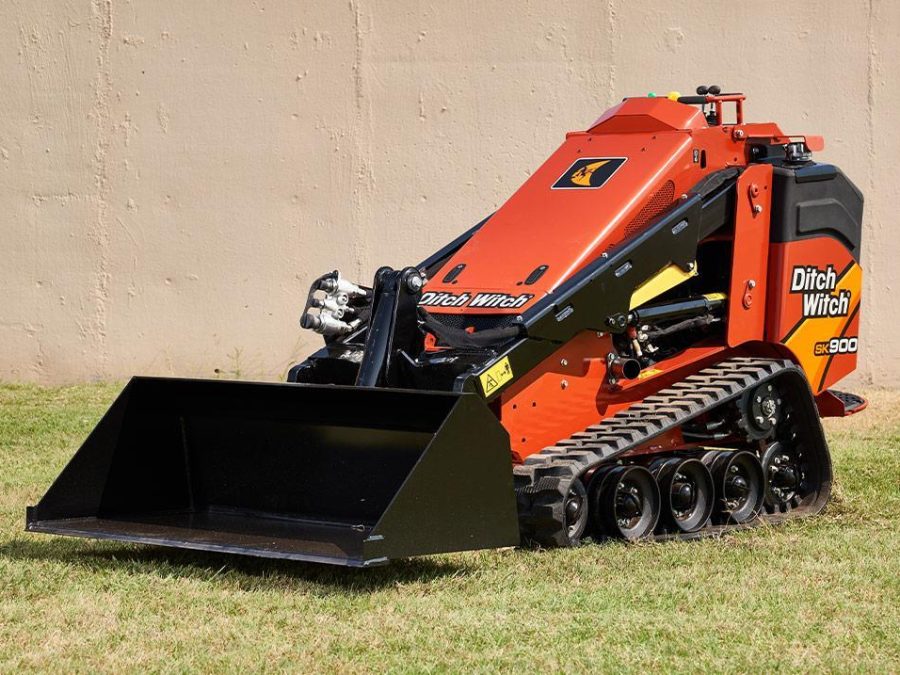
Overview & Specs
The Ditch Witch SK900 deserves attention when the buyer wants a compact stand-on carrier for mixed landscape and attachment work, with particular interest in its turbo-diesel engine and diagnostic features. It should not be selected simply because its model number is higher than another machine’s. The worthwhile comparison is the complete job: power supply, tool, route, operator and material handling.
This guide addresses the North American configuration in Ditch Witch’s SK900 brochure carrying a 2021 copyright, checked October 13, 2026. That document remains linked from the manufacturer’s product page. It is useful evidence for shopping in Canada, but serial-specific instructions and the actual installed equipment must settle a used-machine purchase.
On This Page
ToggleWhat the brochure establishes
| Item | Published reference |
|---|---|
| Engine | Yanmar 3TNV80FT turbo diesel |
| Rated operating capacity, 35% basis | 932 lb / 422 kg |
| Hinge-pin height | 83 in / 2.10 m |
| Machine mass, no attachment and fluids full | 3,190 lb / 1,447 kg |
| Auxiliary pump entries | Pump 1: 6.3 US gpm; pump 2: 5.7 US gpm |
| Listed auxiliary pressure | 3,000 psi / 207 bar |
| Maximum ground-drive speed | 4.0 mph / 6.4 km/h |
Source: Ditch Witch SK900 brochure. Its tipping-capacity row visibly contains two different figures, so neither is used here. The brochure also separates pump entries; adding them is not sufficient evidence of the flow available in every attachment mode. Overall machine width is not supplied in that table and should be established for the actual configuration.
Turbo power is a reason to test the task, not skip the comparison
The engine description is relevant when evaluating how the carrier works with the intended attachment. It does not by itself establish tool output, fuel consumption or production per hour. Those outcomes also depend on hydraulic configuration, the tool, material and the way work is organised.
For a buyer considering an upgrade, identify the existing limitation first. Is the attachment mismatched? Is travel taking most of the day? Is the receiver beyond the present machine’s geometry? An engine feature can be valuable, but it cannot resolve every one of those problems.
A suitable demonstration should reproduce the recurring task within approved limits. Record the finished result and complete working sequence. Avoid accepting an unloaded engine demonstration as proof that a particular attachment will perform well in your material.
Separate attachment work from travel work
A landscape operation may spend more time positioning and using a tool than travelling. Another property may require repeated long transfers between stockpile and destination. These are different reasons to buy a carrier, even when both owners request a bucket and auger.
Maximum travel speed is not an average loaded working speed. Turns, restricted visibility, uneven surfaces and the operating instructions determine appropriate movement. Do not calculate a workday from maximum speed multiplied by hours and describe that as achievable production.
Instead, time a representative permitted cycle. If tool operation accounts for most of the cycle, improving the delivery route may have limited impact. If travel dominates, a closer stockpile may help more than a different attachment motor. This distinction makes a demonstration informative rather than theatrical.
The hydraulic specification needs a mode-specific answer
For a motor-driven attachment, obtain the approved flow range and pressure requirements, then establish what the SK900 supplies in the intended operating configuration. Retain the distinction between separate pump entries and the actual selectable or supported supply at the tool.
A mathematical sum cannot confirm the routing, controls or simultaneous functions of a hydraulic system. Treat missing mode information as a documentation question. Do not turn a brochure’s component figures into an invented performance promise.
Complete the pairing check with return requirements, any drain connection, couplers, control functions and mounting compatibility. The hydraulic attachment guide explains the terms; the specific machine and tool instructions provide the final answer.
When inspecting a sale package, identify every powered tool separately. Two visually similar augers or trenchers may have different components or intended carriers. A seller’s statement that an attachment “ran before” is weaker evidence than identification, applicable requirements and a properly evaluated pairing.
Diagnostic information is useful only when someone can act on it
The brochure describes a gauge that displays engine issue codes. For a used purchase, have the inspector assess the display and explain any stored or active information available through the applicable diagnostic process. The existence of a display is not proof that the machine is fault-free.
Ask what support is available for the exact engine and machine near your operating area. A useful service plan identifies who can diagnose it, how transport is handled and how to obtain the correct parts. Avoid promising a particular response time without a service agreement or current confirmation.
Keep the machine identity, service records and any diagnostic findings together. This helps distinguish a documented repair from a vague reassurance. It also makes a future service enquiry more productive than sending only a photograph of the model decal.
Tree-care features do not authorise every forestry attachment
Ditch Witch’s brochure identifies side-shield and brush-guard kits aimed at tree-care work. Treat those as specific equipment items to identify on an offered machine, not as a blanket description that the carrier is ready for any brush or cutting application.
The intended attachment may have its own carrier, protective-equipment and operating-area requirements. Establish those from its documentation. A brush-handling job, a motor-driven cutting job and moving nursery stock impose different demands.
For a buyer doing cleanup, list the material’s size, mass and shape as well as the route. A long irregular load may govern visibility and turning space even when its mass appears modest. Select the complete approved handling method instead of relying on the presence of a guard kit.
Capacity and height: do not let the engine story obscure them
The operating-capacity rating belongs to a stated framework, not to every imaginable tool and load. Forks add their own mass and load-centre questions. A bulky container can require different handling from compact material of the same weight.
The published hinge-pin height describes the lift pivot. Loading a trailer still requires actual dump clearance, reach, approach and withdrawal to work together. Where a receiver is too high or too far away, more engine capability does not fix the geometry.
Use the ROC explanation and lift-path comparison to structure the questions. Do not replace an unresolved factory figure with a number copied from a different model or an unrelated listing.
Measure the actual working footprint
Because the reviewed table does not establish overall width, do not borrow a neighbouring model’s width or infer it from track-shoe size. Obtain the configuration-specific dimension and physically measure the offered machine when access is close.
Record the widest part of the carrier, attachment and load. Include the approach to the narrowest opening and the room needed to turn after it. A machine can fit through an entrance yet fail to position a tool at the work location.
Storage deserves the same attention. A tool parked where it cannot be approached correctly can turn a simple attachment change into a daily inconvenience. Lay out parking space and access for the tools that will actually be used, rather than buying a collection first and finding room later.
A Canadian project example: separate the time savings
Imagine a permitted cleanup routine with 16 trips taking three minutes each, followed by 20 minutes of setup and finishing. Total planned time is 68 minutes. If better staging saves 30 seconds on every trip, the cycling portion drops by eight minutes and the whole task becomes 60 minutes.
These are hypothetical figures, not SK900 test results. They demonstrate why an improvement to one part of the routine should not be advertised as the same percentage improvement to the entire job. Include the manual steps that remain.
For recurring commercial work, document the material, tool and surface conditions with the observation. For occasional acreage projects, compare a rental or contractor quotation before assigning the carrier enough annual work to justify ownership.
Cold seasons and changing ground conditions
A fall purchase trial should not silently stand in for a winter operating assessment. Define the winter attachment, snow destination, operator exposure and access after banks develop. A workable summer entrance may become restrictive once stored snow occupies the approach.
Follow the applicable instructions for starting, fluids, inspection and storage. Do not infer cold-start temperature, traction on ice or service intervals from the diesel brand alone. These are configuration and operating-document questions.
On landscaped ground, evaluate the finish after repeated passes. Tracks spread contact differently from tyres, but surface outcome depends on turning, support, load and moisture. If restoration is required, include it in the job comparison rather than treating it as unrelated to productivity.
Inspect condition before assigning value to features
Have a qualified inspection assess the engine, cooling and air-intake systems, hydraulic functions, drive response, running gear, lift linkage, mounting parts, controls and interlocks. Keep observed condition separate from unverified stories about model reliability.
Inspect fitted guards and accessories for identity, completeness and suitability. Obtain the relevant installation and operation information for modifications. A feature mentioned in the brochure may not be fitted to the used example in front of you.
For hauling, determine the equipped mass rather than stopping at the no-attachment number. Include additional tools and accessories, and verify the complete trailer and towing arrangement. A compact footprint does not make transportation capacity irrelevant.
Compare alternatives by the unresolved requirement
A Bobcat MT100 or Toro Dingo TX700 provides a relevant mini-loader comparison. Evaluate their actual mounting arrangements, attachment capabilities and site fit rather than assuming similar engine classes imply interchangeable performance.
If the recurring work mainly uses rear implements or sustained seated operation, revisit the platform decision using mini skid steer versus compact tractor. If the work is mostly loading a particular receiver, make that geometry the first filter.
Obtain complete Canadian quotations and include condition-related work, essential tools, delivery and support. A turbo engine or diagnostic display can contribute value, but the strongest purchase case remains a machine that meets the actual job and can be supported where it operates.
SK900 questions worth asking
Can I add the two pump figures to select a tool?
Not as a complete compatibility decision. Establish the available supply and controls in the intended mode from the applicable documentation.
Which tipping-capacity number should I use?
The reviewed brochure has a conflicting row. Resolve it for the actual machine instead of choosing the larger figure; neither should become an operating target.
Does the turbo engine increase the permitted load?
An engine feature is not an alternative lifting rating. Use the approved carrier-and-attachment limits.
Do tree-care guards make all cutting attachments suitable?
No. Each attachment needs its own carrier and protective-equipment assessment.
What is the most useful demonstration?
A representative permitted task using the exact proposed tool, with complete time, surface result, control usability and any remaining limitations recorded.
Share your experience
Help other Canadian buyers — leave a quick review for the
Ditch Witch SK900
There are no reviews yet. Be the first one to write one.