Overview & Specs
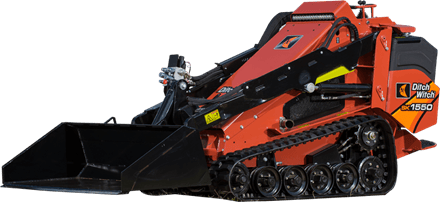
The Ditch Witch SK1550 is a larger stand-on carrier to consider when material placement and substantial front attachments have outgrown a smaller mini loader’s useful envelope. The important buying question is not whether it has an impressive headline capacity. It is whether the actual configuration can handle the intended load, reach the receiving point and still fit the route and transport plan.
For Canadian used-equipment shoppers, configuration is especially important because the manufacturer lists separate standard and weighted ratings. This guide uses Ditch Witch’s North American specification sheet carrying a 2020 copyright, checked October 13, 2026. It does not assert current Canadian availability or apply every figure to every serial number.
On This Page
ToggleKeep standard and weighted specifications separate
| Item | Published reference |
|---|---|
| Operating capacity, standard, 35% basis | 1,558 lb / 707 kg |
| Operating capacity, weighted | 1,978 lb / 897 kg |
| Mass, no attachment and fluids full | 3,990 lb / 1,810 kg |
| Machine mass, weighted | 4,470 lb / 2,028 kg |
| Hinge-pin height | 94.5 in / 2.4 m |
| Width, specified 9-inch track arrangement | 46.6 in / 1.18 m |
| Auxiliary supply | 16 US gpm / 60.6 L/min; 3,700 psi / 255 bar |
| Engine | Yanmar 3TNV86CT diesel |
Source: Ditch Witch SK1550 specification sheet. The weighted rating applies to its documented configuration, not to arbitrary added ballast. The sheet’s ground-pressure entry uses a different track-width description from the width row; those entries should not be combined into one assumed setup.
Start with the material that caused you to consider a larger machine
Write down its mass, dimensions, packaging and destination. A nursery container, pallet of landscape product and loose bucket load create different handling requirements. Long or irregular material can make visibility and turning space important even when weight is not the first limitation.
Then identify the suitable attachment and the permitted carrier configuration. Include attachment mass and the position of the load. A fork frame’s structural rating is not a new machine capacity, and a grapple’s ability to close around material does not prove that the whole arrangement is suitable to lift it.
If a delivered load exceeds the appropriate limits, consider a different delivery method, material packaging or machine. Do not build the purchase justification around exceeding a rating occasionally. The ROC and tipping-load guide helps distinguish the relevant measurements.
Counterweights change the ownership package as well as the rating
A used listing may quote the larger capacity without clearly identifying the fitted equipment. Inspect and document the configuration before accepting that number. Obtain the applicable installation and operating information for the actual machine rather than assuming a visible added weight is the approved arrangement.
The specification’s weighted mass exceeds its standard mass by 480 lb, approximately 218 kg using the printed metric values. That difference matters to hauling and handling the machine as cargo. It also demonstrates why the higher rating should not be considered independently from the equipment required to obtain it.
Do not invent a rule that each pound of ballast creates a fixed amount of extra working capacity. The approved system involves machine geometry and manufacturer limits, not a proportional calculation a buyer can safely extrapolate.
When comparing two offers, put configuration beside price. A documented weighted package and an unidentified standard machine are not equivalent proposals simply because both listings use the SK1550 name.
Height and reach should be evaluated at the receiver
Measure the trailer, container or loading point before choosing the carrier. The receiving edge, desired landing area and available approach determine whether the loading geometry works. A wall, wheel or other obstruction can keep the carrier farther away than expected.
Hinge-pin height identifies a pivot, not the clearance under a dumped bucket or the usable height for every fork load. Evaluate the exact attachment in the relevant position. An empty machine raised beside a truck is not a complete loading demonstration.
Observe a permitted cycle from approach to withdrawal. Confirm where material lands and whether the operator can monitor the task appropriately. If the proposed receiver is awkward, another receiving arrangement may be more useful than a small increase in nominal machine capacity.
For buyers comparing a telescoping alternative, the Toro Dingo TX1300 guide illustrates why reach and capacity must be considered together. Do not compare maximum reach from one configuration with maximum capacity from another as though both are simultaneously available.
The larger footprint changes where a mini loader can work
The SK1550 should not inherit an assumption of narrow-gate access merely because it belongs to the mini-loader category. Measure the actual carrier and selected tool. An attachment can be wider than the tracks, while a carried load can govern the route again.
Look beyond the first entrance. A long attachment may need space to turn in a courtyard or reverse from a stockpile. The receiving point may offer plenty of width but insufficient room to line up correctly. Draw the complete route rather than comparing only one opening.
Storage and trailer layout also need the equipped dimensions. Space used by a bucket on the machine is different from a bare carrier with the bucket transported separately. Account for the whole tool package instead of choosing whichever dimension makes the purchase appear convenient.
Hydraulic tools: match the actual model and controls
The auxiliary figures belong to a specific system, not to a universal attachment class. Obtain the proposed tool’s required flow range, pressure limits, connection arrangement, controls and permitted carrier requirements. Verify the exact hydraulic variant when several versions share the same attachment name.
Ditch Witch’s attachment selector distinguishes tools and carrier models. That model-by-model approach is more useful than assuming all orange attachments fit all orange loaders. A family resemblance is not a compatibility record.
For a motor-driven tool, confirm the supported operating configuration and any required drainage or electrical equipment. For a grapple, establish the actual control functions and handling limits. Both hydraulic function and mechanical suitability must be resolved before a working demonstration.
If an existing smaller-carrier tool is central to your work, check its approved range rather than expecting it to benefit from all the SK1550’s available output. More supply can be irrelevant or unsuitable for a particular tool. The hydraulic matching guide explains the distinction.
Engine tilt angles are not machine slope ratings
The manufacturer explicitly warns that the engine’s permitted operating angles do not establish machine stability. This matters because a specification table can make an angle look like a simple answer to a hillside question when it is addressing a different component.
Use the applicable operating instructions for the actual machine, attachment and site. Do not turn a printed engine angle into permission to traverse a slope or handle a raised load there. If terrain is central to the purchase, have suitability established before arranging a demonstration.
The same discipline applies to nominal ground pressure. It is not a guarantee of support, traction or an unmarked lawn. Surface condition, load, turning and repeated passes remain relevant to the work plan.
Assess the stand-on layout against the real workday
For a routine alternating machine handling with work on foot, a stand-on carrier may be worth evaluating closely. Include proper stopping, parking and securing procedures in the trial; convenient access does not remove those steps.
For hours of uninterrupted travel or work in exposed Canadian winter conditions, operator preferences may point elsewhere. Try the intended duration and control routine after familiarisation. A photograph of an open station cannot establish comfort for a particular person.
Compare a seated loader where it serves the same tasks. The Bobcat L28 represents another layout to investigate, with its own geometry and limitations. Choose based on the working arrangement rather than a universal claim that one station is better.
Measure the benefit of larger permitted loads honestly
Consider a hypothetical job where one independently approved setup needs 20 trips and another needs 15. At an assumed three minutes per complete cycle, the totals are 60 and 45 minutes. That is a 15-minute cycling difference, before setup, finishing and any route changes.
These inputs are invented, not SK1550 capacities or test results. They illustrate a decision method: fewer trips are valuable only if the larger package remains suitable for the route and does not introduce offsetting work elsewhere.
Include receiving and delivery logistics. If another machine must still unload the truck, the mini loader has not replaced that part of the system. Count equipment and labour actually removed, rather than assigning the new machine savings from tasks it will not perform.
Used SK1550 inspection should verify configuration first
Record the serial number, engine identity, fitted counterweights, track arrangement and attachment interface. Compare records with the actual machine. Undocumented modifications deserve resolution before price negotiations assume their value.
A qualified inspection should cover running gear, drive, hydraulics, lift linkage, mounting and locking parts, engine and cooling, controls, platform and interlocks. Have the intended attachment assessed separately and record limitations of any test. These are inspection priorities, not asserted model-specific failure patterns.
For a machine sold with several tools, prepare an itemised list with identification, condition and compatibility. A tool that cannot be supported or matched should not be counted as a fully useful asset merely because it is included in the package.
Where a weighted arrangement is essential to the planned work, include it in every comparison from the beginning. Do not price one proposal using the standard transported mass while crediting it with the weighted operating rating. Keep one consistent equipment list for capacity review, transport planning, inspection and quotation.
Transport and seasonal cost can decide the purchase
Determine the complete transported mass with tools and fitted equipment. Verify the trailer and towing arrangement using actual ratings and loaded conditions, including the appropriate loading procedure. The word “mini” is not a transport exemption.
For snow removal, work backwards from where snow can be placed. Carrying, pushing and blowing require different attachment and route plans. Account for narrowing access, visibility and operator exposure over the full winter, not just the first snowfall.
Request Canadian quotations for the complete inspected package, delivery, required work and essential attachments. Compare ownership at expected use and at lower utilisation, alongside rental or contracted service for exceptional tasks. Do not assume a resale value or repair rate without evidence.
SK1550 buyer questions
Can I use the weighted rating on any SK1550?
No. Establish the approved fitted configuration and applicable instructions for the actual machine.
Does a higher fork rating increase what the carrier may lift?
No. The attachment, carrier and load geometry must all be suitable; the attachment rating cannot override the system limits.
Is the engine-angle entry a hillside operating limit?
No. The manufacturer specifically separates engine operation from machine stability.
Will a larger carrier necessarily complete a job faster?
No. Access, cycle time, setup and remaining manual work can offset fewer trips. Compare the complete task.
What is the strongest reason to buy this model?
A documented handling or attachment requirement that the actual SK1550 package meets, with acceptable access, operator fit, condition and transport cost.
Share your experience
Help other Canadian buyers — leave a quick review for the
Ditch Witch SK1550
There are no reviews yet. Be the first one to write one.