
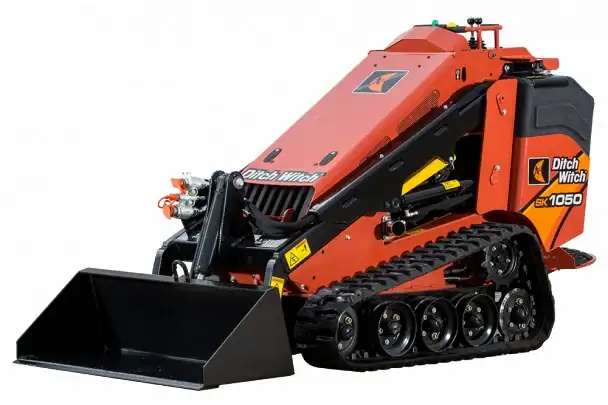
Overview & Specs
The Ditch Witch SK1050 is worth evaluating when a specific powered attachment defines the purchase. Rather than treating it as simply a bigger mini loader, ask whether its documented hydraulic supply, carrier configuration and operator routine suit the tool that earns its place on the property or jobsite. The attachment should shape the comparison before optional equipment or model badges do.
This Canadian buying guide uses Ditch Witch’s North American specification sheet with a 2020 copyright, checked October 13, 2026. Used machines require serial-specific verification. Published figures can also differ between an original launch announcement and a later specification sheet, so keep the document and configuration with every number.
On This Page
ToggleRead the hydraulic rows carefully
| Item | Reference specification |
|---|---|
| Auxiliary flow | 13.9 US gpm / 52.6 L/min |
| Auxiliary pressure | 3,625 psi / 250 bar |
| Engine | Yanmar 3TNV88C diesel, 37 gross hp |
| Operating capacity, 35% basis | 1,062 lb / 482 kg |
| Hinge-pin height | 83 in / 2.10 m |
| Mass without attachment, fluids full | 3,435 lb / 1,558 kg |
Source: Ditch Witch SK1050 specification sheet. A separate ground-drive row lists 15 US gpm; it is not additional auxiliary supply. An earlier launch description also used a different auxiliary-flow figure. This guide retains the reviewed specification sheet’s 13.9 figure rather than blending versions.
Write the attachment requirement before comparing carriers
Start with the finished result: the hole, prepared surface, material placement or other recurring task. Specify the exact attachment proposed to deliver it, including its hydraulic variant. A broad category such as “auger” does not describe the mounting, motor, flow range and controls of the unit being purchased.
Build a two-column requirement sheet. On one side put what the tool requires; on the other put what the actual carrier supplies. Mark each line confirmed, unsuitable or unresolved. This prevents a strong result in one area, such as engine power, hiding a failed requirement elsewhere.
Include mechanical mounting, attachment mass, approved carrier configuration, flow range, pressure, supply and return connections, any required drainage, electrical functions and protective equipment. These questions belong to a complete pairing, not to a hydraulic number in isolation.
More available output is useful only within the tool’s limits
A hydraulic motor has an approved operating range. Choosing a carrier with more capability does not grant permission to send maximum output to every tool. The correct configuration and operating setting must remain part of the handover.
Likewise, pressure is not a constant level at which all work happens. A published system limit should not be presented as continuous measured pressure at the attachment. The buyer needs compatible requirements and a functioning system, not a theoretical calculation relabelled as delivered tool horsepower.
For sustained tool work, arrange a demonstration that reflects the intended duty and material within the applicable instructions. A brief rotation without load establishes far less than a suitable evaluated task. Aglist’s standard versus high-flow guide provides the general matching framework.
Do not pay for hydraulic capability to solve a geometry problem
A buyer frustrated by loading a high-sided trailer may focus on engine output because it is easy to compare. But the receiver may demand a different combination of discharge height, reach and approach. Those questions remain even when the attachment supply is stronger.
Measure the receiver and the available working space. Include any obstruction that keeps the machine away from the side. Evaluate the exact bucket in its permitted discharge position and observe the withdrawal after unloading.
The hinge-pin figure in the table is not a dump-clearance figure. Nor does it describe where the material will land. Use the lift-path explanation to understand the terminology, then compare the actual geometry of the proposed machines.
The recurring job may justify a different attachment size
A large tool can look attractive because its working width or nominal production appears greater. Yet it may require more access, create a different finish or make positioning harder. Tool selection should account for the site as well as the hydraulic package.
For surface work near buildings, a smaller compatible attachment may reduce awkward manoeuvres and leave less hand finishing. On a wide open area, the balance can change. Compare the completed acceptable result, not only a pass width.
For an excavation-related tool, establish the site’s utility-locate and other applicable requirements before work. Tool capability does not replace site assessment. This guide is a purchase framework, not an excavation procedure or permission to work near buried services.
Material handling still has its own limits
Operating capacity and attachment supply describe different capabilities. A powered grapple, for example, needs a suitable hydraulic function and a suitable load arrangement. Passing the hydraulic check does not establish that an arbitrary log or container may be lifted.
Record the handled material’s complete mass, shape and centre of gravity. Forks or a grapple change the relationship between the load and carrier. The attachment’s structural rating is only one part of the assessment.
Use the applicable operating instructions and load information. Do not convert tipping capacity into a preferred working allowance or assume a heavier attachment leaves the same payload available. The ROC guide explains why the ratings must remain distinct.
Access can defeat an otherwise good hydraulic match
Measure the fitted track configuration and the selected attachment together. A carrier-only width is insufficient when a bucket, rake or fork frame projects beyond it. Include the carried load where relevant.
Then evaluate length and swept movement. A narrow opening with a tight turn beyond it can require more room than a straight passage. The tool’s working position can differ from its transport position, so reaching the site does not prove the job can be completed there.
For repeated residential work, make a record of the entrances and turning spaces most often encountered. For an acreage, map the few locations where equipment must work every season. These observations can eliminate unsuitable proposals earlier than a detailed price comparison.
Stand-on operation and the attachment-change routine
The operator may alternate between carrier work and tasks on foot. Evaluate how the SK1050 fits that routine using the required stopping, parking and attachment procedures. A convenient operating layout must still support correct operation.
Storage arrangement influences changeover time. Each tool needs a suitable parking place and a practical approach for coupling. A frequently used attachment blocked by several rarely used tools can erode the convenience of a versatile carrier.
Try the controls and visibility with the intended attachment after familiarisation. Include normal Canadian work footwear and seasonal clothing. Where multiple operators share the machine, note individual fit issues rather than treating one demonstration as representative of everyone.
Evaluate attachment productivity with explicit assumptions
Suppose a hypothetical recurring job requires 90 minutes of powered-tool work and 30 minutes of setup, movement and finishing. If another suitable package reduces the tool portion to 70 minutes, the entire task falls from 120 to 100 minutes. That is a 20-minute saving, not a claim that every part of the job becomes faster.
The example contains invented times and does not predict SK1050 production. Its purpose is to show where evidence belongs. Record actual observations for the intended tool and material, then include all remaining work when comparing options.
Now consider frequency. A useful improvement on a weekly paid job has a different ownership implication from the same improvement on a single garden project. Compare rental or contracted work for rare specialist tasks rather than assuming every available attachment should be owned.
Used-machine inspection should include the hydraulic task
Begin with machine and engine identification, records and the applicable manuals. Confirm the actual auxiliary arrangement and fitted options. A seller’s description of “high flow” or “attachment ready” is not a substitute for the documented configuration.
A qualified inspection should assess drive, lift and tilt, hydraulic condition and performance, cooling, hoses, controls, interlocks, mounting parts and running gear. Have any required diagnostic testing performed with appropriate equipment and procedures. Record what was tested, not merely whether the machine started.
Inspect the intended attachment separately, including its identity and hydraulic components. A worn or mismatched tool can make a sound carrier appear disappointing. Conversely, a good tool cannot establish that an untested carrier meets its requirements.
Support, winter preparation and transport in Canada
Identify a practical service route before purchase: where the machine will go, who can support the actual engine and hydraulic system, and how parts are obtained. Do not assume proximity to a general equipment shop guarantees support for every component.
For winter work, define the attachment and snow destination before comparing clearing capability. Include operator exposure, visibility and the changing width of the route as banks accumulate. Follow the exact machine’s cold-weather instructions rather than choosing fluids or predicting starting performance from a generic diesel rule.
Transport calculations must use the equipped load. The published no-attachment mass leaves out the tool collection carried with the machine and may not represent fitted accessories. Verify the trailer, towing vehicle, loading arrangement and total carried equipment together.
Do not use fuel-tank capacity to forecast hours between refuelling without a reliable consumption basis for the actual work. A carrier spending most of its time positioning with a bucket can have a different duty pattern from one powering a tool for extended periods. For a business comparison, record measured fuel use during representative work if available and distinguish it from an estimate. For an occasional owner, leave uncertain operating costs visible rather than inserting a precise-looking hourly figure.
When to compare another platform
A Toro Dingo TX1000 Turbo offers another mini-loader configuration to investigate, while the Bobcat MT100 is a further category reference. Check each one’s actual tool supply, mounting and loading geometry; similar size does not make their specifications interchangeable.
If your existing tools primarily use a tractor PTO and three-point hitch, reassess the equipment system rather than trying to recreate it through adapters. The mini loader versus compact tractor guide addresses that broader decision.
Compare complete Canadian quotations, including necessary tools, controls, setup, condition-related work and delivery. Keep financing separate from equipment price and test the decision at lower utilisation. There is no defensible universal claim that a more powerful carrier pays for itself.
SK1050 frequently asked questions
Should I use the 15-gpm ground-drive entry for an attachment?
No. Keep the auxiliary and ground-drive specifications separate, and use the applicable version’s documentation.
Will more engine power solve a trailer-loading problem?
Only if the actual limitation involves power. Height, reach and receiver access require their own assessment.
Can the same attachment be shared with every mini loader?
No. Confirm mounting, hydraulic configuration, controls and carrier approval for each pairing.
What should a used-machine demonstration include?
The important attachment function under suitable permitted conditions, alongside the carrier inspection. An unloaded tool spinning briefly is incomplete evidence.
What makes the SK1050 a justified purchase?
A recurring tool requirement it meets, a route it can negotiate and a documented complete package whose cost and support fit the owner’s workload.
Share your experience
Help other Canadian buyers — leave a quick review for the
Ditch Witch SK1050
There are no reviews yet. Be the first one to write one.


