Overview & Specs
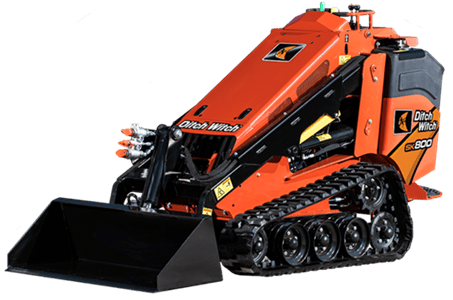
The Ditch Witch SK800 is a machine to assess around the width of the working package and the condition of the route. Its narrow and wider track configurations create a meaningful buying choice: access can favour one arrangement while the required surface outcome favours another. Neither choice should be made from the carrier photograph without considering the tools it will use.
For Canadian landscape, acreage and property-maintenance buyers, the SK800 is most compelling when short material cycles and front attachments dominate the work. It deserves a different evaluation from a tractor bought around rear implements or a larger loader selected mainly for bulk loading. This guide uses the manufacturer’s North American 2020 specification sheet, still linked from its product page when checked October 13, 2026; verify applicability to the offered serial number.
On This Page
ToggleThe track configuration changes the comparison
| Specification | Documented value |
|---|---|
| Width with 7-inch tracks | 36 in / 91 cm |
| Width with 9-inch tracks | 42 in / 107 cm |
| Published ground pressure, narrow / wider tracks | 5.2 / 4.3 psi |
| Rated operating capacity, 35% basis | 911 lb / 413 kg |
| Hinge-pin height | 83 in / 2.10 m |
| Auxiliary hydraulics | 12 US gpm / 45.4 L/min at listed 3,000 psi / 207 bar |
| Mass without attachment, fluids full | 2,920 lb / 1,324 kg |
| Engine | Kubota D1105 diesel, 24.8 gross hp |
Source: Ditch Witch SK800 specifications. These are reference ratings and dimensions, not approval for a particular load, slope or attachment. The model’s name is not its published operating-capacity figure.
Narrow tracks: identify the access you actually need
List entrances the machine must use repeatedly, then measure their clear openings. Include door hardware and the approach angle. A machine listed at 36 inches wide is not proven suitable for an opening also described as 36 inches; there is no useful operating clearance established by equal nominal measurements.
Now add the normal bucket or other tool. If it is wider than the carrier, that tool determines the passage. Removing an attachment to cross an entrance may be practical in some approved work sequences, but it can also turn every routine trip into a cumbersome changeover. Evaluate the actual sequence before buying around that assumption.
Measure the next turn and the exit too. A narrow carrier with long forks has a larger swept working area than the tracks suggest. Gate access should be evaluated as a route through the site, including space for the operator and the intended load.
Wider tracks: judge the finish, not just the pressure number
The specification presents a lower nominal ground-pressure figure with the wider track arrangement. That is useful information, but it does not guarantee an undamaged lawn or permission to travel over unsupported ground. Soil condition, turning, repeated traffic and load distribution remain part of the outcome.
A buyer working mainly across open landscaped areas may value the wider setup if the complete package meets the access requirements. Another buyer entering many constrained yards may find width the decisive limitation. The correct choice can change with the customer base rather than with engine power.
Define an acceptable surface result before a demonstration. Inspect the route after representative permitted work and account for protection or restoration where needed. Aglist’s ground-pressure guide explains why flotation, support and turning disturbance should not be treated as one measurement.
Build the material-handling decision from the load backwards
Begin with the delivered material: weight, packaging, dimensions and where it must be placed. A pallet of bagged product and loose mulch are different handling problems even if the seller calls both ordinary landscaping work.
For forks, establish the permitted carrier-and-attachment arrangement and the relevant load centre. For a bucket, establish a suitable bucket and reliable material mass information. The attachment’s own rating does not enlarge the carrier’s allowance, and a headline ROC should not be read as an unrestricted pallet capacity.
Do not use tipping load as a target. It belongs to the rating framework, while the actual working instructions and attachment limits determine operation. The ROC guide is useful when comparing sellers who use different labels for lifting capability.
Can it load your trailer?
Write down the receiver’s dimensions before comparing loaders. Hinge-pin height identifies the bucket pivot at maximum lift; it does not say how much clearance exists under a tipped cutting edge or how far material lands inside the receiving body.
A trailer with a high side and a restricted approach creates two constraints at once. The machine may need reach as well as height. A lower cart positioned close to the work can present a very different task, even when the total quantity of material is unchanged.
Use the exact bucket proposed in the sale for a suitable demonstration. Observe approach, permitted discharge and withdrawal, not just an empty lift beside the trailer. If geometry fails, changing the receiver or work arrangement may be more effective than searching for another small increase in horsepower.
Choose attachments as a working set
A basic bucket may solve most recurring material work. An occasional auger or surface-preparation tool may be better rented until its use becomes predictable. Buying every available attachment at once can consume storage and money without improving the jobs already scheduled.
For each powered tool, record the model and hydraulic variant. Check mounting, required flow and pressure, return connections, controls, mass and carrier approval. Do not assume that a tool used on another Ditch Witch model is automatically suitable for this SK800.
The manufacturer’s product page is a starting point for identifying attachment families, but individual tool documentation must resolve the supplied configuration. Some web attachment entries contain awkward or inconsistent units; copying them into a purchase specification without checking the relevant manual is poor practice.
For a Canadian rental enquiry, send identification for both sides of the proposed pairing. A booking described only as “mini skid steer auger” may lead to a different mounting or hydraulic version arriving. Retain confirmation for the actual rental unit, including any permitted substitutions.
Where the stand-on routine helps, and where it needs a trial
Landscape work often alternates machine movement with measuring, hand placement and finishing. Assess the SK800 through those transitions using the proper stopping and securing sequence. Ease of stepping on does not remove the need to stop and park correctly.
For sustained travel or long uninterrupted work, operator fit becomes a different question. Try the controls and visibility in normal work footwear and clothing after familiarisation. If several operators share the machine, each should evaluate the approved position rather than assuming one person’s preference applies to everyone.
Include the attachment in the visibility assessment. A tool can obscure the working edge or load even when the empty carrier feels open. The practical result is whether the operator can monitor the intended task and surrounding area without departing from the approved operating position.
Compare completed work instead of isolated cycle speed
Consider an invented example in which an approved arrangement needs 18 material trips at 2.5 minutes each. That is 45 minutes of cycling. A second suitable package might take 15 trips at three minutes, also 45 minutes. Neither set of quantities represents an SK800 rating or measured test result.
The decision then depends on preparation, attachment changes, the finish left behind and work that remains manual. If one option saves loading time but adds restoration time, the apparent benefit can disappear. Record a complete recurring job rather than the best-looking portion of a demonstration.
A closer delivery point or better storage for the frequently used bucket can be a worthwhile improvement without changing carriers. Keep those site changes visible in the comparison so machine capacity does not receive credit for a better work plan.
Canadian seasonal use requires separate assumptions
For spring landscaping, the actual route may be softer than the place used for a purchase demonstration. Establish when and where the work must happen and what protection or postponement options exist. Do not treat wider tracks as a universal solution to poor support.
For snow work, specify the area, clearance, snow destination and appropriate attachment. A narrow carrier can still carry a tool too wide for a walkway. Banks that build through winter may change the turning area and visibility at the end of a route.
The open operating station also changes the ownership comparison for prolonged winter use. Assess exposure and work duration honestly. Follow the applicable cold-weather and service instructions, and avoid assuming a starting temperature or ice performance from the machine category alone.
Inspect the used machine and its claimed configuration
Confirm serial number, installed tracks, attachment mounting arrangement and service history. Record what is physically present instead of copying a seller’s generic brochure. A used offer should include enough identification to find the correct instructions and parts.
Ask a qualified inspector to assess tracks and running gear, drive response, lift and tilt functions, hydraulic condition, controls, platform, interlocks and attachment locking parts. Document repair evidence and any test limitations. This list identifies purchasing questions; it is not a list of known SK800 defects.
Have essential attachments inspected independently. An attractive carrier price can be offset by an unsuitable or worn tool that must be replaced immediately. Conversely, an unneeded tool collection should not distract from an excellent basic machine-and-bucket package.
What belongs in the ownership comparison?
Use an equipped mass for transport planning rather than the no-attachment figure in the table. Consider every item transported with the machine and verify the trailer, towing vehicle and loading arrangement as a complete system.
Request Canadian quotations that separate machine condition, required work, attachments, delivery and setup. Compare a realistic annual use case with a lower-use scenario. The purpose is to reveal how much of the purchase case depends on work that is not yet certain.
A Toro Dingo TX700 or Bobcat MT100 can be a relevant alternative to investigate. Compare actual tool access, approved handling and operator routine. For primarily seated manoeuvring around landscaped spaces, investigate an articulated-loader package as a separate option.
SK800 buyer questions
Does the model number mean an 800-pound working limit?
Use the applicable published rating and operating instructions, not the model badge. This guide’s referenced sheet lists a different number and states its basis.
Are wider tracks always preferable?
No. They change the footprint and published pressure, while the route may make the additional width unacceptable.
Will a narrow setup avoid lawn damage?
No track configuration guarantees that outcome. Evaluate the work, surface condition and restoration requirements together.
Can an attachment rating establish pallet capacity?
No. The complete carrier, attachment and load arrangement must be suitable. A stronger fork frame does not create additional carrier capability.
What should settle the choice?
A documented configuration that fits the recurring route, completes the important jobs and leaves an acceptable result at an understood equipped cost.
Share your experience
Help other Canadian buyers — leave a quick review for the
Ditch Witch SK800
There are no reviews yet. Be the first one to write one.