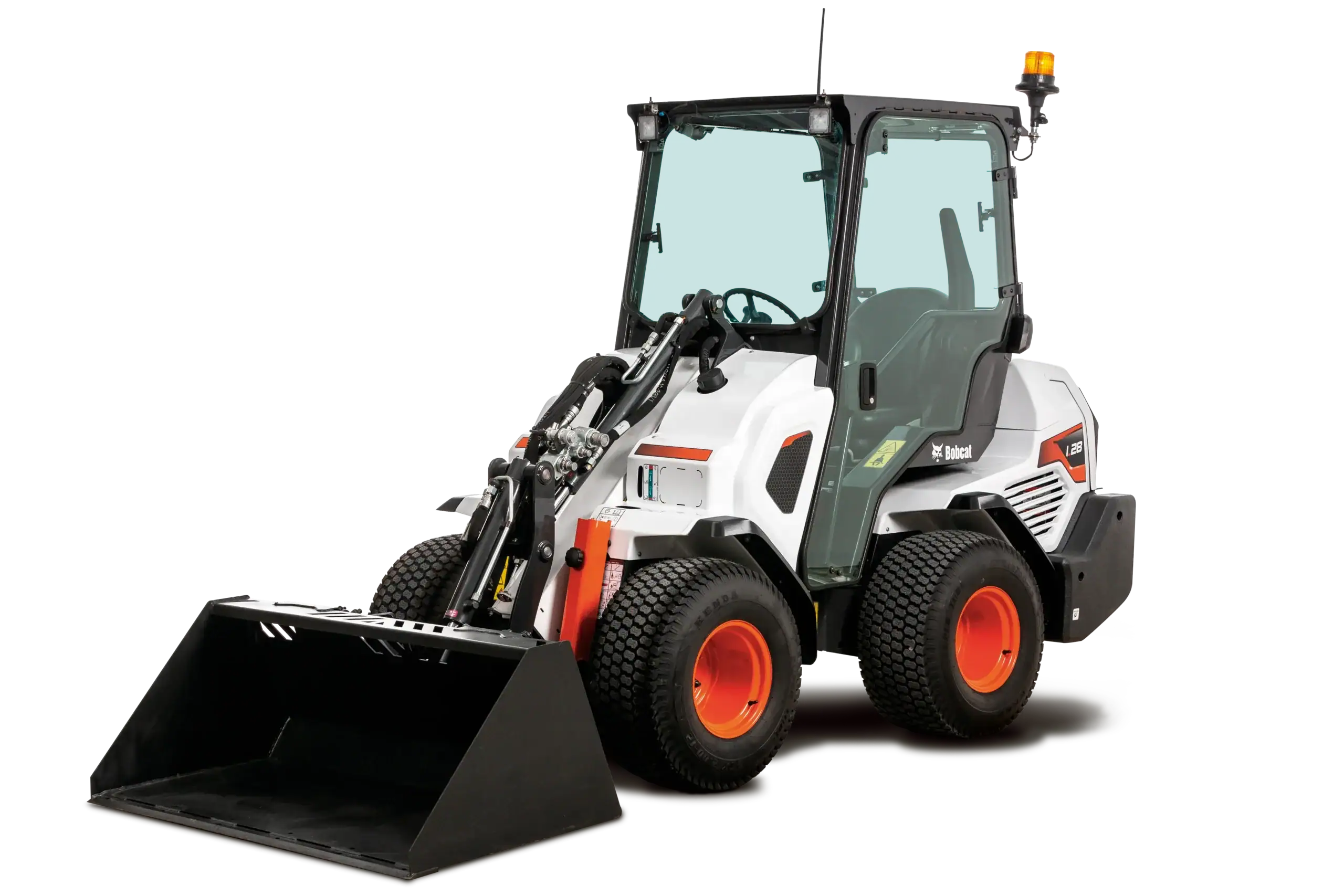
Overview & Specs
The Bobcat L28 is a small articulated loader whose most important buying feature is its telescoping lift arm. It deserves attention when a compact machine can reach the work area but a conventional small-loader arrangement cannot place material where it needs to go. That might involve a receiving container, a trailer or a location with a setback. The extension should solve a measured placement problem, not simply add an appealing specification.
For Canadian property and landscaping work, evaluate access, extension and rated load together. More reach does not imply that the same payload is permitted in every arm position. The complete arrangement also has to fit the route with the selected attachment installed.
On This Page
ToggleL28 specifications for a useful shortlist
| Item | North American specification |
|---|---|
| Engine output | 24.8 hp |
| ROC, straight / articulated | 1,534 / 1,222 lb |
| Optional-counterweight ROC, straight / articulated | 1,952 / 1,475 lb |
| Operating weight | 4,195 lb |
| Hinge-pin height, retracted / extended | 85.4 / 104.4 inches |
| Reach at maximum height | 30.9 inches |
| Width over tyres / with listed bucket | 46.5 / 50 inches |
| Auxiliary standard flow | 11.4 US gpm |
Source: Bobcat’s North American L28 product page, checked October 2, 2026. This summary is not an extension-dependent load chart. Use the operating information for the actual machine, arm position, attachment and counterweight arrangement.
Begin with the placement point
Draw the receiver in side view and mark where the attachment needs to deliver the load. Include its upper edge, any obstruction and the nearest position the loader can occupy. A tall trailer with a clear approach is different from a low container behind a fence or ledge.
Next identify the attachment point that matters. For a bucket, it may be the lip in the dumping position. For forks, it is the load’s required resting position. Neither is fully described by the hinge-pin height. The attachment’s own shape becomes part of the problem.
The L28’s extension is worth investigating when it improves that geometry without moving the carrier closer. But the capacity assessment must use the corresponding conditions. Do not combine a maximum extension measurement with an unrelated maximum load figure and assume they occur together.
A good equipment appointment starts with this drawing. The provider can then identify the applicable documentation and demonstrate an approved arrangement. A photograph of a fully raised empty bucket cannot answer the same question.
Reach can reduce repositioning, but the route still matters
Consider a hypothetical task with 30 placement cycles. If a verified change in layout or equipment saves 12 seconds per cycle, the arithmetic is six minutes. That is a planning illustration, not a measured saving from the L28. It shows why repeated modest improvements can matter, while also keeping the benefit in proportion.
Observe what actually causes delay. It may be the receiving position, a narrow approach, poor material staging or attachment changeover. If a delivery location can be moved at little cost, that may solve the problem without buying for additional reach.
Conversely, some placement points cannot reasonably be changed. Where the task repeats frequently and the extension provides a documented fit, the feature has a clear purpose. The strongest purchase argument names the task and explains what changes in its complete cycle.
Time the withdrawal from the placement point too. A loader that reaches the target but then needs an awkward manoeuvre after every discharge may not improve the overall job. Compare the whole sequence with the same receiver and similar conditions.
Do not select it from the larger ROC number alone
The product table distinguishes straight from articulated ratings and standard from optional-counterweight configurations. Those are separate conditions, not four interchangeable answers to “how much does it lift?” A route involving a turn needs more information than a straight pickup photograph.
Record the complete load, including packaging, pallet or container. Then identify its dimensions and centre of gravity where known. An irregular load may place its mass differently from a uniformly stacked pallet of the same weight.
Keep the fork or bucket documentation with the machine information. An attachment’s own rating does not approve the entire loader arrangement. Nor does adding arbitrary rear weight create a new manufacturer rating. Use the specified configuration and the appropriate operating instructions.
Aglist’s loader-capacity explanation provides useful definitions for measurement points and load centres. Its tractor examples should not be transferred to the L28; the principle is to preserve the conditions of this machine’s own ratings.
Width and turning space: inspect the attachment envelope
The difference between tyre width and bucket width is especially relevant for a machine bought to pass through restricted entrances. Measure the installed tool, not just the carrier. If forks carry a load wider than the machine, that load becomes another part of the access assessment.
Draw the corner after each narrow opening. An articulated carrier follows a different path from a skid-steer machine pivoting in place, and neither should be assumed to fit from a single turning-radius number without its measurement definition.
For properties with gates, plan how the gate remains open and where people stand during movement. Avoid an operating arrangement that depends on someone squeezing beside the machine to hold a gate or guide the attachment. The site layout should support the approved task.
Also consider the route in winter. Snow stored along a fence can reduce a passage that was comfortable during a summer visit. If the machine is expected to clear that same route, the seasonal working width deserves attention before purchase.
Attachment hydraulics: extension is not additional flow
The reason to choose a telescoping arm is different from the reason to choose a hydraulic package. If the main job involves a powered tool, begin with that tool’s requirements. Establish flow, pressure, return arrangement, controls and approved carrier compatibility.
A tool that mounts successfully may still be unsuitable hydraulically. Similar-looking attachments can also use different motor versions. Record the full attachment identity and compare the actual machine’s equipment, not a general claim that it accepts Bobcat tools.
For a clamp or grapple, the requirement may centre on the correct controlled function rather than maximum flow. For a motor-driven implement, the permitted operating range matters. More supply is not automatically better if it exceeds the tool’s specification.
The Aglist hydraulic attachment guide can help organise these questions. Keep a separate line in the purchase plan for every required connection and control so that a missing component does not appear only on delivery day.
Canadian applications where the L28 merits a demonstration
Landscaping with restricted approaches
Use a representative entrance and placement target. Assess the surface afterwards as well as the loader’s movements. Articulated steering can be a reason to investigate the platform, but surface condition, load, tyres and repeated passes still influence the outcome. No machine should be promised to leave every lawn untouched.
Material distribution around an acreage
Map the repeated trips between storage and work areas. If the job is mostly carrying over a clear route, decide whether the receiving geometry actually needs telescoping reach. If it does not, compare simpler arrangements using the same attachment and workload.
Winter cleanup around buildings
Choose the snow destination and attachment first. A blower, blade and bucket ask different things of the machine and operator. Include visibility, exposure, repeated manoeuvres and the space that remains later in the season. A warm-weather bucket demonstration is not a complete winter assessment.
Operator station and the frequent-stop question
Bobcat’s small articulated versus mini track loader discussion highlights the difference between seated work and frequently stepping away from a stand-on machine. Use that distinction to plan a realistic demonstration.
If the operator alternates between machine work and hand placement throughout the day, assess the entry and exit routine. If most of the session is spent in the seat, evaluate the controls and visibility over a representative period. The best arrangement follows the task sequence, not a general preference for one machine category.
Cab and heating equipment should be written into the quote where required. On a used machine, check what is actually installed and whether it functions. Do not value a current optional feature as though every earlier L28 includes it.
Compare the jobs a different platform would solve
The Bobcat MT100 is worth investigating for access-sensitive work with frequent transitions on and off the machine. A Bobcat S70 introduces a small skid-steer alternative. Neither comparison should be settled by engine output alone.
If the central requirement is a substantially different handling envelope, a compact telehandler such as the JCB 514-40 may belong in a broader task-based shortlist. It is a different machine concept, not a direct substitute selected from one reach number. Compare its load chart, dimensions, attachments and ownership requirements separately.
Do not pay for an exceptional task without considering alternatives. A machine can be an excellent fit for routine property work while a supplier unloading service is a better answer for an occasional heavy delivery.
Inspecting a used telescoping loader
Have a qualified inspection cover the extension mechanism and its guidance or wear components, as well as the lift linkage, articulation area, coupler, drive operation and hydraulics. Review damage, repairs and service records using the correct serial-specific information.
These checks arise from the machine’s layout; they are not claims that the L28 has a particular recurring fault. An observed issue needs diagnosis and an estimate, not an assumed repair price based on another machine’s history.
Inspect every included attachment independently. Confirm its identity, condition and compatibility with the proposed work. A collection of tools has little practical value if the buyer needs different functions or cannot use the attachments within the equipment instructions.
Finally, price the complete Canadian package and transport arrangement. Include tools, required equipment, delivery and service access. Use the actual configured hauling load rather than the carrier’s operating-weight entry alone.
Make the reach requirement repeatable
Label each regular receiving location on the site sketch and retain its dimensions with the purchase notes. Record the attachment, typical load and required placement point alongside it. This prevents a demonstration at the easiest receiver from becoming the justification for all loading work.
Where a task changes seasonally, keep both layouts. A trailer parked in an open yard during summer may occupy a restricted space beside stored equipment in winter. The telescoping feature is valuable when the approved arrangement solves those actual locations, not just the most favourable photograph.
L28 FAQ
Is maximum reach available with every listed load?
Do not infer that from separate summary numbers. Use the applicable information for arm position, attachment and configuration.
Why can tyre width understate the access requirement?
The bucket, forks, carried load and turning path may require more room than the tyres.
Does the telescoping arm make it a telehandler?
It adds reach to this small-loader arrangement. It does not make another machine’s load chart or operating rules applicable.
What should justify the step to an L28?
A measured, recurring placement requirement that its approved configuration solves better than the alternatives.
What is the most useful used-machine check?
Combine identification and service records with a competent inspection of the actual extension, articulation, lifting and attachment systems.
Share your experience
Help other Canadian buyers — leave a quick review for the
Bobcat L28
There are no reviews yet. Be the first one to write one.