Overview & Specs
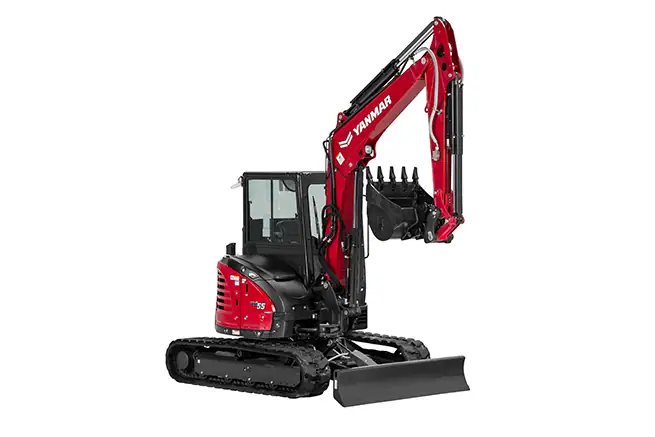
The Yanmar ViO55-6A belongs on a shortlist when an excavator must perform recurring rural excavation and meaningful attachment work while retaining a compact rear layout. Its turbocharged engine and documented auxiliary circuit make it a different proposition from a small access-only machine. The purchase still needs to be justified by the complete job: reaching the site, using the intended tool, moving spoil and transporting the equipped package.
For Canadian buyers, the important distinction is between a machine that can be equipped for a task and a machine actually offered with the equipment needed. This guide covers the North American ViO55-6A. Do not substitute specifications for a ViO55-6B or another market simply because the base model number is familiar.
On This Page
ToggleRead the four weight configurations separately
The July 2020 ViO55-6A brochure gives these references for the documented generation.
| Item | Published reference |
|---|---|
| Engine | 47.6 hp at 2,400 rpm; turbocharged four-cylinder diesel |
| Rubber tracks, canopy / cab | 11,850 / 12,247 lb operating weight |
| Steel tracks, canopy / cab | 11,916 / 12,313 lb operating weight |
| Auxiliary flow at 2,200 rpm | 82.8 L/min |
| Auxiliary flow at 1,200 rpm | 45.8 L/min |
| Track width, drawing L | 1,990 mm |
The brochure lists a slightly different blade-width reference in its specification table. That is a reason to measure the actual equipped width when access matters. It is not a reason to silently round both entries into one assumed dimension.
Make the attachment the starting point when it drives the purchase
If the machine is being bought primarily to run a powered tool, identify that tool before selecting the excavator package. Its permitted flow range, pressure, return requirements, mounting and carrier compatibility establish the brief. The ViO55-6A’s engine power is not the hydraulic output available at the attachment.
The two published flow entries show why engine-speed conditions belong on the comparison sheet. A tool evaluated against the higher figure should not be assumed to receive the same flow at a lower operating setting. Nor should the two values be used to invent a linear relationship across every engine speed and combination of movements.
For a breaker, auger or other powered attachment, obtain the complete approved installation scope. Include hoses, connectors, return and any drainage provisions, controls and commissioning. A quotation for the bare attachment is not equivalent to one for a working machine-and-tool package.
Yanmar’s ViO55-6A product page describes proportional auxiliary control, selectable single or double action and the availability of two auxiliary circuits. Confirm which circuits are installed on a used example. Visible connectors alone do not establish the full control or plumbing arrangement.
Test useful output rather than a large flow number
A demonstration should reproduce the task that makes the attachment worthwhile. Observe how the operator positions the tool, starts and stops its function, moves between work points and returns to ordinary excavation. Record the conditions and the completed result. A short unloaded run answers much less than a representative working sequence.
Separate active tool time from preparation and interruptions. A package may complete the powered portion quickly while spending more time arranging material or moving between locations. If the bottleneck is elsewhere, additional hydraulic capability may not change the job’s completion time.
For illustration, suppose a recurring task takes 20 minutes of tool work and 25 minutes of preparation and material handling. Reducing the tool portion by an assumed five minutes changes the total from 45 to 40 minutes, not from 20 to 15 for the whole job. These invented times are a planning example, not measured ViO55 performance. They show where a demonstration should focus.
Do not convert a brief observation into a promise about full-day production or fuel economy. Use repeated comparable work where the investment depends on those assumptions. Keep the manufacturer’s operating conditions and the attachment’s duty requirements central to the assessment.
Zero tail swing and the place where material goes
The compact rear layout can be useful beside buildings, boundaries or other equipment. It does not mean the entire excavator, including front equipment and load, stays within the track footprint. The site must still provide space for the actual movements and for people and supporting machinery to remain appropriately separated.
A common planning problem is selecting an excavator that fits beside a trench without deciding where the spoil will go. If material piles up where a loading machine needs to stand, excavation stops regardless of the rear layout. Draw the spoil and transport arrangement before judging whether the ViO55-6A’s compactness solves the job.
On a farm, the working area may be open but the route constrained by buildings or stored equipment. Moving a temporary obstruction can sometimes allow a more useful machine package. Conversely, an essential permanent restriction can justify accepting a different production compromise. Distinguish those cases before buying around the narrowest photographable gap.
The tail-swing comparison explains the clearance categories. The final plan must use the actual machine and fitted equipment.
Digging depth is only one part of the envelope
The working diagram presents different depth conditions. Use the appropriate labelled dimension and the required horizontal position rather than selecting the largest depth in isolation. The bucket must make a useful cut, retain material and leave the excavation, not merely touch its deepest point.
For repeated rural trenching or drainage work, identify the machine’s suitable standing positions and the excavation shape. Then check how much useful work can be completed from each position. Repositioning is not inherently a problem; its frequency and consequences determine whether it matters to the purchase.
Loading introduces another requirement. The bucket needs to clear the receiving edge and discharge in a useful location. A truck that can be positioned conveniently on one site may be restricted on another. Include the actual receiving equipment in a demonstration where loading is routine.
Use the depth and reach guide for the geometry questions. Lifting requires the matching load chart and configuration; neither digging force nor a maximum reach figure establishes the permitted suspended load.
The coupler, bucket and thumb form one package
The brochure describes a hydraulic quick coupler while retaining manual fitting and removal of its safety lock pin. Include that full process when evaluating tool-change convenience. A hydraulic label does not mean every step is completed from the seat.
Identify each bucket in a used bundle and check its interface, condition and intended task. A large finishing bucket and a digging bucket should not be valued as interchangeable alternatives. Choose around the required cut and material, then assess the complete movement and load implications.
The bucket selection guide helps separate width, capacity and mass. For a thumb, also check contact with the intended bucket, movement and stowed clearance. An attachment that physically connects may still be a poor working combination.
Published force values can use different coupler conditions. The current webpage and brochure do not provide a clean, consistent basis for every force comparison, so this guide does not select an unqualified best-looking figure. If that rating drives the purchase, resolve the exact configuration with the applicable manufacturer data.
Operator enclosure and seasonal work
The canopy and cab versions serve different ownership patterns. A machine used for occasional summer projects may place less value on an enclosure than one scheduled for long days through cold rain and shoulder seasons. Evaluate the actual cab equipment and condition instead of assuming that a cab in a listing is fully functional.
The manufacturer lists an enclosed cab with heat and air conditioning as an option in the cited brochure. Inspect visibility, doors, glazing and the relevant systems during the viewing. Their repair cost belongs in the purchase comparison just as undercarriage wear does.
Use the correct manual for starting, fluids and seasonal preparation. Frozen material may change the tool and excavation requirement, not merely the starting routine. Likewise, a route that is suitable in dry conditions may need reassessment during thaw. Track material cannot establish ground support.
Plan service access at the place where the machine will be maintained. Identify routine checks and the support available for repairs. No Canadian parts lead time or dealer stock is assumed here; obtain the actual arrangement that will support your machine.
Transport and ownership costs beyond the excavator
The operating-weight table helps identify configuration differences, but the real transport load includes the actual equipped machine and separately carried items. Establish what the reference includes, then account for the rest without double counting. The trailer and complete vehicle combination must suit the load and applicable requirements.
Physical layout matters too. Spare buckets, a powered tool and its associated equipment need suitable deck space and securement. A package that leaves essential tools behind is not operationally equivalent to one that brings everything required for the job.
Compare the full cost of putting each candidate to work: purchase, identified repairs, missing attachments, commissioning, delivery and any transport changes. Keep quoted costs separate from hypothetical time savings. A lower asking price can be outweighed by an incomplete attachment installation or an unsuitable hauling arrangement.
For occasional specialist work, compare hiring a complete carrier-and-tool package. Ownership can still be worthwhile for convenience, but a tool used once a year should not be assigned the same financial justification as one used every week.
Keep a record of which bucket and coupler were fitted during any demonstration. A later substitution can change the package being evaluated, even when the excavator itself is unchanged. The delivered equipment list should match the basis of the purchase decision.
Used ViO55-6A inspection and alternatives
Verify the suffix, serial identity, enclosure, tracks, coupler and auxiliary installation. Review service records and have structural repairs, joint wear, undercarriage condition and hydraulic concerns assessed by a competent inspector. These are general purchase checks, not claims of a recurring model defect.
Demonstrate the features central to your buying brief after normal warm-up. If the powered attachment has not been tested appropriately with the machine, retain that as an unresolved requirement. A successful bucket demonstration cannot answer every attachment question.
The Yanmar ViO50-6A and Takeuchi TB250-2 guides offer comparison starting points. Compare the actual working package, not just neighbouring size labels or engine output.
Is the ViO55-6A interchangeable with the 6B?
No such assumption should be made. Use the exact generation and market documentation for specifications, parts and attachment matching.
Does the higher flow figure apply at low engine speed?
The cited figures have stated rpm conditions. Match the intended operating setup rather than applying one maximum everywhere.
Does hydraulic coupling remove the safety-pin step?
Not for the system described in the cited brochure. Follow the installed coupler’s complete procedure.
Which width should I use for a tight gate?
Measure the widest part of the actual configured machine and assess the approach. Do not resolve conflicting brochure references by choosing the smaller value.
What is the strongest reason to choose this model?
A documented match between recurring excavation or attachment work and a practical access, service and transport package. The specification numbers support that decision; they do not replace it.
Share your experience
Help other Canadian buyers — leave a quick review for the
Yanmar ViO55-6A
There are no reviews yet. Be the first one to write one.