Overview & Specs
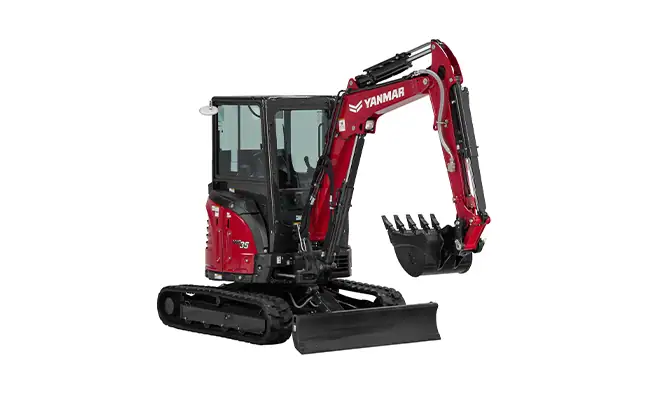
The Yanmar ViO50-6A is a compact zero-tail excavator for buyers whose recurring work has outgrown the compromises of a smaller machine, while still requiring a manageable footprint around buildings and rural sites. The decision is less about owning a nominal five-tonne-class excavator than about obtaining a complete package that can dig, place material and work with the intended attachments without forcing an unsuitable transport arrangement.
For Canadian acreage contractors and farm owners, that means separating routine excavation from occasional exceptional jobs. A larger compact machine can be attractive for repeated work, but it should not be purchased on the assumption that every heavy lift, deep trench or rock-removal task will fit. This guide addresses the North American ViO50-6A documented by Yanmar, with the dated brochure used to keep configuration and measurement conditions clear.
On This Page
ToggleThe dimensions and weights worth recording
The reference below comes from the July 2020 ViO50-6A brochure. Its date identifies the source; it is not a claim that every machine advertised today has identical equipment.
| Item | Brochure reference |
|---|---|
| Engine output | 39 hp at 2,400 rpm |
| Track width / blade width | 1,940 / 1,970 mm |
| Rear swing radius | 970 mm |
| Rubber-track operating weight, canopy / cab | 10,417 / 10,792 lb |
| Steel-track operating weight, canopy / cab | 10,703 / 11,078 lb |
| Depth A / blade-down depth B | 3,550 / 3,740 mm |
| Auxiliary flow reference | 79.5 L/min at 2,200 rpm |
These figures deliberately retain their labels. The blade is wider than the tracks, and the larger depth belongs to a different diagram condition. Neither detail should disappear when the machine is reduced to a short advertisement.
Why the blade width matters at a narrow entrance
Access planning often starts with track width because the tracks are easy to see. On this documented configuration, the blade adds 30 mm to the total width. That difference is small in an open yard but can matter when a buyer has allowed almost no margin through an opening. Measure the actual equipped machine rather than treating the track dimension as the complete clearance envelope.
The rear radius equals half the published track width in the basic plan-view geometry. That explains the zero-tail layout, but it does not mean the front equipment or a carried object remains within the tracks. Establish clearance for the complete movement needed at the work position, including where the bucket will empty and where any other machine will approach.
At a farm building, a clear doorway may lead immediately into a restricted turn. The entire approach needs to work, not just the narrowest straight section. Also account for overhead obstructions and the approved travel posture. A site sketch with the machine, attachment and spoil locations is more informative than a single gate measurement.
The comparison of excavator tail layouts provides more context. Zero-tail design solves a particular rear-clearance problem; it does not replace a complete work-area plan.
Match the machine to repeated excavation, not a size label
List the work that will occupy the excavator over a normal season. Repeated utility excavations, drainage repairs and site preparation have different demands from occasional landscaping or one large construction project. Record the required excavation dimensions, access and attachment needs for the recurring work before looking at the exceptional job.
A useful comparison with a smaller excavator asks where that smaller package would lose time or become unsuitable. It may require more repositioning, a different bucket strategy or more separate material handling. Those are job-specific possibilities, not an assumed productivity percentage. Demonstrate the relevant task or evaluate it from the working diagrams and actual site layout.
For an illustrative rural repair, the decisive limitation might be the space to place spoil rather than digging force. If that space is constrained, a larger bucket can create a handling bottleneck sooner. The equipment plan may need a separate spoil-removal method, not simply a larger excavator. This is why the entire work sequence belongs in the purchase decision.
Read the working diagram at the point you need
The maximum depth describes one part of the envelope. Useful trenching also depends on horizontal position, bottom geometry and the required setback from the excavation. A machine selected with almost no margin at the deepest point may be awkward for the surrounding work even when it can technically reach that point.
Mark the intended machine location and the near and far limits of the excavation. Then assess whether the required bucket movement fits the diagram. Include the dumping or loading position. Repositioning may be entirely acceptable on occasional work, but repeated changes of setup can become a meaningful cost when the same task occurs every week.
The depth and reach guide explains how to avoid mixing maximum-depth and reach-at-depth claims. Keep suspended-load work separate: a digging envelope does not establish a lifting allowance. Use the applicable chart with the actual attachment, radius and machine configuration.
Hydraulic attachments: define the complete requirement
The auxiliary flow reference provides a useful starting point for matching tools, but it is tied to the stated engine speed. A tool must also match pressure limits, return requirements, any case-drain provision, mounting geometry and permitted mass. A larger flow figure alone is not evidence that a particular attachment is approved or will perform as intended.
Prepare a written attachment inventory before inspecting a machine. For each tool, record the manufacturer and model, connection arrangement, hydraulic requirements and the function it must perform. Then compare that with the excavator’s installed circuit. This is especially valuable when a used machine carries aftermarket plumbing or when attachments are being retained from another excavator.
Yanmar’s ViO50-6A product page lists an optional second auxiliary circuit. Confirm its presence and purpose on the offered machine. Additional connectors do not, by themselves, prove that a complete separately controlled circuit exists or that it meets the requirements of a multi-function attachment.
If a powered attachment is central to the purchase, obtain a suitable demonstration of the complete combination. Observe control, positioning and the documented operating conditions. Avoid treating a short unloaded run as proof of sustained performance in difficult material. If the tool has not been assessed with the machine, leave that compatibility question open rather than valuing it as resolved.
Bucket, coupler and thumb should work together
Yanmar describes hydraulic quick coupling with manual handling of the safety lock pin. The complete retention procedure remains part of each change. Inspect the coupler actually fitted and the compatibility of every bucket included in a sale, rather than assuming that an original brochure describes later-installed equipment.
Bucket choice should start with the excavation shape and material. A wide finishing bucket is not automatically an appropriate digging bucket, and a narrow bucket is not automatically the economical choice for a broad excavation. The bucket width and capacity guide separates these decisions.
If a thumb is fitted, assess its movement with the actual bucket. Useful gripping requires compatible geometry and suitable control, not merely the presence of opposing teeth. Added equipment also belongs in the machine’s weight and lifting assessment. The thumb selection guide can help decide whether the intended work justifies a particular arrangement.
Digging-force figures also need consistent attachment conditions. This guide does not combine differently qualified brochure and webpage values into a single rating. When force is important to a comparison, use the same reference basis and then consider the actual bucket and task.
Operator station, blade and track choices
The manufacturer lists cab heating and air conditioning, a four-way blade and other equipment choices for this model. Identify what is actually installed. A cab in an advertisement is not proof that every comfort function works, and the model name does not establish a particular blade package.
For Canadian seasonal work, evaluate the operator station at the time and duration of use you expect. Repeated cold or wet days make visibility and functional enclosure equipment more relevant than occasional fair-weather use. Inspect doors, glazing, controls and the condition of the supplied systems. Repairing neglected operator-station equipment can be part of the real purchase cost.
Track selection should follow the surfaces and exposure. Rubber can be useful where finished surfaces form part of the route, but it does not guarantee no marking or ground disturbance. Steel requires its own assessment around paving and other sensitive areas. Neither material proves that soft ground will support the excavator.
Consider the finishing stage before selecting a blade option. Determine the passes you need to make and where loose material will be located. Additional movement may be useful, but it cannot compensate for a work area that leaves no sensible final exit or material route.
Transport may be the decisive ownership constraint
At this size, an apparent bargain can become a poor fit if the equipped machine requires a substantially different transport arrangement. Start with the relevant operating-weight entry, then establish the actual load with fitted and carried equipment. Include the trailer and every additional tool when assessing the complete vehicle combination and applicable requirements.
Check loading geometry and deck layout as well as mass. The front equipment’s transport position, ramp suitability, securement arrangement and space for spare attachments all need to work together. A machine that fits only by leaving essential tools behind is not the same operational package as one that arrives ready for the full job.
Obtain these answers before comparing purchase prices. Transport changes, missing buckets and required repairs can reverse the apparent ranking of two listings. Use documented costs for your situation rather than assuming a universal ownership cost per hour.
Inspecting a used ViO50-6A
Verify the exact model and serial identity and obtain available service records. Inspect undercarriage components, joints, cylinders and hoses, then examine any added hydraulic equipment. Look for evidence that modifications are documented and suitable for the intended attachments.
Have the machine demonstrated after normal warm-up in an appropriate area. Include controlled positioning and the functions you plan to use, not only a quick travel pass. If the included attachments are a significant part of the price, demonstrate their fit and operation too. Record unresolved observations and obtain independent assessment where necessary.
These are purchase checks, not a list of alleged model-specific failures. The useful outcome is an estimate of the cost to bring the machine into the condition your work requires. A lower-hour machine with missing equipment or uncertain repairs may not be the better value.
Alternatives and remaining questions
The Takeuchi TB240 guide offers a smaller compact-machine reference for buyers deciding how much excavator their routine work needs. Compare work envelopes and equipped packages rather than assuming that a smaller transport burden or a larger machine always wins.
Can I use track width as overall access width?
Not on the documented ViO50-6A configuration: the blade is wider. Measure the actual package and allow for the approach and required operating clearances.
Does zero tail swing allow work directly against any wall?
No. The front equipment, load, site conditions and complete machine setup still need clearance. The rear layout is only one part of the assessment.
Is a second auxiliary circuit included automatically?
No. It is listed as an option. Verify the installed plumbing and controls against the attachment requirements.
Which depth should I compare with another excavator?
Use matching diagram definitions and operating conditions. Keep the normal and blade-down references distinct rather than selecting whichever number is larger.
When would hiring a larger excavator be preferable?
When an exceptional task exceeds the appropriate work envelope or handling capability, compare specialist hire with changing the everyday machine and transport package. The occasional exception need not dictate the equipment used for every routine job.
Share your experience
Help other Canadian buyers — leave a quick review for the
Yanmar ViO50-6A
There are no reviews yet. Be the first one to write one.