Overview & Specs
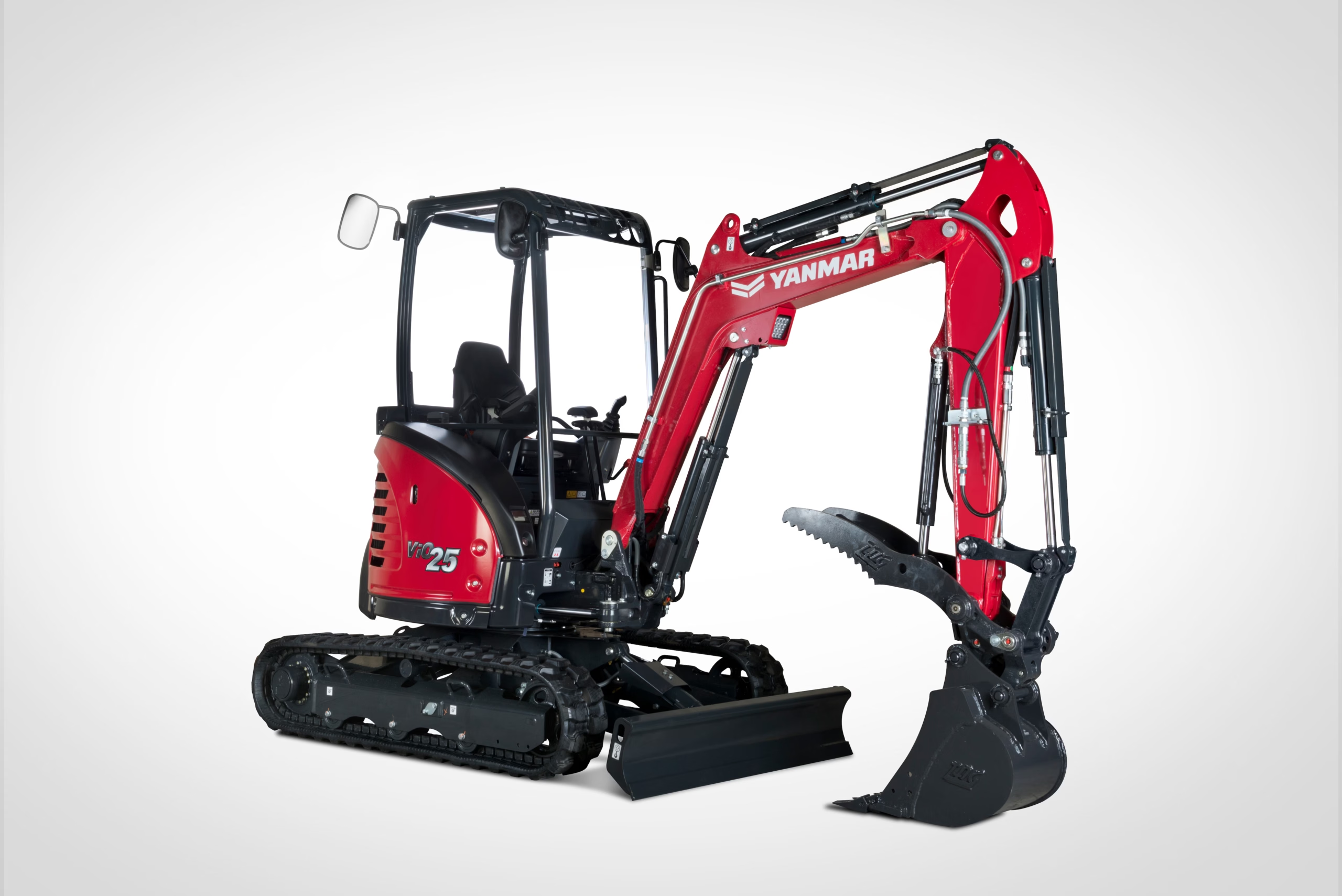
The Yanmar ViO25-6B suits buyers who want a compact excavator for a succession of small digging, grading and attachment jobs, rather than a machine selected only for squeezing through the narrowest gate. Its fixed footprint makes access a straightforward pass-or-fail measurement. Once on site, the more interesting question is how well the supplied bucket, coupler and hydraulic controls support the sequence of work.
For a Canadian property-maintenance business or an acreage owner, that sequence might include opening a short trench, changing buckets for backfilling and finishing a disturbed area. A useful purchase handles those transitions without leaving a weak link in the package. This guide addresses the North American ViO25-6B, using its dated manufacturer brochure and product page; specifications for a ViO25 carrying another suffix should be checked independently.
On This Page
ToggleA compact specification with important configuration choices
Yanmar’s July 2022 ViO25-6B brochure provides the reference figures below. The four weight entries are useful because a cab and track choice are part of the machine specification, not cosmetic differences.
| Reference | Brochure figure |
|---|---|
| Engine output | 20.4 hp at 2,500 rpm |
| Track and blade width | 1,500 mm |
| Digging depth, dimension A | 3,050 mm |
| Rubber tracks, canopy / cab | 5,908 / 6,140 lb operating weight |
| Steel tracks, canopy / cab | 6,151 / 6,383 lb operating weight |
| Auxiliary flow reference | 53 L/min at 2,500 rpm |
The product webpage contains a different metric depth entry; this guide retains the dated brochure’s figure rather than combining inconsistent values. For a purchase, match the documentation to the serial-numbered machine and its installed equipment. A small discrepancy matters when a proposed job has almost no dimensional margin.
Start with a 1,500 mm access plan
Unlike an expandable-track access strategy, the documented ViO25-6B footprint gives you one basic width to accommodate. Measure the route at its tightest point and include space for the actual approach. A passage that clears the tracks in a straight line may still be impractical if a wall forces an immediate turn. Account for the blade, overhead clearance and the machine’s transport posture as well.
The zero-tail layout is useful near boundaries, but it does not make the entire excavator rotate within a protected cylinder. Front equipment, hoses, attachments and anything being handled need their own clearance. Establish where the operator will place spoil before the machine enters a confined work area. That often determines whether the work can proceed continuously or requires another machine to remove material.
On a farmyard project, the access restriction may be temporary rather than structural: stored implements, feed deliveries or a parked trailer can occupy the best approach. Moving those obstacles before mobilisation may be cheaper than buying a smaller excavator for every future job. Compare the cost of changing the site arrangement with the operational compromise of changing machine size.
The coupler is part of the work cycle
The ViO25 product page describes a hydraulic quick coupler, but also specifies manual fitting and removal of the safety lock pin. That qualification is essential. A hydraulic mechanism should not be read as a promise that every tool change is completed entirely from the seat.
Think through a complete change between a trenching bucket and a finishing bucket. You need a suitable place to set down the first attachment, access to the locking arrangement, a compatible second attachment and a proper engagement check. A cramped work area or poorly arranged bucket storage can erase much of the convenience of a faster coupling mechanism.
When evaluating a used machine, identify the coupler actually fitted. Confirm the bucket interface and inspect the locking components, rather than assuming that an original brochure describes equipment installed years later. A package with several buckets has little extra value if they do not fit correctly or if one lacks the required retention hardware.
Make the inspection practical: lay out the included attachments and have the seller demonstrate the prescribed change procedure in a suitable area. Note whether hoses interfere with bucket movement and whether the arrangement remains visible enough for the required checks. This is a more informative comparison than counting attachments in an advertisement.
Choose buckets around the finished excavation
The most useful bucket is the one that creates the required excavation with manageable material handling. For a narrow service trench, extra width increases the volume removed and subsequently replaced. For a broad excavation, a bucket chosen solely because it looks gentle on the machine may require many unnecessary passes. Soil condition and the approved bucket size also belong in the decision.
Imagine two illustrative tasks: exposing a short existing line and forming a wider shallow planting area. The first rewards careful placement and a controlled excavation width; the second may reward a different bucket and a different machine position. Neither task can be evaluated from maximum digging depth alone. The excavator bucket selection guide provides a framework for separating width, volume and purpose.
Finishing is another distinct stage. A smooth final surface depends on position, material condition and control, not simply on fitting a wide bucket. Include the last part of the job in a demonstration. A machine that opens the excavation satisfactorily but cannot work comfortably in the remaining space may leave more hand work than expected.
What the auxiliary circuit needs to do
Yanmar describes proportional auxiliary control and a selectable single- or double-action arrangement on its North American product page. These features are relevant when the machine will alternate between hydraulic tools with different operating needs. They do not remove the need to match each tool’s circuit requirements to the equipped excavator.
List the attachment manufacturer’s permitted flow and pressure, required return arrangement, any case-drain requirement, mounting interface and mass. Then compare that list with the excavator’s documented circuit and installed plumbing. A suitable flow range does not prove that the connectors, return path or control response are suitable. Nor should maximum pump output be substituted for available attachment flow.
For a thumb, decide how often you need to reposition its grip during the work. An occasional positioning task and repeated sorting of varied material have different control demands. Read mechanical and hydraulic excavator thumbs before valuing a thumb as an automatic upgrade. Its geometry with the supplied bucket matters as much as its presence.
For an auger or other powered tool, arrange a demonstration with a properly matched attachment if that tool is central to the purchase. Observe starting, stopping and positioning at the intended settings. Avoid turning a brief no-load demonstration into a claim about production in your soil or sustained performance through an entire working day.
Cab, canopy and tracks: buy the working package
The weight table shows why comparing all ViO25-6B listings as identical machines is misleading. A cab and a canopy serve different operating patterns, while steel and rubber tracks involve different surface and transport considerations. Evaluate the equipment supplied on the particular machine, including the condition of doors, glazing and weather protection where fitted.
For Canadian shoulder-season work, operator comfort can affect the practicality of a job that is technically within the excavator’s capabilities. Consider how long the operator remains seated, how often they get out for tool changes and whether visibility can be maintained in the expected conditions. An enclosure is valuable only when its condition and equipment support that use.
Track choice should reflect the surfaces you actually cross. Rubber does not guarantee undamaged lawns or paving, and steel should not be selected without considering finished surfaces along the route. A machine working mostly on one site may have a different compromise from a contractor moving daily between established properties. Include restoration work and access protection in the ownership estimate.
Depth, reach and site layout
Use the working diagram to assess where the bucket can operate relative to the excavator. The listed maximum depth is not a promise of a useful flat-bottom working area at that depth. If the machine must stay back from an edge, horizontal reach becomes part of the same decision. The site arrangement must also allow safe access and any required excavation protection.
A useful pre-purchase exercise is to draw one recurring job to scale. Mark the machine position, required excavation, spoil area and loading point. Look for the movement that forces repositioning. Sometimes an extra change of position is perfectly acceptable on occasional work; sometimes repeated repositioning makes a compact machine a poor production choice. The distinction is frequency, not a blanket judgement about machine size.
Aglist’s guide to excavator depth and reach explains the drawing terms. Object placement still requires its own lift-chart assessment; digging reach cannot be used as a lifting approval.
A used-machine inspection focused on the whole package
Begin with identity and service records, then inspect the components that connect the excavator to its work. Look at bucket pins, the coupler, hoses and the condition of included tools. Excess movement at several joints can make finishing difficult even if the engine starts readily. These are general inspection considerations, not documented model-specific failure claims.
Inspect the undercarriage beyond the visible tread or shoes. Rollers, idlers, sprockets and tensioning components can change the repair budget substantially. Ask an independent inspector to assess condition where you cannot reliably distinguish normal wear from a component approaching replacement. Compare written repair allowances rather than vague assurances that everything is serviceable.
During a controlled demonstration, include low-speed positioning, a bucket change and operation of any hydraulic attachment included in the sale. Record which functions were actually demonstrated. A working auxiliary connector in a photograph does not establish that a complete attachment circuit has been tested under suitable conditions.
Compare ownership against the jobs you repeat
A smaller access-oriented machine such as the Takeuchi TB216 and a larger package such as the Takeuchi TB240 provide useful reference points for a shortlist. Their guides address different compromises; neither is automatically a direct equivalent to the ViO25-6B.
Compare the same job package across candidates: fitted bucket, second bucket, required hydraulic tool, transport and surface restoration. Separate quoted purchase costs from estimates of your own time. If most work consists of brief varied jobs, reliable setup and tool compatibility may matter more than the advantage a larger excavator offers on sustained bulk excavation.
Frequently asked buying questions
Is the ViO25-6B a narrow-gate excavator?
Only when the actual route accommodates its documented width and operating clearances. Do not budget for a retractable undercarriage that is not part of this specification.
Can hydraulic coupling eliminate every exit from the seat?
No. The manufacturer’s safety-pin requirement remains part of the procedure. Plan attachment storage and changes around the full prescribed process.
Can I order a replacement bucket by excavator weight class?
That is only an initial search filter. The mounting geometry, coupler compatibility, mass and approved use must also match. Obtain identification and measurements for the installed interface before ordering.
Does a cab version have the same transport weight?
No. Use the appropriate configuration as a starting reference, then establish the weight of the actual equipped load. Additional tools and trailer weight remain separate parts of the transport calculation.
What makes one used example better value?
A complete compatible attachment package, documented maintenance and sound working condition can outweigh a lower asking price. Compare the cost to put each machine into the same ready-to-work condition before deciding.
Share your experience
Help other Canadian buyers — leave a quick review for the
Yanmar ViO25-6B
There are no reviews yet. Be the first one to write one.