Overview & Specs
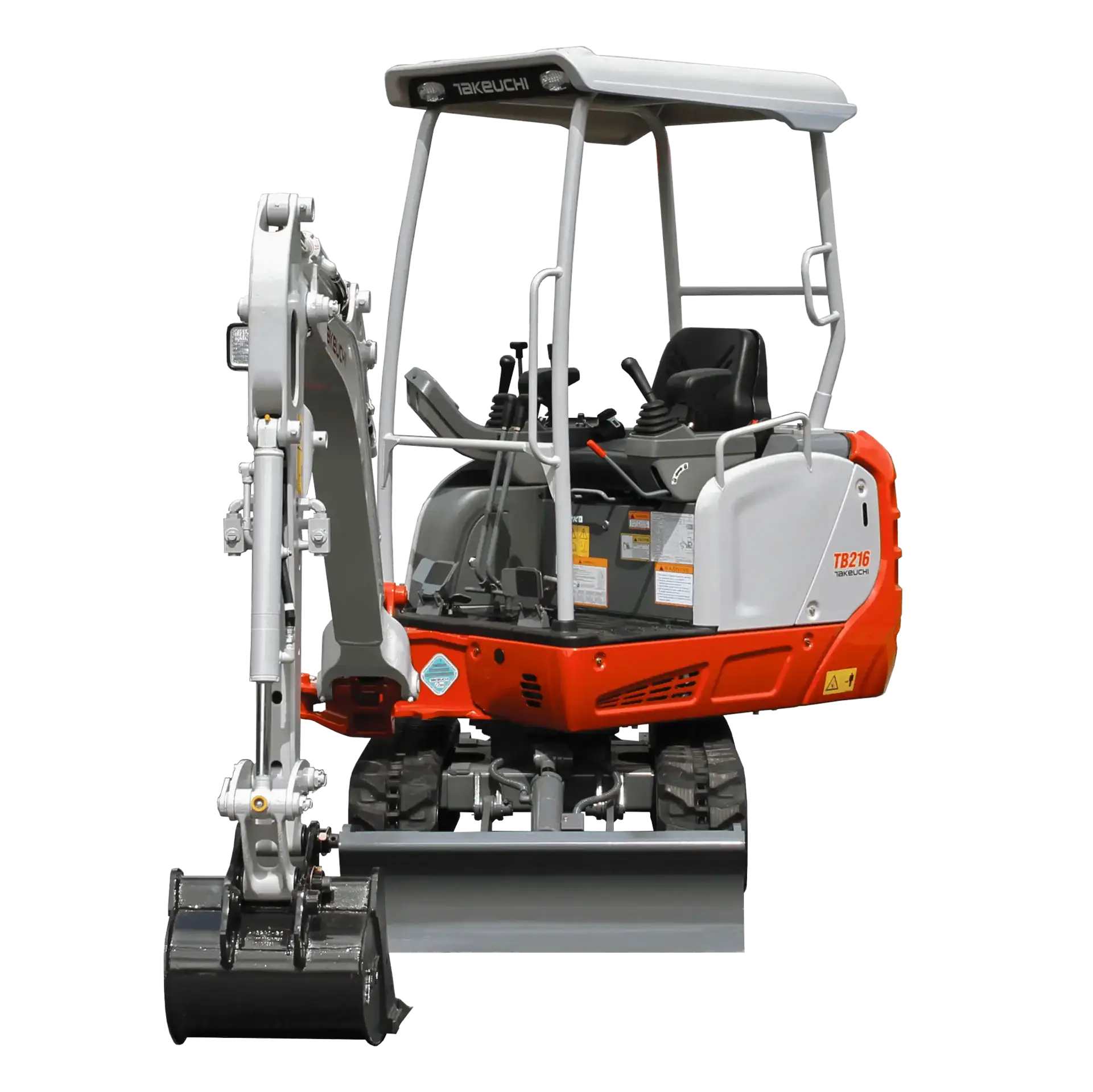
The Takeuchi TB216 is worth considering when getting an excavator to the work is harder than finding enough headline horsepower. Its retractable undercarriage can make a narrow route practicable, while the expanded track arrangement provides the configuration intended for the working area. That is a useful distinction for Canadian property owners and landscape contractors: access width and working setup are two separate decisions.
This guide concerns the diesel TB216, not the TB216H hybrid. It uses Takeuchi’s North American product page and the dated brochure currently linked from it. Some specifications differ between those sources, so the source date and actual machine identity matter. The aim is to help specify a workable package, not to treat every machine carrying the model name as identical.
On This Page
ToggleStart with the route, not the excavation depth
Measure the narrowest usable passage along the entire route. Gates are only one obstacle. Hinges, wall projections, turns, overhead features and the position of the carried bucket can determine whether the equipment reaches the job. An opening nominally wider than the tracks does not by itself establish a suitable passage.
The TB216’s advantage is that its track arrangement can change between access and work. The cited brochure lists 980 mm retracted width and 1,300 mm extended width. That 320 mm difference is significant when comparing possible routes, but it is not permission to excavate in the narrow configuration. Follow the applicable operating instructions for the actual machine and task.
Measure the destination too. There must be a suitable place to configure and operate the machine, handle excavated material and move supporting equipment. A machine that squeezes through the entrance but has no workable excavation and discharge arrangement has solved only the first part of the problem.
Which specifications apply?
| Reference | Published value | How to use it |
|---|---|---|
| Operating weight | 1,770 kg / 3,900 lb | Starting reference, not the weight of every equipped package |
| Retracted / extended track width | 980 / 1,300 mm | Distinguish access from working configuration |
| Maximum digging depth | 2,390 mm | One point in the working envelope |
| Maximum reach | 4,090 mm | Retain the brochure’s measurement label |
| Auxiliary hydraulic flow | 33.6 L/min in the 2018 brochure | Do not substitute total system flow |
The current North American TB216 page lists 15.4 hp, while the linked April 2018 brochure lists 15 hp and identifies a serial-number starting point. The brochure’s dimensional and hydraulic references above describe that document’s configuration. Confirm the corresponding data for the individual machine rather than merging the power figures into an unexplained specification.
Takeuchi’s North American dealer locator includes Canada. That establishes a route for finding support, not current stock, a Canadian price or proof that every regional option is available locally.
The rear still needs room
A retractable undercarriage does not make the TB216 a zero-tail-swing excavator. The brochure lists a 1,075 mm tail radius. The rear outline, front equipment and blade need their own clearance assessment through the intended movements. Do not confuse a small travel footprint with an unrestricted ability to turn beside structures.
A useful site sketch identifies where the tracks stand, where the excavation lies and where material will be discharged. Mark fixed obstacles and the route used by other equipment. This often reveals that the limiting problem is material removal or front-tool movement rather than the entrance itself.
On an acreage, that may mean separating a narrow-access digging stage from bulk material movement elsewhere. For a contractor, it may mean choosing a different machine for jobs whose working area is restricted even after entry. The TB216’s narrow-access capability is valuable when it solves a measured constraint, not as a substitute for a complete layout.
Depth, bucket movement and the finished cut
The maximum depth number is useful for screening, but the bucket must do more than touch a bottom point. It needs to cut, fill, curl, clear the excavation and discharge at a useful position. The working-range drawing describes a shape, not a rectangle combining maximum reach and maximum depth.
Identify the recurring excavation profile before deciding whether this machine is sufficient. Record the working points relative to the machine’s suitable standing position. Where the task lies close to the outer envelope, a representative demonstration or another equipment arrangement deserves consideration.
The Aglist depth and reach guide explains the measurement differences. Keep excavation design and suitable machine positioning separate from equipment geometry; a brochure cannot establish ground support, utility clearance or an acceptable trench arrangement.
For occasional deeper work, compare hiring another machine with owning a larger excavator all year. The larger option may offer capability that is seldom needed while making everyday access harder. Conversely, repeatedly stretching a small machine around an essential task can consume the very mobility advantage that justified buying it.
Bucket width can matter more than bucket count
A small excavator package is often advertised with several buckets. Start by assigning a job to each one. A narrow digging bucket, a wider excavation bucket and a finishing tool serve different purposes; three poorly matched tools are not automatically better than two suitable ones.
Consider a hypothetical rectangular excavation 15 m long and 0.5 m deep. At 0.3 m width its geometric volume is 2.25 cubic metres. At 0.45 m width it is 3.375 cubic metres, an additional 1.125 cubic metres before any bulking. These assumed dimensions are not an excavation design or a prescribed bucket choice. They show why excess cut width can create extra handling and restoration work.
The correct width must still satisfy the actual project and material requirements. Choosing the narrowest tool blindly can introduce other difficulties. Compare the permitted bucket arrangement, how it fills and empties in the intended material, and the finish required after digging.
For a used bundle, identify the bucket manufacturer, mounting arrangement and condition. Inspect the pin areas, cutting components and repair history with a competent evaluator. Uncertain mounting or badly worn tools should be priced as unresolved equipment, not counted at the value of a ready-to-use attachment.
Hydraulic attachments need a complete match
The brochure distinguishes 50.9 L/min total hydraulic flow from 33.6 L/min auxiliary flow. The smaller circuit-specific figure is the relevant starting point for an attachment supplied by that circuit. Neither figure alone establishes that a breaker, auger or other hydraulic tool is suitable.
Obtain the tool’s accepted flow range, pressure and return requirements, mounting information and carrier compatibility. Establish the controls and plumbing actually fitted to the machine. A connection that physically mates is not proof of a complete approved installation.
The dated brochure describes foot-operated auxiliary controls. Inspect the offered machine rather than assuming its control arrangement from another listing or from newer promotional language. A regular operator should demonstrate the intended approved task before the purchase decision depends on attachment productivity.
If a thumb is part of the plan, select it with the bucket and coupler. Useful contact, movement and stowed clearance all matter. The thumb selection guide provides a separate framework for that decision. A thumb mount on the arm does not mean the complete hydraulic package is included.
Mobility includes the time between jobs
A compact machine can be appealing to an owner who moves frequently, but transport should be evaluated from the complete equipment package. Establish the mass of the actual machine and the items included in its reference weight. Then account for separately carried buckets, coupler, thumb and other equipment without double counting.
The trailer and tow vehicle must suit the loaded arrangement and applicable requirements. Deck space, loading geometry, axle ratings and securement provisions matter alongside mass. An informal truck category is not a transport approval.
For a property owner whose excavator stays on one site, delivery can be compared with maintaining a hauling setup. For a contractor, record loading, unloading and travel as part of job time. A ten-minute gain in active digging is less meaningful if the chosen package adds much more preparation elsewhere.
Also plan where attachments are stored and how they arrive at the working area. Bringing a suitable bucket to site but leaving it inaccessible on a trailer can encourage using the wrong tool. A practical package includes an orderly tool-change and storage arrangement.
Canadian seasonal use and service access
The cited brochure describes a canopy machine. Consider the actual working season, weather exposure and session length before assuming it fits a year-round schedule. Avoid treating an improvised enclosure as equivalent to a manufacturer-approved cab package.
Use the serial-specific manual for fuel, fluids, starting and warm-up requirements. Frozen ground changes the excavation task as well as the ambient temperature. Ordinary published digging figures should not be read as a guarantee of performance in every winter material condition.
Inspect access to service points where the machine will be stored and maintained. Mud, snow and packed debris can make an otherwise simple inspection inconvenient. The buying demonstration should include opening the service panels and identifying routine checks, rather than focusing entirely on digging motion.
For remote properties, establish how filters, wear parts and repair support will be obtained. Ask for a practical support arrangement and local quotations where needed. This guide does not assume a particular parts lead time or operating cost simply from the brand name.
What to inspect on a used TB216
Begin with identity: serial number, equipment list and service records. Reconcile the offered machine with the dated specification document and distinguish it from a hybrid model. Confirm that the retractable undercarriage and adjustable blade components are present and function as specified.
Have undercarriage wear, linkage condition, visible leaks and structural repairs assessed by a competent inspector. Observe normal starting, warm-up and representative operation. Investigate an unusual symptom rather than assigning it to a known defect without evidence.
Pay attention to completeness. Missing blade-extension hardware, damaged attachment components or unclear coupler documentation can prevent the machine from delivering its intended access and tool-changing benefits. Obtain repair or replacement estimates before comparing the package with a more complete alternative.
No model-specific failure frequency or service-life claim is established here. The inspection is about the condition of the individual machine and whether its equipment suits your work. A low hour reading cannot answer those questions by itself.
Alternatives and a useful acceptance demonstration
The Bobcat E20 and Kubota U17-5 pages can help build a comparison list. Verify the exact generations and manufacturer configurations before comparing dimensions. Do not assume equivalent capability because machines occupy a similar broad size category.
A useful TB216 demonstration follows the actual buying brief: access route, appropriate working setup, representative excavation, discharge and return to transport. Record any supporting equipment and interruptions. The result should explain why the machine fits the job, not simply show that its controls move smoothly.
Frequently asked questions
Is TB216H the same machine?
No. Keep the diesel TB216 and hybrid designation separate when checking specifications, equipment and service documentation.
Does the 980 mm width describe normal digging setup?
It describes the cited retracted track width. Use the operating instructions for the required working configuration and assess the whole fitted machine.
Can I use the largest included bucket for every task?
Choose a compatible tool around the material, finished cut and complete working cycle. Extra volume is useful only when it produces useful work without creating other limitations.
What should a quote identify beyond the machine?
List the exact buckets, coupler, hydraulic provisions, thumb if required, delivery and any missing equipment. Include the documents needed to verify the offered configuration.
When is a different machine the better decision?
When an essential recurring task exceeds the TB216 package’s practical envelope, or when a different layout completes the work with fewer consequential compromises. Access is a strong reason to shortlist it, but the entire job decides the purchase.
Share your experience
Help other Canadian buyers — leave a quick review for the
Takeuchi TB216
There are no reviews yet. Be the first one to write one.