Overview & Specs
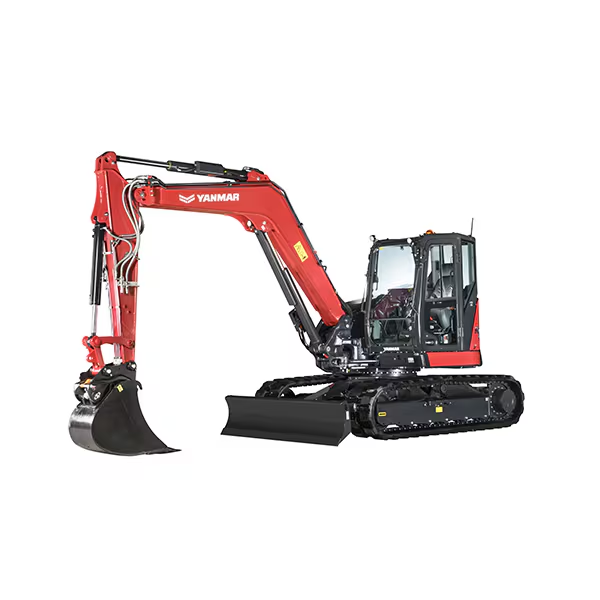
The Yanmar SV100-7 is a compact-excavator purchase that should begin with the job’s logistics. Its larger working package can be useful for sustained rural excavation and loading, but the machine, receiving vehicles, attachments and transport arrangement must all fit together. For a Canadian contractor or farm owner, buying more excavator is worthwhile only when the rest of the operation can use that capability.
The SV100-7 uses an ultra-tight-tail layout rather than a true zero-tail arrangement. That distinction matters on developed sites, especially where a buyer is comparing it with a smaller machine that keeps its rear housing within the tracks. This guide covers the North American SV100-7 and does not transfer specifications from the earlier SV100-2A.
On This Page
ToggleReference specifications for the offered configuration
Yanmar’s October 2023 SV100-7 brochure gives these starting references.
| Item | Published reference |
|---|---|
| Engine output | 72 hp at 2,100 rpm |
| Cab, rubber-track operating weight | 21,671 lb |
| Cab, steel-track operating weight | 21,914 lb |
| Overall track / blade width | 2,320 mm |
| Rear swing radius | 1,365 mm |
| AUX1 / AUX2 at 2,100 rpm | 100 / 70 L/min |
| Digging depth, diagram A | 4,570 mm |
These values retain their configuration and measurement labels. Operating weight is not the full trailer load, auxiliary entries are not a promise of summed flow, and a maximum depth does not describe useful reach at every position.
Rear clearance: compact does not mean no overhang
Half the listed track width is 1,160 mm. Comparing that with the 1,365 mm rear radius gives a simplified difference of 205 mm beyond the track edge. This illustrates the distinction between tight tail and zero tail; it is not a prescribed safe clearance.
The actual working arrangement must account for terrain, installed equipment and the nearby obstacle. Do not plan to rotate against a boundary using only the arithmetic difference. The front equipment and handled material create additional swept space.
For a farmyard project, mark the excavator position, loading vehicle and access route on the same sketch. A machine may clear a building while preventing the next truck from reaching the loading point. That is a logistics problem even when the rear housing itself has enough room.
The tail-swing guide helps distinguish the layouts. Use it to frame the comparison, then assess the exact SV100-7 package and site.
Can the rest of the operation keep up?
A larger excavator is not automatically the answer to a slow excavation job. Identify whether the delay comes from digging, repositioning, loading, truck availability or finishing. The machine change should address a recurring limitation rather than simply increase a specification.
Consider an illustrative loading operation where the excavator waits between receiving vehicles. A faster digging cycle may finish each load sooner but create more waiting if the haul cycle is unchanged. Improving vehicle positioning or scheduling could be more useful than purchasing a larger bucket.
On another job, the opposite may apply: the receiving equipment is ready, but a smaller excavator requires repeated repositioning or struggles to complete the necessary working movement. A larger package could then solve a genuine constraint. Demonstrate the full sequence under comparable conditions before assigning a financial value to the change.
Record completed useful work, not just the number of bucket cycles. Bucket fill, unwanted excavation and material left for cleanup affect the result. The comparison should end with the required job finished, including restoration where applicable.
Depth and loading reach must be assessed together
The published depth is one point in a shaped working envelope. The excavator also needs horizontal reach from suitable standing positions and a workable path for cutting, curling and extracting the bucket. A task close to the boundary requires more specific assessment than a simple subtraction from maximum depth.
Mark the required excavation points relative to the machine’s reference level and position. Keep the project’s elevation reference explicit. Then check the movement to the spoil pile or receiving vehicle. Maximum excavation depth and maximum loading height cannot be assumed to occur at the same horizontal distance.
For truck loading, include the actual body height and the useful placement of material. Clearing the near edge is only the first requirement. If the truck must repeatedly move to distribute the load, that movement belongs in the time comparison.
Aglist’s depth and reach guide explains the diagram terms. It does not replace site planning or establish suitable machine positions near an excavation.
Hydraulics: keep the carrier and attachment requirements separate
The SV100-7 product page describes a two-pump load-sensing hydraulic system, proportional auxiliary controls and a cab with a seven-inch display and side and rear cameras. These features should be evaluated in the intended work sequence rather than converted into an assumed percentage improvement.
For a hydraulic tool, identify the supplying circuit and the tool’s accepted flow, pressure, return and drainage requirements. Include mounting, mass and control needs. The two auxiliary ratings are separate references; adding them does not establish that the combined amount is available to one attachment or during every simultaneous movement.
Ask for the complete installed arrangement in the quotation. Plumbing, connectors, controls and commissioning can distinguish a ready-to-work package from a machine that merely has the potential to run the tool. A powered attachment can connect mechanically while still lacking a required hydraulic provision.
A representative demonstration should include transitions between the attachment task and ordinary machine movement. Record the configuration and settings used. A brief unloaded operation is not evidence of sustained performance in the actual material.
Bucket selection should follow the excavation and haul plan
A larger nominal bucket is valuable only if it moves useful material efficiently and suits the approved machine configuration. Excess width can produce more excavation, spoil and backfill than the project requires. An unsuitable profile can also make filling or emptying less effective.
Start with the finished excavation dimensions and material, then select the bucket and assess the complete cycle. The bucket width and capacity guide explains why volume and payload are different questions.
If a thumb or other handling tool is part of the package, assess its interaction with the actual bucket. Useful contact, movement and stowed clearance all matter. The ability to grip an object does not establish an approved lifting operation.
Use the correct lifting chart for the machine, position and configuration where lifting is required. Do not substitute bucket breakout force, operating weight or engine power. This guide does not infer lifting allowances from the numerical examples in the brochure.
Coupler identification and operator handover
The brochure lists a double-lock quick coupler. Establish the exact installed unit and its prescribed operation, including the retention checks. Do not apply a procedure remembered from an older SV100 or a different manufacturer’s machine.
Include every supplied attachment in the acceptance process. Identify the interface, inspect condition and confirm compatibility. A photograph showing a bucket hanging from the coupler is not a complete demonstration of correct retention or approved use.
For a shared machine, keep the attachment identities and relevant setup information with the equipment records. A clear handover helps operators distinguish a familiar-looking tool from one with different requirements. It also makes later replacement and service work easier to specify.
Cab equipment matters on longer working days
When the excavator is expected to work for extended periods, the operator station becomes part of the production assessment. Evaluate visibility of the actual task, control reach, seating and display readability. Cameras can support awareness, but they do not remove the need for appropriate procedures and separation around the machine.
For Canadian cold or wet conditions, inspect the installed climate and visibility equipment. Doors, glazing, washer and defroster condition can affect whether a cab delivers its expected value. Include repairs in the comparison rather than treating the enclosure as automatically complete.
Do not assume a fuel-saving percentage from the presence of ECO or load-sensing features. If fuel use matters financially, compare equivalent completed tasks and relevant operating conditions. Idle time and supporting logistics may matter as much as active digging.
Transport should be priced before the purchase decision
The SV100-7’s documented operating mass makes delivery a central ownership question. Establish the actual equipped load, including tools and any options, and evaluate the complete hauling arrangement and applicable requirements. An informal machine size category is not enough.
Check deck space, loading geometry and securement provisions alongside ratings. A package with several attachments needs a practical way to carry and unload them. If a second trip or different trailer is required, include that in the cost and schedule comparison.
A farm keeping the machine on one property for long periods may favour contracted delivery. A contractor moving between small jobs may assign much greater weight to mobilisation. The same excavator can be a sensible purchase in one pattern and inconvenient in the other.
Obtain quotations for the complete ownership change before deciding that the excavator itself is affordable. Transport, missing attachments, identified repairs and commissioning can materially change the total investment.
Used SV100-7 inspection
Verify the model suffix and serial identity first. Record the tracks, coupler, hydraulic circuits and cab equipment, and match them to the applicable documents. Do not use an earlier SV100-2A specification to fill a gap in a shortened listing.
Have the undercarriage, front joints, structure and hydraulic system assessed by a competent inspector. Review service history and inspect any modifications or repairs. These are general inspection priorities, not claims of a known recurring SV100-7 fault.
Include cameras, display and the attachment controls in a suitable demonstration after normal warm-up. Record functions not tested and obtain estimates for unresolved work. A low hour reading does not establish that all systems are functional or that the machine was maintained appropriately.
Yanmar describes maintenance access and telematics capabilities. Inspect the physical service access and confirm the support and account arrangements actually available to the buyer. New-sale promotional terms should not be assumed to transfer automatically to a used purchase.
Alternatives and final buying questions
The Takeuchi TB250-2 and Yanmar ViO50-6A guides provide smaller-package reference points. They are not direct equivalents; they help test whether routine work truly requires the larger investment and transport commitment.
Is the SV100-7 zero tail swing?
No. Treat its ultra-tight-tail description as a compact rear layout with an actual clearance requirement.
Can a larger bucket solve slow loading?
Only if bucket performance is the real constraint and the tool is appropriate. Truck availability, positioning and material behaviour can dominate the cycle.
Does 100 L/min describe every operating condition?
The brochure states a circuit and engine-speed basis. Match the tool to the documented conditions and required simultaneous functions.
Should I choose rubber or steel tracks?
Assess the working surfaces, access route and approved configuration. Neither material establishes ground support or guarantees freedom from surface damage.
What is the most useful acceptance test?
The complete recurring job sequence with the quoted attachments and an appropriate receiving arrangement. It should demonstrate why the larger package is needed and identify any remaining limitations before purchase.
Share your experience
Help other Canadian buyers — leave a quick review for the
Yanmar SV100-7
There are no reviews yet. Be the first one to write one.