Overview & Specs
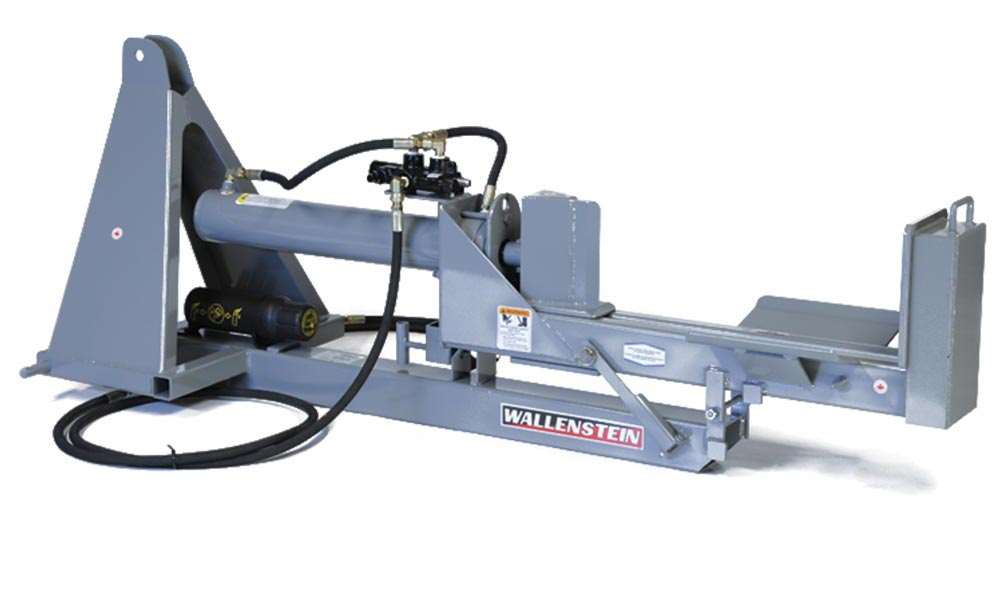
The Wallenstein WX370 is a tractor-mounted hydraulic log splitter for owners who want both horizontal and vertical working positions without adding a separate engine to the base splitter. Its useful distinction is that the same attachment can accommodate different round-handling routines. The decision is whether those two positions solve a real recurring problem and whether the tractor supplies the correct hydraulic circuit, flow and pressure.
A twenty-ton label is not enough to establish that fit. Nor is a quick-coupler connection or a tractor horsepower figure. This guide uses the Canadian WX370 page and May 2019 operator manual, checked in October 2026, and keeps an important valve-description inconsistency visible rather than silently choosing one version.
On This Page
ToggleHorizontal and vertical positions address different movements
In horizontal work, rounds must arrive at the splitting bed in a manageable way. That can suit a planned station with material at a convenient receiving level. In vertical work, the positioning routine changes and may avoid lifting a heavy round onto the horizontal bed. It does not remove the need to position, turn and clear material correctly.
Look at a representative batch before deciding how valuable the change of orientation will be. If almost every round is manageable in one position, switching capability may be occasional convenience. If the batch regularly includes pieces better handled in different ways, it may be central to the purchase.
Compare the horizontal WX310 on that basis. The WX370 is not automatically more productive because it has another position. It offers a different handling option, which is valuable when the operator can use it within a well-organized work area.
Read the cycle-time labels carefully
| Canadian specification | Published figure | What it does not establish |
|---|---|---|
| Split opening | 24 inches | A universal maximum round diameter. |
| Recommended hydraulic flow | 10 US gpm | The flow available from every tractor with a remote outlet. |
| Average splitter cycle | 6.62 seconds, dependent on tractor flow | The separately listed full-cycle time. |
| Full cycle | 13.24 seconds, dependent on tractor flow | A guaranteed time for every loaded split. |
| Attachment weight | 290 lb | The complete transport or operating suitability of the tractor. |
| Working positions | Horizontal and vertical | Permission to change position while operating. |
The two time figures should remain attached to their original labels. Doubling a claimed hourly output by using the shorter number as a full extend-and-return cycle would mislead a buyer. Even the full-cycle figure does not include every second spent selecting, positioning and removing wood.
The manual specifies a four-inch-bore, twenty-four-inch-stroke cylinder. It lists sixteen tons at 2,550 psi and twenty tons at 3,000 psi. The force claim therefore has a pressure condition. Do not adjust a tractor’s relief pressure merely to reach the larger advertised number; the entire approved system must remain within its limits.
The valve inconsistency must be resolved on the actual machine
The May 2019 manual’s introduction says standard WX370 splitters use an open-centre valve and identifies closed-centre versions as WX370C. Its specification table, however, says closed centre. Those statements cannot both be treated as a universal description of every base WX370.
For a purchase, identify the fitted valve and the exact machine configuration, then confirm compatibility with the tractor. This is especially important with used equipment, where a valve or plumbing may have been changed. A seller’s model description should not override the component actually installed.
The tractor hydraulic-controls guide explains why remote outlets, third functions and diverters are different arrangements. It is useful background, but the splitter needs a verified supply-and-return circuit appropriate to its own valve and the tractor’s system.
Do not solve uncertainty by connecting the hoses and seeing whether the wedge moves. Movement alone does not prove the circuit is appropriate for sustained operation. Correct identification before use is part of the ready-to-work cost, not an optional refinement.
Available flow matters more than the largest brochure number
A tractor may have a combined hydraulic-flow figure that includes steering and other services. The relevant question is how much suitable flow reaches the implement circuit under the approved operating arrangement. The engine horsepower badge cannot substitute for that information.
Lower available flow can change the time spent waiting for cylinder movement. But the result should not be represented by a guessed WX370 cycle time. Establish the tractor’s actual supply and use a suitable demonstration to observe the complete routine with representative wood.
Pressure and flow answer different questions. More pressure is not a general cure for slow movement, and more flow is not permission to exceed the attachment’s limits. A good purchase assessment identifies the circuit, operating range, couplers and return path as one system.
Build two usable work layouts, not just two beam positions
Sketch how the round reaches the splitter in horizontal mode and where the finished pieces go. Then repeat the exercise for vertical mode. The operator’s space, incoming material and outgoing pile may need different positions. If a mode change requires reorganizing the entire yard, it may be better to process suitable batches separately rather than switch frequently.
Use only the manufacturer’s shutdown, support and locking procedure when changing orientation. The ability to pivot a beam is not an invitation to handle it while the machine is active or unsupported. Check the relevant hardware during a demonstration so the procedure is understood before purchase.
For a Canadian yard, footing is part of the layout. Gravel ruts, snow, ice and thawing ground can change how comfortably and safely material can be positioned. Choose a suitable level operating site rather than relying on the attachment’s vertical capability to overcome poor ground conditions.
The tractor is occupied for the entire splitting session
The base WX370 draws on the tractor’s hydraulic supply. If that tractor also moves rounds, carries bins or removes finished wood, its availability can determine the practical sequence. Staging a batch beforehand may work well, but the staging time and required space belong in the comparison.
For illustration, imagine forty minutes preparing and positioning material, sixty minutes splitting and handling pieces, and twenty minutes moving finished wood. The full task is two hours. A change that saves ten minutes of cylinder waiting reduces the job to one hour fifty minutes; it does not reduce every stage by the same percentage.
Compare an independent splitter such as the WX540 when tractor scheduling is the main constraint. Independent power introduces another engine, but it may leave the tractor available for other work. The relevant question is which complete arrangement fits the actual labour available.
Accessories should solve an observed problem
The Canadian page lists a shelf, stroke limiter, four-way wedge and a PTO pump kit among the accessories. Their roles differ. A shelf can affect receiving and handling, a limiter can reduce unnecessary return travel for appropriate shorter pieces, and a different wedge changes the splitting arrangement.
None should be assumed standard from a photograph. Confirm the exact included parts and the serial-specific compatibility of any kit. A used unit with an accessory installed may still need inspection of its installation and condition.
The listed PTO pump kit also changes the power-system discussion. The base hydraulic splitter should not be described as inherently PTO-driven simply because a pump kit is available. Compare the supplied configuration, including its installation and servicing requirements, rather than merging all optional equipment into one fictional standard machine.
Start with the observed limitation. If the operator spends most of the time repositioning wood, a shorter return stroke may not change much. If the tractor’s circuit is unsuitable, an accessory must be assessed as a complete approved alternative, not a shortcut around compatibility.
Hitch fit and transport are separate from splitting performance
The product page describes Category I, iMatch and quick-hitch compatibility. Check the actual tractor and any adapter for pin fit, clearance and hose routing through the permitted hitch movement. A suitable interface does not guarantee that every hose length or rear arrangement will work.
The quick-hitch compatibility guide helps distinguish connection convenience from complete equipment fit. For the WX370, include the approved transport position and the space needed to park and reconnect the machine.
The listed overall dimensions are 86 by 30 by 30 inches. They are useful for comparison, but measure the exact supplied unit in the intended approved position before arranging transport or storage. Hoses and accessories can affect the usable space around it.
What a used WX370 demonstration should establish
Confirm the model, serial number and installed valve first. Ask which tractor was used and whether any hydraulic components were replaced. Retain that information with the machine, but still verify compatibility with your own tractor.
With the splitter safely isolated and supported, inspect the beam, cylinder attachments, wedge, hitch points and orientation-locking components. Look for distortion, missing retaining parts and repairs requiring assessment. These are normal used-equipment checks, not a claim of a known model-specific failure pattern.
Inspect hoses, fittings and the cylinder rod using proper procedures. Never use a hand to look for a pressurized leak. A dry machine in storage has not demonstrated how it behaves warm and under an appropriate load.
A safe demonstration should show predictable controls, correct return behaviour and the approved mode-changing procedure. It should use representative suitable wood, not just one easy piece. If a fault appears, price the actual repair rather than accepting a vague promise that a different tractor will fix it.
Questions that help make the final choice
Is 6.62 seconds the full cycle?
No. The Canadian page separately labels 13.24 seconds as the full cycle and conditions both figures on tractor flow. Compare matching definitions when evaluating other machines.
Is every WX370 open centre?
The manual introduction and specification table conflict. Identify the fitted valve and configuration on the actual unit and match it to the tractor. Do not infer the answer from a generic listing.
Will vertical mode eliminate heavy handling?
It can change how a round reaches the splitting position, but turning, positioning and clearing material remain. Evaluate those movements with the wood you actually process.
Does the base machine need a PTO shaft?
The base arrangement uses tractor hydraulics. A listed optional PTO pump kit is a different configuration and must not be assumed included. Confirm the quoted power arrangement.
When is the WX370 the better fit than a single-position splitter?
When both positions address recurring material-handling needs, the tractor circuit is confirmed and the yard layout supports each mode. If nearly all work suits one position, compare the simpler alternative on complete cost and convenience.
The most useful quotation identifies the splitter, valve configuration, included hoses and accessories, and any tractor-side work. That lets the buyer compare ready-to-use arrangements instead of a low attachment price against an unresolved installation.
Retain the valve identification and any installation paperwork with the machine. That information is valuable at resale and during service because the model label alone does not resolve the contradictory valve descriptions in the cited manual.
Sources
Share your experience
Help other Canadian buyers — leave a quick review for the
Wallenstein WX370
There are no reviews yet. Be the first one to write one.