Overview & Specs
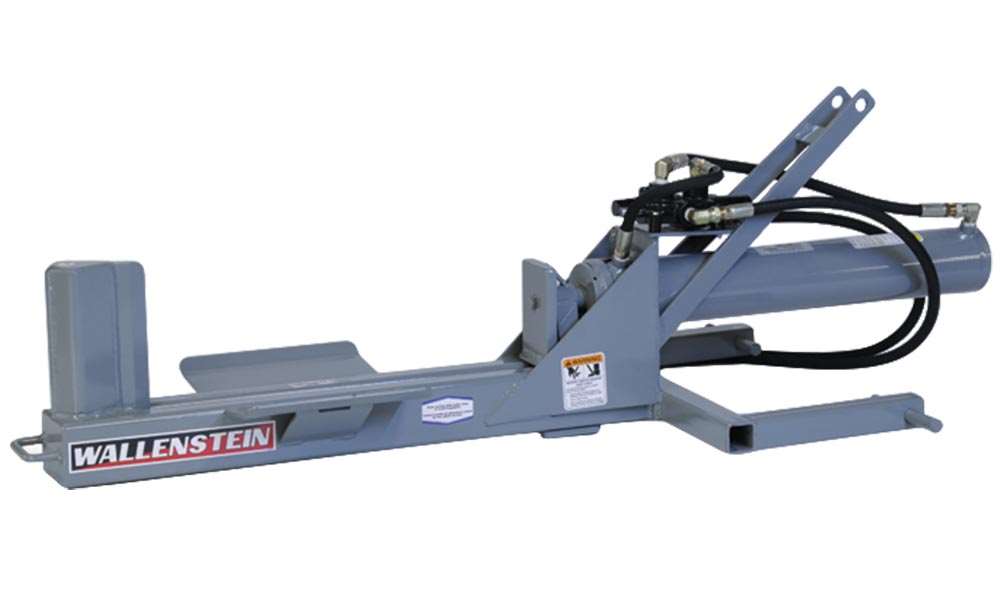
The Wallenstein WX310 is a horizontal, three-point-mounted log splitter for an owner who already has a suitable tractor hydraulic system and a workable way to bring rounds onto the splitting bed. Its main appeal is using existing power. Its main buying trap is assuming that tractor horsepower, matching couplers or a headline tonnage figure proves the combination will perform as expected.
For Canadian firewood work, evaluate the WX310 as a complete stationary work arrangement: tractor, hydraulic connection, splitter, incoming rounds, operator position and outgoing wood. A compatible splitter can still be inconvenient if the tractor is needed elsewhere or most of the effort goes into lifting and repositioning material.
On This Page
ToggleThe specification that needs the most attention is hydraulic
The Canadian product page lists a 24-inch opening, a four-inch cylinder diameter, a 215-lb machine weight and Category 1 quick-hitch-compatible mounting. Hydraulic hoses and couplers are included. Recommended flow is 10 gpm, approximately 38 L/min. The page labels average cycle time as 6.62 seconds and full cycle as 13.24 seconds, explicitly qualifying both by tractor flow.
Those cycle labels should remain separate. Do not use the shorter figure as the time for a complete extension and return. Nor should either number be treated as a guarantee for a tractor whose actual attachment flow has not been established.
The machine is hydraulic-powered rather than simply driven by attaching a rotating PTO shaft to the splitter mechanism. The product page lists a separate PTO pump kit among accessories. If that route is being considered, price and verify the complete approved kit rather than assuming it is part of the basic package.
Twenty tons is not independent of tractor pressure
The January 2021 WX310 manual lists 16 tons at 2550 psi and 20 tons at 3000 psi. These are the manufacturer’s stated ratings at different conditions. A buyer should not detach the larger number from its pressure qualification or assume every compatible-looking tractor supplies it.
This is a selection check, not an instruction to raise a relief setting. The permitted pressure and configuration of both tractor and splitter must be respected. If the available system does not provide the required performance within its approved limits, compare a different approved arrangement rather than altering settings to chase a label.
Force and speed also answer different questions. Available pressure relates to force; flow relates to cylinder movement. A system can move quickly without providing the desired splitting force, or have adequate pressure while moving more slowly than the buyer expects. Ask for both values at the relevant connection.
Wood adds another variable. A nominal force rating cannot guarantee that every round of a particular outside diameter will split in the same way. Knots, grain and the shape of the piece make a practical demonstration more useful than a simplistic diameter-to-tonnage chart.
Find the flow available to the splitter
A tractor brochure may give a total hydraulic figure that includes services not available to this attachment. Record the flow supplied through the proposed working connection, under the documented operating conditions. Do not substitute a combined pump total or an engine horsepower figure.
The required valve arrangement matters as well. The cited manual describes an open-centre valve with return detent and an optional closed-centre configuration. These are not interchangeable labels. Identify the exact tractor system and splitter version before agreeing on the connection method.
Aglist’s hydraulic-control guide explains why rear remotes, power-beyond arrangements and control valves should be identified by function. A pair of couplers alone does not tell you how the attachment’s own valve will be supplied or whether the combined installation is correct.
Request a written description of the completed connection, including any necessary tractor-side equipment. This avoids comparing a bare implement price with another package that already includes installation and commissioning. It also gives a useful record when the splitter is moved to a different tractor later.
Use cycle time as one part of the work study
To understand the effect of flow, consider an idealised example involving an unspecified hydraulic movement. If it requires one litre of oil, 20 L/min supplies that volume in three seconds, while 10 L/min takes six seconds. This ignores losses and load effects and is not a predicted WX310 cycle. It simply shows why identifying actual flow matters.
A complete wood-handling cycle includes more than cylinder travel. A round must arrive, be positioned, be split as needed and leave the working area. Some pieces require several passes. The finished output should therefore be measured over a representative session rather than calculated by dividing an hour by a brochure cycle number.
As a hypothetical work sample, suppose material handling takes 25 seconds and powered movement takes 15 seconds for a defined task. Total time is 40 seconds. Reducing powered movement by five seconds lowers the total to 35 seconds, a 12.5% improvement. It does not cut the entire task by one-third.
Repeat the observation with ordinary material, not only the easiest rounds. Record interruptions and rest periods honestly. A faster theoretical cycle has limited value if the next piece cannot be positioned appropriately or finished wood accumulates where the operator needs to stand.
Horizontal splitting makes material handling central
The WX310’s horizontal arrangement should be selected around a realistic supply of rounds and an appropriate handling method. It does not provide the same workflow as a splitter that can be positioned vertically. A buyer dealing with pieces that are difficult to bring onto a horizontal bed should examine that issue before comparing tonnage.
Assess the whole regular workload: the normal round size, how it reaches the work area, and how often pieces need to be repositioned. A demonstration should make the operator’s repeated motions visible. One successfully split large piece says little about whether a whole afternoon will be manageable.
Do not assume that a second person should hold or steady material near the moving mechanism. Use the manufacturer’s operator-position and control requirements. Labour planning must fit the approved routine, not the other way around.
A suitable receiving arrangement can also matter after the split. If finished pieces repeatedly fall into an inconvenient location, time and effort move from splitting to cleanup. Evaluate approved accessories and worksite layout for the actual routine rather than adding equipment merely because it appears in a catalogue.
The tractor cannot be in two places at once
Using existing tractor power can be economical, but it occupies the tractor for the splitting session. If the same machine normally brings rounds or carries finished wood away, plan the sequence explicitly. Staging material before splitting may solve the conflict, provided there is adequate suitable space.
An independent splitter changes that arrangement by freeing the tractor. That can be valuable for a household or farm with enough appropriately coordinated labour and an approved layout. It offers less benefit when one operator would do the tasks sequentially regardless of the power source.
Aglist’s grapple, bucket and pallet-fork comparison helps with the separate material-handling decision. Choose that equipment by its task and host-machine limits; do not treat the splitter purchase as proof that a loader attachment is suitable for every round or container.
Seasonal demand matters too. If the tractor is also needed for other recurring work during the intended splitting period, the apparent saving from shared power may come with scheduling compromises. Count the inconvenience honestly without inventing an hourly cost for work that would not otherwise occur.
Hitch compatibility remains a separate check
The three-point connection carries and positions the implement, while the hydraulic circuit powers it. A successful check of one does not prove the other. Include the complete mounted geometry, transport arrangement and tractor requirements in the purchase assessment.
Quick-hitch compatibility can simplify attachment changes, but the actual combination still needs verification. Read the quick-hitch fitment guide for the distinction between interface compatibility and complete equipment fit. Check the approved working position and hose routing with the proposed hardware installed.
For a used machine, hoses included in the sale may not suit the new tractor’s arrangement. Identify their condition, specification and routing needs. The presence of connectors is not evidence that the package is ready to use unchanged.
Price the functioning system, not just the beam
| Cost or constraint | What belongs in the comparison |
|---|---|
| Hydraulic readiness | Required tractor controls, approved connection and commissioning |
| Handling | Bringing rounds to the bed and moving finished wood |
| Tractor use | Fuel, maintenance allocation and competing tasks |
| Storage | Secure parking, connection access and seasonal readiness |
| Used condition | Documented repairs to cylinder, valve, hoses, structure and guards |
For a purely illustrative ownership comparison, assume CAD 400 annualised implement cost plus CAD 120 of additional annual operating and service allowance. At eight sessions, CAD 520 is CAD 65 per session before labour and other excluded costs. At two sessions it becomes CAD 260 per session. These are invented inputs, not WX310 prices or repair predictions.
The calculation highlights utilisation. Existing tractor ownership does not automatically make the splitter the least expensive choice, but neither does an independent engine automatically make another machine better value. Use actual quotations, a realistic number of sessions and the same cost boundaries for each option.
Inspect a used WX310 under representative conditions
Confirm the model, hydraulic configuration and applicable documentation. Have a competent person assess the frame, wedge, cylinder, valve, hoses, couplers and three-point components. Look for damage, leaks, missing components and undocumented alterations without turning those inspection priorities into claims of common model faults.
A demonstration should use a documented compatible hydraulic supply and permitted material. Record whether it reflects the prospective buyer’s tractor arrangement. A demonstration on a different supply can show that the splitter functions while still leaving the buyer’s expected speed and force unresolved.
Hydraulic inspection and service require the prescribed shutdown and pressure-release procedure. Do not search for leaks with a hand or loosen a connection to improvise pressure relief. Have uncertain condition or valve behaviour resolved through competent service before use.
Ask for a written readiness estimate when repair is needed. Include the cost of the complete fix rather than assuming that an inexpensive seal or hose will resolve an unconfirmed symptom. A used machine’s value is the price of a correctly functioning package, not only the negotiated purchase figure.
Frequently asked questions
Will a more powerful tractor always split faster?
No. Relevant hydraulic flow, pressure and system compatibility matter. Engine horsepower alone does not establish the splitter’s cycle or force.
Is 6.62 seconds a full cycle?
The Canadian page separately labels the full cycle as 13.24 seconds and qualifies performance by tractor flow. Preserve those labels when comparing offers.
Can I raise pressure to obtain the advertised tonnage?
Do not change settings to chase the rating. Verify the approved limits and performance of the complete tractor and splitter combination.
Does the basic splitter need a PTO shaft?
Its working power comes from hydraulics. A separately listed PTO pump kit is a different proposed supply arrangement that must be specified and verified as a complete package.
Who should choose this horizontal model?
An owner with suitable available hydraulics, manageable material handling and a tractor that can remain committed to the session. If lifting, tractor scheduling or missing hydraulic equipment dominates the decision, compare other configurations before buying on tonnage alone.
Share your experience
Help other Canadian buyers — leave a quick review for the
Wallenstein WX310
There are no reviews yet. Be the first one to write one.