Overview & Specs
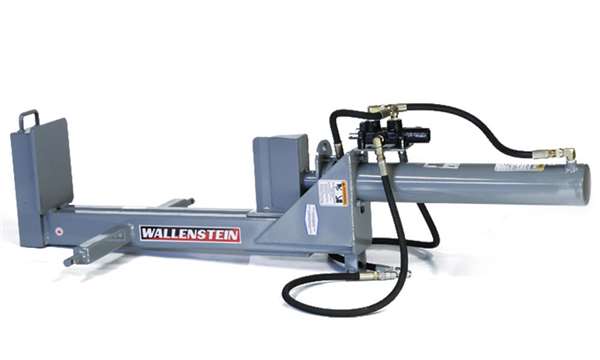
The Wallenstein WX350 is a discontinued, three-point-mounted vertical wood splitter that deserves consideration as a used purchase only after its hydraulic requirements and working arrangement have been checked. Its defining advantage is the vertical splitting layout: the buying discussion begins with how rounds reach the splitting position, rather than assuming every piece will be lifted onto a horizontal bed. That can be useful, but it does not eliminate manual handling or make an unsuitable tractor hydraulic system adequate.
Wallenstein’s support catalogue identifies the WX350 as discontinued. This guide uses its May 2019 WX350/WX360 operator manual and the manufacturer’s support listing, checked in October 2026. It does not describe a current new-model specification or imply dealer stock. The WX350 and WX360 share a manual, but their cylinders, force figures, flow requirements and weights differ.
On This Page
ToggleWho should consider a used WX350?
The strongest candidate is an owner with a compatible tractor, repeat firewood work and a clear place to run a vertical splitting station. The owner should be comfortable arranging the incoming rounds, operator space and outgoing wood as one process. A cheap attachment is not a good purchase if the tractor needs costly hydraulic changes or must constantly leave the station for other chores.
Start with the wood rather than the nominal force. Record the typical round length, diameter, shape and handling difficulty. A vertical arrangement can avoid one kind of lifting while introducing bending, positioning and repeated turning. A hands-on assessment of the stationary layout is more useful than deciding from the orientation label alone.
The horizontal WX310 offers a useful contrasting arrangement. The comparison is not simply vertical versus horizontal performance. It is whether the complete workflow lets the owner position suitable rounds, operate the machine correctly and remove the pieces without unnecessary handling.
Read the WX350 column, not the WX360 column
| May 2019 manual item | WX350 | Why it matters |
|---|---|---|
| Cylinder bore and stroke | 4 by 24 inches | Defines the listed cylinder, not a universal permitted log diameter. |
| Published splitting force at 2,550 psi | 16 ton | The pressure condition belongs with the force claim. |
| Published splitting force at 3,000 psi | 20 ton | Not a reason to alter the tractor’s pressure setting. |
| Recommended minimum hydraulic flow | 10 US gpm | Check available implement flow, not combined pump output. |
| Orientation | Vertical | Assess round positioning and the operator’s work area. |
| Weight | 220 lb | Verify the full hitch and transport arrangement. |
| Valve | Open centre with automatic return detent; closed centre optional | Identify what is actually fitted to the used machine. |
The manual lists the WX360 with a larger cylinder and a higher flow requirement. Those figures should not migrate into a WX350 advertisement merely because the seller found the shared manual. Ask for photographs of the model plate and the actual machine before travelling to inspect it.
The dimensions printed in an old manual are also less useful for transport planning than measuring the exact used unit and its approved transport position. Accessories, replacement hoses and storage arrangements can affect the space required. Establish the real envelope before collecting it with a vehicle or trailer.
Hydraulic flow determines a different part of the result than pressure
Pressure is associated with the available cylinder force. Flow influences how quickly oil can move the cylinder, subject to the circuit and load. A tractor that can develop adequate pressure may still deliver a slow cycle if little flow reaches the splitter. Conversely, a large combined hydraulic-flow figure in a tractor brochure may include oil reserved for steering and other services.
Request the tractor’s available remote-flow information and the splitter’s actual valve configuration. Matching coupler shapes proves only that the fittings join. It does not prove circuit compatibility, acceptable return conditions or the correct control arrangement. The rear remotes and hydraulic controls guide helps distinguish the functions involved.
The manual’s two pressure-conditioned force ratings are specifications to interpret, not tuning instructions. Do not raise relief pressure to chase the larger number. The tractor, hoses, valve, cylinder and other components must operate within their approved limits. If a seller explains poor performance by proposing an unverified pressure adjustment, resolve the actual compatibility and condition questions first.
There is no verified WX350 production rate in this guide. It would be misleading to convert a headline tonnage into cords per hour. Wood handling, knotting, repeated splits and the position of the finished pile can dominate the session, even when the hydraulic system behaves correctly.
Build the work area around vertical splitting
Map three places: the waiting rounds, the operator’s working position and the destination for split wood. Keep the route between them clear. A layout that requires walking around a growing pile after every few pieces is inefficient regardless of how fast the wedge moves.
Evaluate whether rounds can be brought into the permitted working position without an awkward lift or uncontrolled movement. Vertical orientation does not guarantee that every large round is manageable. Some material may need a different handling method or a different processing service. The purchase should suit the pieces the owner can handle safely, not just those that could theoretically fit.
The manual requires the frame to remain vertical during operation and specifies a clear, level work area. That is a meaningful site requirement for a Canadian yard with gravel, ruts, snow or seasonal softness. Choose a proper work window and prepared location; do not assume the three-point hitch compensates for poor footing.
Operate outdoors with the tractor positioned according to its instructions and the splitter manual. An open doorway does not turn an enclosed shed into a suitable engine-operating space. Storage convenience and operating suitability are separate questions.
The tractor can become the bottleneck
A tractor-powered splitter occupies both the hydraulic supply and the tractor. If that same machine brings rounds, moves bins and carries finished wood, the daily schedule deserves attention. It may be possible to stage a sensible batch before splitting, but staging itself takes time and space.
Suppose, purely as a planning example, a session involves 25 minutes staging rounds, 70 minutes splitting and handling pieces, and 25 minutes moving the finished wood. The complete job is 120 minutes. Saving ten minutes of cylinder waiting reduces that to 110 minutes, while avoiding two fifteen-minute equipment changeovers would save thirty. Neither saving is a WX350 test result; the example shows why observing the whole job matters.
Compare this with an independent machine such as the engine-powered WX540 when tractor availability is the principal problem. Independent power brings its own engine and maintenance obligations. It is not automatically a better or cheaper arrangement, but it can solve a different scheduling constraint.
Identify the valve and any added accessories
The standard valve arrangement in the May 2019 manual is open centre, with a closed-centre option. A used machine may have been altered. Have the installed valve and plumbing positively identified rather than relying on the original brochure. The cost of correcting an unsuitable modification belongs in the purchase decision.
The return detent allows the return movement described in the manual. It should not be represented as an automatic complete splitting cycle or as permission for a second person to load while the wedge moves. Correct operation depends on understanding all control positions and keeping the work coordinated.
A stroke limiter and four-way wedge appear as accessories in the manual. Their presence on a used unit must be verified. The stroke limiter’s purpose is to avoid unnecessary return travel on suitable shorter material. That may improve one part of the cycle, but it cannot remove the time needed to reposition a round or clear the finished pieces.
Do not treat an accessory photograph as proof that a particular kit fits every serial number. Wallenstein’s support page separates several parts-book ranges. Use the actual identity of the machine when checking replacement components and accessories.
A useful used-machine inspection sequence
First confirm ownership details, model and serial number, then obtain the matching documentation. Ask what tractor powered it, how it was connected and what changes were made. A clear maintenance history is helpful, but the condition still needs inspection. A claim that it worked well on another tractor does not establish compatibility with yours.
With the equipment isolated and supported as instructed, examine the frame, hitch attachments, wedge assembly, cylinder mounting and visible repairs. Look for distortion or damage that could affect alignment. These checks are general buyer precautions, not evidence of a known WX350 defect pattern.
Inspect hose condition, routing, fittings and the cylinder rod. An old hose that does not leak while parked may still need replacement based on its condition. Never search for a pressurized leak with a hand. The assessment should be made using appropriate procedures by someone qualified to evaluate the hydraulic system.
A proper demonstration should use a compatible tractor and suitable wood, with all controls behaving as documented. Observe whether the return detent releases correctly, whether movement is consistent and whether the machine becomes unusually noisy or leaks. Do not accept an unsafe demonstration as the price of discovering whether a bargain works.
Finally, obtain prices for any identified work before agreeing on the purchase. Include transport, correct couplers and hoses, required service, missing documentation or guards, and any compatible accessories actually needed. Avoid treating the seller’s asking price as the ready-to-work cost.
Ownership economics without an invented market price
Compare three alternatives: buying the used WX350, buying another suitable splitter, or arranging occasional processing. Use actual quotes. A lower acquisition cost may be worthwhile for regular sessions, but an attachment that sits unused because the tractor connection is inconvenient has poor practical value.
For a simple sensitivity check, an additional annual ownership cost of $240 would equal $20 per session at twelve sessions, or $80 per session at three. These hypothetical amounts are not Canadian selling prices or maintenance estimates. They help reveal how strongly the decision depends on actual use.
Storage should leave the machine stable, protected and ready for inspection before the next season. Plan for the tractor connection and safe access around the parked splitter. A unit buried behind other implements is less likely to be used for a small timely batch, which can change the whole workflow.
Frequently asked questions
Is the WX350 a current model?
The manufacturer’s support catalogue marks it discontinued. This guide therefore concentrates on identifying and assessing an existing unit. It makes no claim about remaining new stock or current pricing.
Is it always a twenty-ton splitter?
The manual conditions its force figures on hydraulic pressure. Quoting the higher figure without that condition is incomplete. The right operating pressure is the approved pressure of the complete matched system, not whatever produces the largest advertising number.
Will it work well on a small compact tractor?
That requires checking the specific tractor’s available hydraulic flow, pressure, circuit type, hitch fit and operating arrangement. Horsepower or coupler fit alone is insufficient. The listed ten-gallon-per-minute minimum deserves particular attention on a smaller tractor.
Does vertical splitting eliminate heavy handling?
No. It changes how a round reaches the splitting position. Positioning, turning and removing material still require an appropriate method. Evaluate those movements before choosing the machine.
What makes a used example worth buying?
Correct identity, sound condition, a compatible hydraulic connection and a workable firewood routine matter together. A well-matched, serviceable unit can be useful; a low price does not compensate for unresolved compatibility or structural damage.
Sources
Share your experience
Help other Canadian buyers — leave a quick review for the
Wallenstein WX350
There are no reviews yet. Be the first one to write one.