Overview & Specs
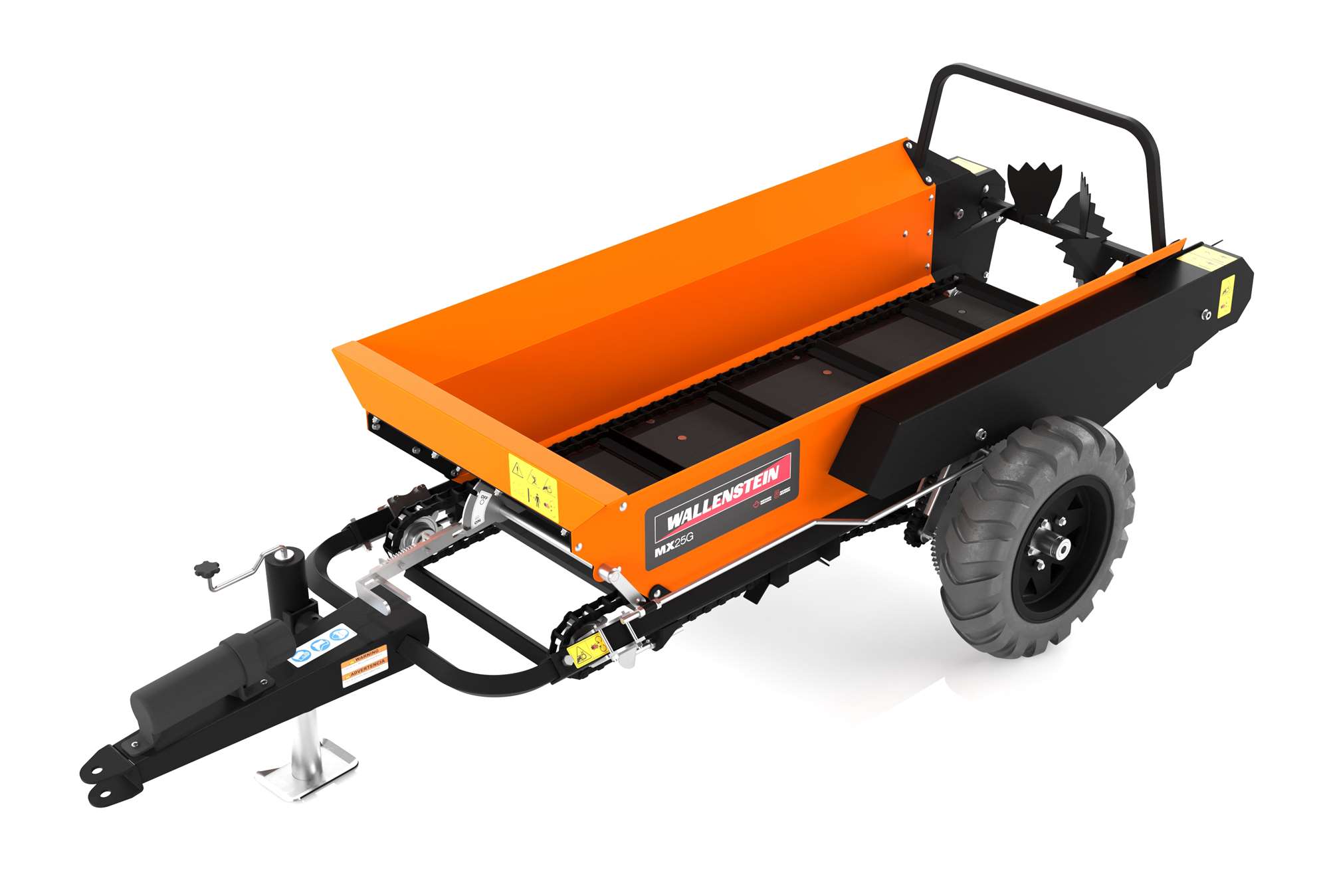
The Wallenstein MX25G is a small ground-driven manure spreader whose strongest argument is manageable, recurring batches. It can be a sensible candidate for a small livestock property where a larger machine is awkward to store, load or manoeuvre. Its small size does not, however, make the loaded combination suitable for every ATV, utility vehicle or lawn tractor. Start with the towing vehicle’s documented limits and the actual route.
This assessment uses the Canadian MX25G page and March 2024 MX-series manual, checked in October 2026. It focuses on equipment selection and handling. The correct application area, timing and nutrient rate require a separate plan appropriate to the property and its local requirements.
On This Page
ToggleA small spreader works best as part of a small-batch routine
Consider where material accumulates, how it will be loaded and how often it needs to move. A low loading height can make recurring chores more practical, while a compact footprint can help where storage space is limited. Those benefits disappear if each trip involves a long detour or the receiving area is inaccessible when the material needs handling.
For a few regularly cleaned stalls, convenience may matter more than maximum batch volume. For a large accumulated pile, repeated loading and return trips may dominate. Do not size the machine solely for the largest pile left after an unusually long delay; decide whether that pile represents the normal management routine or a separate occasional job.
The MX25G is a spreader, not a complete manure-management system. Storage, loading, appropriate application opportunities and cleaning still require time and space. Ownership should improve that whole sequence rather than merely move the bottleneck from the stable to the field entrance.
Understand the published capacity before comparing sizes
| Canadian specification | MX25G | What to check |
|---|---|---|
| Heaped volume | 25 bushels, stated as 31.25 cubic feet | Not a payload mass or a guarantee that any vehicle can tow a full load. |
| Box dimensions | 72 by 26 by 15 inches | Compare loading access and material placement. |
| Overall dimensions | 117 by 48 by 29 inches | Allow additional space for the tow vehicle and turns. |
| Listed machine weight | 510 lb | Add the actual load when evaluating the towing combination. |
| Listed tongue weight | 34 lb | Do not treat this as the tongue load under every loading condition. |
| Drive | Ground drive | Wheel traction powers the spreading mechanism. |
| Beater paddles | Eight | Condition and the material still influence distribution. |
Heaped volume and box dimensions describe different shapes. Multiplying the rectangular internal dimensions produces a level-box approximation; the published heaped volume includes material above that simple rectangular space. Neither calculation establishes the safe mass to carry. Wet manure with bedding can weigh very differently from a dry, loose mixture.
For buying purposes, replace the question “How many bushels does it hold?” with two questions: “What approved load can this complete vehicle combination handle?” and “How much of my actual material does that represent?” Those answers may limit practical batch size before the nominal volume is reached.
Ground drive removes a PTO connection, not the towing checks
The MX25G uses chain-and-sprocket drive for the beater and apron. Wheel movement supplies the mechanical input. This is why the machine can be considered with suitable tow vehicles that do not provide a PTO. It is also why traction at the spreader’s wheels belongs in the buying discussion, not just traction at the towing vehicle.
The Canadian page mentions ATVs, UTVs and lawn tractors as possible tow-vehicle types. That is not approval of every machine in those categories. Check the exact vehicle’s towing and hitch limits, permitted tongue loading, braking arrangements and terrain restrictions. A powerful engine does not compensate for inadequate stopping or steering control.
The March 2024 manual lists a 12–45 hp recommended tractor range for the MX25G. Treat that as one manufacturer specification, not as a universal cross-reference to recreational vehicles. Horsepower says little about whether a particular vehicle can safely control the loaded spreader on the intended route.
Before purchasing, map the steepest section, tightest turn, softest area and any crossing on the route. Include the return journey and the space required to stop and turn. If the combination is unsuitable at its limiting point, a larger engine or a shorter loading time does not solve the problem.
Traction is part of the distribution system
With a ground-driven spreader, forward travel and mechanism drive are connected. A wheel that fails to turn as intended can disrupt delivery even if the vehicle continues moving. This matters on loose, wet, icy or otherwise unsuitable surfaces. It does not mean that a PTO alternative makes those surfaces appropriate for towing; it means that the source of drive changes one constraint.
The MX25G has three apron-control speed choices. These provide a way to adjust delivery, but a control position is not an agronomic application rate. Material consistency, travel, effective spreading width and loading condition still affect what reaches the ground. A consistent result must be evaluated with representative material and a suitable application plan.
Do not attempt to solve poor distribution simply by increasing travel speed. First establish whether the issue is material, loading, traction, adjustment or worn parts. Higher speed can make a different problem more severe and does not replace the operator manual’s limits.
Bedding, chunks and moisture change the job
A manure-and-bedding mixture can vary substantially from batch to batch. Long fibres, dense clumps and foreign objects are different challenges from a fine, uniform material. Keep a record of the normal mixture when comparing equipment or arranging a demonstration. A clean sample selected to make a machine look good may not represent the recurring chore.
The MX manual directs operators to break up large chunks, avoid foreign objects and be alert to frozen material that could damage the machine. Those are practical loading considerations for Canadian conditions. They do not authorize spreading at an unsuitable time or location. If the material or ground is not appropriate, storage and timing remain part of the solution.
The product page lists a fines-pan accessory. Do not assume that adding it makes the spreader suitable for any slurry or completely prevents losses in transit. Confirm its intended material and function for the actual machine. A spreader designed around one form of material should not be converted by assumption into a different application system.
Fit the loader, gate and storage space together
The listed 29-inch loading height can be helpful for certain small-batch methods. Check it against how you actually load: by hand, with a suitable loader or another approved method. Consider whether material can be placed evenly without striking the box or spilling around it.
A 48-inch machine width is not the width of the whole moving combination. Gate posts, offset approaches, tow-vehicle width and the turning arc matter. Measure the narrowest realistic approach rather than the widest part of a gate. Also leave room to inspect, clean and service the machine when stored.
The manual specifies loading on a flat, solid area and distributing material from front to back without overloading. The purpose is a controlled loading arrangement, not a target of filling every visible space. Keep the vehicle and hitch restrictions in view while establishing the actual batch.
When does the larger MX50G make more sense?
The MX50G offers more nominal volume, but it also changes the physical and loaded towing package. A bigger spreader is useful when it reduces costly repeat trips within an approved combination. It is less attractive if the smaller machine already handles the routine batch and the larger one creates access or storage problems.
Suppose an approved practical batch in one arrangement is 20 cubic feet and a larger arrangement can safely carry 40 cubic feet of the same material. Moving 80 cubic feet would require four batches versus two. If each return-and-positioning cycle takes eight minutes, the smaller arrangement incurs sixteen additional minutes across those extra two cycles. These are hypothetical approved batch sizes and times, not MX25G payload ratings or production claims.
For a short route, those minutes may have modest value. For a long route repeated many times, they may dominate. This is a better comparison than assuming twice the advertised capacity automatically means twice the useful productivity.
Would PTO drive solve the actual problem?
A PTO-driven model uses the tractor to power the spreading mechanism. It may be worth considering when mechanism drive needs to be less dependent on the spreader’s wheel traction and a suitable tractor is available. It adds a driveline and tractor requirements, and it still needs a safe towing route.
The MX80P guide discusses a larger PTO-driven example. It is not a like-for-like size replacement for the MX25G. Separate the drive decision from the batch-volume decision so that one appealing feature does not conceal an unsuitable overall package.
Inspecting a used MX25G
Begin with the serial number and the correct parts information. Inspect the floor, box, frame, hitch and axle area with the machine made safe. The poly floor does not make the entire spreader immune to corrosion or damage; the box and supporting structure still deserve attention.
Examine the apron chain, slats, sprockets and accessible bearings for condition and correct adjustment. Look at the beater paddles and their clearance. Uneven wear or a poor repair can affect delivery. These are inspection priorities for this type of equipment, not claims of unusually frequent failures on the MX25G.
Check the drive engagement and each control position during a safe demonstration. A machine that rolls freely when empty has not demonstrated that the complete drive works correctly with representative material. At the same time, do not accept a demonstration on unsuitable ground just to test the mechanism.
Price identified repairs before deciding that a used spreader is inexpensive. Include correct replacement parts, service, transport and any hitch work. Compare that ready-to-work cost with an alternative that actually fits the property, rather than with an unrelated new machine’s advertisement.
Questions small-property buyers often overlook
Can I leave material in it until the next convenient day?
Plan to follow the manual’s cleaning and storage instructions rather than use the spreader as permanent storage. Material left in the mechanism can complicate cleaning and readiness. A separate storage plan is especially important when application conditions change unexpectedly.
Does the low empty tongue weight prove ATV suitability?
No. The actual loaded tongue force and total towed weight must suit the exact ATV and hitch. A published empty-machine figure cannot substitute for evaluating the working combination.
Can one setting handle every bedding mixture?
Do not assume so. Evaluate delivery with the material actually produced and reassess when its character changes. Controls are mechanical adjustments, not a guarantee of uniform nutrient application.
What is the strongest reason to choose the MX25G?
A compact machine that can be loaded, moved, cleaned and stored conveniently may encourage a workable recurring routine. That benefit is real only if the towing combination and application plan are appropriate.
Sources
Share your experience
Help other Canadian buyers — leave a quick review for the
Wallenstein MX25G
There are no reviews yet. Be the first one to write one.