Overview & Specs
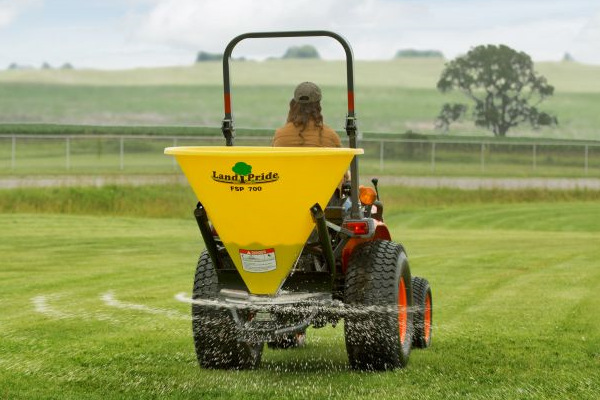
The Land Pride FSP700 is a tractor-mounted broadcast spreader whose extra hopper capacity is useful only when the tractor can carry the intended load and fewer refills improve the actual job. It should not be selected by the widest advertised spread alone. Product distribution, loading arrangements and field access determine whether a larger hopper makes the work easier.
For a Canadian acreage, small farm or property-maintenance operation, begin with the material and its application plan. Seed, granular fertilizer and other permitted products can have very different handling and distribution requirements. The spreader delivers material; it does not establish the correct product or rate. This guide uses North American manual 309-065M dated October 1, 2026.
On This Page
ToggleThe FSP700 column, not a family average
The current specification table lists 9.18 cubic feet of hopper volume, a 563-lb maximum material load, 128-lb empty weight, Category 1 attachment and an 18-hp minimum tractor requirement. Loading height is 41 inches. Its listed granular spread range is 23–54 feet and crystalline range 12–27 feet, subject to actual material and setup.
The table expressly marks the FSP300 as quick-hitch compatible, but does not make that same statement in the FSP700 column. Do not transfer a smaller sibling’s designation across the row. Establish the approved connection for the exact spreader, tractor and any proposed quick hitch.
A quotation should identify the model and supplied equipment clearly. An offer described only as an “FSP spreader” leaves capacity and handling details unresolved. With a used machine, retain serial identification and establish which instructions apply rather than assuming that a current family document answers every older configuration question.
A full hopper creates a different tractor load
Using the listed figures, 563 lb of material plus 128 lb of machine equals 691 lb before additional fitted equipment. That simple inventory total is useful because a buyer may otherwise compare only the empty spreader with the tractor’s lifting figure.
It is not permission to fill the hopper on every tractor meeting the horsepower minimum. Carrying capacity at the relevant position, ballast, steering, transport and attachment restrictions remain separate checks. The loaded spreader sits behind the tractor, so geometry matters as well as scale weight.
A partially filled hopper may be the appropriate working arrangement for a particular approved combination. If so, calculate refill needs from that permitted load rather than the brochure maximum. Paying for unused capacity can still be reasonable for other reasons, but the claimed reduction in stops should reflect reality.
Volume and mass impose independent limits
The hopper can reach its mass limit before it is physically full when carrying a denser material. A lighter material may use the available volume first. Neither limit should be ignored simply because the other appears to have room remaining.
For an arithmetic illustration, 9.18 cubic feet is about 0.260 cubic metres. At an invented bulk density of 1,200 kg per cubic metre, that volume would contain about 312 kg, exceeding the listed approximately 255-kg mass limit. The example is not a density claim for a particular product; it shows why filling to the rim is not a universal loading method.
Use the actual product information and permitted loading procedure. Do not infer mass from bag volume or from the appearance of another material. Record what is loaded so the operator can distinguish an intentionally partial load from uncertainty about how much the hopper contains.
Refill planning is the main capacity calculation
Suppose an illustrative application plan requires 100 kg per hectare over 4 hectares. The project needs 400 kg of product. If the approved working load is 200 kg, it can be planned as two loads. At 125 kg per load, it needs four loads, with a smaller final quantity. These are hypothetical rate and load assumptions, not agronomic recommendations.
Now include the refill location. If each return, loading and resumption takes an assumed 12 minutes, three intermediate refills add 36 minutes while one adds 12 minutes. The 24-minute difference comes from the stated route and load assumptions, not a measured FSP700 advantage.
If loading can happen close to the work, the time difference shrinks. If the tractor cannot carry the larger proposed load, it disappears. This is why a hopper comparison should start with the permitted loaded combination and actual refill route rather than the largest catalogue number.
The 41-inch loading height changes the routine
Consider how the intended product reaches the hopper. Bag handling, a suitable loading arrangement and access around the parked tractor deserve attention before delivery. A capacity increase is less convenient if the owner finds the repeated loading process awkward or cannot position supplies appropriately.
Assess the whole routine under the relevant instructions, including where empty packaging goes and how the final partial quantity is measured. Do not improvise a work platform or use the attachment as support for a person. The appropriate loading method should be established as part of the equipment plan.
For several operators, agree on the load record and stopping point. A hopper that is intentionally kept below its maximum needs an understandable method of maintaining that limit. Relying on “about this full” can undermine both load planning and application records.
Visible throw is not calibrated pass spacing
Material reaching the edge of a visible pattern does not mean the same amount lands there as near the centre. Effective pass spacing must produce the required combined distribution. A maximum spread figure therefore should not be multiplied by travel speed and presented as accurately completed area.
Product characteristics and condition can change the pattern. Treat a previous setting as a starting record for comparable work, not permanent approval for another product. A different granule, mixture or material condition needs its own appropriate check.
For irregular properties, boundaries and turns can dominate the operation. Sketch the treated area and any places that must remain untreated. The spreader’s broad reach may be useful on open ground but create a different control problem beside narrow or sensitive boundaries.
Average rate and uniformity require separate evidence
Suppose 20 kg is distributed over a measured 0.20-hectare trial. The average application is 100 kg/ha. If the same mass covers only 0.16 hectares, the average becomes 125 kg/ha. This arithmetic exposes area error even when the gate setting and loaded amount appear unchanged.
However, the correct average does not prove a uniform pattern. Material could be concentrated in some strips and sparse in others. The acceptance check must address both the quantity delivered and its distribution under the prescribed calibration method.
Keep a record of product identity, intended rate, measured area, mass used, travel setting and spreader adjustments. A later discrepancy is easier to investigate when those inputs are known. Without them, a complaint that the hopper emptied too quickly cannot identify whether the issue was area, pace, setting or material.
Travel and drive conditions must stay coordinated
Application depends on how much material is delivered while a given ground area is covered. Changing travel pace without accounting for delivery changes the amount per unit area. Changing drive conditions can also affect the pattern. Use the exact operating requirements for the machine and product.
Do not assume that lowering engine throttle simply slows the tractor while leaving the spreading process unchanged. The appropriate travel control depends on the tractor’s transmission and PTO arrangement. Establish a repeatable permitted method before treating the entire area.
The FSP500 guide provides comparison context for the smaller-capacity model. Choosing the FSP700 should follow a reasoned load-and-refill advantage, not the assumption that a larger hopper automatically gives a more accurate pattern.
Canadian seasonal applications need separate records
A machine used for one product in one season should not inherit the same calibration for another product later. Record the new material and the appropriate setup. The equipment’s ability to distribute a broad material category does not establish a suitable rate for every local purpose.
Choose conditions appropriate to the actual application. A fixed workday should not force spreading when the product directions or the intended distribution cannot be respected. The relevant decision is whether the application can be completed correctly, not whether the tractor is available that afternoon.
Include cleaning and storage in the changeover plan according to the manual and product requirements. A hopper and mechanism left with unwanted residue can complicate the next application. Do not treat seasonal storage as a substitute for the required maintenance procedure.
Compare the complete operation with alternatives
| Situation | Question to investigate |
|---|---|
| Open area with repeated large applications | Does an approved larger load materially reduce refill travel? |
| Small irregular patches | Would a more confined delivery system better fit the boundaries? |
| One establishment project | Does rental or a complete service avoid owning rarely used equipment? |
| Limited tractor carrying margin | Would a smaller suitable package deliver the same practical load? |
This comparison should preserve application quality as a requirement. A faster system that cannot meet the intended distribution is not an equivalent alternative. Likewise, a smaller machine may remain practical when supplies are close and refills are quick.
For a multi-stage establishment job, account for the equipment before and after spreading. A broad spreader does not replace necessary preparation or the planting plan’s finishing operation. Compare the whole project rather than one attractive capacity figure in isolation.
Used inspection should focus on delivery consistency
Confirm model identity and inspect the hopper, frame, metering parts, agitator, spreading components, drive and guards under the prescribed isolation procedure. Look for corrosion, damage, missing parts and repairs requiring assessment. These are individual condition checks, not claims of a recurring FSP700 defect.
A hopper that looks sound does not prove that the delivery mechanism moves and closes correctly. Establish whether the supplied components match the applicable documentation and whether the machine can be calibrated appropriately. A seller’s old rate setting is not evidence for your product.
Price identified repairs and missing equipment using actual quotations. Include delivery, tractor-specific setup and the loading arrangement. Do not invent a standard annual maintenance cost or assume that a cheap spreader will be economical without checking the parts that determine application.
Use a purchase demonstration to answer four questions
First, can the complete permitted load be handled by the actual tractor? Second, can the operator load and connect the machine through a workable routine? Third, can the intended product be delivered at the required rate and pattern? Fourth, does the refill plan produce a useful whole-job advantage?
Record the answer to each separately. A successful carrying demonstration does not prove application uniformity, and a good pattern with one material does not settle another. Leaving an answer unresolved is more useful than treating an impressive demonstration as universal approval.
Frequently asked questions
Is the maximum loaded weight 563 lb?
That is the listed material limit. Adding the 128-lb empty machine gives 691 lb before additional equipment, subject to the actual tractor and configuration limits.
Can every material fill the hopper to the rim?
No. Mass and volume are separate constraints, and the tractor may impose a lower appropriate working load.
Does the 54-foot figure establish pass spacing?
No. The actual distribution and overlap must be verified for the material and operating setup.
Can FSP300 quick-hitch compatibility be applied to FSP700?
Not from the shared table alone. The designation is explicit for the smaller model; establish the approved FSP700 arrangement separately.
When is the larger hopper worthwhile?
When a verified loaded combination and actual refill route give a useful advantage while preserving application quality and manageable loading.
Source
Land Pride manual 309-065M, October 1, 2026, checked November 13, 2026. Rate, density and time examples are hypothetical calculations, not product prescriptions or measured performance.
Share your experience
Help other Canadian buyers — leave a quick review for the
Land Pride FSP700
There are no reviews yet. Be the first one to write one.