Overview & Specs
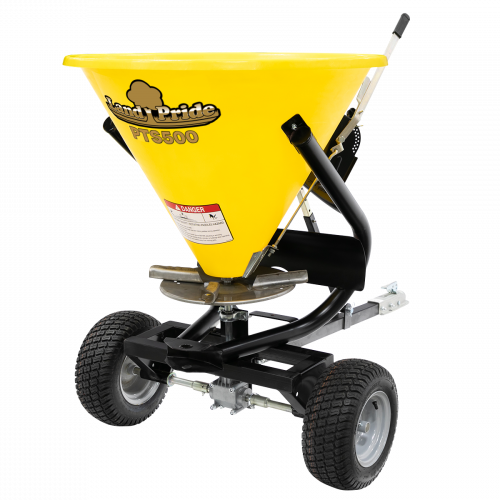
The Land Pride PTS500 is a pull-type, ground-wheel-driven broadcast spreader for distributing a suitable material over a measured area. It is an alternative to a rear three-point PTO spreader when the towing arrangement, loading routine and actual distribution pattern fit the property. It is not automatically an accurate applicator merely because its drive follows ground travel.
The most useful starting question is what material must be applied, where and under which product directions. Seed, granular fertilizer and winter-maintenance materials have different purposes and constraints. A spreader can deliver material without establishing the correct rate, timing or location for its use.
On This Page
ToggleWhat the documented PTS500 package contains
The November 22, 2023 manual lists a 15-hp minimum, 2-inch ball hitch, 165-lb machine weight, 350-lb maximum hopper load and 5.83-cubic-foot volume. It gives 59-inch overall length, 41-inch width and 51-inch loading height. Its stated net spreading-width range is 26 inches to 40 feet, not one constant calibrated swath.
The manufacturer’s PTS listing identifies the ground-wheel drive and gearbox disengagement for transport. It describes stainless spinner, vanes, hopper door and adjustment components. Those features are useful to identify, but do not remove cleaning, calibration or towing requirements.
Keep PTS500 separate from FSP500. The similar number does not mean the hitch, drive, loading height or operating routine is interchangeable. The FSP500 guide covers the three-point PTO arrangement as another process to compare.
A towable spreader changes where the load goes
The PTS500 travels on its own wheels behind the towing vehicle. That changes the connection and handling assessment from a mounted hopper. It does not make the contents weightless or mean every vehicle with a ball can tow the loaded combination appropriately.
Confirm the actual vehicle’s towing, hitch and operating requirements. Include the loaded spreader, connection geometry and route. A minimum horsepower statement cannot establish stopping ability, suitability on a slope or the correct hitch installation.
The listed machine and maximum product mass total 515 lb before any additional equipment: 165 plus 350. This is a basic mass inventory, not a permissible trailer-weight calculation for an unspecified vehicle. Use the actual configured weights and applicable limits.
Also plan how the spreader follows through turns and close areas. The towing vehicle can clear an obstacle while the trailing machine takes a different path. A route suitable for a mounted attachment may need a different approach when the application tool is behind on wheels.
Ground drive does not make the application rate independent of speed
Ground travel powers the spinner through the wheel-driven system, but the material passes through an adjustable discharge arrangement. Spinner drive and material metering are not the same mechanism. Do not assume that doubling travel speed preserves either the same distribution pattern or the same quantity per unit area.
The manual identifies travel speed, distribution radius, wind, terrain and material properties as influences on distribution. Its vane settings also change the pattern. That makes a repeatable operating setup and a measured check essential.
A ground-driven seed meter on another implement may relate seed delivery to distance in a different way. The APS1572 guide describes such a different arrangement. A shared phrase such as “ground driven” should not cause the calibration method or control behaviour to be transferred between machines.
Before purchase, ask how the intended operator will maintain the tested travel condition across the actual site. Frequent slowing for turns or obstacles creates a different application problem from an open uninterrupted run. Equipment selection should reflect that layout.
Maximum throw is not effective pass spacing
Visible particles reaching the edge of a pattern do not establish uniform delivery across that whole width. A useful spacing must produce the intended distribution when adjacent passes are combined. The outside reach is only one observation.
Define the required product rate from the appropriate instructions, then verify both total delivery and pattern using the permitted method. Correct average consumption over the whole property can coexist with strips receiving too much and others receiving too little.
For an invented example, suppose 24 kg is used across 0.3 hectares. The average is 80 kg/ha. That arithmetic says nothing about whether half the ground received 120 kg/ha and the other half 40 kg/ha; those unequal halves would produce the same average.
Those rates are not application recommendations. The example explains why weighing the remaining product is necessary but insufficient. A purchase demonstration should address distribution, not merely show that the hopper empties at approximately the expected time.
Volume and maximum mass can limit different materials
The 5.83-cubic-foot space and 350-lb maximum are separate constraints. A dense material may reach the mass limit before filling the available space; a lighter material may fill the hopper before reaching that mass.
Use product information and a suitable weighing method rather than treating a level hopper as a known load. Bags also differ in size and contents. A familiar bag count is not reliable when the product or packaging changes.
Seven 50-lb bags would equal 350 lb arithmetically. That does not establish that all seven fit by volume, that the full load suits the towing setup or that the application requires that quantity. Load from the measured job and permitted arrangement.
Partial loads can be entirely sensible. Avoid buying more material or increasing application merely to use all the hopper space. The product plan should determine the quantity; the machine should accommodate it.
The 51-inch loading height deserves a practical trial
Refilling is part of using the spreader, not a task outside the equipment decision. Consider where bags or bulk material are stored and how they will be transferred through an appropriate handling method.
A towable unit can be convenient to connect yet awkward to fill from the available supply. Evaluate the actual operator’s routine and avoid relying on an improvised elevated platform or repeated difficult lifts. The loading method should be ready before the first full session.
For a hypothetical 120-kg job, an approved and practical 40-kg working fill requires three loads. A 60-kg working fill requires two. The larger fill only saves time if it remains appropriate and loading it does not introduce a slower or unsuitable routine.
Measure the complete refill cycle: return to supply, secure the equipment, load, rejoin the route and resume correctly. Moving the supply to a suitable convenient location may save more than buying a larger hopper. Keep the comparison within product storage and handling requirements.
Control application and transport separately
The manual specifies removing the drive retaining pin for transport and replacing it for spreading, with the proper stopped procedure. It also directs emptying the hopper for site-to-site transport and states that the spreader is not designed for public roads. Do not interpret a transport-speed ceiling as road approval.
For selection, this means the work plan must distinguish applying within the intended area from moving equipment between sites. A convenient ball hitch does not turn the spreader into a general-purpose road trailer.
Establish how the operator controls the discharge and changes between travel and application under the instructions. Do not assume that stopping wheel rotation alone positively shuts off all material flow. Gate position and drive engagement are separate things to understand.
If several operators share the machine, keep a simple setup record tied to the manual. Confusion between transport state and application state can undermine an otherwise well-calibrated job.
Boundaries can decide whether broadcast spreading is suitable
Map the permitted treatment area and the places that must remain untreated. Buildings, neighbouring property, planted borders and other sensitive locations should shape the application method. Total property acreage is not automatically the area to receive product.
A broad broadcast pattern may be useful in an open area but awkward in a narrow strip. Pattern adjustment should not be treated as a guarantee that no material crosses a boundary. Verify the result and use another suitable method where needed.
Divide a mixed property into zones rather than forcing the same setting and route everywhere. This also improves quantity planning because each area has a defined size and purpose.
Weather and product condition belong in that plan. A setting checked on one day or material lot is not permanent approval after the inputs change. Follow the product’s directions and reassess the machine’s distribution when relevant conditions differ.
Winter use is a material-and-site decision
The manufacturer lists suitable winter-maintenance materials among PTS applications. That does not mean every de-icing or abrasive product is appropriate, or that a machine capable of spreading it determines the correct treatment rate.
Establish the product specification, permitted use and site requirements first. Then assess flow, pattern, loaded towing behaviour and cleaning. An icy route can be unsuitable for the proposed vehicle even when the hopper and spinner handle the material.
Plan storage so moisture and contamination do not invalidate the assumptions used during calibration. Material that has clumped or changed condition should not be treated as identical to the previous sample. Investigate irregular delivery through the safe stopped procedure.
Include cleanup and residual-product management in the session. Stainless components do not make residue harmless or eliminate maintenance. A machine stored ready for the next job has more practical value than one that merely completed the last pass.
Used inspection: follow the drive and material paths
Check tyres, wheel-drive components, gearbox engagement, frame, hitch, hopper, gates and spinner assembly under the prescribed secured inspection. Look for wear, damage, corrosion, binding or missing parts that could affect towing or repeatable application.
Test whether the controls select and retain settings correctly. A vague or sticking adjustment can make useful records difficult even if the spreader still throws material. Identify the actual remedy rather than assuming a new scale marking will fix a worn mechanism.
Inspect the hitch and vehicle-side connection as a pair. A sound spreader does not resolve an inadequate towing arrangement. Price the complete setup before comparing used and new offers.
A meaningful demonstration uses suitable known material and a permitted calibration check. An empty spinner turning proves only part of functionality. These are inspection priorities, not claims that PTS500 units have a recurring defect pattern.
When the PTS500 makes sense
Shortlist it when recurring applications justify a towable system, the vehicle and site fit, refilling is practical and the operator will verify delivery. Compare the mounted FSP arrangement if the tractor already supports that routine; compare a different application method if boundaries or product placement dominate the job.
For occasional work, include rental or a suitable service on equivalent scope. Ownership can improve timing, but it also creates storage, calibration and cleaning obligations. Do not justify a purchase with invented yield gains or a guaranteed percentage saving in product.
Frequently asked questions
Does ground drive guarantee a constant rate?
No. The spinner drive, discharge setting, travel and material pattern must be checked together.
Can I use 40 feet as pass spacing?
Not from the maximum stated range alone. Use a verified distribution pattern and appropriate overlap for the actual material.
Is 350 lb the complete towed weight?
No. It is the maximum hopper load. The documented empty machine adds 165 lb before other equipment.
Does the ball hitch imply public-road suitability?
No. The cited manual states that the spreader is not designed for public roads. Plan site transport accordingly.
What should the purchase demonstration prove?
Compatible loaded towing, workable refilling, correct controls and measured application on a representative area, including distribution rather than only hopper consumption.
Share your experience
Help other Canadian buyers — leave a quick review for the
Land Pride PTS500
There are no reviews yet. Be the first one to write one.