
Overview & Specs
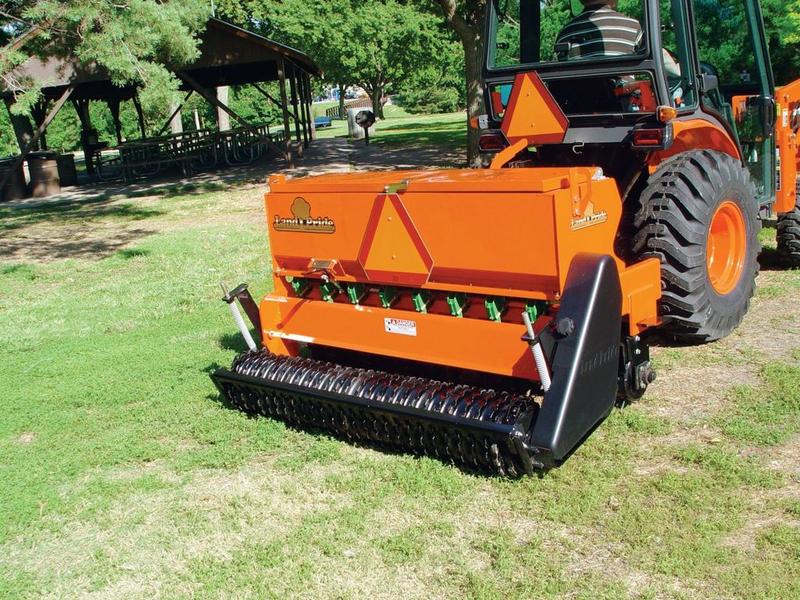
The Land Pride APS1572 combines surface-working rollers with a ground-driven seed-metering system. It deserves consideration when acreage seeding involves both preparing the immediate surface and distributing seed across a suitable area. Its usefulness depends on the required establishment method, the seed being used and whether the tractor can handle the complete loaded implement.
Do not start with the assumption that an all-purpose seeder performs every type of planting. A broadcast seeding arrangement is different from a machine that places individual seeds or drills rows to a specified depth. Define the required seed placement and site preparation first, then decide whether the APS1572’s method belongs in the plan.
On This Page
ToggleUse the newer manual consistently
The November 6, 2025 operator manual lists the APS1572 at approximately 1,046 lb, with a 73-inch broadcast seeding width, 85⅜-inch overall width, a six-bushel seedbox and ten seed cups. It specifies a Category 1 hitch for this model and describes a rear-roller ground drive.
Older promotional literature lists different dimensions and weight. Those figures should not be mixed into a single specification set. If shopping used, identify the actual machine and the equipment supplied; if shopping new, obtain the configuration-specific confirmation on the quotation.
The manufacturer’s APS15 family listing places the APS1572 in a 25–130-hp tractor range. That range does not mean that every tractor within it can carry a loaded seeder. It is one screen within a complete hitch, mass, ballast and clearance assessment.
Ground drive changes the calibration question
The metering system takes its drive from ground travel through the rear roller. This is different from choosing a PTO speed to run a powered tiller or broadcast spinner. The important relationship is between actual distance travelled and seed delivered through the correctly configured mechanism.
That does not remove the need for calibration. Seed characteristics, selected metering configuration and the machine’s condition still matter. A rate-chart setting is a starting point to check with the actual seed, not proof that the desired quantity has reached the ground.
Keep a record of the seed lot, configuration, calibration result and area covered. This makes it possible to distinguish a metering discrepancy from an incorrect area estimate. Without those records, an unexpectedly empty box can lead to the wrong adjustment.
For a hypothetical target of 80 kg per hectare over 0.4 hectares, the planned quantity is 32 kg. If 40 kg is actually consumed over the same measured area, the apparent application is 100 kg per hectare, 25% above the intended rate. These invented figures illustrate checking arithmetic; they are not agronomic recommendations.
Separate preparation passes from seeding passes
The APS1572’s front rollers and seed system participate in the same overall process, but preparation and seed application need not be confused. Evaluate whether the surface is ready before allocating the seed budget to a pass.
The cited manual provides a specific method of disengaging the seed drive for preparation. It warns against treating a zero rate-lever setting as the way to stop seed flow while the cups turn. Follow that procedure rather than improvising from how another spreader works.
This distinction matters financially as well as mechanically. If a second preparation pass is needed, it should not unintentionally become a second full seeding application. A work plan should identify which traversals condition the area and which deliver seed.
Before the main job, use an appropriate trial to assess the preparation result and correct setup. The manual also advises against working in wet or muddy conditions. More aggressive adjustment is not a universal answer to a surface that is unsuitable for the intended operation.
Six bushels is volume, not a fixed seed weight
The box capacity tells you the volume available. The mass of seed occupying that space depends on the actual material. Do not convert it to a universal bag count or payload without the seed information and the implement’s applicable limits.
For the tractor assessment, consider the loaded configuration rather than only the approximately 1,046-lb implement figure. Additional boxes, accessories and connection equipment must also be accounted for. A tractor that raises the empty machine for a demonstration has not necessarily been approved for the planned working load.
Refill convenience should be evaluated on the actual property. Identify where seed is stored, how it will be transferred under the prescribed procedure and whether the location remains accessible during the job. A large box offers little benefit if filling it creates an unsuitable handling routine.
Buy seed quantities from the measured area and appropriate establishment plan, not from a desire to fill the hopper. Some projects will sensibly use only part of its volume. Avoid treating unused hopper space as a reason to increase the application rate.
Measure the full machine, not the model number
The difference between the documented broadcast width and overall width affects gates, storage and plot access. The machine needs room beyond the treated strip. Include turns and alignment space, not just whether it can pass straight through an opening.
For area planning, use the actual pass spacing that achieves the required application. Overlap and irregular boundaries change net coverage. Dividing the entire property area by the nominal width ignores areas that are not seeded and sections receiving repeated coverage.
As an invented planning example, a 1.7-metre effective width at 4 km/h gives a straight-line rate of 6,800 square metres per hour. At an assumed 60% efficiency, that becomes 4,080 square metres per hour. A 4,000-square-metre area would take about 59 minutes for one pass, before separate calibration, filling and cleanup.
Those inputs are not operating recommendations or measured APS1572 performance. They demonstrate why the working pass may be only part of the session. If the project requires a separate preparation pass, add it explicitly instead of presenting the first calculation as completion time.
Roller configuration belongs on the quotation
The manual describes rear roller alternatives and optional scrapers. Verify which equipment is supplied and why it suits the intended surface. Photographs showing an optional configuration should not be used to infer that every quoted unit includes it.
Do not choose a roller solely from a promise of a finer-looking finish. State what the establishment plan requires and assess the resulting surface accordingly. The appropriate choice must consider the work rather than an isolated feature list.
If a used machine has a different roller arrangement from the one demonstrated, revisit the comparison. Changes in configuration can affect condition, handling and parts needs. A common model name does not establish that two packages are equivalent.
Likewise, record whether an additional seedbox is present and suitable for the intended material. Separate metering equipment introduces its own setup and calibration questions. Do not assume a mixture can be handled correctly merely because both ingredients are described broadly as grass or small seed.
Distinguish application accuracy from establishment success
A seeder can distribute the measured quantity correctly without guaranteeing the desired stand. Seed selection, site condition, placement requirements, timing and subsequent management remain part of the establishment project. The equipment purchase should not be sold as a substitute for that plan.
Define two sets of acceptance checks. During the machinery demonstration, assess the seed-delivery system, preparation result and completed coverage. For the broader project, establish appropriate expectations and follow-up with the seed supplier or qualified local advice.
Do not attribute a later poor result automatically to the meter setting. First reconcile the records: material used, measured area, machine setup, site conditions and any subsequent events. This is more useful than repeating the entire application simply because the initial result was disappointing.
For Canadian properties, avoid a universal planting date. The appropriate window depends on location, species and intended use. Equipment availability should support a suitable plan rather than force the work onto the day the machine happens to arrive.
Compare the complete establishment system
| Alternative | What to compare | Possible reason to choose it |
|---|---|---|
| APS1572 arrangement | Integrated surface action and ground-driven application | Recurring projects suited to its method |
| Separate preparation and spreader | Additional passes, calibration and final required operation | Existing equipment already covers much of the process |
| Different seeding mechanism | Required placement and establishment method | The project needs a different form of delivery |
| Contracted establishment | Complete scope, timing and follow-up | A large one-time project or unsuitable host tractor |
The FSP500 spreader guide covers a different application arrangement. Compare the entire sequence needed to achieve the project result, rather than comparing only how quickly each device empties seed.
Where substantial cultivation is needed first, the RTA1258 guide explains a separate powered-tillage purchase. Adding that operation to a seeding plan should respond to a site requirement, not an assumption that every area needs maximum disturbance.
Used inspection should include the metering path
Check the hopper, lid, cups, drive components, guards, roller bearings, frame and hitch. Confirm that adjustments and shutoff components are complete and correspond to the applicable manual. A freshly painted hopper does not establish accurate seed delivery.
Look for residue, corrosion, worn parts or repairs that could affect the mechanism. Assess the installed roller and any additional box separately. These are general used-equipment checks, not claims of a recurring APS1572 failure pattern.
A meaningful demonstration includes a permitted calibration check with suitable material. Turning a roller and observing movement proves less than measuring delivery and verifying consistent operation through the intended system. Have repairs and setup priced before judging the used offer.
Store the configuration and calibration notes with the machine records. They support repeatable setup, but they should not become permanent settings applied blindly to different seed lots or a changed machine. Recheck whenever the relevant inputs change.
Before delivery, ask for a written handover covering the supplied seed-drive configuration and the calibration procedure for the intended material. Keep the actual measurements rather than only the final lever position. When a later job uses a different area or seed lot, the record should help explain what changed, not encourage copying a setting without checking delivery again.
Buying questions to close
Does a ground-driven seeder require a PTO driveline?
The documented APS1572 seed drive comes from its rear roller. That distinction does not remove tractor carrying and compatibility requirements.
Is 72 inches the exact treated width?
The November 2025 manual lists 73 inches of broadcast seeding width and a larger overall envelope. Actual pass planning must still account for appropriate coverage and overlap.
Can an empty lift demonstration establish tractor fit?
No. The loaded and equipped configuration, hitch geometry, transport position and tractor requirements must be assessed together.
Can the seed chart replace calibration?
No. Check delivery with the actual material and correct procedure, then reconcile use against measured area.
Who should shortlist this model?
An owner with recurring suitable seeding projects, a verified tractor combination and a practical calibration and filling routine. For occasional establishment, compare the complete rental or service option before committing to storage and upkeep.
Share your experience
Help other Canadian buyers — leave a quick review for the
Land Pride APS1572
There are no reviews yet. Be the first one to write one.