Overview & Specs
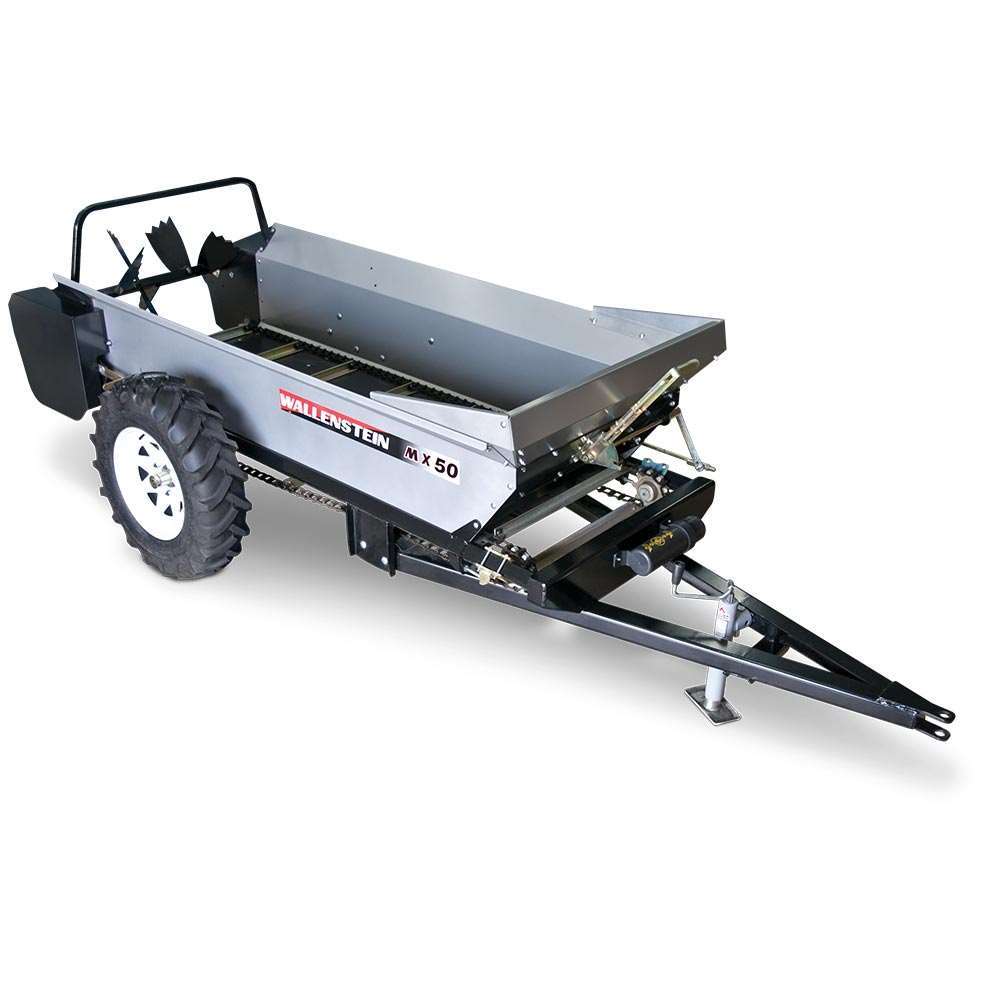
The Wallenstein MX50G is a ground-driven manure spreader to consider when small livestock chores need a towable distribution tool without a PTO connection. Its usefulness depends on the loaded towing combination, ground traction and a suitable application plan. The absence of a PTO shaft simplifies one part of the connection; it does not make every small towing vehicle suitable.
For a Canadian acreage or small horse property, begin with the actual material generated and the route from storage to the permitted application area. A compact spreader can be convenient for recurring batches, but capacity alone cannot establish how frequently it should be used or where manure may be applied.
On This Page
ToggleWhat the 50-bushel specification means
The Canadian product page lists 50 bushels of heaped capacity, expressed as 62.5 cubic feet. It describes a ground drive, chain-and-sprocket apron, ten paddles and a tongue-and-groove poly floor. Listed machine weight is 795 lb, with an overall envelope of 156 by 57 by 36 inches.
Heaped volume is not a maximum permissible mass. Material density and bedding content can vary, and the towing system has its own limits. Do not fill to a visual heap and assume that the combination is acceptable because the box has room.
Similarly, the listed tongue-weight figure should not be treated as the loaded hitch requirement for every material distribution. Assess the actual loaded arrangement and the tow vehicle’s applicable limits. An empty demonstration establishes much less than a complete working assessment.
Ground drive needs movement and traction
The spreader’s working drive comes from its ground wheels rather than a tractor PTO. That makes wheel contact and traction part of the distribution process. A surface that allows the tow vehicle to move is not necessarily a surface where the spreader’s drive behaves consistently under load.
Assess the recurring route and application area for the intended season. Soft, slippery or uneven conditions can affect the combination in ways that an empty demonstration on a firm yard does not reveal. Do not treat ground drive as a guarantee of uniform delivery regardless of surface.
The operating relationship also differs from a PTO-driven machine. Movement of the combination is part of the mechanism’s energy supply. A buyer should understand the manufacturer’s engagement and control sequence before deciding whether it suits frequent starts, stops and short passes.
Do not attempt to compensate for an unsuitable site by towing faster or bypassing controls. Establish that the machine is appropriate for the conditions and use the prescribed procedure. The buying decision should resolve the task rather than transfer uncertainty to the operator.
Resolve the published tractor-range difference
The current Canadian page lists a 15–30 engine-hp range. The March 2024 MX manual gives a broader 15–55-hp recommended tractor range for the MX50G. Those ranges should not be merged into an approval for an unidentified towing vehicle.
Obtain confirmation for the exact spreader and proposed tow vehicle, especially when an ATV, UTV or lawn tractor is being considered. Power is only one screening figure. Hitch configuration, loaded towing capability, braking, terrain and the manufacturer’s conditions all remain relevant.
The useful result is a documented combination, not a statement that a vehicle of similar horsepower has towed a similar spreader. An anecdote does not establish the buyer’s loaded arrangement or route.
If a suitable tractor is already available, compare the actual convenience of using it with the proposed smaller vehicle. Avoid adding another towing solution merely to avoid a PTO connection that this machine does not require in the first place.
Material characteristics determine the real workload
Describe the manure and bedding mixture normally handled. Its condition, consistency and storage history affect how it occupies the box and how it can be distributed. A nominal bushel capacity cannot replace that material assessment.
Separate recurring work from exceptional accumulations. A machine convenient for regular small batches may be inefficient for clearing a large backlog. Conversely, buying around one unusual cleanout can leave the owner storing and towing more machine than daily chores justify.
Keep foreign objects and unsuitable material out of the handling stream. The spreader is a distribution machine, not a general waste processor. Cleaning and sorting upstream can be more useful than expecting the beater to deal with whatever enters the box.
For a demonstration, use appropriate representative material through the approved procedure. The result should show how the machine handles the ordinary mixture, not merely how it runs empty. Note any material left for separate handling rather than counting it as completed work.
The apron setting is not an agronomic prescription
The product page describes three speed selections. Those control choices help govern delivery, but a lever position alone does not establish a nutrient application rate or uniform coverage. Machine setup, material characteristics, travel and effective distribution all interact.
Use an appropriate nutrient and site-management plan to determine what application is suitable. The spreader delivers material; it does not decide the agronomic requirement. This guide does not provide a universal manure rate or an all-province seasonal spreading rule.
Aglist’s FSP500 guide illustrates the distinction between distributing a material and verifying mass per area. The equipment and material are different, so its settings do not transfer to manure. The useful shared lesson is to measure the result rather than assume the control label proves it.
Application uniformity is a separate question from average quantity. Delivering the intended total over a field does not prove that it was distributed evenly. The evaluation should consider both the amount and the pattern using an appropriate method and the manufacturer’s instructions.
Plan capacity with actual permitted loads
Estimate the recurring quantity that must be moved, then determine a permitted working load for the verified combination. Do not begin by assuming every trip uses the full heaped volume. A partial load may be the correct choice for the material, towing limits or site.
As an invented logistics example, suppose a task involves 180 cubic feet of suitable material and the verified arrangement permits a 45-cubic-foot working batch. Four trips are required. If a different approved combination carries 60 cubic feet, three trips would be needed. These are planning assumptions, not MX50G loading recommendations.
The benefit of eliminating one trip depends on the route. If each return-and-loading cycle takes twelve minutes, one avoided cycle saves twelve minutes. If the supply is beside the application area, the saving may be much smaller. Count the complete trip rather than comparing box sizes in isolation.
Also assess loading effort. A larger batch can save travel but require a less convenient loading arrangement. The best size is the one that fits the whole recurring chore, including the equipment and people already available.
Measure access beyond the box width
The overall machine envelope matters for gates, turns and storage. The box itself is narrower than the complete machine. A straight-through clearance check does not establish that the tow vehicle and spreader can negotiate the approach or turn afterward.
Sketch the full route from loading point to field and back. Include places where reversing would otherwise be necessary and assess them under the applicable instructions. A compact machine can still be inconvenient in a poorly arranged yard.
Loading access deserves equal attention. Confirm how the actual loading equipment reaches the box without contact or an unsuitable position. A demonstration should use a realistic arrangement rather than assume that any loader can reach from any side.
Leave room for inspection, cleaning and connection in storage. A parked footprint that fits tightly between other machines may make routine preparation difficult. Equipment used frequently for chores benefits from straightforward access, not merely a place where it can be squeezed in.
Poly flooring does not make maintenance disappear
A poly floor is one component of a larger machine. The apron, chains, sprockets, bearings, beater, frame and protective components still require the documented inspections and service. Do not interpret a rustproof floor description as a maintenance-free spreader.
Build cleanup into the chore schedule. Follow the manufacturer’s cleaning and storage procedure and manage the resulting material appropriately. Leaving residue because the next use is expected soon can make condition harder to assess and the next session less predictable.
Retain a record of adjustments and repairs with the serial number. This helps distinguish the actual installed arrangement from an assumption based on another MX-family model. It is particularly useful when a used machine has a long or unclear service history.
For seasonal storage, assess the machine before putting it away and before returning it to service. An empty-looking box does not establish that the apron and drive are ready. Avoid waiting until the next urgent cleanout to discover missing or worn components.
Used inspection should focus on delivery as well as towing
Have a competent person inspect the complete drive path, apron, paddles, bearings, floor support, box, frame, tyres, hitch and guards. Use the prescribed shutdown and secured condition. These are general condition priorities, not claims of known MX50G failure patterns.
Look for undocumented alterations and parts that do not correspond to the applicable manual. A machine can tow easily while delivering material inconsistently. Cosmetic repair does not establish that the metering and spreading mechanism is ready.
A representative demonstration should clarify engagement, selected delivery settings and the actual distribution routine. Do not reach into a moving apron or beater to investigate an irregular result. Uncertain behaviour belongs in a competent service assessment.
Compare the used price plus required work with a complete ready alternative. A low purchase price can be misleading when the drive, tyres and protective components all need attention. Obtain a scope of work rather than guessing that one replacement part will resolve an unconfirmed problem.
When the MX50G fits the property
| Situation | Selection implication |
|---|---|
| Recurring modest batches and suitable firm access | Evaluate ground drive and the verified towing package |
| Long trips with a large recurring quantity | Compare approved working loads and complete trip time |
| Uncertain tow-vehicle limits | Resolve loaded compatibility before buying |
| Application plan not established | Determine suitable handling and destination before selecting capacity |
The strongest ownership case combines regular work, a confirmed towing arrangement and a practical application plan. For infrequent large cleanouts, compare a suitably equipped service for the same scope. That comparison should include loading, transport and application rather than a bare machine rate.
Frequently asked questions
Does the MX50G need a tractor PTO?
No. Its documented drive is ground-powered. Loaded towing and traction requirements still need verification.
Does 50 bushels establish a safe payload?
No. It is a heaped-volume figure. Material mass and the complete combination’s limits must be assessed separately.
Can the listed horsepower range approve an ATV?
No. Exact vehicle, hitch, loading and terrain conditions matter, and the page and manual show different power ranges.
Does three-speed control establish application rate?
No. It is a machine adjustment. Appropriate rate and distribution must be verified for the material and site plan.
What makes a demonstration useful?
Representative suitable material, the intended verified towing arrangement and an assessment of the complete loading, travel and distribution routine. Empty running alone does not answer those questions.
Share your experience
Help other Canadian buyers — leave a quick review for the
Wallenstein MX50G
There are no reviews yet. Be the first one to write one.