Overview & Specs
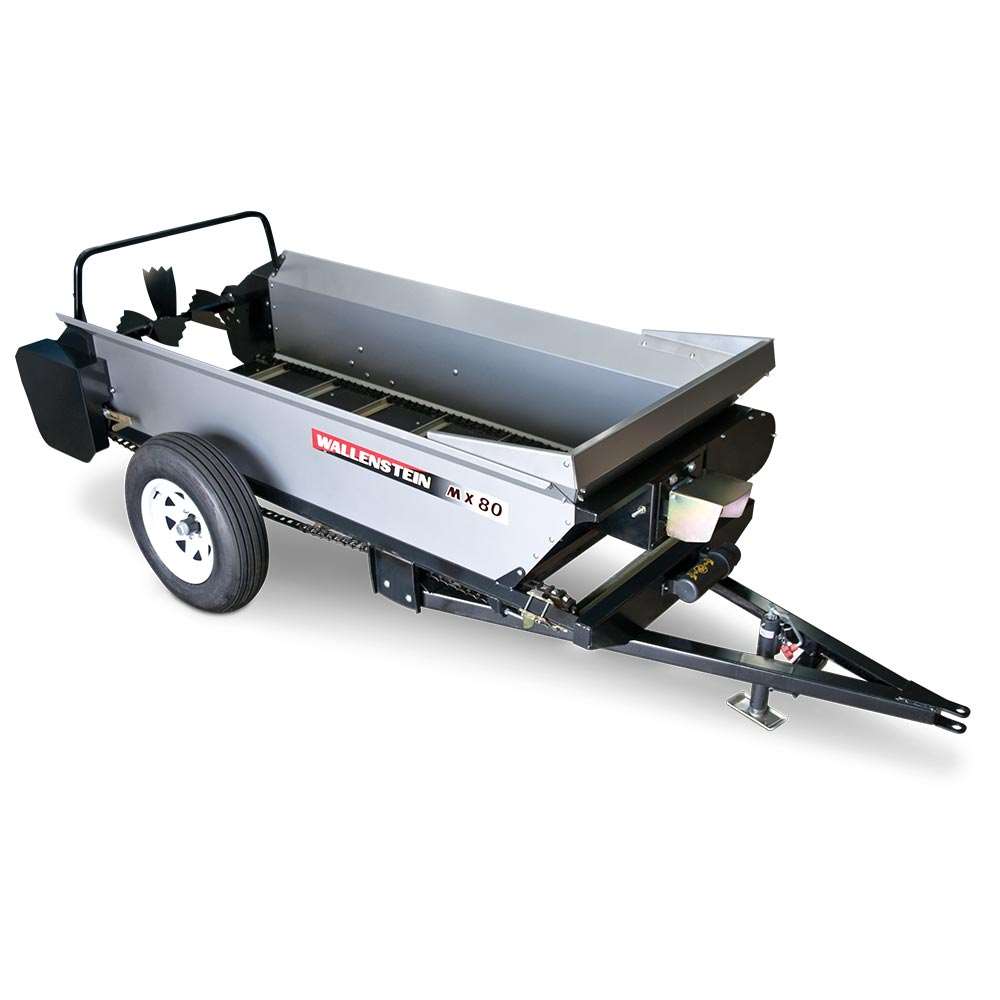
The Wallenstein MX80P is a PTO-driven manure spreader for buyers whose recurring work benefits from a larger batch and a powered spreading mechanism. The ownership case should be built around the whole loading-and-return cycle, not the assumption that an 80-bushel box automatically makes every small-farm chore more efficient.
Its PTO arrangement distinguishes it from ground-driven alternatives. The tractor supplies rotational power rather than relying on the spreader’s wheels for that drive. This changes the relationship between travel and the spreading mechanism, while adding shaft compatibility and tractor requirements that must be verified before purchase.
On This Page
ToggleDefine the recurring batch before selecting the machine
List how much suitable material accumulates between normal jobs and where it must go. Include the loading method, distance to the application area and the time spent returning for another load. A machine selected around those facts is easier to evaluate than one chosen around maximum advertised volume.
The Canadian MX80P page lists 80 bushels heaped, or 100 cubic feet, a PTO drive, chain-and-sprocket apron and ten paddles. It gives a 920-lb machine weight and an overall size of 168 by 63 by 37 inches. The box dimensions are 102 by 38 by 20 inches.
These are useful physical descriptors, but none establishes the permissible loaded mass for every towing combination. A material with more moisture or a different bedding proportion can change the mass occupying a given volume. A visually full box is not a scale.
Keep the load plan separate from the application plan. Having enough material to fill the spreader is not a reason to apply more than the site requires or to use an unsuitable location. The machine should support the farm’s plan rather than determine it.
What PTO drive changes in practice
PTO drive allows the mechanism’s power source to be considered separately from ground-wheel rotation. That distinction can be useful when comparing work patterns, but it is not a guarantee of uniform application at any travel speed. The amount delivered per area still depends on the complete operating relationship.
Think of delivery and travel as separate variables that must be coordinated. If the amount discharged per unit time stays similar while less area is covered, the average amount per area changes. Conversely, covering more area does not prove the desired distribution has been maintained.
Use the model’s specified engagement, drive and adjustment procedures. Do not assume that a method used on a ground-driven spreader applies unchanged. Starts, stops and turns deserve attention because they can create local differences even when the overall field average looks reasonable.
Aglist’s PTO and engine horsepower guide helps distinguish shaft output from engine ratings. It is not a substitute for the MX80P’s requirements, and a universal percentage deduction from engine horsepower should not be used to invent a compatibility rating.
Published tractor ranges do not fully agree
The current Canadian product page gives a 30–50 engine-hp range. The March 2024 MX-series manual lists 35–95 hp as the recommended tractor size for the MX80P. This is a material difference, not a rounding issue.
Before committing, obtain confirmation for the actual spreader and tractor. Do not combine the lowest minimum from one source with the highest maximum from another. The final documented package should resolve which requirements apply to the supplied unit.
The manual separately identifies a belt/gearbox beater drive and a chain-and-sprocket apron. That distinction matters for service inspection: one working mechanism does not establish the condition of the other.
Power remains only part of compatibility. Loaded towing, hitch arrangement, shaft geometry, braking and the intended terrain all need assessment. A tractor that can turn the empty mechanism has not thereby been shown suitable for the proposed loaded route.
Calculate trips using a permitted working volume
Theoretical box capacity is useful for screening alternatives, but actual trip planning should use the allowed working load for the material and combination. This may be less than heaped capacity. A larger box can still be useful at a partial fill, but its advantage must be calculated honestly.
For an invented example, suppose a recurring job involves 240 cubic feet of material. An approved 60-cubic-foot working batch requires four trips. An approved 80-cubic-foot batch requires three. The larger working batch removes one complete trip; it does not eliminate a quarter of every activity in the job.
If loading and return travel together take 18 minutes per trip, the assumed saving is 18 minutes. If total distribution time remains 45 minutes, the first arrangement takes 117 minutes and the second 99 minutes before other setup and cleanup. Those are illustrative inputs, not MX80P performance measurements.
Now consider a property where the loading point is close and each cycle takes only five minutes. The same one-trip reduction saves five minutes. This is why a larger spreader can be compelling on one farm and provide little practical benefit on another with a similar annual quantity.
Loading equipment can set the useful size
Check the actual loader or other approved filling method against the box and available approach. Reach, clearance and positioning matter. A machine that carries a larger batch may still be inconvenient if filling it requires repeated repositioning or an unsuitable loading angle.
Include the material’s physical consistency in the trial. A loading system that works for one loose mixture may handle another differently. Keep the demonstration focused on the regular material rather than selecting an easy sample that conceals the real workload.
Consider whether the loading point remains accessible during the intended season. The advantage of fewer trips depends on being able to fill and travel appropriately. Equipment ownership does not make an unsuitable route or application condition acceptable.
If the same tractor performs loading and towing, include changeover time. A larger batch may reduce the number of changes, but the sequence must be practical. If another machine is required, its cost and labour belong in the comparison rather than disappearing behind the spreader’s capacity figure.
Verify quantity and pattern separately
A satisfactory job requires more than emptying the box. The appropriate amount must be distributed over the intended area in a suitable pattern. Machine control settings help produce that result but do not define the agronomic requirement.
Use a site-specific nutrient-management plan and appropriate local requirements for timing and application. This guide does not prescribe a manure rate, a setback or a universal Canadian seasonal rule. Those depend on the actual location and circumstances.
A simple arithmetic example illustrates the measurement distinction: if a hypothetical permitted plan calls for a particular material quantity over one hectare, spreading that same quantity over only half a hectare doubles the average amount per area. The calculation does not establish that either rate is agronomically suitable.
Uniformity is another layer. Correct total quantity can still be concentrated in strips or at turning points. Evaluate the pattern and operating routine using an appropriate method rather than treating the field average as proof that every part received the intended application.
The FSP500 article discusses measurement and calibration for a different material and machine. Its numerical settings do not transfer. The relevant principle is to verify delivery against area and distribution instead of relying solely on a lever position.
Access and turning space can outweigh volume
The listed overall width is larger than the box width. Gates and storage openings should be assessed using the complete machine, with room for the approach and tow-vehicle path. Passing through an opening in a straight line is not the same as completing the turn beyond it.
Map the recurring route before delivery. Identify tight corners, narrow loading areas and places where the combination would need to reverse. Check the intended manoeuvres against the operating instructions rather than assuming a trailer-like outline implies identical behaviour to another implement.
Storage should allow connection, inspection and cleaning access. A larger machine that saves one field trip but requires rearranging the shed every time it is used can give back the saving at the start and end of the session.
Where transport between properties is planned, verify the machine’s instructions and the requirements applicable to the proposed arrangement. Physical towing capability is not a blanket approval for every road or towing vehicle.
Compare a smaller spreader and a service on equal terms
| Alternative | What must be included |
|---|---|
| Smaller spreader | Additional loads, travel and possible attachment changes |
| Ground-driven spreader | Traction-dependent drive and a verified loaded towing package |
| MX80P package | Confirmed tractor requirements, PTO setup and useful working load |
| Contracted work | Actual loading, hauling, application and timing scope |
A service quote may cover work beyond the owner’s bare distribution step. Identify that scope before comparing prices. If the service includes loading and transport, add those tasks to the owner-operated estimate as well.
For a cost illustration only, assume CAD 900 of annualised ownership and service allowance before tractor operation and labour. At twelve sessions it is CAD 75 per session; at three sessions it is CAD 300. These invented figures show utilisation sensitivity, not a Canadian MX80P price or predicted maintenance bill.
Convenient timing can still justify ownership when the simple cost comparison is close. State that preference directly. It should not be supported by an invented yield benefit, guaranteed nutrient saving or optimistic resale figure.
Inspect the used drive system as a complete chain of components
A used assessment should cover the shaft and guards, beater drive, apron system, controls, floor support, box, frame, hitch, tyres and bearings. Have a competent person inspect under the specified secured conditions. These are inspection priorities, not assertions about recurring defects.
Ask for records of repairs and identify substituted parts. A newly painted box can coexist with worn delivery components. A mechanism that turns unloaded may still need further assessment before it is considered ready for representative work.
Price restoration as a complete package. Do not assume that a noisy or irregular mechanism needs only the cheapest visible component. An informed estimate should distinguish confirmed repairs from unresolved symptoms.
The correct manual and serial information should stay with the machine. That helps avoid applying another MX variant’s parts or adjustments simply because the family shares a box size or similar appearance.
Make cleanup part of the equipment decision
Evaluate how the spreader will be cleaned and stored under the manufacturer’s instructions. Access to the machine and a suitable place to manage residues are practical ownership requirements, especially where several livestock chores share a small yard.
A poly floor does not eliminate service needs in chains, drives, bearings or protective components. Keep inspections and maintenance tied to the actual machine requirements. Seasonal storage should not begin with an unresolved mechanical issue that will reappear during the next urgent cleanout.
Record the final working setup, actual load assumptions and observations from the first appropriate application. That creates a useful starting point for future comparable jobs without turning one setting into a permanent prescription for every material.
Frequently asked questions
Is the MX80P ground-driven?
No. The cited configuration uses PTO drive. Ground-driven MX variants are separate models and should not be treated as the same operating package.
Does 80 bushels mean every load should be heaped?
No. The safe and suitable working load depends on material mass and the complete approved towing arrangement.
Which horsepower range is correct for my tractor?
The current page and March 2024 manual differ materially. Obtain confirmation for the exact supplied machine and tractor rather than selecting a convenient combination of the two ranges.
Does PTO drive guarantee even spreading?
No. Quantity, travel, material condition and distribution pattern still need appropriate verification.
When is the larger box worth choosing?
When the verified working load removes enough recurring loading and travel effort to justify the larger complete package, while access, tractor fit and the application plan remain suitable.
Share your experience
Help other Canadian buyers — leave a quick review for the
Wallenstein MX80P
There are no reviews yet. Be the first one to write one.