Overview & Specs
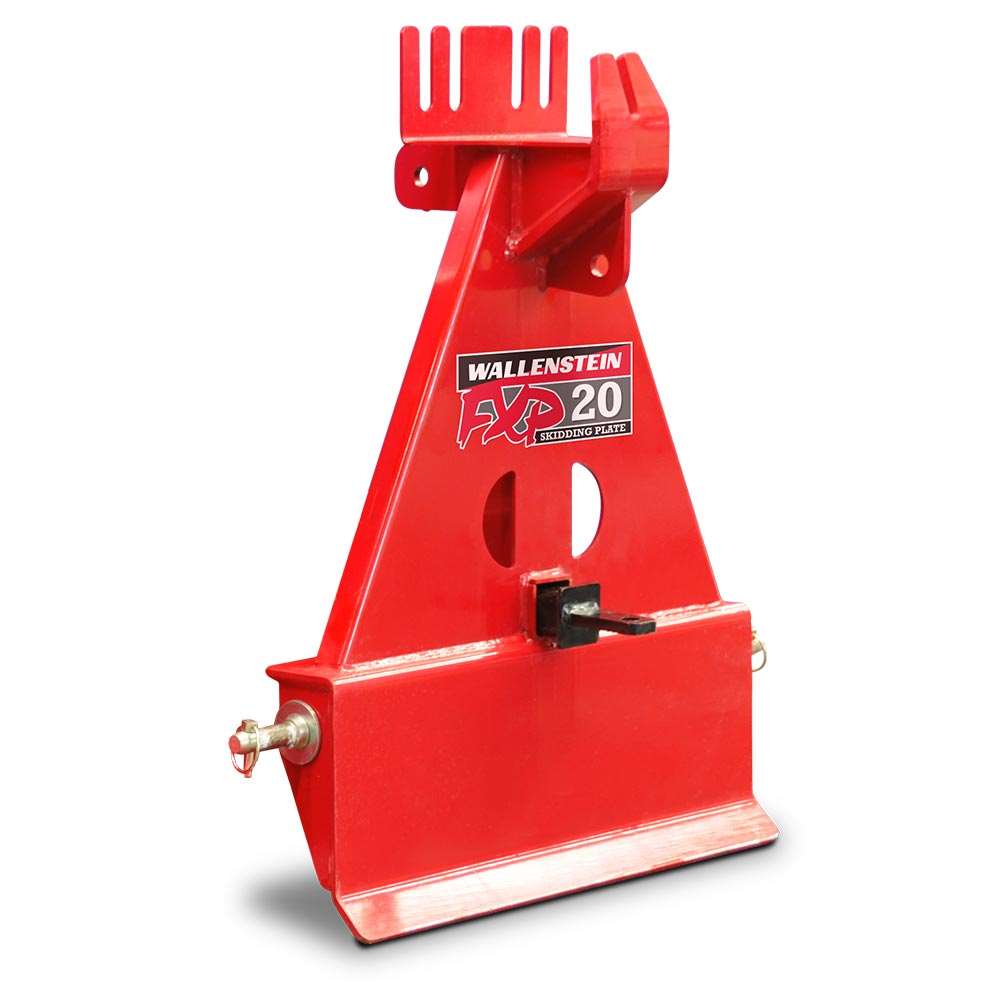
The Wallenstein FXP20 is a Category I three-point skidding plate for suitable tractors up to the manufacturer’s stated forty-horsepower range. It provides attachment points for approved log-connection equipment so the front of suitable logs can be raised for skidding. It has no powered winch, hydraulic grapple or independent drive. That simplicity is its main attraction and the boundary of what it can do.
For a Canadian acreage owner, the first question is whether the tractor can reach an appropriate connection position and then follow a suitable route with the timber. If the real need is to retrieve logs from beyond tractor access, the FXP20 does not supply that missing reach. A skidding plate and a cable winch solve different parts of the job.
This guide uses the Canadian product page and March 2021 FXP-series manual, checked in October 2026. It assesses the FXP20 separately from the larger FXP30 and does not treat an engine-horsepower range as a permitted log-load rating.
On This Page
ToggleWhat the plate adds to a tractor
The plate provides a purpose-designed rear structure with a mast, saddle-grab hook and chain-holder slots. Its function is to support the intended skidding connection rather than simply attach a chain wherever it happens to fit on the tractor. The complete setup still needs the correct tractor, approved connecting equipment and the operating method in the manual.
Raising the front of a suitable log changes how it contacts the ground during movement. It does not make the whole log weight disappear or turn the tractor into a loader. Part of the load may remain on the ground, while the tractor must still control the supported portion and the forces generated during travel.
The product page says the plate can handle multiple logs, but that is not an instruction to maximize the bundle. The appropriate material and connection must be assessed as a complete load. More pieces can change shape, trailing behaviour and the space required, even when their combined mass appears modest.
FXP20 specifications and what they leave unanswered
| Item | Published FXP20 specification | Buying consequence |
|---|---|---|
| Tractor engine range | Up to 40 hp | Not a promise that every smaller tractor suits every load. |
| Saddle-grab hooks | One | Hook count is not a rated number of logs. |
| Attachment weight | 98 lb | This is the plate’s mass, not its log capacity. |
| Dimensions | 35 by 12 by 32 inches | The trailing timber determines a much larger movement envelope. |
| Mounting | Category I | Verify the actual three-point connection and tractor requirements. |
The Canadian page identifies four chain-holder slots and a removable hitch. Neither feature supplies a universal towing or skidding load limit for an unknown tractor. Do not manufacture a tonnage figure from the attachment’s dimensions or from what another owner says they pulled.
The manual lists the FXP30 as a different, heavier model with two saddle-grab hooks and Category I/II mounting. Those specifications should not be copied into an FXP20 description. Buying the smaller plate is a decision about the actual tractor and recurring work, not just a lower number in a product family.
Access decides whether a passive plate is enough
Walk from the proposed tractor position to each typical log location. Can the tractor reach an appropriate connection point on suitable ground? Is there space to align the intended movement? Can the load follow the route without catching on obstacles or swinging into something?
A powered winch such as the FX85 can provide cable retrieval within its own approved operating conditions. The FXP20 does not have that capability. It relies on the tractor’s movement for skidding once the load is correctly connected.
This distinction is especially important when a property contains scattered timber beyond a maintained trail. A low-cost plate may be attractive for accessible pieces near a landing, but it is not a substitute for the retrieval method needed elsewhere. Evaluate the proportion of the recurring work it can actually address.
Do not let a purchase price determine the operating route. If the only way to use the plate is to drive the tractor into an unsuitable area, it is the wrong tool for that part of the job. A different method or professional assistance may be more appropriate than trying to compensate with a larger tractor.
The tractor’s stability and hitch geometry remain central
Engine output describes only one aspect of the tractor. Mass, wheelbase, hitch capacity, ballast requirements and the approved operating conditions affect the complete combination. A tractor below forty horsepower is not automatically suitable because it falls below the page’s stated upper range.
The manual emphasizes keeping the pulling point low and being cautious around hills and rough ground. Use the complete instructions rather than turning that statement into an improvised rigging formula. The attachment’s purpose-designed connection does not authorize arbitrary changes to chain position or tractor setup.
A quick hitch can change the plate’s position behind the tractor. Do not infer approval merely from the Category I designation. Verify the exact connection, clearances and permitted arrangement. The Category I quick-hitch guide explains why matching pin category is only part of equipment fit.
Before collecting a used plate, establish where it will be parked and how it will be connected. Its relatively low mass can make it seem easy to handle, but it still needs stable support and the correct shutdown and attachment procedure.
Choose and inspect the connecting equipment
The FXP manual discusses choker chain, logging tongs and synthetic chokers as connection methods with their own instructions. The plate is not a reason to use an unidentified chain or damaged sling simply because it passes through a slot.
Synthetic equipment and steel chain have different inspection considerations. The manual notes the abrasion vulnerability of synthetic chokers and the importance of avoiding shock loading. Select the correct approved equipment and follow its inspection criteria. A visibly damaged connection should not be retained to make a used purchase appear complete.
Ask which connecting items are included in the sale, identify them and inspect them separately from the plate. A sound steel attachment with unsuitable rigging is still an incomplete working package. Price correct replacement equipment before comparing offers.
Keep the operating sequence manageable for the person doing the work. Repeated connecting and disconnecting may take more time than the actual travel. If that is the dominant part of the job, a different approved handling system may deserve comparison even when the plate itself performs its intended function.
Plan for the full length of the timber
The FXP20 is only thirty-five inches in its listed length dimension, but the working combination can be much longer. The end of a log can follow a different path from the tractor’s wheels during a turn. Gateways and trees that the tractor clears may still obstruct the trailing material.
Mark the receiving area as carefully as the pickup point. Logs deposited across the return path create another handling task. An orderly landing should allow the next movement without repeated repositioning of previously delivered material.
Consider the next operation too. If the timber will be cut, split, loaded or stored, leave suitable access for that stage. A plate can help move accessible logs to a location, but it does not stack them at loader height or replace a sawmill’s loading arrangement.
A log grapple such as the LXG210S represents a different carrier-based handling method. Its mount, controls and rated limits belong to that complete carrier package. It should be compared for the task it performs, not because its jaw opening can be matched to the plate’s dimensions.
A simple workflow comparison
Suppose a representative set of accessible movements takes three minutes to connect, four minutes to travel and three minutes to release and return to the next setup. Ten movements total one hundred minutes. If improved landing organization removes one minute from each release-and-return stage, the total falls to ninety minutes without changing the attachment.
These are invented planning times, not measured FXP20 output. They show why a passive attachment can still be part of an efficient system when the route and connections are well planned. They also show why buying more pulling equipment may not solve a delay caused by a congested landing.
For occasional use, convenience can be the main benefit. Compare the complete cost with another suitable service or arrangement using actual quotations. Include the connecting equipment, transport and any tractor preparation rather than treating the bare plate price as the whole investment.
Used inspection: simple does not mean inspection-free
Identify the model and compare the plate with the correct parts information. Inspect the mast, frame, saddle-grab hook, chain slots and three-point mounting locations. Look for deformation, cracks, missing retaining hardware and repairs needing qualified assessment.
Pay attention to the condition of contact surfaces and connecting equipment. Wear at a load-bearing point can matter even when the rest of the attachment looks freshly painted. A cosmetic finish is not proof of structural condition.
The removable hitch and its retaining parts should also be present and correctly identified if they are part of the sale. The manual describes a ball-mount arrangement in a two-inch square receiver, but this does not supply a blanket trailer-towing rating for every tractor combination. Treat any proposed towing use as a separate compatibility question.
A demonstration should use an appropriate tractor, suitable material and the manufacturer’s procedure. Do not ask for an oversized load to prove strength. The objective is to confirm condition and fit, not to discover the failure limit of an unknown used attachment.
Seasonal work on Canadian properties
A route that is practical during one work window may be unsuitable after rain, thaw or ice. Review ground and access conditions before each planned job. The plate has no mechanism that compensates for a tractor losing traction or encountering a blocked path.
Store the attachment and connection equipment so they can be inspected before the next session. Keep the manual with the machine and retain identification for replacement parts. A simple attachment is most convenient when the complete kit is ready, rather than scattered across several sheds.
For storm cleanup or unfamiliar timber, assess the job itself before choosing equipment. The FXP20’s intended role should not be stretched to cover unstable trees, overhead hazards or a recovery task simply because something needs to be moved.
Frequently asked questions
Does the FXP20 need a PTO or hydraulic remote?
The plate has no powered winch or grapple drive. The tractor’s three-point hitch and movement are part of its intended operation. Confirm the complete mounting and operating arrangement for the tractor.
Does one saddle-grab hook mean one log only?
Hook count does not define a universal permitted log count. The manufacturer describes multiple-log capability, but the complete load, connection, tractor and route still have to be appropriate.
What is its log-weight capacity?
The cited specifications do not provide a universal log-weight rating that can be applied to any tractor. The ninety-eight-pound figure is attachment weight. Do not substitute that or engine horsepower for a verified load assessment.
Can it replace a skidding winch?
It can address suitable accessible skidding work, but it provides no powered cable retrieval. If the tractor cannot reach an appropriate connection position, a different method is needed.
When is the FXP20 worth shortlisting?
When a suitable smaller tractor already handles the property, the logs are accessible and a planned skidding route makes a simple plate useful. Its value is a defined connection and handling role, not a promise to move any timber the tractor can approach.
Sources
Share your experience
Help other Canadian buyers — leave a quick review for the
Wallenstein FXP20
There are no reviews yet. Be the first one to write one.