Overview & Specs
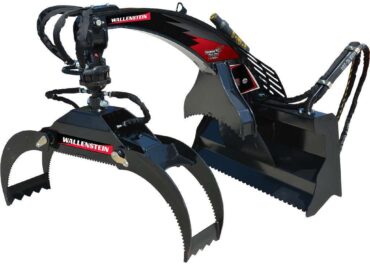
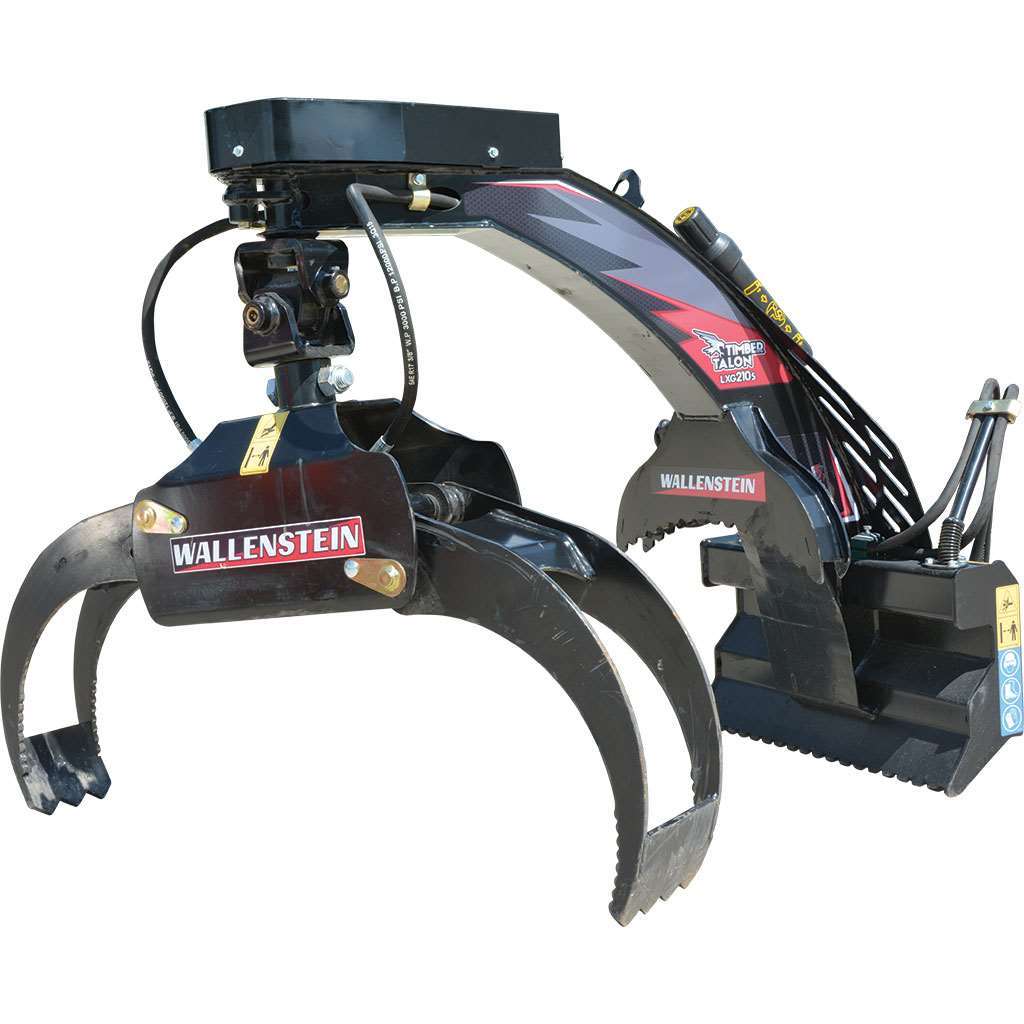
The Wallenstein LXG210S is a mini-skid-steer log grapple for controlled handling of suitable logs where a compact carrier is useful. Its distinguishing feature is a spring-centred pivot rather than a powered rotator. That design should be evaluated through the actual pickup, turn and placement routine, not assumed to provide the same positioning control as a hydraulically rotated grapple.
The purchase begins with the carrier and the load. An attachment can have a published capacity while the complete mini loader has a lower permitted capability in the intended position. A large jaw opening and strong clamp do not remove the host machine’s limits.
On This Page
ToggleThe relevant LXG210S specification
The Canadian product page lists a 3–40-inch grapple opening, 180-degree spring-centred rotation, 1000-lb lift capacity and 285-lb attachment weight. Recommended hydraulic flow is 3 gpm, and the mounting system is a universal mini-skid-steer plate. The stated power range is 12–50 hp.
Keep the word mini in the mounting description. A universal mini interface is not the same claim as a full-size skid-steer interface, and it does not guarantee compatibility with every compact carrier sold under a broad mini-loader label.
The page also lists 9400 lb of clamp force. That is not a payload rating. Its large numerical value should not be used to argue that the carrier can lift a similarly heavy log.
Spring-centred rotation is not operator-commanded rotation
A spring-centred arrangement allows a different response during turning from a rigid connection, while returning toward its centred position as designed. It is not a hydraulic motor that lets the operator actively rotate the grapple through a chosen angle on command.
This difference matters most when the job includes precise placement. If the objective is to bring suitable material along a route to an open collection area, the passive arrangement may fit well. If the task repeatedly requires aligning logs in a confined receiving space, compare the actual placement routine with a powered alternative.
The manufacturer describes locking positions as part of the spring-centred design. Have the permitted use explained for the supplied machine. Do not improvise restraints or modify the pivot to imitate a different attachment architecture.
A demonstration should show the complete turn with representative suitable material. Looking only at the unloaded grapple’s movement gives an incomplete picture of the route clearance and operator view once a long object is involved.
Separate four different capacity questions
First is the attachment’s own stated lifting limit. Second is the carrier’s permitted load in the actual configuration and position. Third is the clamping action needed to retain the particular material. Fourth is whether the route and placement can be completed within all applicable operating restrictions.
The February 2021 LXG210 manual lists a separate 6750-lb rotator/pivot rating alongside the 1000-lb lift figure. Those numbers describe different components or functions. The larger pivot number must not replace the attachment lift limit.
Attachment weight also belongs in the carrier assessment. As simple mass accounting, an invented 400-lb material load plus the listed 285-lb attachment totals 685 lb before other equipment. That total is not permission to lift it; it merely prevents the attachment from being omitted from the discussion.
Use the host manufacturer’s applicable capacity information, including the relevant geometry and operating position. Subtracting attachment mass from an unrelated brochure figure is not a complete load assessment. Aglist’s mini-skid attachment compatibility guide explains that distinction.
A log’s length changes the clearance problem
The steel attachment width is only part of the moving envelope. A long log can project far beyond the carrier and sweep through a much larger area during a turn. A route that fits the empty machine may not fit the loaded combination.
Map the intended path from pickup to destination. Look at gates, trees, structures and turning space. Include the approach to the final position, where an object may need a different alignment from the travel route.
Do not infer log mass from appearance alone. Species, moisture, dimensions and shape can vary. The buying process should establish a reliable way to assess the actual material within the equipment’s requirements rather than rely on an operator’s impression that a piece looks modest.
Also distinguish loose, already-separated material from embedded or entangled objects. A log-handling attachment should not be assumed suitable for extracting stumps or pulling against unknown resistance. Define the permitted task before treating jaw strength as a general clearing capability.
Identify the correct mini-loader mount
The cited manual separates the LXG210S from the LXG210SB. It assigns the latter a Bobcat mini-skid plate and a different weight of 343 lb. Those entries should not be silently transferred to the LXG210S specification.
Record the carrier model, actual mounting interface and attachment variant on the quotation. Inspect the mating parts and locking engagement on both sides. A correct attachment plate cannot compensate for a damaged carrier connection.
If an adapter is proposed, assess the complete approved combination. Added mass and altered reach can affect capability and clearance. An adapter should not be considered an invisible connector that preserves every original rating unchanged.
For a used machine, photographs may not clearly distinguish the plate. Obtain exact identification rather than assuming a familiar brand name establishes the interface. Correct fitment can determine whether an otherwise attractive offer is usable at all.
Hydraulics operate the grapple, not the carrier’s capacity
The required hydraulic supply must suit the attachment’s controls and connection. Matching couplers are only one element. Verify flow, pressure requirements, routing and the complete installation using the applicable documentation.
The listed 3-gpm figure should not be read as a reason to supply as much flow as possible. More available flow does not increase the carrier’s permissible load or turn the spring pivot into powered rotation.
Observe hose routing through the approved movement. A connection that looks satisfactory with the empty attachment centred may need further assessment through the actual range. Do not accept a workaround that leaves hoses vulnerable to pinching or contact.
Keep hydraulic condition checks separate from load demonstrations. A grapple that opens and closes correctly has passed one functional check, not every requirement for the proposed work.
Choose between a log grapple and a broad brush grapple
A dedicated log grapple and a broad claw attachment organise material differently. The correct comparison depends on whether the recurring job is handling individual suitable logs, collecting loose branches or carrying other irregular material.
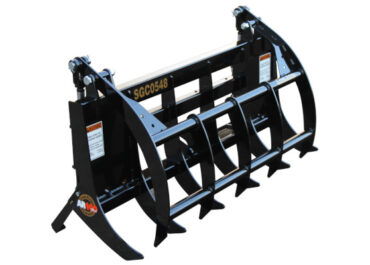
The Land Pride SGC0660 guide covers a tractor claw grapple and illustrates a different attachment arrangement. It is not an interchangeable mini-loader recommendation. Use the contrast to define the task, then verify equipment for the actual carrier.
If most work is loose brush gathering, a dedicated log tool may not eliminate the need for another attachment. If most work is log movement and orientation along a defined route, a broad brush tool may not deliver the preferred control. Compare the completed work rather than the apparent amount held in a photograph.
Aglist’s grapple, bucket and fork comparison provides a general task framework. Its tractor examples do not override mini-loader limits or mount requirements.
Evaluate the landing as carefully as the pickup
A successful pickup is only the beginning. The material must travel and be placed in a suitable location without creating a problem for the next movement. Plan the receiving area and any later processing before selecting the attachment.
For a small woodlot, a compact carrier may help with access but offer less room to reposition once material arrives. A clear landing layout can be more useful than choosing equipment solely by a wide jaw opening.
Consider whether another machine or process handles the material after placement. Keep those stages distinct. The grapple’s contribution is the movement it can perform within its approved use, not every subsequent cutting, splitting or loading operation.
A representative trial should end where the real job ends. Placing a log in an open demonstration area is not equivalent to positioning it beside a narrow processing station. State the intended destination before judging the attachment’s convenience.
Measure handling cycles without inventing production rates
Use a simple record of approach, pickup, travel, placement and return. Include adjustments and interruptions. This reveals whether the passive rotation suits the work or whether repeated alignment becomes a meaningful cost.
For an invented example, assume each complete movement takes six minutes and twelve movements are needed. That is 72 minutes. If a better landing layout removes 45 seconds of adjustment per movement, total time falls by nine minutes to 63 minutes.
Those figures are not LXG210S performance claims. They show why the receiving arrangement can matter as much as a feature advertised on the attachment. A different carrier or powered rotator should be compared using the same material and end point.
Record effort and visibility alongside time. A slightly slower approved routine may be preferable if it is easier for the regular operator to repeat. Avoid disguising a personal preference as an unsupported universal productivity advantage.
Used inspection: focus on the pivot and complete connection
Have a competent assessment cover the jaws, pins, pivot, spring and locking components, hydraulic cylinder and hoses, cradle, frame, plate and guards. Follow the prescribed secured inspection procedure. These are sensible inspection areas, not claims of model-specific defects.
Look for undocumented welds or modifications and identify the correct replacement parts. A strong-looking repair can alter geometry or function. Resolve its acceptability before treating the machine as ready for the proposed load.
A demonstration should establish the supplied control behaviour and the condition of the rotation arrangement as well as jaw movement. An unloaded open-close cycle alone cannot reveal whether the complete attachment suits the intended handling routine.
Include restoration, host connection and any approved adapter in the price comparison. A cheap attachment with the wrong plate or uncertain pivot condition may cost more to make usable than an apparently dearer complete package.
Keep the carrier identification and approved mounting configuration with the attachment records. A later move to another machine requires a fresh assessment of interface, hydraulics and load geometry; the first successful installation does not establish universal compatibility.
Frequently asked questions
Does 9400-lb clamp force mean it lifts that much?
No. Clamp force, attachment lift rating and carrier capability are different quantities. The documented lift figure is 1000 lb, subject to the complete system’s limits.
Can I rotate it hydraulically?
The LXG210S uses spring-centred rotation. It should not be purchased on the assumption that it has an operator-commanded hydraulic rotator.
Is the universal plate the full-size skid-steer standard?
The cited model uses a universal mini-skid-steer plate. Verify the exact carrier interface; the manual also lists a separate Bobcat-mounted variant.
Does a large opening establish a suitable log size?
No. Mass, shape, retention, carrier limits and the complete travel envelope still require assessment.
Who should shortlist this model?
An owner with compatible mini-loader equipment and recurring suitable log movements that work well with passive spring-centred rotation. Frequent precise alignment or a different material stream may justify another attachment arrangement.
Share your experience
Help other Canadian buyers — leave a quick review for the
Wallenstein LXG210S
There are no reviews yet. Be the first one to write one.