
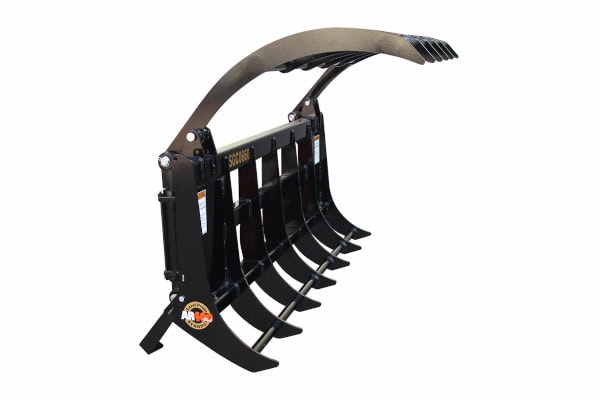
Overview & Specs
The Land Pride SGC0660 is a light claw grapple to consider when a tractor loader needs to gather and retain irregular material such as suitable brush and branches. Its attraction is the combination of an open tine arrangement and a closing upper jaw. It is not a bucket for loose granular material, and its opening does not describe how much weight your tractor can carry.
Before buying, identify the cleanup job that repeats: collecting pruning debris, moving already separated limbs, or transferring manageable piles to a designated collection point. Those tasks are different from extracting embedded objects or clearing an unknown site. A grapple selected around a known handling routine is easier to match than one bought on a general expectation of doing all property cleanup.
On This Page
ToggleThe documented SGC0660 configuration
Land Pride’s September 10, 2024 specification sheet lists a 250-lb grapple, a 40-hp maximum tractor requirement, 61¾-inch overall width, a 35-inch jaw opening and a maximum hydraulic pressure of 2,500 psi. It identifies universal quick-attach, a Kubota B-series hitch and a no-mount arrangement as alternatives. Confirm which version is actually offered.
The same sheet contains a rated operating load expressly restricted to approved Australian Kubota combinations. That number is not a general Canadian tractor payload and should not be transferred to your loader. Obtain the applicable host-machine capacity information for the actual attachment, position and tractor configuration.
Older family descriptions show different jaw and tooth-spacing figures. This guide retains the dated detailed specification rather than combining attractive numbers from different descriptions. For a used example, record its identity and verify the corresponding documentation before treating a current advertisement as applicable.
Support and retention are separate jobs
The lower structure supports suitable material while the upper jaw helps retain it. That distinction explains why a grapple can be useful for a loose collection of branches yet unsuitable for another object with a similar outside size. The material must sit in a workable arrangement, remain controlled and satisfy the complete equipment limits.
A pile of long branches may extend well beyond the implement. The clearance question then concerns the load envelope, not just the steel frame. A load that fits through the opening can still project into a fence, building or adjacent tree during a turn.
Think about the material’s shape before its volume. Long flexible pieces, short dense pieces and mixed debris behave differently. A visually impressive large bundle is not a meaningful demonstration unless it resembles the owner’s actual work and remains within the approved application.
For loose soil or aggregate, openings that are useful for separating unwanted dirt also allow the desired material to escape. A bucket remains the relevant comparison when containment is the main task. Owning a grapple normally adds a handling method rather than eliminating the need for a bucket.
The loader still determines the permitted lift
A light attachment can be attractive on a smaller loader because the implement itself is part of the carried mass. It does not follow that subtracting its weight from a pivot-pin brochure figure gives an approved goods load. The manufacturer rating point and actual geometry must correspond.
List attachment mass, material mass, any adapter and the location of the load together. Then assess the intended pickup, travel and placement using the proper loader information. A routine can be limited by the final placement height even when the initial low pickup appears easy.
As a simple inventory example, a hypothetical 300-lb material load plus a 250-lb attachment totals 550 lb before any additional equipment. That is an accounting observation, not permission to perform the lift. It prevents the grapple from becoming invisible in the purchase discussion.
Aglist’s loader-capacity guide explains why measurement point and attachment geometry matter. Use it to organise the questions, then obtain the specific limits for the actual machine. Neither tractor horsepower nor jaw pressure substitutes for that assessment.
A hydraulic connection needs more than matching couplers
The jaw requires a suitable tractor-side control circuit. Confirm the approved pressure, connection arrangement, hose routing and operating controls for the complete installation. Couplers that physically connect do not establish that the system is correct.
The listed maximum pressure is a limit, not a target to exceed for a firmer grip. Do not infer a payload from pressure or cylinder size. Grip depends on geometry and material contact, while carrying capability involves the host loader and tractor as well.
A quotation should identify the control kit and every required component. The cost of making the tractor ready may materially change the comparison with using an existing attachment or hiring cleanup equipment. Compare complete working packages rather than the grapple’s advertised price alone.
Ask to see the permitted range of movement with the correct hose arrangement. The operator manual, downloaded in its January 26, 2026 revision, includes clearance and operating checks. Those model-specific checks are more useful than a general assurance that a loader has auxiliary hydraulics.
Choose the mount before discussing convenience
The mounting alternatives in the specification are not interchangeable parts of one universal package. Identify the tractor’s carrier and the attachment’s supplied mount. A no-mount version is not a ready-to-connect bargain unless the approved installation is included in the plan.
Inspect locking engagement and the condition of both mating components. A sound grapple does not compensate for a damaged carrier, and a familiar quick-attach label does not excuse checking the actual connection. Include any adapter’s effect on weight, reach and clearance.
For an owner switching frequently between a bucket and grapple, parking arrangements matter. The replacement attachment needs an accessible stable location where the prescribed connection procedure is practical. Storing it behind several other implements can erase much of the convenience expected from a quick connection.
Evaluate the entire cleanup route
A useful route has four stages: gather, carry, release and return. Walk through each before shopping. The limiting stage could be sorting material at the collection point or manoeuvring through a narrow opening rather than gripping the first bundle.
Separate collection from disposal. If a pile must later be loaded into another container or processed, decide what condition and location that next step requires. Moving brush twice because the first pile blocks access is avoidable work that an attachment demonstration may not reveal.
Consider an invented time comparison: twelve suitable trips at eight minutes each take 96 minutes. Redesigning the staging arrangement so those same trips take six minutes reduces the total to 72 minutes. The 24-minute difference comes from the assumed route, not a claimed SGC0660 productivity advantage.
Do not chase fewer trips by increasing an uncertain load. Improve organisation within the approved operating limits. A slightly smaller controlled bundle can be a more useful plan than a maximum-looking pile that complicates every turn and release.
Canadian seasonal work needs a flexible plan
Spring cleanup and autumn pruning can create distinct travel conditions on the same property. A route used on firm ground may be unsuitable when soft or slippery. The need to finish cleanup does not establish that the tractor can use the planned route acceptably that day.
Inspect the work area again after weather or other activity changes it. Snow can conceal material and uneven ground; a familiar pile can contain new debris. Describe the actual task to whoever evaluates the equipment rather than relying on a summer photograph.
Keep a practical alternative for work outside the machine’s verified capability. That may mean postponing a non-urgent task, changing the collection location or using a suitable service. Purchasing a grapple does not require assigning every awkward object on the acreage to it.
What to compare with the SGC0660
| Recurring material | Starting comparison | Question to resolve |
|---|---|---|
| Loose soil or aggregate | Suitable bucket | Containment and approved payload |
| Palletized supplies | Correct pallet forks | Support, load centre and placement |
| Irregular manageable brush | Suitable grapple | Capture, retention and load envelope |
| Embedded or unidentified objects | Separate site assessment | Appropriate extraction or removal method |
The PFL2042 fork guide illustrates why pallet support and a defined load centre are different from gripping brush. Neither tool is universally superior. Select according to the material and complete handling sequence.
If comparing another grapple, record equipped weight, mounting arrangement, allowed host machine, opening geometry and documented application. Do not treat a higher steel grade or larger jaw as a complete ranking. The more substantial attachment may be appropriate for a different loader and job.
Inspect a used unit where movement and load meet
Confirm the identification, supplied mount and matching manual first. Examine the frame, tines, jaw, pivot areas and attachment interface for deformation, cracks, missing components or undocumented repairs. These are general inspection priorities, not allegations of recurring faults in the SGC0660.
Inspect the cylinder, pins, hose protection and fittings with the equipment secured and competent help where needed. Price identified repairs using correct parts. A clean exterior cannot establish the condition of the working connections.
A permitted demonstration should include opening, capturing suitable known material, carrying and releasing it. Observe whether the geometry suits the task and whether hose clearance and attachment engagement remain correct. A test that deliberately overloads the machine proves nothing useful about a sound purchase.
Ask what comes with the sale. Missing parking equipment, mounting parts or tractor-side controls can change the ready-to-work cost. Keep a written list so an apparently cheaper used offer is compared on the same scope as a complete alternative.
For brush cleanup, include the release behaviour in the trial notes. A bundle that can be gathered easily may still require careful positioning at the receiving pile. Record whether the intended destination allows the prescribed release without extra handling by people nearby. If the next stage is collection by another machine, agree on an accessible pile location and suitable material arrangement beforehand. This turns the demonstration into a check of the complete cleanup process rather than a photograph of the largest bundle the attachment can close around.
Questions buyers often overlook
Does the 35-inch opening define a maximum load size?
It describes one dimension of the jaw. Support, shape, protrusion, retention and approved machine capacity still determine whether a particular load is suitable.
Can the Australian rating be used for a Canadian tractor?
No. The sheet explicitly restricts that rating to approved Australian combinations. It is not a transferable universal payload.
Is hydraulic pressure a way to calculate lifting capacity?
Not from the grapple pressure limit alone. The jaw circuit and the loader’s permitted carrying arrangement answer different questions.
Will a grapple replace pallet forks?
Not for a pallet-handling routine requiring the support and geometry of properly matched forks. Choose the attachment designed for the actual load.
When does ownership make sense?
When repeated suitable cleanup work, a compatible equipped tractor and a practical collection route justify the complete cost. For one large project beyond the verified duty, compare a properly equipped service before buying around an exceptional task.
Share your experience
Help other Canadian buyers — leave a quick review for the
Land Pride SGC0660
There are no reviews yet. Be the first one to write one.