
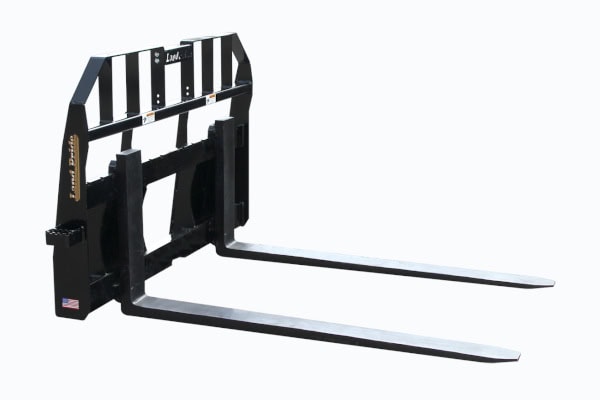
Overview & Specs
The Land Pride PFL2042 is a plate-mounted pallet-fork assembly with 42-inch tines. It is a candidate for handling suitable palletized materials around a Canadian acreage or farm, provided the host loader can carry the actual load in the required position. The number on the fork rating is not a promise that a compact tractor can lift that much.
The most useful purchase exercise is to identify three real loads before shopping: the heaviest pallet, the deepest pallet and the load that must be placed at the greatest height. They may be different objects. A fork that works comfortably with one can be unsuitable for another because weight, centre of gravity, support and placement geometry change together.
On This Page
ToggleWhat the PFL2042 rating actually describes
The Land Pride manual dated December 19, 2025 lists 2,100 lb at a 24-inch load centre measured from the fork face, with the load palletized and supported by both forks. It gives an assembly weight of 301 lb, a universal quick-attach mounting arrangement, 42-inch tines and a frame approximately 45⅞ inches wide. These are attachment specifications, not a complete loader capacity chart.
Record the rating basis alongside the number. A seller describing these as “2,100-pound forks” has omitted the load location and support condition. Those qualifications are essential when deciding whether a particular object is within the documented application.
For a tractor loader, use the approved capacity information for the actual attachment and operating configuration. A pivot-pin figure, a bucket figure and a pallet-fork figure at a stated centre should not be treated as interchangeable. Aglist’s loader lift-capacity guide explains why the measurement point changes the comparison.
The attachment consumes part of the lifting capability
The loader must handle the fork assembly as well as the goods. An unloaded attachment is therefore not a weightless connection between the loader and the pallet. This matters most on smaller loaders, where a heavier fork frame can materially affect the useful package.
Do not simply subtract 301 lb from any convenient brochure capacity and declare the remainder an approved payload. The load centre, attachment geometry, lift height and manufacturer rating method need to match first. Subtraction is useful only within a valid calculation for the documented configuration.
For initial inventory, however, it is sensible to record the weights separately. A hypothetical 700-lb palletized shipment plus the listed 301-lb assembly represents 1,001 lb of combined material and attachment mass. That arithmetic does not approve the lift; it helps prevent the attachment from disappearing from the assessment.
If the pallet itself is not included in the shipment’s stated mass, include it too. Ask whether packaging, containers and remaining product are represented in the figure. Estimating the goods alone can understate what actually leaves the ground.
Forty-two-inch tines and a twenty-four-inch load centre are different dimensions
Tine length describes the support available beneath a load. Load centre describes where the load’s centre of gravity acts relative to the fork face. Neither is simply half the other in every real job.
A uniformly loaded rectangular pallet may suggest a centre near its midpoint, but uneven contents can shift that point. A stack concentrated at the far end or an object projecting beyond the pallet can create a different load arrangement from its outside dimensions.
Use a simple moment comparison to understand the direction of the effect, not to create a substitute capacity chart. An illustrative 800-lb load at 24 inches produces 19,200 lb-in about the fork face. The same load at 30 inches produces 24,000 lb-in, a 25% increase. That does not tell you the allowable load at either position; it explains why moving a load outward deserves a fresh check.
Do not approve a larger pallet because the fork tips extend beneath part of it. Confirm support, load security and the relevant limits. A long object that can be balanced briefly is not necessarily a suitable palletized load for this assembly.
Check the mount as a complete connection
The PFL2042 configuration in the cited manual uses the universal quick-attach arrangement. That label should lead to a physical and documented fitment check on the actual loader. It should not be transferred to a Euro-style carrier or another attachment interface merely because the two frames look similar.
Inspect the receiving plate, locking mechanism and contact surfaces. The connection needs to engage correctly and remain secure through its permitted movement. Wear or an undocumented modification can change the assessment even when the original product families are compatible.
If the loader requires an adapter, include its mass and geometry in the capacity review. An adapter may move the load forward. Convenience at the mounting plate does not remove the consequences at the load centre.
Ask for the complete offered configuration on the quotation: frame, both tines, locks and any required mounting equipment. A low price for an incomplete frame is not directly comparable with a ready-to-use matched assembly.
Adjustable spacing should match the pallet
Before choosing forks, inspect the pallet types that arrive at the property. Entry openings, bottom boards, load distribution and available approach direction can differ. The most convenient tine spacing for one pallet may not suit another.
Position and lock the forks according to the manufacturer’s instructions. Do not treat freely sliding or damaged locking components as a minor inconvenience. Correct spacing and secure retention are part of supporting the intended load.
A useful demonstration begins with an empty pallet on an appropriate level site, followed only by a known permitted load under competent operation. This lets the buyer assess visibility, entry clearance and placement without turning the purchase inspection into a capacity experiment.
Record whether the operator can see the tips or needs a different approach to align accurately. Good visibility can reduce repeated repositioning, but no claim about visibility should substitute for keeping people clear of the working area.
Plan the receiving area before the delivery truck arrives
Unloading is a sequence: approach the vehicle, engage the load, withdraw, travel and place it. The most difficult stage may be the reach or height at the truck rather than the short trip to storage.
Measure the available space and identify where the load will be set down. A loader that can move a pallet at low height on level ground may not have the required approved capability at the truck bed. Compare the intended operation with the correct load information.
Arrange a suitable unloading method before ordering a heavy shipment. If the package exceeds the verified capability, alternatives include delivery equipment provided by the supplier or a different handling service. Do not rely on splitting an awkward load at the last moment while it is already elevated.
For recurring deliveries, a consistent staging area can make the work easier to assess. Keep it clear, maintain the surface and avoid building a routine that depends on threading a loaded tractor between closely spaced obstacles.
Canadian conditions change the route, not the rating
Snow, ice, soft spring ground and uneven yard surfaces can change the practicality of material handling. They do not increase the attachment’s capacity or make a marginal load acceptable. Evaluate the route and conditions separately from the static number on the frame.
A pallet that can be handled on a prepared summer surface may require a different delivery plan when the approach is slippery or obstructed. Build that possibility into the purchase decision if year-round deliveries are essential.
Keep the load in the prescribed travel position and follow the loader and attachment manuals. The manufacturer’s operating guidance addresses stability, travel conditions and keeping people away. This guide is a selection aid, not a substitute for training on the actual machine.
Where the job is occasional, compare the cost of preparing a suitable route and receiving area with the convenience of another delivery arrangement. Owning forks does not mean every shipment must be unloaded with the tractor.
When longer or heavier forks may be the wrong upgrade
Longer tines can help support some loads, but they also extend the physical envelope and may be unnecessary for the pallets actually used. They can make it harder to work close to material behind a pallet. Select length from the load and access requirements rather than assuming more length is always useful.
A higher-rated frame likewise does not upgrade the loader. If the host machine is the limiting component, a heavier attachment can consume capability without improving the allowed goods load. Compare the complete approved package before paying for a larger rating.
On the other hand, an attachment that is too lightly rated for the verified loader and intended loads is not a sensible economy. The system must satisfy every applicable limit. The lowest relevant limit governs the job, not whichever number is most prominent in the advertisement.
Used PFL2042 inspection
Confirm identification and the applicable manual. Inspect both tines for deformation, damage and excessive wear, and have questionable findings assessed by a competent person. Do not assume that heating, straightening or welding a damaged tine is an acceptable repair.
Check the frame, upper carrying bar, lower contact surfaces, locking parts and mounting plate. Look for cracks, distortion, missing pieces and evidence of alterations. These are inspection priorities rather than claims of recurring defects in this model.
Compare the two tines as a pair and confirm correct part identification. A replacement that looks similar is not automatically suitable. The documented load condition uses both forks, so the condition of the weaker or incorrect component cannot be ignored.
Inspect the loader-side connection too. A sound attachment does not cure a worn or damaged carrier. Price all identified work before comparing the used package with a complete serviceable alternative.
Value the handling job, not just the steel
The value of forks may come from handling repeated deliveries, moving palletized supplies or placing materials more conveniently. Write down those recurring jobs and their actual load details. Avoid justifying the purchase with hypothetical loads that the host loader cannot safely handle.
For an illustrative cost comparison, suppose the complete attachment and required setup cost CAD 1,800 and are used for 30 suitable jobs over three years. That is CAD 60 per job before maintenance, tractor costs, financing and resale. At only six jobs over the same period, it is CAD 300. These are invented inputs, not PFL2042 market prices.
Compare actual supplier unloading charges or local handling services on equivalent scope. Ownership can still be worthwhile for timing and independence, but those benefits should be stated directly rather than supported by invented fuel savings or guaranteed resale values.
Questions to settle before purchase
Can the tractor lift 2,100 lb because the forks can?
No. The attachment rating has a defined load centre and support condition, and the host loader may have a lower limit for the intended position.
Can one tine carry half the rated load?
Do not infer that. The cited rating is for a palletized load supported by two forks, not a single-tine lifting approval.
Does a quick-attach label guarantee fit?
No. Verify the exact interface, locking engagement, condition and any adapter effects.
Are fork extensions an automatic way to handle deeper pallets?
No. They change support and load geometry and require specific approval. They cannot be treated as a free increase in capacity or reach.
Who should shortlist the PFL2042?
An owner whose recurring palletized loads fit its documented duty and whose loader, route and placement requirements have been verified together. The strongest case is a known handling problem solved by a complete compatible package.
Share your experience
Help other Canadian buyers — leave a quick review for the
Land Pride PFL2042
There are no reviews yet. Be the first one to write one.