Overview & Specs
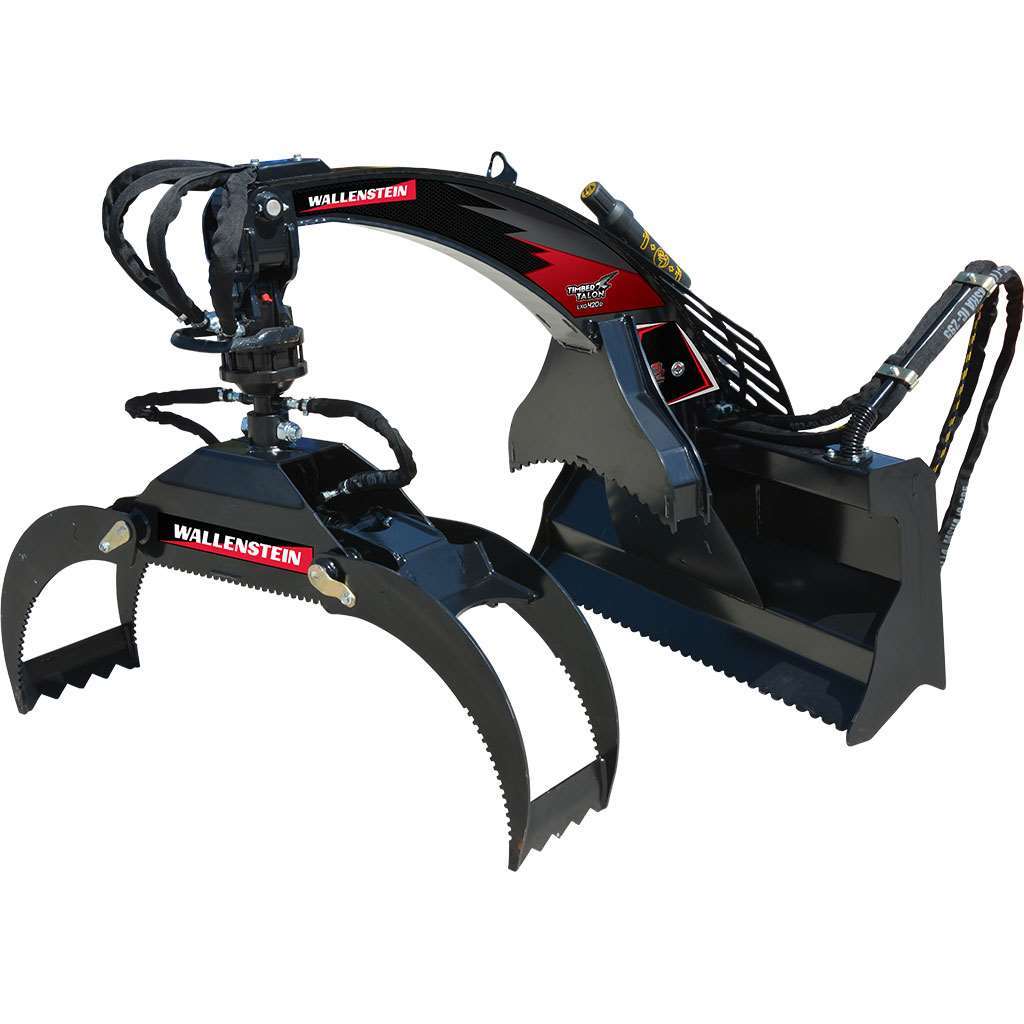
The Wallenstein LXG420R is a full-size skid-steer log grapple with hydraulic rotation. Its strongest buying argument is the ability to command log orientation as part of a controlled handling routine. That can matter at a landing or receiving area where alignment is repeated, but it does not make a long load fit into an unsuitable space or increase the carrier’s permitted lifting capability.
Choose it around a defined pickup-to-placement task. If the recurring problem is gathering loose brush, extracting embedded material or moving a load beyond the host machine’s limits, a powered rotator is not the answer. The attachment should solve an identified handling requirement within an approved complete combination.
On This Page
ToggleThe LXG420R configuration in the Canadian listing
The Canadian product page lists 360-degree hydraulic rotation, a 3–48-inch opening, a 3000-lb lift rating and 588-lb attachment weight. Recommended flow is 5 gpm, with a 30–70-hp carrier range and a universal skid-steer quick-attach plate.
The same page lists 9400 lb of clamp force. Keep that separate from lift capacity. It describes the clamping function, not a payload that the grapple or carrier may transport.
These figures identify the attachment, but the actual carrier must still be evaluated for the load position and complete equipment. A compatible-looking mount and adequate horsepower are not enough to approve the task.
Why commanded rotation can be useful
A powered rotator lets the operator change orientation through the intended control system. That is a different function from a spring-centred pivot that responds passively during movement. The benefit should be assessed where orientation matters in the real job.
For example, a receiving area may require suitable logs to be aligned consistently for later handling. If the current routine involves repeated carrier repositioning solely to achieve that alignment, a powered attachment may change the sequence. The result must be demonstrated with representative material and adequate clearance.
Do not assume that rotation can happen in any available gap. The whole log sweeps through space. Nearby equipment, structures and people must remain outside the required movement and exclusion areas. A 360-degree feature describes capability of the mechanism, not unrestricted permission at every site.
The practical purchase question is how often commanded orientation removes a real adjustment. If placement is always in a large open area and alignment is unimportant, the feature may offer less value than its specification suggests.
Keep the family variants straight
The March 2021 LXG400 manual distinguishes the LXG420R from the spring-rotation LXG420S and larger LXG430 variants. Its specification lists 588 lb for the 420R, rather than the 560-lb figure for the 420S.
The same family table reserves winch and push-bar specifications for another variant. Do not assume those features belong to the LXG420R because they appear in the shared manual. A quotation should identify the complete supplied equipment rather than rely on a family photograph.
The manual lists a separate 6750-lb rotator/pivot rating. That does not supersede the 3000-lb attachment lift figure or the carrier’s lower applicable limits. Component ratings must retain their original meaning.
For a used unit, confirm the serial identification and actual controls. Changes in equipment or undocumented repairs can matter more than a seller’s broad description of it as an LXG grapple.
The carrier must handle the attachment and the material
The grapple’s own mass is part of the working load. As inventory arithmetic only, an invented 1000-lb log plus a 588-lb attachment totals 1588 lb before other fitted equipment. That calculation does not establish a permissible lift; it simply ensures the attachment is counted.
Next consider where the material’s centre of mass sits relative to the host machine and how that changes through pickup and placement. An awkward load can create a different geometry from a compact test mass. Use applicable carrier capacity information rather than subtracting attachment weight from an unrelated headline figure.
Aglist’s rated operating capacity and tipping-load guide explains why those carrier numbers must also remain distinct. Tipping load is not a normal working payload, and an attachment’s rating does not override the host’s operating limits.
The final placement may be more restrictive than the initial pickup. A load that appears manageable near the ground has not thereby been approved for every height, reach and travel condition. Evaluate the entire intended movement.
Hydraulic rotation adds a control question
The operator needs to command both gripping and rotation through the supplied approved arrangement. Understand how the controls select those functions and what the actual carrier installation requires. Do not infer the answer solely from a count of hoses or couplers.
A demonstration should show the complete sequence: approach, grip, reposition as permitted, orient and place. Observe whether the controls are clear to the regular operator and whether the hose arrangement remains appropriate through the documented range.
The 5-gpm listing should not be interpreted as a request for maximum possible carrier flow. Confirm the attachment’s full hydraulic requirements and use the approved setup. Additional flow does not increase the permitted material load or justify altered controls.
If the carrier already has auxiliary equipment or aftermarket controls, include that in the compatibility assessment. The working installation matters more than a generic statement that the machine has hydraulics available.
Plan a placement envelope, not just a travel corridor
Draw the route and receiving area with the actual intended material dimensions in mind. A long log’s end can move far beyond the attachment during rotation. The relevant clearance is therefore the complete load envelope, not merely the listed grapple width.
Consider the transition from travel alignment to final alignment. That transition may require a larger open area than either the approach corridor or the final resting space. If the site lacks that area, powered rotation alone does not solve the layout.
Visibility should be evaluated with representative suitable material. An unloaded attachment gives a different view from a load that obscures part of the destination. The correct response is a workable approved routine, not relying on unseen clearance.
Keep the landing organised so that each completed movement leaves room for the next. A machine with useful positioning control can still lose time if placed material blocks access or requires repeated rearrangement.
Use a demonstration that measures alignment work
Define the start and finish before timing anything. The trial should begin with material in a representative pickup condition and end in the actual type of receiving arrangement. An open demonstration yard may show the mechanism clearly but omit the buyer’s main positioning problem.
Record the number of carrier adjustments, the time spent orienting the load and the final result. Also note any limitations that make the proposed job unsuitable. An honest demonstration is allowed to show that another process would fit better.
For an invented comparison, assume a repeated movement requires four minutes of pickup and travel plus two minutes of alignment and placement. Ten movements take sixty minutes. If an appropriate powered-rotation arrangement reduces the second portion to one minute, the total becomes fifty minutes.
The assumed saving is ten minutes across the session. It is not evidence that the LXG420R will achieve that result on every property. The example shows how to measure the feature’s contribution separately from unrelated travel or loading differences.
Do not compare an experienced operator on one machine with an unfamiliar operator on another and attribute the entire difference to the rotator. Use a fair, competent demonstration and allow the supplied control routine to be understood.
Compare against a spring pivot and other handling tools
| Recurring task | Comparison to make |
|---|---|
| Repeated controlled alignment of suitable logs | Powered rotation through the actual placement sequence |
| Open-area movement with little alignment demand | A simpler compatible pivot arrangement |
| Loose branch and brush gathering | An attachment designed for that material stream |
| Extraction against uncertain resistance | A separately appropriate method and competent assessment |
Aglist’s grapple, bucket and fork comparison is useful for defining the job, although its tractor examples are not interchangeable mounting recommendations for this attachment. Choose the function first, then verify the carrier-specific equipment.
A dedicated log grapple need not replace every handling tool on a property. Its purchase is strongest when a recurring task rewards its particular control. Buying it to cover every possible cleanup job can produce an expensive mismatch.
Estimate the cost of useful positioning
Compare complete ready-to-use packages, including any required approved carrier controls and connection equipment. A bare attachment quotation and a fully installed alternative are not equivalent starting points.
For illustration, suppose a powered arrangement adds an invented CAD 300 of annualised cost over another verified option. If it saves ten minutes on twenty sessions, that is 200 minutes, or about 3.33 hours per year. The difference is approximately CAD 90 per saved hour.
That arithmetic does not determine whether the purchase is worthwhile. Better control, a more manageable routine or fewer attachment changes may matter independently of time. Keep those benefits explicit rather than inventing a large production increase to justify them.
At low annual use, storage and service readiness become prominent. Consider whether rental or a service can accomplish the same defined task. Include the same pickup, placement and material-handling scope in each comparison.
Used inspection should include the rotation system
Have a competent inspection assess the rotator, pivot support, jaws, pins, cylinder, hoses, control arrangement, frame, cradle and mounting plate. Follow the manufacturer’s shutdown and secured inspection procedures. An open-close test is not a complete assessment of a rotating attachment.
Look for deformation, undocumented welding, missing guards and uncertain replacement components. These checks do not imply a known defect trend. They establish whether the particular used machine remains in the intended configuration and condition.
Ask for the cost of restoring the complete system where work is needed. A low price can conceal significant uncertainty if the rotator or controls require diagnosis. Do not assume a visible leak or irregular movement has a simple repair without assessment.
Verify the carrier side too. Worn locking components or an unsuitable hydraulic installation can undermine a sound attachment. The purchased result is the complete working combination, not only the tool lying on the seller’s yard.
Handover information worth retaining
Keep the exact model and serial details, applicable manual, hydraulic setup, control explanation and parts records together. If the attachment is later moved to another carrier, repeat the compatibility assessment rather than treating the first installation as universal approval.
Record the representative load and placement task used during commissioning. That gives a concrete reference for the work actually evaluated. It should not become permission to handle different material or geometry without checking the limits again.
Plan secure storage that protects the connection and allows inspection without awkward access. A specialised attachment is most useful when it can be prepared correctly for the job, rather than recovered from an inaccessible corner only when work becomes urgent.
Frequently asked questions
Does the LXG420R rotate under hydraulic control?
Yes. The cited Canadian specification identifies a 360-degree hydraulic rotator. That differs from the spring-centred S configuration.
Can every carrier lift the attachment’s rated 3000 lb?
No. The complete carrier, attachment, load geometry and operating conditions determine the applicable limits.
Is the 9400-lb clamp figure a lifting capacity?
No. It describes clamping force and must not replace the separate lift rating.
Is a winch included?
The family manual assigns winch equipment to another variant. Do not assume it is part of the LXG420R package.
When does powered rotation provide the clearest value?
When repeated suitable log-placement tasks benefit from commanded alignment, demonstrated on the actual carrier and site arrangement. If alignment is rarely needed, compare a simpler compatible tool before paying for extra control.
Share your experience
Help other Canadian buyers — leave a quick review for the
Wallenstein LXG420R
There are no reviews yet. Be the first one to write one.