Overview & Specs
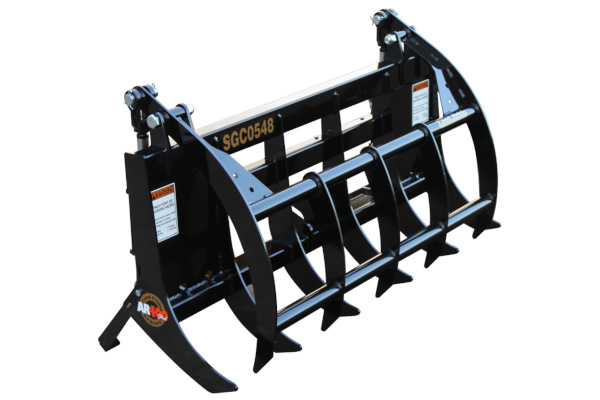
The Land Pride SGC0548 is a light claw grapple whose most important buying feature is its tractor-specific mounting arrangement. The April 2021 operator manual describes it for particular Kubota BX tractors and loaders, with different connection hardware for different BX generations. It should not be purchased as though it were a generic skid-steer quick-attach grapple that happens to be narrow.
Once the mounting question is settled, the SGC0548 offers an open-tooth arrangement for gathering and holding suitable loose material. For a Canadian acreage owner moving brush or irregular cleanup material, that can be more useful than balancing the same material in a bucket. Its value comes from controlling the load, not from turning a small tractor into a heavier loader.
This guide follows North American manual 380-138M, dated April 14, 2021. It does not extend that document’s fitment to newer BX generations or to other tractor families. When assessing a used grapple, identify the exact mounting kit and loader rather than relying on a broad claim that it fits a Kubota.
On This Page
ToggleStart with the loader connection
The manual identifies BX60, BX70 and BX80 series tractors with a front loader, and the BX23S with front loader and backhoe. It then lists three mounting arrangements: the original quick hitch for BX60 and BX70, direct loader pin connection for those series, and loader-arm pin-on mounting for BX80. These are separate configurations, not interchangeable names for one universal plate.
That distinction changes what a complete used package looks like. A grapple removed from one BX loader may include hardware that is inappropriate for another. Photograph the connection points and collect the attachment and loader identification before arranging transport. A matching paint colour or similar loader-arm shape is not evidence of a correct mechanical interface.
Ask the seller to identify what stayed on the tractor when the grapple was removed. A sale photograph may show the grapple itself while omitting brackets, pins, hose supports or other parts needed for the intended installation. Include those components in the assessment of completeness and cost.
Do not solve an uncertain mount by assuming an adapter is harmless. An adapter can change the location of the load and introduce another connection that must be approved. The correct starting point is the documented installation for the exact equipment, followed by the loader’s applicable capacity and operating guidance.
Specifications with practical consequences
| Item | Documented SGC0548 figure | What it tells the buyer |
|---|---|---|
| Attachment weight | 156 lb (71 kg) | Include the grapple in the carried package before considering material. |
| Overall width | 48⅞ inches | Measure the entire route, including any load projecting beyond the teeth. |
| Jaw opening | 30 inches | This is an opening dimension, not an approved log diameter or load rating. |
| Teeth | Six lower and five upper | The open arrangement behaves differently from a bucket floor. |
| Tooth spacing | 9⅜ inches | Small loose material may not be retained like it would be in a solid bucket. |
| Hydraulic pressure rating | 2,500 psi | Verify the complete hydraulic match; a pressure rating does not establish lifting capacity. |
The specification table and drawing round the width slightly differently: the table gives 48⅞ inches while the drawing labels approximately 49 inches. For a constrained opening, measure the actual machine and leave practical clearance rather than planning passage at a nominal width. Hoses and the load itself also need space.
Why 156 pounds is only the beginning of a capacity check
A lightweight attachment can leave more of a suitable loader’s capability available for material than a heavier arrangement, but the comparison must use the same geometry and configuration. Do not subtract 156 pounds from an unrelated headline loader capacity and call the remainder a safe payload.
The loader’s published capacity may be measured at a specified height or point that does not match the centre of the grapple load. A long bundle held forward of the attachment can affect the tractor differently from a compact load close to the mounting point. Rear ballast, tyres, ground and the permitted operating configuration also remain part of the assessment.
As a bookkeeping example, a hypothetical 200-pound bundle plus the listed 156-pound grapple totals 356 pounds before any additional mounting equipment. That sum describes mass only. It does not approve the bundle for a particular BX loader or account for its forward reach. The example is useful because it makes clear that the attachment is not weightless.
Aglist’s loader lift-capacity guide explains the distinction between reference points and real loads. Apply the actual tractor and loader documentation to the installed grapple rather than transferring a rating from a different loader, attachment or test position.
A gripping circuit is separate from loader lift
The manual lists a duplex outlet supplied through an appropriate Land Pride or Kubota third-function valve kit. The grapple needs a suitable hydraulic control arrangement to open and close; having hydraulic lift and bucket curl on the loader does not by itself establish that this additional circuit is present.
Identify the installed valve kit, controls, couplers and hose routing. The configuration should allow the attachment to move through its permitted range without stretching, pinching or exposing hoses to damaging contact. The supplied instructions, including pressure-relief and connection procedures, should govern setup and use.
For a used machine, include hydraulic installation in the quotation before comparing its asking price with a complete package. An inexpensive grapple may require mounting and control components that were not included in the sale. Conversely, a package already configured for the correct tractor may be more convenient, provided its condition and compatibility are verified.
The 2,500-psi figure is a component-system rating, not a reason to increase tractor hydraulic pressure. It also does not tell you how much an irregular load can safely weigh. Keep gripping function, hydraulic compatibility and loader lifting ability as separate checks.
Choose it for material the jaws can control
An open grapple can be useful where material is awkward to keep in a bucket: a collection of loose branches, for example, may need a closing upper jaw to remain organized during a suitable handling operation. The task should still be within the attachment and tractor instructions, and the material must be loose enough for the intended handling method.
Do not confuse gathering loose material with pulling rooted trees, prying out embedded objects or using the grapple as a demolition tool. A jaw that closes around an object does not establish that the structure or tractor is designed to extract it. Define the task before judging the apparent strength of the teeth.
The open lower teeth can allow small material to fall through. That may be desirable when the objective is to collect larger loose pieces while leaving some fines behind, but it is undesirable when the job requires carrying sand, gravel or other small bulk material. A bucket’s continuous floor serves a different purpose.
Likewise, a 30-inch opening should not become an advertised maximum log size. An object’s shape, balance, grip and weight matter, as does its position within the jaws. Evaluate the actual load and handling route instead of selecting material by one opening dimension.
When a bucket or forks make more sense
A bucket remains the more appropriate category for many bulk-material jobs. Pallet forks address a supported load with suitable lifting points and a known handling arrangement. A grapple addresses another problem: retaining appropriate irregular material between its jaws. None of these mechanisms replaces all the others.
The Land Pride PFL2042 guide provides context for a fork attachment, but it is not an alternative fitment approval for the same BX loader. Each attachment needs its own connection and capacity assessment. Compare the completed job rather than assuming that all loader attachments with a similar width are interchangeable.
For a property with mostly bucket work and one cleanup project, hiring the cleanup work may be more sensible than fitting a new hydraulic circuit solely for occasional grapple use. Where awkward-material handling recurs, the convenience of a correctly configured grapple may justify the changeover and storage routine.
A wider grapple such as the SGC0660 belongs in a separate fit and load assessment. Wider reach can be useful, but additional width does not establish a better match for a small loader. Confirm the machine’s exact mount and requirements before making a family-level comparison.
Plan the whole cleanup route
Walk the route from the material to its destination before operating. Consider gates, turns, overhead clearance, the ground under the tractor and the space needed to release the load. An attachment that fits between posts can still carry a bundle that projects well beyond them.
Separate collecting from disposal. Moving branches from one corner to another is only useful if the destination supports the next step, whether that is storage, further processing or removal. Plan the pile so that later handling does not require undoing the work just completed.
On a Canadian property, changing ground conditions can alter access even when the material itself is ready to move. A recurring task should have a practical operating window and a fallback when the route is unsuitable. Do not treat the availability of a grapple as proof that the tractor can travel acceptably over every surface.
Consider attachment changes as part of the session. If the bucket must be reinstalled immediately afterward, the mounting and hydraulic connection routine affects convenience. A demonstration should include those changes when they are central to the ownership decision, rather than showing only a single successful pickup.
Used-grapple inspection: look beyond the teeth
First verify identity and the complete mounting package. Then inspect the frame, teeth and connection points for distortion, damage or repairs that need explanation. These are inspection priorities, not a claim that the SGC0548 has a particular common failure pattern.
Examine pivots, pins and retaining hardware. Uneven movement or unexplained looseness should be assessed before the machine is used to hold a load. A freshly painted attachment can still need mechanical work, so appearance should not substitute for checking the moving and load-carrying components.
Inspect cylinders, hoses and couplers for visible damage and leakage using the safe procedures in the manual. Do not use hands to search for a pressurized leak. Have hydraulic defects assessed appropriately, and account for repairs before treating the package as ready to work.
Check the parking stands and their locking arrangements. The manual describes them as part of supporting the grapple upright for setup and storage. Missing or damaged stands can affect the practicality of connecting and parking the implement, even when the jaws themselves operate.
Request a demonstration on the correct tractor with a suitable, known task. Evaluate attachment movement, hose clearance, control access and load retention. A demonstration on a different loader is evidence only for that demonstrated combination; it should not become a substitute for verifying yours.
Ownership costs without invented prices
Build the purchase comparison from the grapple, correct mounting hardware, hydraulic controls, installation, transport and any repairs. Add storage and changeover time. Use actual quotations for the intended tractor rather than comparing a bare used attachment with a fully installed new package.
For seasonal use, record how often the grapple will solve a recurring handling problem. Avoid justifying it by a long list of imagined tasks that are outside its instructions. A modest number of well-defined jobs can be enough to support ownership; an impressive list of unsuitable jobs cannot.
Keep the mounting-kit identity, hose information and applicable manuals together. This becomes especially valuable when buying replacement parts or moving the attachment to another tractor. Treat any future tractor change as a fresh compatibility decision.
Frequently asked questions
Is the SGC0548 a universal SSQA grapple?
The cited manual describes specific BX mounting arrangements. Do not buy it on the assumption that it is a universal SSQA attachment.
Does this guide approve newer BX models?
No. Its compatibility scope follows the April 2021 manual. A later tractor or different loader needs its own verified fitment documentation.
Does the jaw opening establish load capacity?
No. Opening size, grip, attachment structure, loader capability and load position are separate considerations.
Can the grapple replace a bucket?
It can improve control of suitable irregular material, but its open teeth do not provide a bucket’s continuous carrying floor. Keep the tool choice tied to the material.
What is the most important used-purchase check?
Identify the exact tractor, loader and mounting package before judging the price. An incomplete or incompatible connection can make an otherwise sound grapple unsuitable for the intended purchase.
Source and scope
Specifications and fitment were checked against Land Pride SGC0548 operator manual 380-138M, April 14, 2021, particularly its tractor requirements and specification table. This is a guide to that documented configuration, not a claim about current stock or later-model compatibility. The load example is hypothetical arithmetic, not an approved payload.
Share your experience
Help other Canadian buyers — leave a quick review for the
Land Pride SGC0548
There are no reviews yet. Be the first one to write one.