Overview & Specs
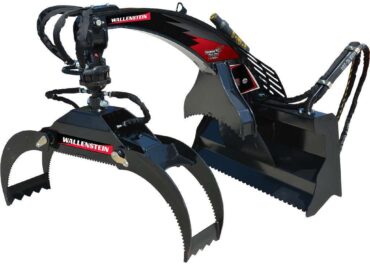
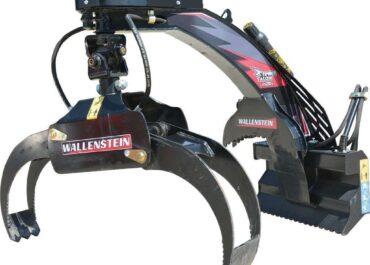
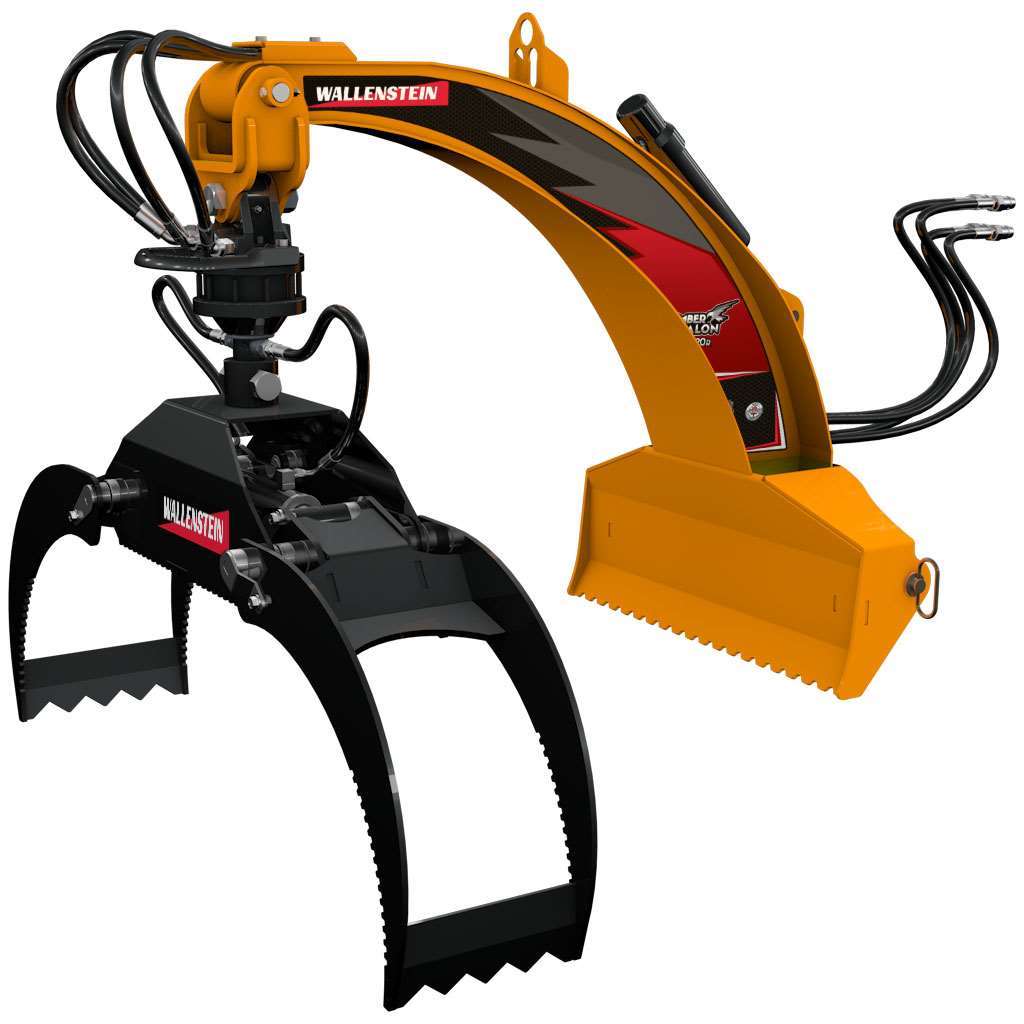
The Wallenstein LXG320R is a three-point-hitch log grapple for a suitable tractor, with hydraulic rotation to help orient the grapple during handling. Its most important distinction is where it mounts. This is a rear-mounted tractor attachment, so the buying decision depends on three-point lift geometry, tractor stability, hydraulic controls and the path of a trailing log. A skid-steer capacity figure cannot be substituted for those checks.
For a Canadian acreage or woodlot, consider it when the recurring task is collecting accessible logs and moving them through a planned route. It is not a loader boom, an integral winch or a tool that automatically gives a compact tractor a 3,000-pound carrying capacity. This guide uses the Canadian product page and March 2021 LXG300-series manual, checked in October 2026.
On This Page
ToggleChoose the handling method before the attachment
Ask where the tractor can travel, where the log can be gripped and where the material needs to finish. A grapple is useful when the machine can reach an appropriate pickup position. If the central problem is retrieving timber beyond that access, a winch-based method may be a different and more appropriate system to evaluate.
At the receiving area, identify whether the work requires simple placement or loading at height. A three-point attachment moves within the hitch’s range; it does not provide the reach of a loader or crane. Buying a grapple for a later task it cannot geometrically reach creates another machine requirement rather than solving the original problem.
The FX85 skidding-winch guide provides a contrasting extraction approach. The distinction is access and method, not just which tool has the larger force number. Winch line pull, grapple lift and tractor hitch capacity describe different limits.
What the LXG320R specifications actually mean
| Specification | Published figure | Interpretation |
|---|---|---|
| Mounting | Category I three-point | Confirm actual hitch geometry, clearances and tractor suitability. |
| Recommended tractor range | 25–65 hp | A starting range, not proof of adequate lift or stability. |
| Grapple opening | 3–48 inches | Jaw travel does not establish a permitted load weight. |
| Rotation | 360-degree hydraulic | Powered orientation, with the full load path still needing clearance. |
| Attachment lift rating | 3,000 lb | Not the tractor’s available payload at the grapple. |
| Recommended hydraulic flow | 5 US gpm | Verify the supply and control configuration. |
| Attachment weight | 353 lb | Part of the load the tractor must support and control. |
The manufacturer separately lists 9,400 lb clamp force and a 6,750 lb rotator/pivot rating in the manual. These are not interchangeable with the 3,000 lb lift figure. Choosing whichever number is largest would misrepresent the attachment and could badly misstate what the complete tractor can handle.
The listed overall dimensions are 51 by 52 by 46 inches. They describe the attachment, not the swept space of a long log. A narrow attachment can still carry or trail material that reaches far outside its own footprint when the tractor turns.
Rear-hitch capacity needs the correct measurement point
Tractor three-point lift ratings may be stated at different locations. A rating at the lift-link ends cannot automatically be treated as the remaining capacity at the grapple’s load position. The attachment’s own mass and the load’s distance behind the tractor both matter. Use the tractor manufacturer’s limits for the actual geometry.
As a simple mass inventory, a hypothetical 700-pound supported load plus a 353-pound attachment totals 1,053 pounds before accounting for anything else. That addition is not a safe-load calculation. It says nothing by itself about leverage, front-axle loading, dynamic forces, hitch position or the actual supported share of a log. Its purpose is to show why the attachment cannot be omitted from the assessment.
Tractor horsepower also cannot establish the result. Two tractors with similar engine output can have different mass, wheelbase, hitch capacity and ballast requirements. An implement that attaches to both may be appropriate for only one particular working arrangement.
If a quick hitch is involved, verify that Wallenstein and the tractor documentation permit the actual connection. Category I is not a blanket promise about every quick-hitch adapter. Additional setback can change clearance and leverage. The Category I compatibility guide explains the questions to resolve.
Hydraulic rotation helps orientation, not every placement problem
The R model’s powered rotator lets the operator command orientation. That can be useful when approaching a log at an angle or arranging material at a suitable receiving location. It does not create more lift height, shorten the log or remove the need to keep the complete movement clear.
Think about the entire length of the timber when assessing rotation. A small change at the grapple can sweep a distant end through a much larger area. Buildings, fences, other machines and people must remain outside the operating path. The right site layout is established before work, not discovered by testing the available clearance with a load.
Powered rotation also needs the correct hydraulic control arrangement. The clamp and rotator are separate functions. Confirm how the supplied attachment is connected and controlled on the specific tractor, including the valve package and hoses actually included. The tractor hydraulic-controls guide is a planning reference, not a substitute for the attachment’s plumbing instructions.
The manual and product page specify five US gallons per minute for this model. Do not assume more flow makes it better. The complete system must meet the attachment’s approved operating requirements, and controls must allow predictable movement. Couplers that fit are only one small part of that compatibility check.
LXG320R versus a loader-mounted grapple
A rear-mounted grapple can make use of a tractor already assigned to woodlot work, but its operating viewpoint and movement range differ from a loader attachment. Evaluate whether looking back and controlling the tractor’s path suit the task. The easiest attachment to buy is not necessarily the easiest arrangement to use repeatedly.
The LXG420R is a skid-steer-mounted example with hydraulic rotation. Its mounting interface, carrier assessment and handling geometry are different. Similar grapple opening or nominal attachment capacity does not make the two tools interchangeable.
For compact carriers, the LXG210S illustrates another distinction: a mini-loader interface and spring-centred pivot rather than powered rotation. It should be evaluated as a complete carrier-and-attachment package, not selected simply because the grapple looks smaller.
Plan the route for the log, not just the tractor
Walk the proposed route and identify tight turns, obstacles, changes in grade and the final unloading space. A tractor that fits between trees may not be able to negotiate the same passage with a long log. The rear end of the material can follow a different path from the tractor’s wheels.
Ground conditions matter to both traction and control. Wet areas, frozen ruts or uneven footing can turn a nominally short route into an unsuitable operation. Having a grapple does not make the tractor a forestry machine for every terrain. Choose work sites and methods within the equipment instructions and the operator’s competence.
Break the job into pickup, movement, release and return. Repositioning at the receiving area is often overlooked. If logs must be moved again immediately because the landing is too small or poorly arranged, that second handling stage belongs in the comparison with other equipment.
For example, ten movements that each require four minutes of travel and two minutes of alignment total sixty minutes. Reducing alignment to one minute would produce fifty minutes, saving ten. This is a hypothetical workflow illustration, not measured LXG320R productivity or proof that powered rotation will achieve that saving. Time a representative task before paying for a feature on assumed savings.
Know what is absent from the package
The LXG300 manual covers several variants. Its winch and push-bar specifications apply to the appropriate larger configuration, not automatically to the LXG320R. Do not use a family photograph or an advertisement for another suffix to infer that this model includes a winch.
Confirm the actual hoses, couplers, mounting components and control provisions included in a quotation. “Ready for a tractor” is too vague. A useful quote identifies the attachment configuration and the exact tractor-side work required to operate it properly.
Similarly, the hydraulic rotator is not a substitute for a lifting plan or an approved overhead lifting device. Use the attachment only for the operations described by the manufacturer. A numerical component rating does not authorize an unrelated use.
What to inspect on a used LXG320R
Read the identification plate and compare the machine with the correct parts diagrams. The support page provides a dedicated LXG320R parts manual. That is more reliable than assuming every LXG300 part is shared. Confirm whether controls or hydraulic components have been replaced.
With the attachment isolated and properly supported, inspect the three-point frame, welds, mounting pins, grapple jaws and accessible pivot areas. Look for distortion, missing retaining hardware or repairs that need professional assessment. These are general checks for a loaded attachment, not claims of a particular recurring defect.
Inspect hoses and their routing through the allowed movement. Damage may occur where a line rubs, stretches or is pinched. Evaluate the rotator and cylinder condition using appropriate procedures, and never use a hand to locate a pressurized leak.
A demonstration should use a suitable tractor and load, with the controls and movement kept within the manual. Observe whether the jaws and rotator respond predictably and whether the attachment clears the tractor through the permitted hitch movement. A demonstration of empty movement alone does not establish the condition of the complete working arrangement.
Ownership costs follow use and setup
Use actual quotations for the attachment, any required hydraulic equipment, delivery and initial service. For a used unit, include the cost of correcting identified defects. Do not assign a resale value or annual repair allowance from an unrelated model without evidence.
Annual use can change the decision sharply. If a hypothetical additional annual cost is $300, it represents $15 per work session across twenty sessions or $75 across four. Neither figure is an equipment price estimate. It is a way to test whether convenience and avoided handling justify ownership at the frequency you expect.
Storage also deserves a plan. The attachment should be parked and supported as directed, with clean couplers and protected hoses, so reconnection is straightforward. An inconvenient or unstable parking arrangement can turn a simple recurring task into a lengthy setup exercise.
Frequently asked questions
Can my tractor lift a 3,000-pound log with it?
The attachment rating does not answer that. The tractor’s capacity at the actual load position, the attachment mass, ballast, stability and operating conditions must all be checked. Do not treat a component’s rating as permission for the entire combination.
Does the 48-inch opening determine the maximum log size?
It describes the jaw opening. Shape, weight, grip and the intended method still matter. A piece that can enter the jaws may be unsuitable for the tractor or the operation.
Is it useful without a loader?
It can address appropriate rear-hitch log-handling tasks, but it does not replace a loader’s reach or height. Identify the receiving position and any later loading task before deciding the tractor can complete the entire job.
When is powered rotation worth considering?
When repeated alignment is a real, observed part of the workload and the tractor can provide the required controls. It is less persuasive when the limiting problem is access, capacity or an inadequate landing area.
Sources
Share your experience
Help other Canadian buyers — leave a quick review for the
Wallenstein LXG320R
There are no reviews yet. Be the first one to write one.