Overview & Specs
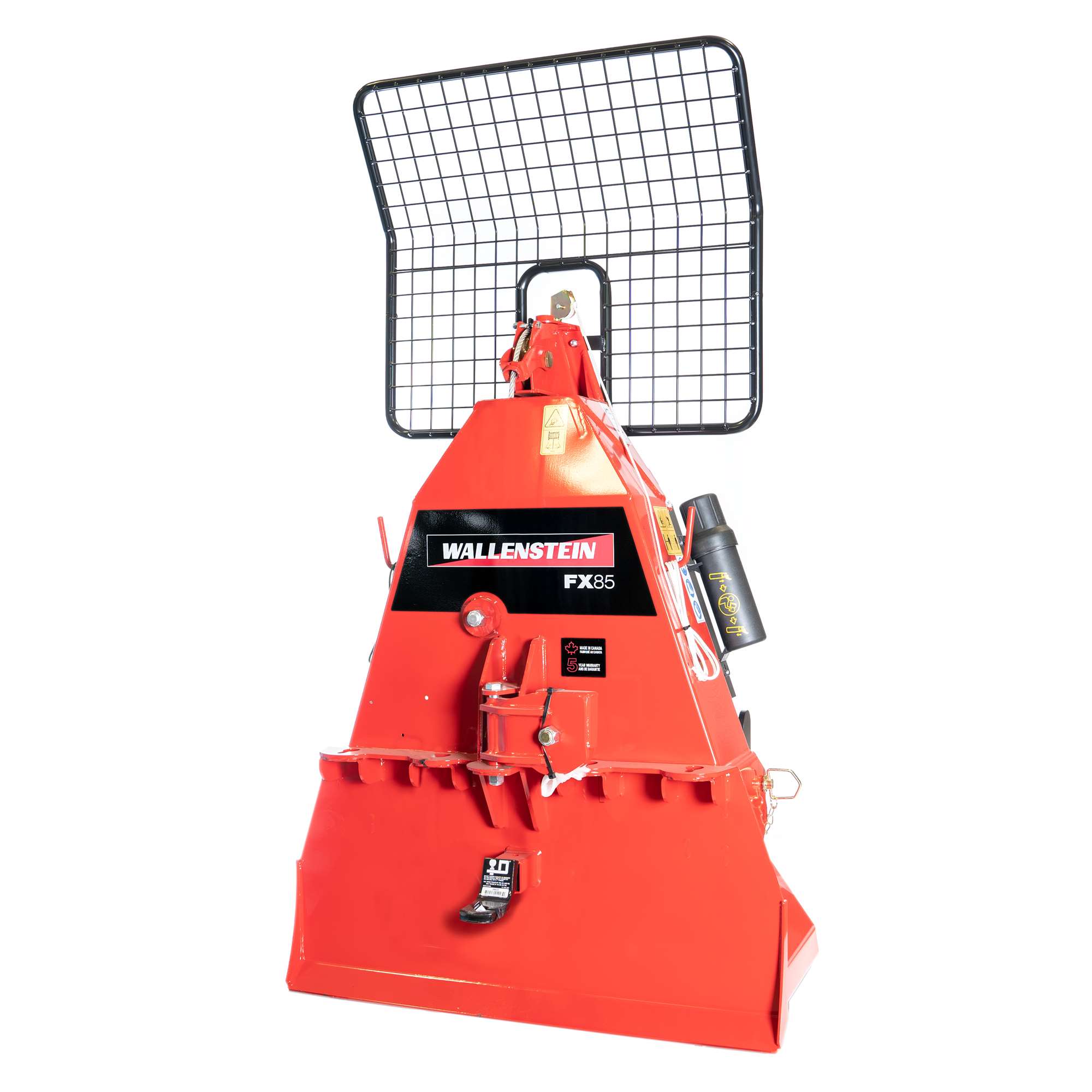
The Wallenstein FX85 is a tractor-mounted skidding winch for bringing suitable logs toward an appropriately positioned tractor before the next handling stage. Its buying case is access: the tractor need not travel to every piece in order to move it. That does not make the winch a universal recovery device or remove the need for a suitable site, competent operating plan and correctly matched tractor.
For a Canadian woodlot owner, start with the recurring extraction route and landing arrangement. The useful question is whether the FX85 makes that defined work practical. A large pulling-force number cannot by itself establish a safe log size, acceptable terrain or complete tractor combination.
On This Page
ToggleKnow which FX85 variant is being offered
The Canadian FX85 page identifies the base machine with manual pull-rope control and steel cable. It lists an 8500-lb pulling capacity, 165-foot cable, 540-rpm PTO input, Category 1 mounting and 470-lb weight. This guide concerns that base configuration, not an assumption that remote control or synthetic rope is included.
The January 2024 FX operator manual covers several variants together. Its tables distinguish steel-cable and synthetic-rope versions and identify hydraulic requirements specifically for remote-control versions. Do not transfer those requirements or features to every machine carrying the FX85 family name.
Ask for the exact model identification, fitted line and control arrangement on the quotation. On a used unit, compare those with the original documentation and any recorded modifications. Similar paint and frame shape do not establish identical equipment.
Pulling capacity changes with the drum
The manual lists maximum bare-drum pull of 8553 lb and maximum full-drum pull of 2992 lb for the FX85 family. That distinction is more useful than treating the headline capacity as constant. As line builds on the drum, the effective radius changes; the same available drum torque does not produce the same line pull at every radius.
The practical consequence is that a pull cannot be evaluated only at its starting point. The complete planned movement and changing conditions matter. This is a reason to obtain appropriate training and use the manufacturer’s operating guidance, not a basis for improvising a load calculation from a brochure.
Line pull is also not log weight. Resistance depends on the object, contact with the ground, obstacles, direction and other site conditions. A log weighing less than a published pull figure is not automatically an acceptable load, and the rating does not establish tractor stability.
Keep winching and later transport separate in the purchase assessment. Bringing material to the tractor does not prove that the tractor can carry or skid it under the intended conditions. The complete combination and prescribed methods still determine what work is permissible.
The horsepower discrepancy should remain visible
The current Canadian product page gives a 30–55 engine-hp range, while the January 2024 manual gives 30–60 hp. Those are different published ranges. This guide does not combine them into a new approval or assume that the larger upper limit applies to every available unit.
For a tractor near a boundary, obtain confirmation for the specific winch serial number and tractor configuration before purchase. Do not use the discrepancy as a reason to select the more convenient number. The manual also contains a questionable metric horsepower conversion, which is not reproduced here.
Even a tractor comfortably within a stated power range needs a complete assessment. Hitch capacity, geometry, ballast, protection, traction and the permitted operating arrangement matter. Power alone does not establish whether the tractor is appropriate for a particular woodlot task.
Aglist’s engine and PTO horsepower guide helps keep ratings distinct. Retain the manufacturer’s wording rather than silently replacing an engine range with a PTO range or using a generic conversion percentage.
Start with an extraction route and a landing
Draw the intended movement on a simple property sketch. Identify where the tractor can be properly positioned, the intended path of the material and where it will end up. Mark access restrictions and places where another method or professional service may be needed.
The landing is not merely the end of the cable. It needs enough suitable space for the approved operating arrangement and subsequent handling. If logs accumulate where they obstruct the next pull, a machine with sufficient pulling capability can still become part of an awkward workflow.
Decide what happens after extraction: further movement, processing, loading or storage. Each stage has its own equipment and handling requirements. A winch should be purchased as one part of that process, not expected to replace every tool used after the logs arrive.
The Aglist attachment-selection guide addresses a different stage of material handling. A suitable grapple may help with appropriate already-positioned material, but that does not make it interchangeable with a winch for extraction. Define the task before comparing attachments.
Cable length is not a universal working radius
The listed line length is equipment inventory, not permission to use every foot in every direction. Required drum wraps, operator position, line routing, terrain and the manufacturer’s operating restrictions all limit the actual arrangement. Avoid drawing a simple circle around the tractor and treating everything inside it as accessible work.
Likewise, the advertised line-speed range is not an extraction production rate. Walking, preparing the permitted connection, checking the route, controlling the pull and managing the landing all take time. The speed of line movement is only one part of the job.
For planning, identify how often the tractor must be repositioned and how the next task begins after each movement. A theoretically longer reach may have little value if the landing becomes congested or the route is unsuitable. The useful setup is the one that can be repeated correctly.
Do not improvise rigging, anchoring or load-multiplication arrangements from a buying guide. Those decisions require the applicable equipment ratings, manufacturer procedures and competent site assessment. The purpose here is to identify the questions that must be resolved before ownership.
Terrain claims need to be read with the restrictions
Marketing descriptions of reaching difficult ground should not be read as blanket approval for steep, wet or otherwise unsuitable sites. The operating manual includes specific restrictions on pull direction and tractor positioning, including prohibitions on downhill and across-slope winching.
Assess the actual property with those restrictions in view. A location that looks accessible from a distance may lack a suitable tractor position or a controlled material path. If the intended job depends on ignoring a restriction, the winch is not an appropriate solution to that job.
Seasonal access can change the planning without changing the machine. Ground conditions, visibility and the ability to move material afterward should be evaluated for the actual work period. Do not assume that a different season automatically makes a difficult route acceptable.
Keep the ownership case focused on recurring work within the permitted application. Exceptional storm damage, unstable trees or complicated extraction may require a qualified service. Buying a winch does not supply the training or site expertise needed for every wooded-property problem.
Manual controls and remote controls are different buying choices
The base FX85’s manual arrangement should be demonstrated as supplied. A video of a remote-equipped family member does not show the same control routine. Identify where the operator must be and how the prescribed sequence works before deciding that one version suits the property.
A remote option is not simply a convenience label to add mentally to a used base machine. If a different configuration is desired, obtain a complete approved specification and quotation. Include any supporting tractor requirements and verify which changes are actually permitted.
The best demonstration is an explanation of the whole authorised routine by a competent operator, using appropriate conditions and material. It should make limitations visible, not merely show an impressive pull. A buyer who cannot explain the supplied controls after handover needs further instruction before work begins.
Tractor connection and storage deserve early attention
The mounted winch must fit the tractor and its PTO driveline correctly. Check the actual hitch relationship, shaft arrangement and permitted movement. A common hitch category does not establish complete compatibility with every accessory or quick-hitch setup.
If a quick hitch is proposed, require explicit approval for the assembled combination. Aglist’s quick-hitch guide explains why physical connection and acceptable driveline geometry are separate issues. Do not assume that an adapter solves the problem without consequences.
Plan secure storage and straightforward connection access. A heavy rear attachment parked in an inconvenient place may make short jobs disproportionately cumbersome. Include the time needed to prepare and inspect the equipment when deciding whether ownership suits occasional use.
For shared equipment, keep the approved tractor setups documented separately. Each user should receive the correct operating information and a clear condition record. A machine being passed between properties needs more than an informal agreement about returning it with fuel in the tractor.
Evaluate productivity by completed movements
Use a representative task with a clear start and finish. Record preparation, permitted connection work, the pull itself, repositioning and landing management. Count any additional labour rather than reporting only elapsed time.
For an invented planning example, assume a task takes eight minutes of preparation and connection, two minutes of actual pulling and five minutes of subsequent handling. Total time is fifteen minutes. Even halving the pulling portion would save only one minute, reducing the whole task to fourteen minutes.
That calculation does not predict FX85 performance. It explains why line speed alone is a weak purchase criterion. Improving an approved route or landing arrangement may matter more than selecting equipment by the fastest advertised number.
Compare ownership with a service quotation for the same result. If the service includes processing or transport that the owner-operated plan omits, add those tasks before comparing costs. Also distinguish recurring woodlot work from a single unusual cleanup event.
Used inspection should not stop at the cable
Have a competent person assess the line and its terminations, drum, clutch and braking arrangements, guides, frame, ground-contact structure, guards, hitch and PTO equipment. Use the manufacturer’s secured inspection procedure. These are condition checks, not claims that the FX85 suffers particular common failures.
A visibly sound line does not prove that the control and holding functions are ready for service. Conversely, obvious line damage may be only one item in the repair estimate. Obtain an assessment of the complete working system and the correct replacement components.
Undocumented modifications deserve particular scrutiny because they can alter the relationship between controls, force and protection. Do not accept a stronger improvised component as an upgrade without manufacturer approval. Resolve uncertain configuration before considering the machine’s apparent discount.
Record the serial number, manual revision, fitted cable or rope and included accessories. That information helps separate a genuine base FX85 from a differently equipped family member and makes future service requests more precise.
Frequently asked questions
Can it pull an 8500-lb log?
The headline line-pull rating is not a universal permitted log weight. Drum fill, resistance, terrain, tractor stability and the complete approved arrangement all matter.
Does maximum pull stay constant?
No. The manual distinguishes bare-drum and full-drum figures. Evaluate the whole planned pull rather than treating the headline number as available throughout.
Does the base model have wireless control?
The Canadian base FX85 page specifies manual pull-rope control. Identify the exact variant and fitted equipment before assuming remote features.
Which horsepower upper limit should I use?
The current page and cited manual differ. Obtain serial-specific confirmation for the proposed tractor instead of choosing whichever published limit appears more convenient.
Who should shortlist the FX85?
An owner with recurring extraction work that fits the documented application, a verified tractor and a workable landing plan. If the job depends on uncertain terrain, rigging or machine limits, resolve those issues with competent assistance before buying.
Share your experience
Help other Canadian buyers — leave a quick review for the
Wallenstein FX85
There are no reviews yet. Be the first one to write one.