Overview & Specs
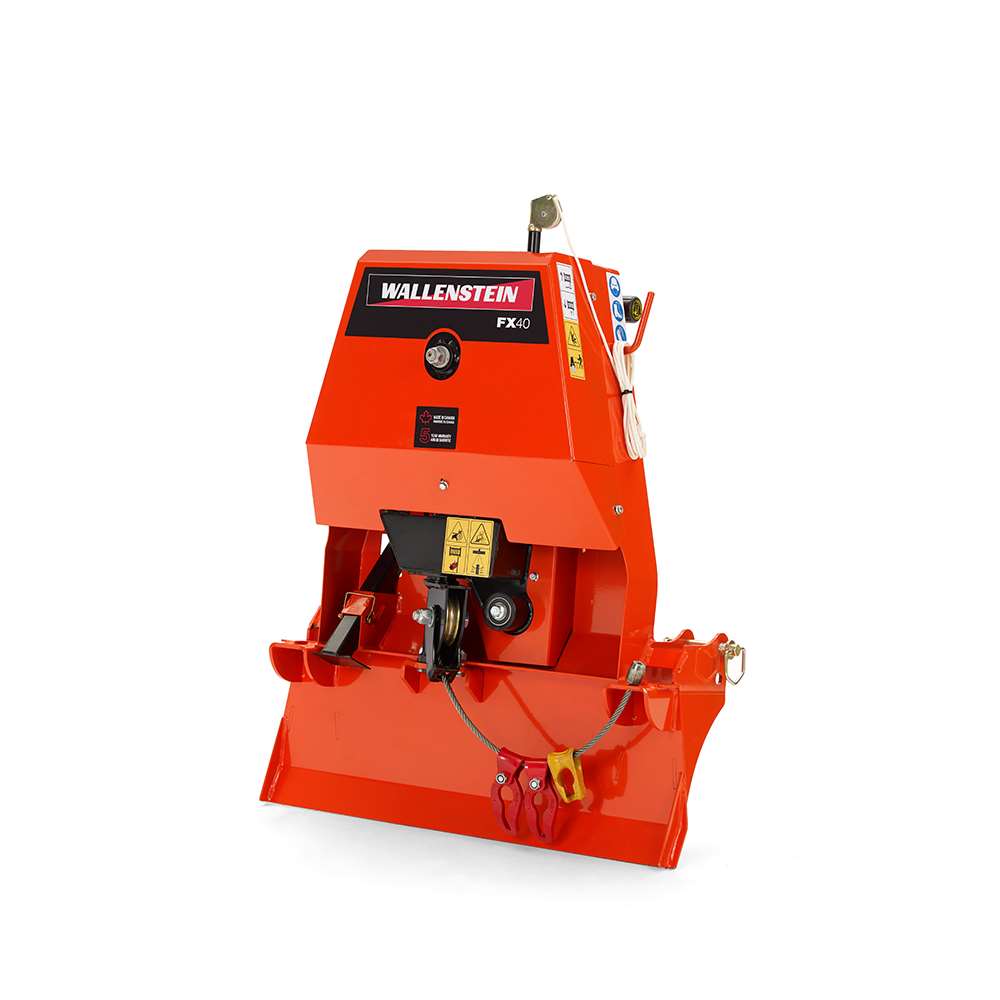
The Wallenstein FX40 is a compact tractor-mounted skidding winch for an owner whose woodlot work benefits from pulling suitable logs toward a properly positioned tractor. Its value is access: the tractor may not need to reach every piece directly. The machine should be assessed around a planned extraction route, a suitable tractor and a safe working method, rather than by treating its 4,000-pound pulling figure as a permitted log weight.
The Canadian product page and May 2021 FX40 operator manual were checked in October 2026. They agree on many central specifications, but their horsepower ranges differ: the page says 12–30 hp, while the manual says 15–30 hp. That discrepancy is unresolved here. A tractor at the lower end must not be declared suitable by selecting whichever source gives the more convenient answer.
On This Page
ToggleBegin with the route from the wood to the landing
Identify the material to be moved, the tractor’s possible operating locations and the place where the logs will be received. A winch is most useful when it addresses a recurring access problem within a suitable operation. It does not make every slope, wet area or obstructed route appropriate for a compact tractor.
Separate pulling a log toward the tractor from the subsequent movement to its final destination. The winch can change the first stage without solving the second. If logs arrive at a congested landing and must immediately be moved again, the handling plan may need improvement before the equipment size does.
Also distinguish managed woodlot work from emergency recovery or unstable storm damage. The FX40 should not be purchased as a universal answer to every object that needs pulling. Its manual and the operator’s competence define the appropriate use. Difficult situations may call for a different professional service rather than a larger winch.
The specifications describe several different constraints
| Item | Published FX40 specification | Decision relevance |
|---|---|---|
| Pulling capacity | 4,000 lb | Line pull is not a log-mass rating or tractor stability rating. |
| Machine weight | 280 lb | Check the tractor’s rear attachment and transport requirements. |
| Mounting | Category I | Confirm the complete hitch and PTO geometry. |
| PTO input | 540 rpm | Use the approved driveline and operating setup. |
| Cable | 165 feet of 3/8-inch steel cable | Cable length is not the same as permissible working reach. |
| Winch mechanism | Mechanical dry-disc clutch | Controls and clutch condition matter on a used example. |
| Published line-speed range | 103–290 feet per minute | Not a whole-job productivity figure. |
The listed dimensions are 17 by 36 by 45 inches, and the PTO height is listed at 16 inches. These help plan a physical fit, but a tape measure cannot confirm the operating suitability of the tractor. The manual, the tractor’s instructions and the correct driveline setup remain necessary.
The product page lists two choker chains and two keyhole sliders. Verify what is actually included in a particular new or used package. Missing or unsuitable rigging can change both the ready-to-work cost and whether the machine can be used as intended.
Why a 4,000-pound winch does not mean a 4,000-pound log
A log’s resistance to movement depends on more than its mass. Its contact with the ground, obstacles, slope and orientation affect the pull required. A lower-mass log caught behind an obstruction can be a more demanding and less predictable problem than a heavier piece on a suitable clear route.
The line-pull rating also does not describe what the tractor can resist or control. The tractor’s position, approved anchoring arrangement, terrain and the direction of the load are part of the system. A winch powerful enough to generate a certain pull is not proof that every tractor in an advertised horsepower range can safely sustain every possible use of that pull.
Do not use the number as an invitation to test the system until something moves. Plan suitable operations within the manual and stop when conditions are outside that plan. Rigging and directional arrangements require the correct rated equipment and competent judgment; a buying guide cannot supply a universal recipe for an unknown site.
The horsepower discrepancy needs an explicit answer
The difference between 12–30 hp on the Canadian page and 15–30 hp in the May 2021 manual is small numerically but important for a buyer with a very small tractor. It may reflect a documentation or revision difference, but that explanation has not been confirmed. Obtain manufacturer confirmation for the exact tractor and FX40 serial/configuration before purchasing at the disputed lower end.
Even outside that disputed band, horsepower is only one screening criterion. Check tractor mass, hitch capacity, ballast requirements, PTO setup and the manufacturer’s approval for the intended operation. The PTO and engine horsepower guide explains why the figure on the hood cannot answer every implement question.
A compact package can be appealing when storage is limited or the tractor already carries several rear implements. However, low attachment weight does not erase the working forces. Evaluate the tractor while operating and while transporting the attachment, not only while lifting it from a parking stand.
PTO and hitch fit should be settled before delivery
The FX40 uses a 540-rpm PTO input. Confirm the correct shaft, guarding, length and clearance for the actual tractor connection. A shaft supplied with a used winch may have been shortened for a different tractor and may no longer be appropriate. Its presence in the sale is not proof that it is usable.
The attachment must clear the tractor through the permitted hitch movement without binding the shaft or interfering with other components. If a quick hitch or adapter is proposed, establish that the exact arrangement is approved. An extra connection changes geometry, even when the hitch pins appear to match.
The Category I quick-hitch guide is a useful checklist for the questions, but the final setup must follow the FX40 and tractor instructions. Avoid solving a driveline mismatch with an improvised extension simply to make a demonstration possible.
Cable length is not the same as useful work radius
The published 165-foot cable length describes the installed line. The amount that can be used in a particular operation depends on the required remaining wraps, route, rigging and the manufacturer’s instructions. Do not draw a 165-foot circle around the tractor on a map and assume every point inside it is reachable or appropriate.
Repositioning the tractor can sometimes be more sensible than trying to reach the farthest possible piece from one location. Compare setup time, access and the receiving area. The best operating position is the one that suits a controlled complete job, not necessarily the position that uses the most cable.
Steel cable condition deserves careful attention. Damage, corrosion, poor spooling or an unsuitable repair can matter even if the winch still turns. Have the line assessed against the manufacturer’s criteria and replace unsuitable components correctly. A discount on a used machine should not depend on accepting questionable load-bearing equipment.
Where the FX40 differs from an FX85 or a grapple
The FX85 addresses a different capacity and tractor-matching discussion. Moving to a larger winch is not automatically an upgrade for a smaller tractor or a confined site. It can add demands that the current tractor and work method do not satisfy.
A grapple is a different approach again. The LXG420R rotating log grapple relies on a suitable carrier reaching the pickup and placement positions. It can be useful for accessible material handling, but it does not provide the same remote pulling function as a cable winch.
Choose between them by identifying the limiting stage. If the carrier can readily access the logs but repeated placement is difficult, a grapple arrangement may deserve attention. If access to individual pieces is the recurring problem, a winch method may be more relevant. Some operations need both stages, which should be priced and planned separately.
Measure complete-job time before assigning economic value
A line-speed figure is only one part of extraction. Walking out the rigging, arranging the connection, setting up the tractor, pulling, releasing and repositioning all take time. A faster line does little for a job dominated by access or repeated changes in setup.
For illustration, suppose ten suitable movements each require five minutes of preparation, two minutes of pulling and three minutes of release and repositioning. The total is one hundred minutes. Reducing the pulling portion by half would save ten minutes overall, not fifty. These hypothetical times are not FX40 test results; they show why a complete cycle is the appropriate comparison.
For occasional work, the value may be convenience and avoiding a separate arrangement rather than high annual utilization. Use actual quotes for alternatives and a realistic estimate of how often the task occurs. Do not justify ownership by assuming every spare weekend will become productive woodlot work.
Inspecting a used FX40
Start with identification and documentation. Compare the model and serial number with the correct operator and parts information. Ask about previous tractors, modifications, storage and service. A photograph of a similar winch is not enough to identify the included configuration.
With the machine in the safe condition specified by the manual, inspect the frame, hitch points, guards and visible structural repairs. Check the cable, end fittings and included rigging using the appropriate inspection criteria. These are general priorities for used pulling equipment, not a claim that the FX40 has a particular common failure.
The clutch and operating controls should be assessed by someone familiar with the machine. A winch that pulls briefly in a demonstration has not necessarily demonstrated correct release, control behaviour or condition under its intended use. Do not bypass a questionable control to finish the test.
Inspect the PTO shaft independently from the winch. Check its guards and compatibility, and identify any required replacement before negotiating. Include the cost of sound rigging and correct setup in the comparison with another machine.
Seasonal readiness for a Canadian woodlot
Plan service before the work window rather than after the tractor is already committed to the site. The machine should be stored and maintained as instructed, with its documentation available and critical components ready for inspection. A missing or damaged component can cancel a short seasonal opportunity.
Ground conditions can alter the operating plan more than the calendar suggests. A route suitable in one season may be unsuitable after thaw, rainfall or ice. Reassess access and the receiving area before bringing equipment into the woodlot. The attachment’s published dimensions and pulling rating do not describe the condition of the site.
Also arrange the downstream use of the wood. If logs need cutting, splitting or loading after extraction, leave an appropriate area for those steps. A winch purchase is easier to justify when it supports a complete planned process rather than producing a new pile in an inconvenient location.
Frequently asked questions
Can a twelve-horsepower tractor use the FX40?
The Canadian page and May 2021 manual disagree at the lower end. Obtain confirmation for the exact combination rather than treating the page’s lower number as blanket approval. Other tractor and site requirements still apply.
Can it lift a suspended load?
Do not infer a lifting authorization from the pulling rating. Use the machine only for the operations permitted by its manual. Skidding line pull and an approved suspended-load lifting capacity are different things.
Does it need a hydraulic remote to power the winch?
The described FX40 is mechanically PTO-driven with a dry-disc clutch. Its operating arrangement must be checked as supplied; it should not be confused with a different hydraulic or remote-control winch configuration.
What should a complete quotation identify?
The exact winch, driveline, included rigging, delivery and required tractor setup. Resolve the horsepower discrepancy and any configuration questions before committing to a package.
Sources
Share your experience
Help other Canadian buyers — leave a quick review for the
Wallenstein FX40
There are no reviews yet. Be the first one to write one.