Overview & Specs
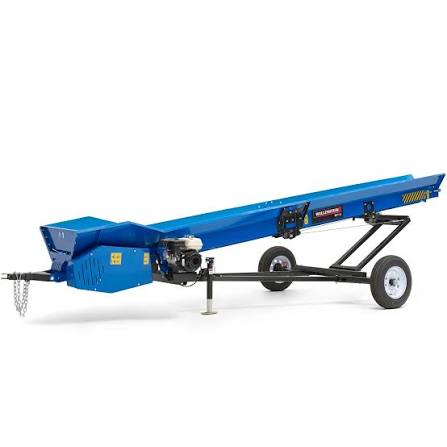
The Wallenstein CT16B is a sixteen-foot, engine-powered firewood conveyor for moving suitable split wood away from a splitter or processor and toward a receiving pile or vehicle. Its best buying case is a wood yard where finished pieces are handled repeatedly after splitting. It is less persuasive when the real delay is supplying rounds, cutting them or finding space for the final wood.
Before comparing conveyor lengths, sketch the loading station. Mark the splitter, the person feeding the conveyor, the receiving position and the route used to remove a full load. The CT16B must fit that entire arrangement. A published maximum pile height does not prove that it can load every trailer at every position.
This guide uses the Canadian CT16B page and January 2024 CT16B/CT24B manual, checked in October 2026. That manual identifies CT16B serial numbers CT16B27–39 and 1100000 upward. Earlier machines have separate manuals in the support catalogue, so an older conveyor should be assessed with its own documentation.
On This Page
ToggleWhere a conveyor changes the firewood routine
A splitter produces pieces at a working position; a conveyor moves them to another position. These are separate jobs. If pieces otherwise fall into an inconvenient heap and must later be lifted into a trailer, a conveyor may remove a handling stage. If pieces already drop into their final suitable container, the additional machine may offer much less benefit.
Consider the tractor-powered WX310 as one possible upstream machine. Its hydraulic performance does not determine whether a conveyor is useful. The deciding question is what happens to the split wood after it leaves the operator’s working area.
With an independent splitter such as the WX540, the same question applies. The conveyor has its own engine, so it does not inherently require the splitter’s tractor or hydraulic circuit to drive it. Independence can simplify power matching while adding another engine to inspect and maintain.
CT16B dimensions: keep three different measurements separate
| Manufacturer specification | CT16B | Why the distinction matters |
|---|---|---|
| Trough length | 16 feet | This is not sixteen feet of horizontal reach at every angle. |
| Maximum pile height in specification table | 8.5 feet | A pile-height label is not a guaranteed trailer-side clearance. |
| Raised overall dimensions | 180 by 70 by 119 inches | The upper structure is not identical to the material discharge point. |
| Lowered overall dimensions | 212 by 70 by 63 inches | Storage length is greater than the raised horizontal envelope. |
| Machine weight | 880 lb | Include the complete moving and towing arrangement in the assessment. |
The Canadian page’s introductory copy uses eight feet five inches, while its table and the January 2024 manual state 8.5 feet. Those are not exactly the same measurement. This guide follows the specification table for comparison, but a tight loading-clearance decision should be made by measuring the actual setup, not choosing the more favourable wording.
Height alone is insufficient. The conveyor may clear the side of a receiving vehicle yet discharge too close to its edge, or it may reach the desired point only when the inlet sits where the splitter needs to be. Record height and horizontal placement together.
The trough and chain are part of the material-handling system
The manual describes a trough eight inches wide at the rear and twenty inches at the front, with a seven-inch depth. It uses 662 heavy conveyor pintle chain and two-inch serrated cleats. These details explain the material path and drive architecture; they do not establish that any piece produced by a splitter will travel satisfactorily.
Use representative firewood in a demonstration. Include the normal mixture of lengths and shapes rather than only neat, uniform pieces. Look for how material enters, travels and leaves the machine under the manufacturer’s operating instructions. A piece that repeatedly needs intervention is evidence that the proposed feed arrangement or material needs reassessment.
Do not equate a moving chain with unlimited receiving capacity. The manual instructs the operator not to put too much firewood on at once. A splitter that releases a burst of pieces may require an appropriate intermediate handling routine so the conveyor is not overloaded.
Independent power: useful freedom with another service obligation
The January 2024 manual lists a Vanguard five-horsepower, 169 cc engine. The Canadian page repeats that figure in one field but lists 160 cc elsewhere. Identify the engine on the offered unit and use its own engine documentation for parts and maintenance. An inconsistent website field should not become a confident model-specific parts recommendation.
The conveyor chain is driven through the engine and sprocket arrangement. There is no need to assume a tractor hydraulic outlet is the normal power source for this documented configuration. That can help when the tractor is occupied moving logs or finished wood elsewhere in the yard.
The tradeoff is fuel, engine servicing, starting and storage preparation. Compare the convenience of independent operation with the actual number of sessions. Another engine is easier to justify when the conveyor removes recurring labour than when it is used once and then stored without preparation.
Receiving geometry changes as the pile grows
An empty trailer or clear ground area is the easiest condition to demonstrate. The more revealing condition is the one near the end of a batch. As wood accumulates, the free receiving space changes. The conveyor may need to stop and be repositioned, or the receiving vehicle may need to leave and be replaced.
Plan those interruptions. The manual requires the machine to be stopped and emptied before its angle or position is changed. Pivoting wheels are a positioning feature, not permission to sweep a running, loaded conveyor across a pile.
A buyer should therefore count repositioning as part of the work rather than an unexpected inconvenience. A longer conveyor might reduce some movements, but it may also require more yard space. The right answer depends on where the growing pile and vehicle actually sit.
Compare a complete batch, not just chain movement
Suppose a hypothetical batch takes forty minutes to split and feed, twenty minutes to move loose pieces into their destination and ten minutes to clear the station. That is seventy minutes. If a conveyor removes fifteen minutes of the separate handling but adds eight minutes of setup and repositioning, the net saving is seven minutes, not fifteen.
That example is deliberately modest. It is not a CT16B production result. In another layout, avoiding repeated lifting could matter more than elapsed time alone. Record the number of handling steps, the labour involved and the final location of the wood so the comparison captures the actual benefit.
For two people, distinguish elapsed time from labour time. Two people working for one hour represent two labour-hours. A conveyor that lets one person complete the same defined task in eighty minutes has a different economic result from one that merely keeps both people busy for fifty minutes. State which outcome matters to the property.
CT16B versus a longer conveyor
The same manual lists the CT24B with a twenty-four-foot trough and a 13.5-foot maximum pile-height figure. It is also a larger storage and positioning package. The extra length should be purchased for a measured receiving requirement or demonstrated workflow improvement, not because a longer machine looks more capable.
For a low receiving point near the splitter, the CT16B may provide a more manageable layout. For a higher or more distant receiving position, a longer conveyor may be needed. Neither conclusion can be drawn solely from the height of the vehicle side; the discharge location, inlet position and permitted machine angle matter together.
A practical comparison places both proposed footprints on the yard plan, including the lowered storage dimensions. Check whether a vehicle can arrive, fill and depart without crossing the operator’s working area or forcing the splitter to move each time.
Towing and storage need their own plan
The documented standard hitch is a clevis, and the product page lists a two-inch ball-hitch accessory. Identify which connection is supplied and whether the intended towing vehicle and route are appropriate. Tires and a hitch are physical features, not universal permission for every road journey.
The manual requires the conveyor to be fully lowered and locked for transport or storage. Use the exact procedures and limits for the machine. Do not base a collection plan on the raised length because it happens to fit a shorter space on paper.
Leave room to inspect the chain, engine, supports and wheels when parked. A conveyor that fits tightly into a storage corner but cannot be prepared without moving several machines may be inconvenient for small batches. Easy access can determine whether the intended routine is actually followed.
Inspecting a used CT16B
Start with the serial number and the correct manual revision. Check the trough, frame, supports, hitch and visible repairs with the equipment isolated and supported. Distortion can affect the material path even when the engine starts normally.
Have the chain, sprockets, cleats, bearings and drive alignment assessed. Look for wear, damaged components and evidence of poor adjustment. These are normal inspection priorities for a chain conveyor, not claims that the CT16B has a documented recurring defect.
The angle-adjustment mechanism, locks and pivoting-wheel hardware also deserve attention. A machine that conveys wood but cannot be positioned and secured correctly is not ready for service. A demonstration should cover the approved positioning and shutdown routine as well as material movement.
Price required repairs, engine service and the correct towing connection before comparing used and new offers. Avoid comparing an incomplete used package with a fully prepared alternative solely by the advertised purchase price.
Questions to settle before ordering
Will it load my trailer?
Measure the receiving height, desired landing point and available inlet position. Confirm the actual conveyor geometry in an approved setup. The maximum pile-height label alone cannot answer the question.
Can I reposition it while it runs?
The January 2024 manual requires stopping and removing the firewood before changing angle or position. Build those pauses into the layout and production comparison.
Does it need tractor hydraulics?
The documented CT16B uses its own Vanguard engine. Verify the supplied configuration rather than assuming it shares the power arrangement of another conveyor model.
What is the useful comparison with carrying wood manually?
Use the same starting pile and final destination, and include setup, pauses and cleanup. Count repeated handling and labour-hours as well as elapsed time.
Who has the strongest ownership case?
An owner who repeatedly handles split wood between a production station and a suitable receiving point, with enough space for the conveyor and its planned movements. A machine that removes a specific recurring handling stage is easier to justify than one purchased on length alone.
Keep the receiving vehicle exchange workable
Mark a waiting position for the next receiving vehicle before choosing the conveyor location. A station that fills one trailer efficiently but traps it behind the splitter is incomplete. Check the departure turn with the conveyor in its approved position and preserve the operator’s clear working area throughout the exchange.
Sources
Share your experience
Help other Canadian buyers — leave a quick review for the
Wallenstein CT16B
There are no reviews yet. Be the first one to write one.