Overview & Specs
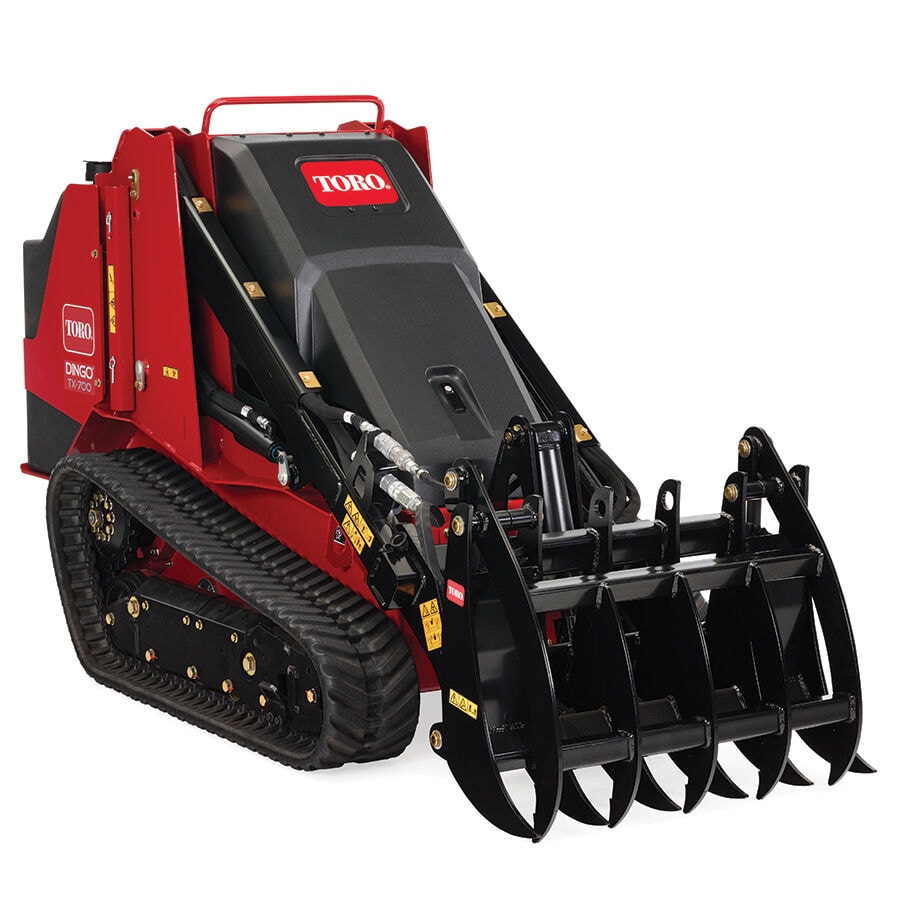
The Toro Dingo TX 700 is worth investigating when a stand-on tracked carrier can improve repeated property or landscape work, but the site still makes access a priority. The useful question is whether its combination of platform, controls, hydraulic tools and loading geometry fits the whole job. A nominal capacity class alone cannot decide that.
This guide uses the Canadian page for narrow model 22351. Other narrow and wide model numbers appear in Toro’s catalogue, so keep identification with every specification. Do not assume that a familiar TX 700 name guarantees the same rating, engine description or equipment across all serial ranges.
On This Page
ToggleSpecifications for an initial comparison
| Item | Model 22351 entry |
|---|---|
| Rated operating capacity | 700 lb / 317.5 kg |
| Machine width | 34.2 in / 86.9 cm |
| Auxiliary flow | 13.7 US gpm |
| Lift path | Radial |
| Hinge-pin height | 73.5 in / 186.7 cm |
| Dump height | 52.9 in / 134.4 cm |
| Length with listed bucket | 102.8 in / 261.3 cm |
Source: Toro Canada’s TX 700 narrow page, checked October 12, 2026. It describes a dedicated stand-on platform. The page’s engine table retains 24.7 hp while its footnote announces a change to 23.2 hp from January 2025; confirm the exact build rather than treating either figure as universal. Reversed-looking track length and width entries are excluded here.
Resolve the model identity before comparing capacities
Toro’s 2024 lineup article gives a different TX 700 capacity from the reviewed Canadian product page. This guide uses the latter’s 700 lb entry for model 22351, not the larger number from another description. The operating documentation for the actual machine and attachment remains the authority for the task.
This matters when buying used or comparing rental offers. Record model and serial, the attachment supplied and any relevant configuration details. A quotation saying only “TX 700 or equivalent” leaves the buyer unable to check the exact equipment package.
Do not convert the discrepancy into a claim that a particular machine has been upgraded or downgraded. The public descriptions alone do not establish the reason. Preserve the uncertainty until the applicable equipment information resolves it.
The stand-on platform should improve a real routine
Consider a job that alternates between machine work and hand placement. The operator moves material, parks and secures the machine, performs the hand task, then returns for another cycle. A stand-on layout deserves evaluation through that sequence, including the correct stopping and exit procedures.
Now compare a job involving long uninterrupted travel or continuous work from one position. The operator may value a different station. A platform that is convenient for frequent transitions should not be assumed comfortable for every duration, surface or operator.
During a demonstration, assess the position of the controls, visibility of the working tool and the way the operator maintains a stable approved stance. Include normal work footwear. Keep the assessment practical: can the operator perform the intended task comfortably and see the required area?
If several people share the machine, let each assess it after appropriate familiarisation. A feature that seems convenient to one person may be awkward for another. Those observations can justify choosing a different machine more convincingly than a small difference in advertised engine output.
Access includes the exit and the next turn
Measure the narrowest usable opening with hinges and other hardware included. Then draw the complete route to the work, not just the entrance. The selected tool and carried material may be wider or longer than the carrier.
A machine may enter a courtyard successfully yet need more room to turn with forks or an auger. It may also need space to withdraw after placing material. Evaluate the attachment’s swept path and the operator’s visibility throughout the movement.
The listed length with bucket is relevant when comparing storage or restricted turns. It should not be replaced by a bare-machine length to make a close fit appear better. If a different bucket is proposed, obtain its actual dimensions.
For a recurring narrow route, an appropriate demonstration can settle what dimensions alone leave uncertain. For an occasional problem, compare another material drop point or work sequence. Buying a machine around one exceptional entrance may compromise all the routine work elsewhere.
Loading geometry: the receiving body is half the specification
The difference between the table’s hinge-pin and dump heights is a reminder that the highest pivot position is not the space beneath a dumping bucket. Use the actual attachment and receiver when assessing loading.
Draw the trailer or container in side view. Mark the top edge, desired landing area and the closest suitable approach. An obstruction that prevents moving closer can turn a height problem into a reach problem. Both must be resolved with the approved configuration.
Do not judge from an empty bucket raised beside an unfamiliar truck. Demonstrate a permitted complete cycle using the actual receiver or reliable dimensions. Observe approach, discharge and withdrawal, including where the material lands.
The lift-path comparison explains the general geometry. Apply it without assuming that all radial loaders share this machine’s reach or that a vertical loader is automatically the correct alternative.
Match the hydraulic attachment, not its marketing category
Begin with the exact attachment model and variant. Record the permitted flow range, pressure requirements, return arrangement, controls, mass and approved carrier installation. A tool described simply as a “mini-loader auger” may leave important compatibility questions unanswered.
The auxiliary-flow figure belongs in that assessment. The separate traction entry is not extra supply to add to it. A hydraulic motor also has operating limits; more flow is not automatically beneficial if it exceeds the tool’s range.
For a grapple, the required clamp function and connection arrangement may be the central issue. For a motor-driven tool, sustained operating requirements deserve attention. The machine must both carry the attachment appropriately and supply its required functions.
Write these items into the quotation and have the supplied arrangement demonstrated at handover. The hydraulic attachment guide provides a worksheet approach, but the final answer must come from the TX 700 and tool documentation.
Do not confuse a capacity class with a pallet allowance
Identify the full handled load, including packaging, container or pallet. Then assess its dimensions and centre of gravity with the attachment and placement position. A headline operating-capacity figure is not a promise about every fork load.
For bulk material, the same bucket volume can represent very different mass depending on material and condition. As a hypothetical example, 0.15 m³ at an assumed 1,200 kg/m³ represents 180 kg; at 1,800 kg/m³ it represents 270 kg. These invented densities are not instructions to load this machine to either amount.
The purpose is to identify what needs measuring, not to derive an operating limit from a simple multiplication. Obtain reliable material information and the approved equipment requirements. The ROC guide explains the rating terminology.
Ground finish and repeated travel
Toro describes a track system intended to reduce surface disturbance, but the buyer should still assess the actual route. Ground support, turning, load and repeated passes affect the result. A product description cannot guarantee an untouched lawn in every condition.
Agree on an acceptable finish before a trial. Inspect the surface afterwards and include any necessary restoration in the job comparison. A dry gravel demonstration is not evidence for a damp landscaped passage.
Material staging can reduce the number or length of trips. If moving the delivery point removes half the travel route, that may contribute more than another increment of machine capacity. Evaluate the site plan alongside the carrier.
The ground-pressure guide explains why pressure, flotation and turning damage should not be treated as the same question.
A useful demonstration for Canadian acreage work
Choose two representative tasks: one that uses the loading cycle and one that uses the intended powered attachment or another essential function. Define the required result, permitted configuration and working area before the demonstration.
Record the complete time, including setup and transitions. Suppose a hypothetical job contains 20 cycles and a changed route saves 15 seconds per cycle. That is five minutes, not a transformation of an entire workday. Use observations to keep the purchase case realistic.
For winter use, make a separate assessment of the attachment, snow destination, visibility and operator exposure. The route can narrow after banks develop. Follow the exact machine’s cold-weather instructions rather than inferring performance on ice from the presence of tracks.
If much of the annual work is mowing or rear-implement work, compare a compact tractor package. If most work is seated material movement, a small articulated loader such as the Bobcat L23 offers another operating routine. A Bobcat MT100 is a direct category comparison to investigate with its own specifications.
Tool storage belongs in the working plan
Allocate suitable parking space for each attachment before deciding how many tools to buy. A tool left at the far end of the property or obstructed by another implement can add more inconvenience than the carrier saves. Follow the attachment’s approved parking and coupling procedures, and evaluate whether the regular operator can perform the change in the available space.
Keep identification and compatibility records with each tool. This is particularly useful when borrowing or renting an attachment that looks like one already owned but has a different motor or connection arrangement. Familiar appearance should not replace the matching check.
Used-machine inspection and transport
For a used TX 700, confirm model and serial before reading a current brochure. Have a qualified inspection assess the platform and controls, tracks and running gear, drive, lift linkage, attachment connection, hydraulics and repair evidence. Check maintenance records against the correct service instructions.
Inspect included tools separately. Their wear, identity and installation hardware can change the value of the package. A machine with several unsuitable attachments is not necessarily a better offer than one supplied with the tools the buyer actually needs.
Determine the equipped mass for hauling rather than guessing from size. Include attachments and everything carried with the machine, then check the full trailer and towing arrangement. Loading and unloading must follow the applicable procedures as well.
Use local Canadian quotations for purchase, delivery, service and identified work. Compare ownership at the expected utilisation and at a lower-use scenario. If the justification depends on a project that may not occur, show the decision without that project too.
TX 700 questions worth resolving
Should I use the larger capacity found in a Toro news article?
Not without establishing that it applies to the actual model and configuration. This guide uses the reviewed Canadian model 22351 page and flags the difference.
Does the engine-rating footnote mean every older machine changed?
No. Identify the engine and applicable serial documentation. Do not infer a physical change from the footnote alone.
Does the dedicated platform make every task comfortable?
No. Evaluate the operator and duration through a representative work sequence.
Can hinge-pin height establish dump clearance?
No. The bucket and receiving geometry must be assessed in the relevant position.
What should justify this model?
A confirmed access, attachment and operator fit that improves recurring work at a complete ownership cost the buyer understands.
Share your experience
Help other Canadian buyers — leave a quick review for the
Toro Dingo TX 700
There are no reviews yet. Be the first one to write one.