Overview & Specs
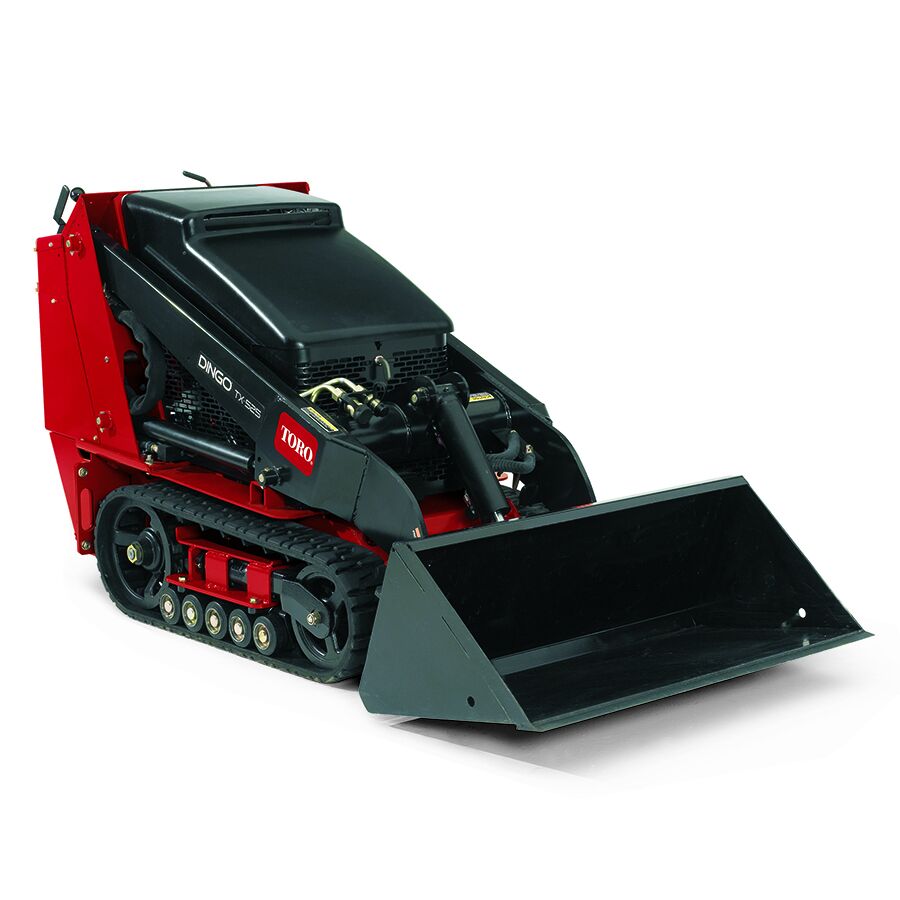
The Toro Dingo TX 525 is a compact diesel attachment carrier to investigate when getting equipment into the work area is the first constraint. It is particularly relevant to a buyer planning smaller landscape and property jobs behind restricted entrances, where a larger loader’s additional capacity has little value if the machine cannot reach the task.
This guide concentrates on the narrow-track model 22323 listed by Toro Canada. Wide-track and older serial configurations need their own documentation. For a useful purchase comparison, establish the exact carrier, selected attachment and complete route before discussing engine power or the longest list of available tools.
On This Page
ToggleTX 525 narrow: useful screening specifications
| Item | Canadian model 22323 entry |
|---|---|
| Engine identity | Kubota D902E3B diesel |
| Rated operating capacity | 553 lb / 250.8 kg |
| Machine width | 33.7 in / 85.5 cm |
| Auxiliary hydraulic flow | 13.8 US gpm |
| Lift arrangement | Radial |
| Dump height | 46.1 in / 117 cm |
| Length with listed bucket | 92 in / 233.6 cm |
Source: Toro Canada’s TX 525 narrow page, checked October 12, 2026. Its engine-power descriptions disagree, and the tipping-load row has inconsistent pound and kilogram values. This guide does not use those disputed entries. A current catalogue page is not a substitute for the exact machine and attachment operating instructions.
Plan the access problem in three dimensions
Start with the narrowest usable opening. Include gate hardware, posts and anything preventing a door or gate from opening completely. Then examine the approach and the first turn after the opening. The loader’s straight-line width is only the beginning of the access assessment.
Next measure the attachment and load. A bucket, auger assembly, fork frame or bulky carried item can determine the working envelope. The fact that one listed bucket matches the carrier’s nominal width does not establish that every tool will do so.
Finally, check length and height throughout the movement. A machine can pass an entrance and still lack space to turn or position the tool. A low branch, overhang or doorway may create a restriction above the carrier. Include the operator’s required space and the approved working position; an empty-machine dimension does not describe every operational clearance.
For a hypothetical 36-inch usable opening, subtracting the listed machine width leaves 2.3 inches in total. That is an arithmetic difference, not a recommended clearance. Surface irregularity, alignment and the complete equipment package must be assessed before calling the passage suitable.
Why the attachment should lead the purchase
The strongest TX 525 proposal names the tools that will perform the recurring work. An auger for a known application, a suitable trencher or a bucket for a defined material movement gives the buyer something concrete to evaluate. “It takes many attachments” does not establish that the essential one fits.
Record each attachment’s model and required carrier arrangement. Include mounting, weight, hydraulic flow range, pressure, return path and controls. Some tools have different motor or configuration options under similar names, so identify the version as well as the product family.
The auxiliary-flow entry is relevant to a powered tool; the traction-flow entry is not additional attachment supply. Do not add them together to produce a more impressive figure. The hydraulic system’s architecture does not remove the need to meet the tool’s own limits.
For the buying method, see Aglist’s hydraulic attachment guide. Use the TX 525’s actual instructions and equipment when applying it. A compact attachment mount is not universal proof of compatibility.
Trenching and augering: evaluate the completed task
For trenching, describe the required dimensions, ground conditions, spoil placement and access before selecting equipment. The carrier and attachment should be suitable for the intended duty. A narrow entrance can make access attractive while leaving insufficient room to manage the spoil or complete the route.
For augering, define the hole requirement and the material conditions from appropriate site information. Compare the actual tool and carrier package. Do not assume that more flow or a larger engine always produces a better hole; tool design, duty and the approved operating arrangement matter.
Have underground services identified through the appropriate local process before ground disturbance. A buying demonstration should be planned for an authorised area and a suitable task, not use an unknown patch of ground as a casual test.
Record completion quality as well as elapsed time. A task requiring rework or additional cleanup should not be credited with the speed of the machine movement alone. The useful comparison is the finished job with the same requirements.
Radial lift and a relatively low receiver
The TX 525’s loading proposal should be built around the receiving body. A low cart, container or other suitable receiver presents a different problem from a high-sided truck. Measure the edge, the target discharge location and how close the machine can approach.
Keep dump height separate from hinge-pin height and maximum operating height. The bucket’s lip and orientation determine where material can go. A photograph with the arms raised does not establish that the selected bucket can discharge into your receiver.
Where loading is frequent, use a side-view sketch with actual measurements. If the receiver can be moved closer or replaced with a suitable lower arrangement, that may solve the task. If it is fixed, a different lift geometry may be necessary despite the TX 525’s access advantage.
The radial and vertical lift guide explains the geometry question. Do not transfer another loader’s dimensions or capacities to this machine just because the lift-path label is shared.
Capacity is not a promise about every load
The published rated operating capacity is a model-comparison input. The actual attachment, load centre and operating conditions still need their own assessment. A fork frame and pallet should not be approved by treating the bucket-related headline as permitted goods weight.
Describe the load completely: product, packaging, container or pallet, dimensions and placement height. For bulk material, estimate mass from reliable material information and the intended volume, then verify the equipment arrangement. A light bulky product and damp aggregate do not impose the same load when occupying an equal bucket volume.
Do not resolve the source’s tipping-unit inconsistency by selecting the more convenient value or inventing a new operating percentage. Use the applicable instructions for the exact machine. The ROC guide explains why tipping load and operating capacity cannot be interchanged.
Track width does not guarantee an untouched lawn
Access-sensitive jobs often cross finished ground. Evaluate the route under representative conditions rather than accepting a broad claim about turf friendliness. Ground support, carried load, turning and repeated passes can affect the result.
A narrower machine may reach a location that a wider one cannot, but that does not prove it produces the best surface outcome there. Compare the whole task, including any approved route protection or restoration. The ground-pressure explanation helps separate published pressure from actual site performance.
Plan the material drop point. If a supplier can place material closer to the work without creating another problem, the reduction in repeated travel may improve both time and surface outcome. Equipment selection and site organisation should be assessed together.
When a small carrier saves meaningful time
Use a realistic recurring quantity rather than the largest project imagined. Suppose a hypothetical task requires 18 suitable trips at three minutes each. That is 54 minutes of cycle time. If better staging shortens each trip by 40 seconds, the saving is 12 minutes. These are invented planning inputs, not measured TX 525 performance.
The example shows why route design can matter without changing rated capacity. It also keeps the benefit in proportion: setup, tool changes and cleanup remain outside the cycle calculation and must be included in the full job.
For an occasional large project, compare hiring or renting appropriate equipment. Owning a compact carrier may be justified by repeated smaller tasks even if it is not the best machine for one substantial excavation or delivery. Avoid making every purchase requirement serve an exceptional job at the expense of normal work.
Operator routine and Canadian seasonal work
Evaluate the actual control layout, operating position and entry or transition routine on the proposed machine. Do not assume it is identical to a newer stand-on Dingo simply because both are tracked. Any platform or accessory must be identified as part of the approved configuration.
For work that alternates with hand placement, include those stops in the demonstration using the correct shutdown and exit procedures. For longer sessions, assess comfort and visibility over a representative period. A short empty drive cannot answer both questions.
Winter work requires a separate attachment and route plan. Identify where snow will be placed or discharged, how the operator sees the task and whether the required tool is approved. Narrow summer access may be reduced by banks or stored equipment later in the season.
Use the serial-specific instructions for cold-weather preparation and service. This guide does not infer winter traction or a particular starting temperature from the diesel engine or tracks.
Alternatives worth comparing
A Bobcat MT100 is another mini-loader candidate where the required package and access fit. The Bobcat L23 introduces seated articulated operation. Compare the actual equipment and route rather than declaring a winner from model class alone.
A compact tractor can be a more coherent choice where rear-PTO mowing or other three-point work dominates. A mini loader’s hydraulic tool ecosystem does not automatically replace those implements. Retaining an existing mower while adding a carrier may also be a valid arrangement.
Used TX 525 inspection and ownership cost
Begin with the model and serial identification, then inspect the machine against the correct documentation. A qualified assessment should cover tracks and running gear, drive operation, lift linkage, attachment connection, hydraulic functions, cooling system and repair evidence.
Review maintenance records and have unresolved warnings or abnormal operation assessed before purchase. These are general priorities for this layout, not claims about recurring TX 525 defects. Inspect attachments separately, including identification, wear and complete installation hardware.
Price the configured transport load rather than assuming that a narrow machine is easy to haul. Include the carrier, tools, fuel and other equipment, and check the complete towing and loading arrangement. Delivery or collection services can be compared with owning a suitable trailer.
Use actual Canadian offers for machine, attachments, repairs and service. A used bundle with the wrong tools may cost more to make useful than a less extensive package with the correct ones. Separate those items before comparing the headline price.
TX 525 buyer questions
Does the model name describe all narrow and wide versions?
No. This guide uses narrow model 22323. Match the identification and documentation of the actual machine.
Can auxiliary and traction flow be combined for an attachment?
Do not treat the separate entries as one available tool supply. Use the documented circuit and installation.
Will the machine load any truck it can approach?
No. Receiver height, reach and attachment geometry must match the complete permitted cycle.
Why not publish one definitive engine-horsepower number?
The current descriptions differ. Resolve the exact engine specification where it affects the purchase rather than borrowing a number from another version.
What makes this a strong shortlist candidate?
A verified access-limited job, suitable hydraulic tools and a practical material route that benefit from the complete narrow carrier package.
Share your experience
Help other Canadian buyers — leave a quick review for the
Toro Dingo TX 525
There are no reviews yet. Be the first one to write one.