Overview & Specs
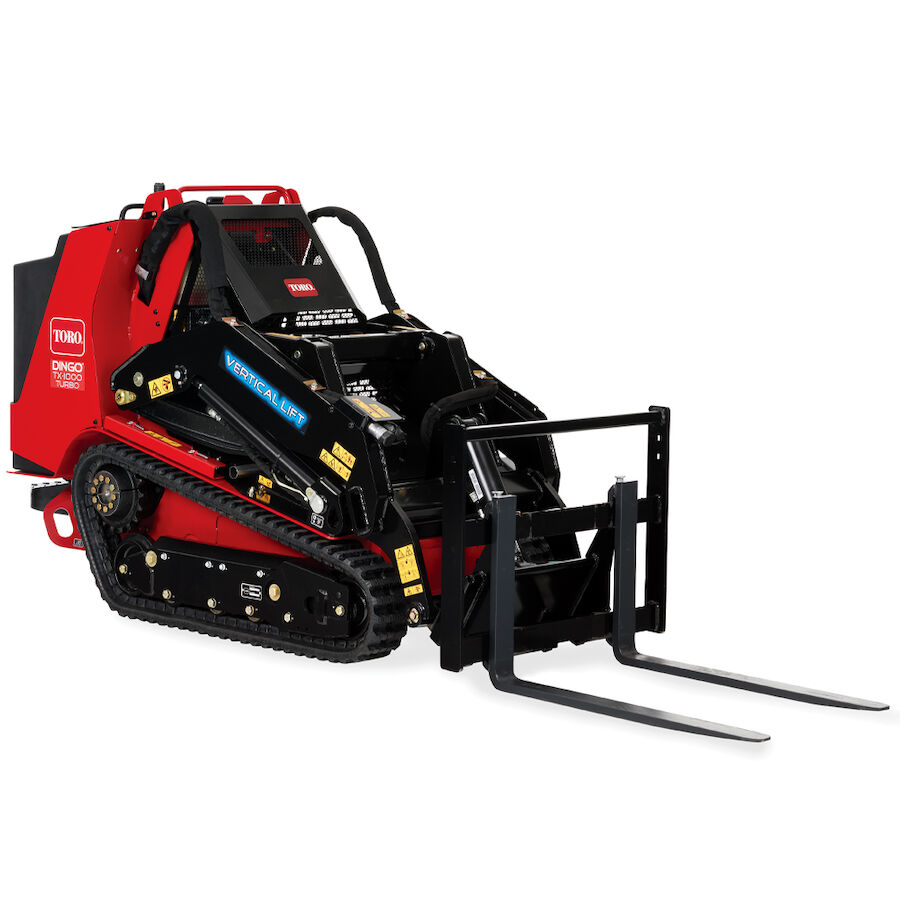
The Toro Dingo TX 1000 Turbo is a compact tracked loader to shortlist when restricted access and repeated loading both matter. Its vertical lift arrangement and traction-management feature give it a different purchase argument from simply buying the smallest carrier available. The important test is whether the complete machine and attachment can reach the work, handle the documented load and place it where required.
This guide covers the Turbo generation, with narrow model 22587 as the main Canadian reference. It does not transfer specifications from the earlier Kubota-powered TX 1000. The model name, engine generation, track configuration and serial-specific instructions should remain attached to every comparison.
On This Page
ToggleKey specifications, with the attachment width visible
| Item | Canadian model 22587 entry |
|---|---|
| Rated operating capacity | 1,000 lb / approximately 454 kg |
| Width without listed bucket | 34.6 in / 87.8 cm |
| Width with listed bucket | 42.2 in / 107.2 cm |
| Hinge-pin height | 81 in / 205.7 cm |
| Dump height | 60.3 in / 153.2 cm |
| Auxiliary modes | 13.2 US gpm high; 4.9 US gpm low |
| Lift path | Vertical |
Source: Toro Canada’s TX 1000 Turbo narrow page, checked October 12, 2026. The engine table and January 2025 power-rating footnote differ; identify the actual engine documentation rather than assigning one horsepower number to every machine. Toro’s Turbo overview describes Smart Power as automatic adjustment of traction speed to manage the available output.
The narrow-gate claim needs the bucket beside it
The difference between bare width and bucket width is one of this model’s most useful buying details. A carrier narrow enough for a particular opening may not pass with the bucket a buyer expects to use. Comparing only the smaller number can produce an equipment package that cannot reach its essential work.
For a hypothetical 36-inch clear opening, the bare-width arithmetic leaves 1.4 inches in total, while the listed bucket is wider than the opening. Neither calculation is a recommended clearance. It simply shows why the attachment cannot be omitted from the first access check.
If a narrower approved tool is proposed, identify it and evaluate its capacity, geometry and usefulness for the task. A changed bucket may solve access while changing the number of trips or the loading result. Removing and refitting an attachment also requires suitable space and the manufacturer’s procedure; it should not be assumed to be a convenient solution for every repeated passage.
Measure the turn after the opening and the return route. Forks, a projecting load or a powered attachment may sweep more room than the carrier during a pivot. A “zero-radius” description does not mean the complete machine needs no turning space.
Vertical lift should solve a measured loading problem
Begin with the receiving container, trailer or storage position. Record its height, the intended placement point and the closest appropriate approach. Include anything preventing the loader from moving closer.
The table separates hinge-pin height from dump height for a reason. The attachment pivot reaching a height does not prove the bucket lip can clear an edge in the dumping position. Fork placement has its own geometry and load conditions.
Compare the full movement: approach, lift, position, discharge or set down, and withdraw. A feature that improves one part of the path is useful only if the rest of the cycle remains suitable. An empty raised bucket beside a truck is not equivalent to a documented loaded cycle.
Aglist’s radial versus vertical lift guide explains the general distinction. Use this machine’s own measurements rather than treating the lift-path label as a guarantee of reach or capacity.
Smart Power manages travel; it does not create extra rated capacity
Toro describes a system that adjusts traction speed as part of managing engine, auxiliary and traction demands. That is a control feature worth demonstrating with the intended work. It is not a reason to increase the published load rating or ignore an attachment’s permitted operating range.
For a suitable powered tool, observe how the machine responds while carrying out representative work under the correct instructions. Does the operator retain useful control of the task? Does the resulting pace and finish suit the job? Those observations are more informative than assuming a fixed productivity gain from the feature name.
Separate tool suitability from travel management. A trencher, auger or other hydraulic attachment needs its approved mounting, flow, pressure, return and control arrangement before the demonstration begins. Automatic travel adjustment cannot make an incompatible attachment compatible.
Keep any economic claim tied to evidence. A control feature may reduce an inconvenience without generating a measurable fuel saving or a guaranteed percentage improvement. No such percentage is assumed in this guide.
High and low auxiliary flow are attachment settings
Obtain the exact tool’s documentation, including any motor option. Compare its permitted range with the relevant mode, then verify pressure, return requirements and controls. A familiar coupler shape is only part of the connection.
As a hypothetical example, a tool specified for 4–6 US gpm presents a different initial flow match from one specified for 12–14 US gpm. Those ranges are invented to illustrate the two-mode decision; they do not identify approved attachments for this machine.
Do not treat the traction pumps’ figures as additional flow available to the tool. Likewise, do not assume that running the higher auxiliary setting is always preferable. The attachment’s limits and the approved installation govern the choice.
The hydraulic attachment guide provides the broader matching method. For the TX 1000 Turbo, write the selected attachment and required mode into the equipment plan so the actual supplied package can be checked.
Read the operating-capacity conditions
The reviewed TX 1000 Turbo operator’s manual states its rating with a standard bucket and a 75 kg operator, and directs users to attachment-specific information for other tools. That condition is more useful than treating the headline as a universal goods-weight allowance.
For pallet work, include the fork assembly, pallet, packaging, material distribution and placement requirement. For irregular loads, describe where the mass acts rather than relying only on total weight. The machine handles the entire arrangement.
The same manual and product page differ on some weight and reach entries. This guide therefore does not provide a definitive transport mass or use those conflicting reach figures to approve a task. Identify the applicable revision and actual configured equipment before those decisions.
Read the ROC explanation for the rating terminology. Do not create a new operating limit by applying another machine’s tipping-load percentage.
A better material-cycle comparison
Suppose two fully suitable arrangements move a hypothetical quantity in 10 and 8 trips. If each trip takes three minutes, the difference is six minutes of cycle time. If the eight-trip arrangement needs an additional ten minutes to change tools or negotiate access, it no longer has the shorter overall job under those assumptions.
These are invented planning inputs, not TX 1000 Turbo performance figures. Their purpose is to keep access and setup in the same calculation as payload. Replace them with observations from a fair, permitted demonstration.
Record the receiver, route, material, attachment and operator. Compare repeated representative cycles rather than a single fast pass. Include cleanup and any necessary surface restoration before concluding that one package saves time.
Tracks and the actual surface result
A narrow tracked machine can be attractive for access, but that does not establish the outcome on a wet lawn or finished surface. Turning, load, ground support and repeated passes remain important. A published ground-pressure figure is only one description of a particular configuration.
Agree on an acceptable finish before testing. Inspect the route afterwards. If the surface requires restoration, include that effort in the comparison; if another machine also causes damage, record that rather than assuming one category is always gentler.
The ground-pressure guide explains the limitations of a single number. Moving the material staging point or reducing repeated travel may improve the result without changing the carrier.
Canadian seasonal and operator requirements
For mixed property work, map the routine through the year. Summer material movement, a powered landscape tool and winter clearing can ask different things of the machine. Identify which tasks are essential and which can be hired or rented.
Evaluate the operator platform, controls and visibility in a representative sequence, including frequent stops where relevant. The approved parking and exit procedure belongs in that sequence. Convenience should not depend on reaching controls from an unsuitable position or leaving an active attachment unsecured.
For winter use, define the snow tool and destination, account for banks narrowing the route, and assess exposure and sightlines. Do not infer traction on ice or a guaranteed starting temperature from the Turbo name. Follow the exact machine’s seasonal instructions.
Compare the whole package with alternatives
The Bobcat MT100 offers another mini-loader package to investigate. The Bobcat L28 offers a different steering and reach concept. Neither comparison is settled by selecting the largest capacity or reach entry from each brochure.
If the work primarily involves rear-PTO implements, compare a suitable compact tractor. If the key problem is a receiver beyond this loader’s approved geometry, assess another handling arrangement. The right purchase may be a different platform rather than a more powerful version of an unsuitable one.
Keep Turbo and earlier-machine records separate
If a business already owns an earlier TX 1000, create a separate equipment record for the Turbo machine. Record the model, serial, engine identity and approved attachments rather than assuming that familiar service parts or tool settings transfer. The same broad model name can otherwise hide an important difference when ordering parts or arranging a rental attachment.
At handover, ask for the applicable manuals and identify the controls actually fitted. Retain any clarification of the conflicting public specifications with that record. It gives a future operator or service provider a concrete configuration to work from instead of an ambiguous advertisement.
Used-machine inspection and ownership records
Verify Turbo generation, model and serial before using the current specification. Have a competent inspection assess controls and display, drive, tracks and running gear, lift linkage, coupler, hydraulic functions, cooling system and repairs. Review records against the correct manual.
Inspect attachments independently and resolve active warnings or unclear modifications. These are inspection priorities, not allegations of recurring model faults. Obtain estimates for identified work rather than assuming a standard repair allowance.
Use the complete configured transport load and check the hauling arrangement separately. Then compare Canadian quotations including tools, required equipment, delivery and service access. Keep the confirmed configuration with the purchase documents so later attachments are assessed against the actual machine.
Frequently asked questions
Is this the original TX 1000 with a different label?
This guide covers the Turbo generation. Do not transfer the earlier model’s engine or other specifications without confirming applicability.
Will the narrow machine pass a gate with its listed bucket?
The bucket is wider than the bare carrier. Measure the exact combination and complete route.
Does Smart Power increase permitted payload?
No additional load allowance follows from the travel-management feature.
Can the high-flow mode power every mini-loader tool?
No. The full attachment requirements and approved configuration still have to match.
What is the best reason to shortlist it?
A repeatable access-and-loading job that benefits from its documented vertical-lift package and controls while remaining within the complete equipment requirements.
Share your experience
Help other Canadian buyers — leave a quick review for the
Toro Dingo TX 1000 Turbo
There are no reviews yet. Be the first one to write one.