Overview & Specs
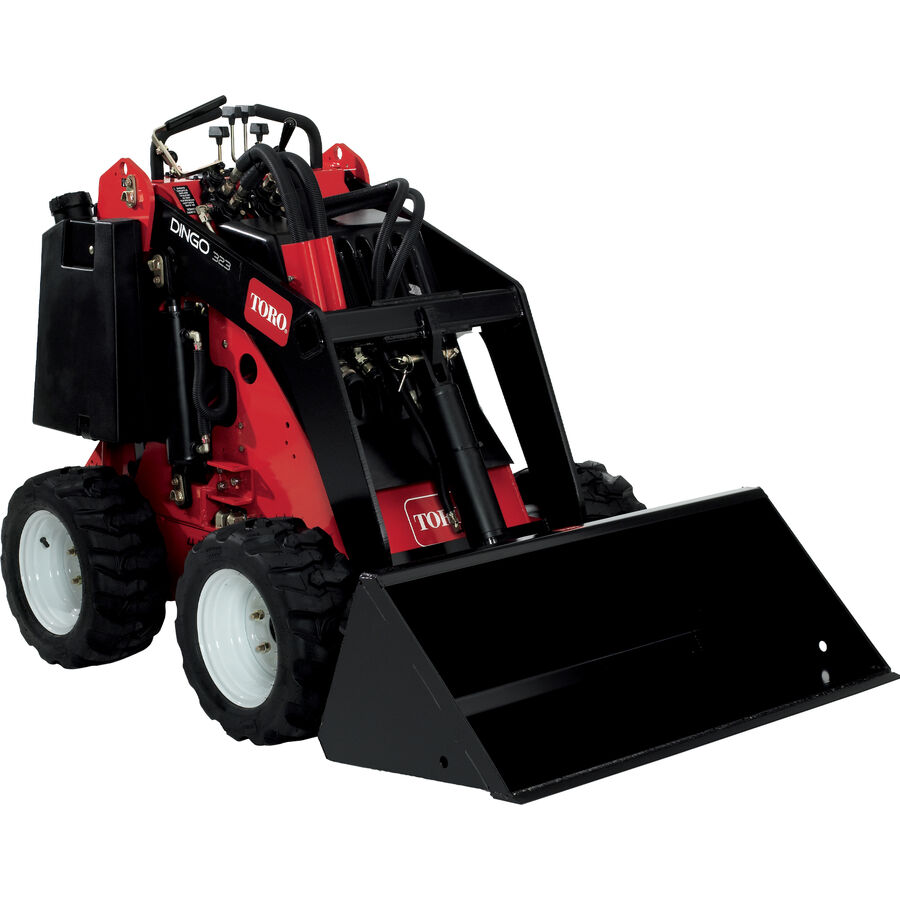
The Toro Dingo 323 is a wheeled compact utility loader to consider when a property job alternates between moving material, using a hydraulic attachment and working on foot. Its appeal is the complete short-cycle routine: reach the work, position the tool, complete a modest task and move on. It is not a substitute for a tractor’s rear-PTO equipment simply because both machines can be sold with a bucket.
For Canadian acreage and landscape work, begin with the route and attachment list. The 323 can be a sensible candidate where its wheeled arrangement, operator controls and approved tools match repeated jobs. If the main requirement is sustained mowing, substantial lifting or work through a narrower opening than the equipped machine can accommodate, investigate the appropriate alternative before negotiating a price.
On This Page
ToggleWhich Dingo 323 does this guide cover?
This guide uses Toro’s Canadian information for model 22318, checked October 12, 2026. Older machines must be identified by model and serial number. A current product description is useful background, but it does not establish the engine, service instructions or installed equipment on every used 323.
| Selection item | Canadian product-page entry |
|---|---|
| Undercarriage | Wheeled, independent four-wheel drive |
| Rated operating capacity | 515 lb / 233.6 kg |
| Width with narrow tyres | 35 in / 88.9 cm |
| Width with standard tyres | 40.5 in / 102.8 cm |
| Hydraulic modes | 10.8 US gpm high; 4 US gpm low |
| Published dump height | 47 in / 119.3 cm |
Source: Toro Dingo 323, model 22318. These are comparison entries, not a universal attachment load allowance. The page contains conflicting engine-power and pressure descriptions, so this guide does not use those disputed figures to approve a powered tool. Some track and reservoir entries are also inconsistent with the machine or their units and are not reproduced.
Start with a weekly sequence rather than a horsepower target
Write down the jobs that actually repeat. Moving compost into beds, carrying suitable materials near a building, operating an approved auger and cleaning up a small work area create a different equipment requirement from mowing a large open field. The 323 should earn its place by serving the former sequence conveniently, not by accumulating a long list of theoretically available attachments.
For each job, record the attachment, the access route and what happens after the machine stops. Does the operator spend several minutes placing material by hand? Does someone else need to enter the work area? Is the next tool stored nearby or across the property? These details determine whether the compact carrier changes the whole job or just one movement.
Keep people clear while the machine operates and use the approved stopping and exit procedure. Frequent transitions are a workflow consideration, not permission to leave a running attachment unattended or to reach controls from an unsuitable position.
The tyre choice can determine access
The two published widths in the table describe different tyre arrangements. A buyer comparing a narrow-tyre advertisement with a standard-tyre machine on a lot is not comparing the same access package. Record what is installed, then measure the actual widest point with the chosen tool.
A hypothetical 38-inch clear opening and a 35-inch machine leave three inches of total nominal difference. That arithmetic does not establish adequate working clearance. Hinges, gate stops, uneven ground, alignment and the attachment or load can consume the apparent space. Measure the usable opening rather than relying on the fence panel’s nominal size.
Draw the turn immediately after the entrance. A short carrier may pass through a straight opening yet have insufficient room to turn with projecting forks. A load wider than the tyres can govern the route even when the empty machine fits. Access is a complete movement, not a single width comparison.
If a route is used every week, resolving it should be a mandatory purchase condition. If only one occasional delivery presents the problem, a different drop point may be more proportionate than choosing every machine feature around that exceptional event.
Wheels, surface condition and the finished job
The 323’s wheeled layout is a reason to compare it directly with tracked compact carriers on the surface that matters. Do not assume that wheels always leave more damage, that tracks never mark grass, or that a small machine is harmless on wet ground. Turning method, load, ground support and repeated passes influence the result.
Define an acceptable finish before a demonstration. If the task crosses established landscaping, inspect the route afterwards as well as timing the movement. If restoration is necessary, include that work in the comparison. A fast transfer that creates a separate repair task may not be the fastest complete job.
Where the route is sensitive, investigate material staging and an appropriate protection plan with the equipment provider. Reducing repeated travel can be more valuable than changing the carrier alone. The ground-pressure guide explains why a published pressure figure cannot predict every surface outcome.
Hydraulic modes must match the actual tool
The high and low flow entries give the buyer two different starting points. Neither means that the machine can operate every attachment whose couplers physically connect. Obtain the tool’s permitted flow range, pressure requirements, return arrangement, controls and carrier approval.
As a hypothetical screening exercise, a tool requiring 9–12 US gpm has a different relationship to the two listed modes than a tool requiring 3–5 US gpm. This is not approval of either tool. It illustrates why choosing the larger number automatically can be wrong, even before pressure and installation are considered.
Resolve the product page’s pressure discrepancy through the documentation for the exact machine and attachment. Do not quietly select the larger number because it makes the proposed tool appear suitable. Keep the answer with the equipment quote so a replacement tool can be checked later.
Aglist’s hydraulic attachment guide supplies a useful comparison method. Apply it to this compact carrier’s own circuits and approved equipment rather than borrowing settings from a full-size skid steer.
Controls deserve a working demonstration
Toro describes four-stick fingertip controls on the 323. That is a different operating arrangement from buying solely on the assumption that every Dingo uses the same control layout. Try the actual machine after appropriate familiarisation and instruction.
Choose a representative permitted task involving approach, positioning and withdrawal. Observe whether the operator can coordinate travel and attachment movement while retaining a clear view. Evaluate the reach to controls and the working position over more than a brief straight drive.
If several people will use the machine, include them in the assessment. Familiarity can distort a comparison: an experienced operator may prefer a known layout initially, while another finds a different system easier after training. Record specific observations rather than declaring a control system universally intuitive.
Loading a receiver is different from carrying near the ground
The published dump-height entry is more relevant to a bucket receiver than the highest point of the lift mechanism, but it still needs its attachment conditions. Measure the trailer, cart or container and the available approach. Determine where the material must land, not merely which edge must be cleared.
A low receiving body can suit a compact loading routine better than a taller one. If the receiver can be changed or relocated, compare that option before assuming another machine is necessary. Conversely, a fixed high receiver can rule out an otherwise convenient carrier.
For forks, use the load’s gross mass, dimensions and centre of gravity together with the approved attachment information. The machine’s bucket-based headline capacity should not be treated as a goods-weight allowance for every fork arrangement. See the ROC and tipping-load explanation for the distinction between rating terms.
When short cycles justify ownership
Count complete cycles for an actual recurring task. Suppose two already suitable arrangements move a hypothetical 1,200 kg in 12 and 8 trips. If the respective observed cycle times were two minutes and three minutes, both would total 24 minutes before setup and cleanup. The assumed loads and times are not 323 ratings or performance claims.
The calculation prevents a larger theoretical load from automatically winning. The smaller arrangement may have a shorter route, easier access or a more convenient receiver. Equally, repeated long travel can make a small carrier inefficient for the job even when each individual load is permitted.
Measure the task at a useful scale. One quick trip with an empty bucket does not establish a work rate. Include tool changes, material collection, placement and cleanup, then compare the outcome with the alternative method.
Canadian seasonal use and alternatives
For winter work, begin with the intended snow attachment and storage or discharge plan. The operator environment, visibility and route can differ sharply from a summer landscaping task. Do not transfer a dry-yard demonstration into a claim about traction on packed snow or ice.
Follow the exact machine’s cold-weather, fuel and storage instructions. This guide does not prescribe generic fluid substitutions or starting techniques. If winter work is the main reason to buy, evaluate a suitable winter package rather than adding an unspecified attachment after purchase.
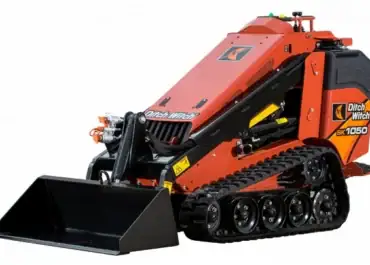
The Bobcat L23 provides a seated articulated alternative to investigate where the operator routine differs. A Bobcat MT100 provides another mini-loader comparison. Neither is an equivalent replacement established by a single horsepower or capacity figure; compare the actual route and approved tools.
Used-machine and package inspection
Identify the 323 by model and serial, then match the service information to that machine. Have a qualified inspection assess wheel-drive operation, tyres, hydraulic functions, lift linkage, attachment connection and evidence of damage or repair. Review maintenance records and investigate unresolved operating issues.
Inspect every included attachment independently. A collection of tools adds value only when their condition and compatibility fit the work. Missing identification, worn cutting parts or incomplete connections can change the practical package substantially.
For transport, use the complete configured load with tools, fuel and other carried equipment. A compact footprint does not prove compatibility with an existing trailer. Check the hauling arrangement and loading procedure against their own requirements.
Obtain Canadian quotations for the ready-to-work package. Separate machine price, attachments, required equipment, delivery and identified repairs. Do not invent a resale premium or fuel-consumption advantage from the wheeled layout. Compare costs supported by the offer and the expected work.
Questions before buying a Dingo 323
Does a narrow-tyre version fit every nominal three-foot gate?
No. Measure the usable opening, tool, load and turning route. Nominal gate size is not a clearance approval.
Can I run any compact hydraulic attachment?
No. Mechanical fit, flow, pressure, return, controls and carrier approval must all match.
Why is no definitive engine-power figure used here?
The reviewed current descriptions conflict. The exact engine and serial-specific documentation are the appropriate basis for a purchase that depends on that figure.
Does wheeled mean no undercarriage expense?
No. Tyres and drive components still need inspection and maintenance. Compare actual condition and service requirements.
What is the clearest reason to choose this machine?
A repeated access-and-attachment routine that the configured 323 completes appropriately, with an operator and ownership plan that fit the property.
Share your experience
Help other Canadian buyers — leave a quick review for the
Toro Dingo 323
There are no reviews yet. Be the first one to write one.