Overview & Specs
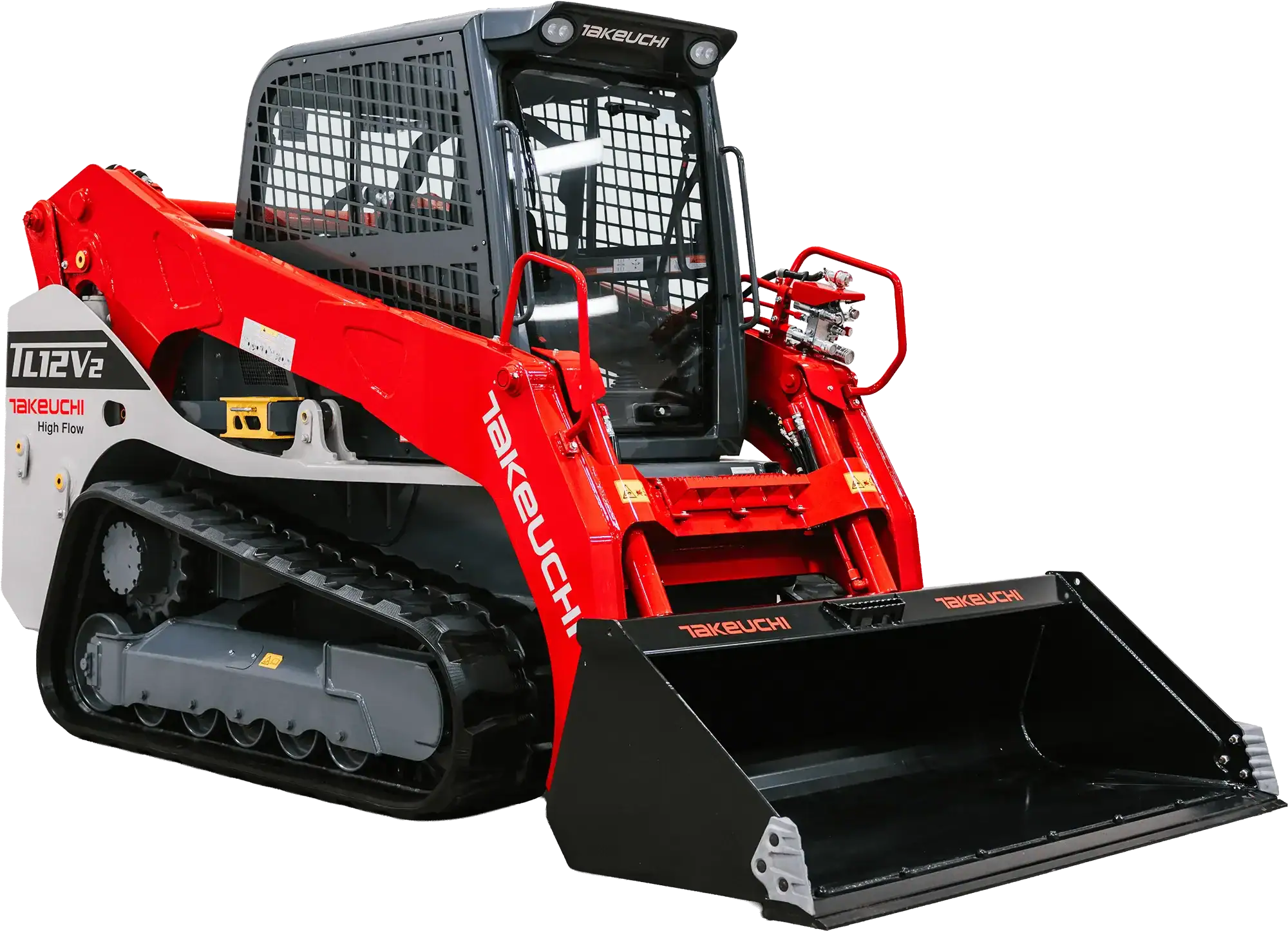
The Takeuchi TL12V2 is a vertical-lift compact track loader to examine when material handling and loading justify a substantial machine. For a Canadian farm or contractor, the important question is whether it can perform the actual load-and-placement task within the applicable limits while fitting the yard, transport arrangement and work calendar. A large rated capacity is useful only when the rest of that method works.
This is a different buying argument from choosing a heavy radial machine mainly for ground work. The TL12V2 should be evaluated from the load outward: its weight and centre, the attachment, the destination and the route. That order helps prevent a familiar horsepower figure from taking the place of a proper handling assessment.
On This Page
ToggleSpecifications and the reference configuration
The figures below follow the October 2022 North American TL12V2 brochure linked from Takeuchi’s current model page. The website rounds some headline values differently. Keep the brochure’s values together rather than mixing rows from different references.
| Specification | Brochure value |
|---|---|
| Power | 111.3 hp at 2,400 rpm |
| Operating weight, canopy / cab | 5,835 / 5,985 kg |
| ROC at 35% | 1,863 kg / 4,107 lb |
| Width without bucket | 1,960 mm |
| Maximum bucket-pin height | 3,302 mm |
| Dump height / reach, fully raised | 2,459 / 924 mm |
| Primary / optional high flow | 88 / 153 L/min |
The documented machine uses vertical lift and DOC, DPF and SCR aftertreatment with DEF. Confirm the serial, enclosure, attachments and options of the actual machine; older TL12 and radial TL12R2 specifications are separate.
Build the load list before the machine list
Start with the heaviest normal loads and the awkward ones, which may not be the same items. A compact dense pallet, a long bundle and a large bale can have different centres of gravity and placement requirements. Record actual weight information rather than estimating from appearance.
Include the pallet or packaging, and identify the attachment proposed for each task. The machine must be assessed with that arrangement. A fork frame’s own rating does not establish that the loader can use the frame to its maximum marked capacity.
Then record the destination. Carrying a load over a suitable route, unloading a delivery vehicle and placing material at height are different parts of the job. A successful low lift does not prove that the complete operation is permitted.
This process may reveal that a different handling machine belongs on the shortlist. A loader can remain attractive for mixed bucket and attachment work, while a dedicated arrangement may suit a narrow set of recurring placement tasks. Compare the methods honestly instead of forcing every farm load into a CTL purchase.
Use the published ROC without turning it into a promise
The brochure explicitly labels its rated operating capacity at 35%. It also contains a larger reference at another percentage. That additional figure should not be substituted for the applicable operating rating simply because it makes a proposed load appear acceptable.
Even the correct ROC is not a universal fork payload at every load centre and height. Attachment geometry, load position, configuration and operating conditions still matter. Obtain the manufacturer’s information for the actual task before proceeding.
Aglist’s ROC and tipping-load guide explains how those limits differ from breakout force and tipping load. It is especially relevant when cross-shopping machines whose brochures emphasize different percentage conventions.
Do not compare a counterweighted rating from one offer with a standard configuration from another without identifying that difference. Approved equipment and its corresponding documentation need to remain together throughout the quotation and inspection process.
Vertical lift: measure useful placement
The vertical arrangement is relevant when the upper part of the lift path is used frequently. The advantage to investigate is the actual placement geometry, not the word “vertical” on its own. A receiver can still be unsuitable because of height, reach, approach or space around it.
Measure the receiving edge and where the material needs to land. Include any difference in the standing elevations of loader and receiver. Test with the intended bucket because its shape and attachment arrangement affect the discharge position.
For pallet handling, establish the required load centre and height using the applicable information. Do not borrow a bucket dump-reach figure and treat it as a fork-placement rating. The measurements describe different tools and reference points.
A useful demonstration reproduces the suitable approach, placement and withdrawal. It should not rely on improvised machine positions to make a receiver fit. Aglist’s lift-path comparison can help organize the geometry questions before arranging that trial.
Do the traffic route and ground support fit?
A large loader can have enough nominal capacity while still being poorly matched to the property layout. Map the entire route from pickup to destination. Include doors, corners, parked machinery and the space required for the fitted attachment and load.
Width without a bucket does not describe every configuration. A wider tool or projecting load can control access. Overhead restrictions also change between ordinary travel and lifting. The site plan must account for the intended operation rather than only where an empty loader can park.
Ground conditions require a separate assessment. Tracks distribute weight, but soft areas, buried infrastructure and finished surfaces are not approved by a low catalogue pressure number. Loaded travel, steering and repeated passes can create conditions unlike a stationary specification.
For an operation serving several properties, document the restrictive sites. If one occasional location is incompatible, hiring another method for that job may be sensible. If most sites are restrictive, that is a stronger reason to choose a different everyday package.
Bucket work remains part of the business case
Material-handling capacity can attract a buyer to the TL12V2, but many owners will spend substantial time with a bucket. Select the bucket for material density, required volume and the finished task. A large bucket that causes spillage, unnecessary disturbance or an unsuitable load is not an efficiency improvement.
Consider how material arrives and leaves. The loader may wait for delivery trucks, receivers or another operation. Increasing bucket output contributes little during those waits. Record the complete cycle when comparing candidates.
If both dense material and light bulky material are regular jobs, separate the tool requirements. Buying one oversized bucket as a universal solution can compromise the denser-material work. Verify each tool’s carrier suitability and include it in the delivered quotation.
High flow is a separate purchase decision
The optional high-flow arrangement can support suitable powered attachments, but it is not the reason the machine has its published payload rating. A business mainly using a bucket and compatible forks should evaluate whether it has enough powered-tool work to justify the option.
For a required powered tool, compare its accepted flow, pressure, return and control requirements with the exact installed circuit. Check carrier mass, attachment geometry and any guarding requirements. A similar class label or mounting plate does not prove full compatibility.
The brochure also lists an optional secondary circuit associated with high flow. Identify what is actually supplied rather than assuming all hydraulic options are present together. Do not add separate flow rows and describe the sum as guaranteed simultaneous output.
Include installation and commissioning costs. A machine that appears cheaper may need additional provisions for the intended attachment. Aglist’s hydraulics guide provides a useful checklist for comparing complete systems.
Plan around utilization rather than peak ambition
A high-capacity loader may be justified by a small number of essential tasks, but the financial case should distinguish essential capability from frequent utilization. List the days on which this size of machine is truly required and the days on which a smaller package would complete the work.
As an illustrative calculation, suppose ownership creates CAD 6,000 in additional annual fixed costs compared with another suitable approach. If the larger package saves an assumed CAD 150 on each relevant working day, it needs 40 such days to offset that difference before variable costs are considered. These are hypothetical inputs, not machine prices or measured savings.
Now test the uncertain inputs. Are those days booked or merely possible? Does the saved time create revenue, reduce paid labour or simply finish a private project sooner? All can matter to the owner, but they should not be described as the same financial benefit.
A rental comparison should include delivery, availability and the consequences of a schedule change. An ownership comparison should include storage, maintenance and downtime planning. Neither option is automatically better; the work pattern determines which costs matter most.
Cab and service needs for Canadian ownership
For year-round or weather-sensitive work, assess the actual operator environment. Test the installed heating, defrosting, ventilation and visibility equipment. Inspect door function, seals and glazing on a used cab machine instead of assuming an enclosed cab is a complete working environment.
The documented DPF and DEF arrangement also belongs in the ownership plan. Use the serial-specific instructions for operation, fluid handling, starting and storage. Arrange appropriate supplies and service access at the places where the loader will work.
Review maintenance and warning history before purchase. An unresolved aftertreatment or hydraulic warning needs diagnosis. This is a condition check, not a claim that the TL12V2 has a known recurring failure. Undocumented changes to the system should be resolved rather than priced as improvements.
The transport package is substantial
The operating-weight distinction between canopy and cab is only the beginning of a hauling assessment. Establish the exact equipment included in the relevant weight basis. Account for fitted attachments, separately carried tools and other cargo without double-counting included items.
Use the approved transport arrangement and actual loaded dimensions. Check deck space, usable payload and the ratings of the complete vehicle and trailer combination. A loader’s “compact” category does not establish compatibility with an existing hauling setup.
For frequent transfers, include loading, unloading and travel time as well as equipment cost. For infrequent moves between long projects, professional transport may be competitive. Obtain actual local quotations rather than assuming that transport is a minor part of ownership.
Inspect a used TL12V2 around its intended duty
Start with full model and serial identification. Record the enclosure, tracks, hydraulic options, counterweights, coupler and modifications. Match those details to the specifications being used in the purchase assessment.
Have the loader structure, lift linkage, pivots, coupler locks and hydraulics inspected by a competent person. The additional joints in a lifting arrangement should be assessed in context rather than judged only by a quick unloaded movement. Obtain repair estimates for concerns.
Inspect the undercarriage as a system, including rubber, rollers, idlers and sprockets. A recent track replacement does not prove every related component has the same remaining life. Review records and observe appropriate cold-start and warmed-up representative operation.
Finally, inspect each attachment separately. Confirm its identity, condition and fit, and put the included equipment in writing. A package price is meaningful only when the usable contents are clear.
Compare alternatives on the same job
The Bobcat T870 and John Deere 333G are other catalogue starting points for a substantial track-loader comparison. Verify exact versions and options rather than treating nearby categories as equivalent.
Use the same load, attachment requirements, receiver and route for the comparison wherever practical. Record completed work and interruptions. A fair comparison should show whether the TL12V2’s particular configuration solves the normal job with an ownership plan the operation can support.
Frequently asked questions
Can the published ROC be used as a universal fork rating?
No. Obtain the applicable information for the fork, load centre, height and machine configuration. The complete handling task must satisfy all relevant limits.
Are TL12V2 and TL12R2 interchangeable specifications?
No. They have different lift arrangements and ratings. Shared engine output does not establish matching payload or working geometry.
Why do website and brochure figures differ slightly?
The current headline values and the linked brochure use some different rounding. This guide keeps a stated brochure basis; the actual serial and equipment documentation governs a purchase.
Is high flow essential for heavy pallets?
Auxiliary high flow is an attachment-circuit feature. It does not independently establish pallet capacity or solve an unsuitable load centre.
What is the clearest reason to choose this loader?
A recurring load-and-placement requirement that the documented package can meet, combined with a workable site route, transport plan and level of use that justifies ownership.
Share your experience
Help other Canadian buyers — leave a quick review for the
Takeuchi TL12V2
There are no reviews yet. Be the first one to write one.