Overview & Specs
John Deere 333G Review, Specs & Owner Ratings — 2026 Canada Used Buyer’s Guide
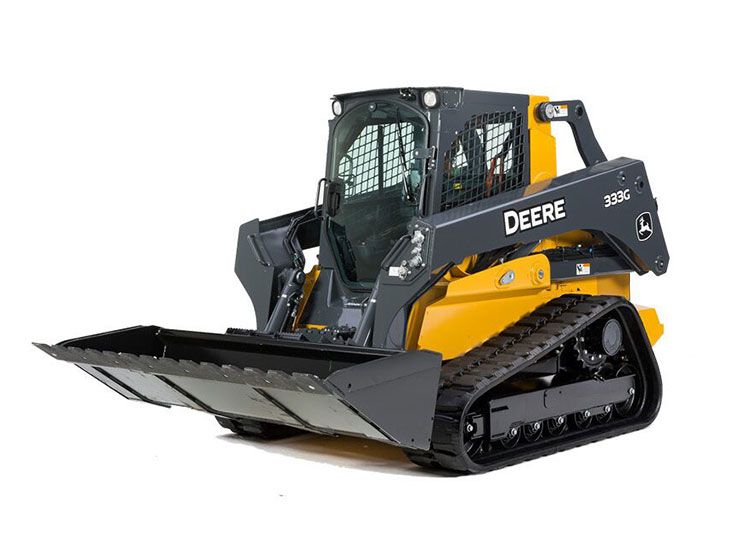
The John Deere 333G is the flagship of the G-Series compact track loader lineup — the largest, most powerful, and most technologically advanced of the four CTLs in the series. With 100 horsepower from the Yanmar 4TNV94CHT diesel, vertical-lift geometry, the Tri-Cool™ cooling system, a 3,700 lb rated operating capacity, and an exclusive integrated SmartGrade 3D grade control option, the 333G defined the upper end of what a compact track loader could do from its 2017 launch through its replacement by the new 333 P-Tier in June 2024.
That status — “recently discontinued flagship, technology-rich, abundant in the used market with 1,000+ MarketBook listings” — is exactly why this page matters. The 333G isn’t being built new anymore, but it carries one feature no Canadian buyer can get anywhere else in this size class: factory-integrated 3D grade control on a CTL. Combined with a healthy parts pipeline, deep dealer support across Canada, and used pricing that has settled into a real value zone, the 333G is one of the most interesting used-market CTLs you can buy in Canada in 2026.
This guide is built for that buyer. Full spec sheet, real Canadian pricing from MarketBook Canada (where 333G listings range from CAD $25,995 to $314,999), owner-reported issues from Heavy Equipment Forums with specific DCU/DEF fault codes, the SmartGrade option breakdown, and a direct head-to-head against the new 333 P-Tier successor and current Bobcat, Cat, and Kubota competitors.
Aglist quick take: The 333G is the right used-market pick for Canadian contractors who (a) need flagship large-frame CTL capability without paying P-Tier money, or (b) specifically want SmartGrade 3D — still the only factory-integrated 3D grade control in this size class. Watch out for: documented DEF/DCU fault codes (specific code numbers are well-known on operator forums), forestry mulching fire-risk reputation, hydraulic lockout failure modes from joystick controller faults, and door-damage incidents. None are platform killers — all are documented and addressable.
On This Page
ToggleQuick Verdict — Who the 333G Is For
Buy a used 333G if: you need full flagship large-frame CTL capability — heaviest lift, max hydraulic flow, the works — without paying for a new 333 P-Tier; you specifically want SmartGrade 3D, Slope Control, or Laser Slope Control for site-prep and finish-grading work that previously required a dedicated dozer; you have a John Deere dealer within reasonable distance for parts; you’re comfortable with a used machine in the 800–4,000 hour range with a documented service history.
Skip it if: you want the latest sealed cab and Surround View tech (buy 333 P-Tier instead); you do daily forestry mulching and want zero compromise on fire-risk mitigation (the 333G has documented incidents on heavy-duty mulching work — manageable with discipline but worth knowing); you don’t have JD dealer parts coverage in your region.
1. Full John Deere 333G Specifications
Below is the consolidated spec sheet for the 333G, sourced from John Deere’s 333G product brochure (DKAGCTL333) and the G-Series Compact Track Loaders technical guide (DKAGCTLL).
| Category | Spec | Value |
|---|---|---|
| Equipment type | Compact track loader | Flagship large-frame G-Series |
| Model designation | 333G | |
| Production status | Replaced by 333 P-Tier in June 2024 | |
| Engine | Manufacturer / Model | Yanmar 4TNV94CHT |
| Configuration | 3.1L turbocharged, intercooled, 4-cylinder diesel | |
| Emissions | EPA Final Tier 4 / EU Stage IV | |
| Gross horsepower (SAE J1995) | 100 HP (74.6 kW) | |
| Net horsepower (SAE J1349) | 96.6 HP (72.0 kW) | |
| Loader performance | Rated operating capacity (35%) | 3,700 lb (1,680 kg) |
| Lift path | Vertical | |
| Bucket breakout force | +40% over previous E-Series models | |
| Bucket option | 90-inch wide bucket available (333G exclusive) | |
| Hydraulics | Standard auxiliary flow | 25 gpm (95 L/min) |
| High-flow auxiliary | 41.1 gpm (156 L/min) | |
| System pressure | 3,450 psi (23,787 kPa) | |
| Hydraulic HP (standard) | 50 HP | |
| Hydraulic HP (high-flow) | 83 HP | |
| Travel | Drivetrain | Hydrostatic, two-speed standard |
| Top travel speed | 8 mph (12.9 km/h) | |
| Tractive effort | 11,500 lbf (5,221 kgf) | |
| Undercarriage | Track rollers per side | 5 triple-flange smooth-ride all-steel |
| Track idlers per side | 2 double-flange smooth-ride all-steel | |
| Bearings/seals | Heavy-duty journal bearings, metal face seals | |
| Cooling | System | Tri-Cool™ with optional reversible fan |
| Grade control options | Three tiers | (1) SmartGrade 3D, (2) SmartGrade Ready w/ Slope Control, (3) Laser Slope Control |
| Standard with grade control | EZ Grade software, DozerMode, SG96 6-way dozer blade | |
| Weight | Operating weight | 12,100 lb (5,493 kg) |
| Controls | Standard | Hand controls or EH joystick |
| Optional | EH ISO/H switchable Joystick Performance Package | |
| Performance package | Return to Dig (RTD), Return to Carry (RTC), Boom Height Kickout (BHKO), Electronic Self-Level (ESL) | |
| Warranty (original new) | Basic | 24 months / 2,000 hours |
Source: John Deere 333G product brochure (DKAGCTL333), G-Series Compact Track Loaders technical guide (DKAGCTLL), James River Equipment, Horizon Ag & Turf, and Heritage Tractor technical pages.
2. SmartGrade, Slope Control & DozerMode — The 333G’s Exclusive Advantage
The single biggest reason to look at a used 333G specifically (rather than a 331G or any competitor’s CTL) is factory-integrated grade control technology. The 333G is the industry’s first compact track loader with fully integrated 3D grade control, and as of 2026 it remains one of the only options in this size class with this capability. There are three offering tiers:
SmartGrade™ (full 3D) — mastless 3D grade control with no stakes, strings, surveyors, masts, or cables. Uses GNSS (3D positioning) integrated from the factory. Eliminates overgrading and rework. Productivity benefit on large or complex grading jobs is substantial — what previously required a dedicated dozer with separate machine-control hardware can be done by a single operator in one machine.
SmartGrade Ready with Slope Control — entry-level grade control. Real-time cross-slope and main-fall slope percentages displayed on the in-cab monitor. Auto Grade feature uses current machine position or operator-desired slopes to automate raising, lowering, and tilting of the blade. Cost-effective for grading flat pads and simple slopes.
Laser Slope Control — laser-receiver-based system for grading flat pads and simple slopes both indoor and outdoor. Cost-effective and precise.
All three tiers come with EZ Grade software (stabilizes the blade for smoother grading in manual mode), DozerMode(push a button on the Sealed Switch Module to switch the EH control pattern so the CTL drives like a crawler dozer), and the Deere-built SG96 6-way dozer blade attachment — robust enough for rough cuts and precise enough for fine finish grading.
Why this matters for used buyers: the 333G with SmartGrade or Slope Control on the used market is a genuinely different-class buy than a non-grade-control 333G. Verify exactly which tier is installed, confirm calibration status, and ask the dealer about base station compatibility (Topcon, Trimble) for SmartGrade machines. A SmartGrade-equipped 333G typically lists CAD $40,000–$80,000 above a comparably-houred non-grade-control unit — but if you do site-prep or finish-grade work, that premium pays back fast.
3. Owner Reviews & Ratings on Aglist
The 333G has been on the market since 2017 and was the flagship of one of the most successful CTL platforms in North America. As Canadian owners share their experience on Aglist, the rating system tracks:
- Reliability — uptime in real Canadian conditions, dealer warranty experience, fault-code patterns (especially DEF/DCU codes)
- Performance — lift confidence, max hydraulic-flow attachment performance, push power
- Comfort — sealed cab effectiveness, HVAC, air-ride seat over 10-hour shifts
- Value for money — used pricing vs. capability, with vs. without SmartGrade
- Ease of maintenance — Tri-Cool serviceability, in-boom hydraulic access, cab tilt
Real Canadian operator feedback — including from operators who’ve run both 333G and the new 333 P-Tier — is the single thing you won’t find on Deere.ca or in a brochure. If you own or operate a 333G in Canada, please leave a star rating and a short note in the form below.
4. John Deere 333G vs Competitors and vs 333 P-Tier
The 333G sits in the 3,501–3,700 lb ROC class in John Deere’s published rental-class comparison.
333G vs 333 P-Tier (predecessor vs flagship successor)
| Spec | 333G | 333 P-Tier |
|---|---|---|
| Production | 2017–2024 | June 2024–present |
| Gross HP | 100 | ~104 |
| ROC (35%) | 3,700 lb | ~3,800 lb |
| High-flow aux | 41.1 gpm | ~42 gpm |
| Cab | Sealed and pressurized | One-piece sealed and pressurized (new design) |
| Display | LCD with grade control monitor | Larger touchscreen with Surround View 270° camera option |
| Joysticks | EH Joystick Performance Package | New ergonomic EH joysticks with rollers |
| Quick-Tatch | Universal Quik-Tatch (Power Quik-Tatch optional) | Redesigned Quik-Tatch coupler |
| Telematics | JDLink (optional) | JDLink standard |
| Grade control | SmartGrade / Slope Control / Laser | SmartGrade Ready (3D) carried forward |
| New price (Canada, 2026) | n/a (used only) | ~CAD $160,000–$200,000+ |
| Used price (Canada, 2025–2026) | CAD $50,000–$135,000 (non-grade) / $90,000–$220,000+ (SmartGrade) | n/a (too new) |
333G vs current direct competitors (used market)
| Spec | 333G | Bobcat T76 | Cat 289D3 | Kubota SVL97-3 | Takeuchi TL12V2 |
|---|---|---|---|---|---|
| Gross HP | 100 | 74 | 74.3 | 96.4 | 113.5 |
| ROC (35%) | 3,700 lb | 2,900 lb | 2,890 lb | 3,459 lb | 3,860 lb |
| Lift path | Vertical | Vertical | Vertical | Vertical | Vertical |
| Std. aux. flow | 25 gpm | 23 gpm | 23 gpm | 23.8 gpm | 22 gpm |
| High-flow aux. | 41.1 gpm | 36.6 gpm | 30.5 gpm | 41.2 gpm | 32 gpm |
| Operating weight | 12,100 lb | 10,250 lb | 10,668 lb | 11,929 lb | 12,500 lb |
| Cooling | Tri-Cool | Standard | Standard | Standard | Standard |
| 3D grade control | Factory SmartGrade option | Aftermarket only | Aftermarket only | Aftermarket only | Aftermarket only |
| Suspension | Anti-vibration undercarriage | 5-Link torsion (opt) | Torsion axle | KSR (newest gen) | Rigid |
Where the 333G wins: factory-integrated 3D grade control is unique in this comparison — no other competitor offers it from the factory. Tri-Cool cooling is a class advantage in dust- and heat-heavy work. 41.1 gpm high-flow effectively ties Kubota SVL97-3 for the class lead and decisively beats Bobcat T76 and Cat 289D3. 100 HP outpowers all direct competitors.
Where it loses:
- Operating weight (12,100 lb) limits trailerability behind 3/4-ton trucks — a heavy-duty trailer is required
- The new 333 P-Tier brings meaningfully better cab and Surround View
- Bobcat T76 ride quality with 5-Link torsion still sets the class benchmark
- Documented DEF/DCU fault history is more prominent on the 333G than on most competitors
Real-world picking guide (used-market):
- Need 3D grade control on a CTL, large-frame capability, max high-flow → 333G with SmartGrade
- Heavy contractor/landscape work, no grade control needed, value pricing → 331G (one tier down, lower price)
- Best ride + premium feel → Bobcat T76
- Newest-gen cooling and undercarriage at 96 HP → Kubota SVL97-3
- Maximum lift + heaviest digging → Takeuchi TL12V2
5. Real-World Performance
Lift Path & Loader Work
The 333G uses the same vertical-lift geometry as the rest of the large-frame G-Series. ROC at 3,700 lb (35%) puts it ahead of every direct-class competitor. Bucket breakout force is +40% over previous E-Series models — Deere quantified this gain in their original launch materials, and operators consistently cite the 333G as digging harder than the equivalent-class machines they’ve owned previously. The optional 90-inch wide bucket (333G-exclusive in the G-Series) significantly increases load volume per cycle on light material — landscape soil, mulch, snow — productivity gain is substantial when work is volume-limited rather than weight-limited.
The Performance Package adds the same four productivity features as the 331G: Return to Dig, Return to Carry, Boom Height Kickout, and Electronic Self-Level (boom up and down). On the 333G specifically, these pair well with SmartGrade workflows where blade position needs to be repeatable.
Hydraulics & Attachment Capability
The 333G’s headline hydraulic spec is 41.1 gpm high-flow auxiliary at 3,450 psi — effectively tied with Kubota SVL97-3 (41.2 gpm) for the highest in this competitive class, and 12% more flow than the next-down 331G (36.5 gpm). That 41.1 gpm is the real reason to step up from a 331G to a 333G if attachments are your main use case. Specifically, 41.1 gpm high-flow opens the door to:
- 70–75-inch forestry mulchers (drum and disc heads)
- Large cold planers (24-inch and up)
- Commercial-class snow blowers and pushers
- Big rotary brush cutters and flail mowers
- Large tilt-rotators
- Stump grinders (heavier-class)
Auxiliary couplers are mounted internally with CORDURA fabric sleeves — a real durability advantage in dirty work.
Cab & Operator Experience
The large-frame G-Series cab is sealed and pressurized, with the same switchable controls (ISO, H-pattern, foot, ISO + foot), continuous footwell, and air-ride heated seat option as the 331G. Cab tilts up in under five minutes for full drivetrain access. Removable side panels with handles. Severe-duty door is available as an option (visible in current Canadian dealer listings) — addresses the cab-door damage issue that 333G owners have reported when raising the loader arms with the door not fully secured. Worth specifying on used inspection.
The newer 333 P-Tier cab is one-piece, sealed, with a larger touchscreen and Surround View — meaningfully better for full-time operators. For owner-operators running 500–1,000 hours a year, the 333G cab is adequate; for 2,000+ hour fleets, the P-Tier upgrade is justified.
Undercarriage & Anti-Vibration System
The 333G features Deere’s anti-vibration undercarriage system, which allows the machine to travel over rough terrain at higher travel speeds with better material retention. Combined with optional ride control, this is the closest 333G gets to Bobcat’s 5-Link torsion suspension feel. It’s not the same — Bobcat’s torsion suspension still wins on pure ride smoothness — but it’s a meaningful step above rigid-frame competitors.
5 triple-flange smooth-ride all-steel rollers and 2 double-flange idlers per side, longer track length and wider rollers/idlers vs the mid-frame 325G. Heavy-duty journal bearings with metal face seals.
6. Common Problems & Reliability Notes (with DCU/DEF Code List)
Transparency note: the items below are aggregated from Heavy Equipment Forums threads, the official John Deere 331G/333G Operation & Diagnostic Test Technical Service Manual (TM14062X19), trade press, and dealer service experience. None of these are universal — most well-maintained 333Gs run reliably to 4,000+ hours. But if a 333G has a problem, these are the most-reported categories.
DEF / DCU (Dosing Control Unit) fault codes — the #1 documented 333G issue. Multiple threads on Heavy Equipment Forums document specific recurring codes on 333G machines:
- DCU 523588.07 (DEF system fault) — flagged on multiple 333Gs that “ran fine on Monday and threw codes on Wednesday.” Code returns after clearing.
- DCU 523636.00 — reported alongside 523588.07; Deere TSM links this to dosing control unit malfunction or software calibration issue
- ECU 1209.04 — pressure sensor circuit
- ECU 102.04 — boost pressure sensor circuit
- 001761.01 — DEF tank empty (resolved by refill)
- 001761.15 — DEF level slightly high or DEF level sensor float stuck
Documented field example (Heavy Equipment Forums 333G PIN 1T0333GMHHF318344): machine operated ~5 minutes with empty DEF, threw DCU 523636.00 + ECU 1209.04 + ECU 102.04, owner replaced DEF Header and Exhaust Temperature Sensor as initial repair attempt. The takeaway: never operate a 333G with the DEF tank empty, even briefly, and always pull complete DCU/ECU fault history during used-machine inspection.
Hydraulic lockout failure mode. Documented on Heavy Equipment Forums (333G serial 1T0333G__KE367896): codes 522446.05, 522447.05, 522448.05, and 522449.05 — unit starts, boom raises and lowers, but as soon as forward or reverse is engaged, hydraulics lock out and cannot be unlocked. These codes typically point to joystick controller circuit faults. Brandt techs were involved on the documented case. Mitigation: pre-purchase functional test must include forward/reverse under load, not just static boom function.
Forestry mulching fire risk. Independent reviewers and operators have flagged the 333G as having a fire-hazard reputation specifically in heavy forestry mulching work. Combination of debris accumulation in the engine compartment under sustained mulching load and the high heat profile of forestry duty. This is not unique to Deere — most CTLs run hot in mulching — but it’s documented enough to warrant attention. Mitigation: aggressive cleanout schedule, optional reversible fan (essential for mulching duty), aftermarket fire-suppression system installation, and break the work day into rest cycles. If forestry mulching is your daily bread, this is worth a candid dealer conversation pre-purchase.
Cab door damage. A real-world issue documented by 333G owners: the cab door swings outward, and when operators raise the loader arms with the door not fully secured, the door contacts the boom and bends/breaks. Replacement runs into thousands of dollars. The optional Severe Duty Door addresses this — current Canadian dealer listings show it as a frequently-spec’d option. Behavioural fix more than mechanical, but visible in service records.
Hydraulic system general care. Same as 331G — leaks at couplers, seals, and hose connections become the most-reported maintenance items past 2,500 hours. Filter and fluid discipline is the single biggest determinant of long-term reliability. Properly maintained, the 333G hydraulic system has earned a strong reputation.
Fuel injector carbon build-up. Same issue family as 331G — documented across the Yanmar 4TNV94 platform on machines run with lower-quality fuel or skipped fuel filter intervals. Symptoms: power loss, increased emissions, misfires. Mitigation: high-quality diesel, fuel additives, strict adherence to fuel filter intervals.
Standard wear items past 2,000 hours. Battery terminals, alternator belt, sensor connector corrosion, parking brake solenoid, joystick electrical glitches. Not 333G-specific, but expected on any machine of this age and duty.
Verifiability: all of the above is sourced from publicly accessible operator forum threads, the John Deere TM14062X19 service manual, and trade content. Always confirm specific machine condition with a Deere dealer pre-purchase inspection, and insist on a JDLink data pull and complete fault history download before purchase on any used 333G — this is non-negotiable on a machine of this complexity and value.
7. Used Price Range in Canada (2025–2026)
Real Canadian pricing from MarketBook Canada and AgDealer listings. Treat as reference bands — final price depends on hours, year, configuration (SmartGrade vs non, cab/HVAC, EH/Power Quik-Tatch, high-flow, two-speed, wide tracks, severe-duty door), and remaining warranty.
MarketBook Canada (1,054 listings): prices range from CAD $25,995 to $314,999 — by far the widest range of any G-Series CTL. The huge upper bound reflects fully-equipped SmartGrade machines with low hours; the lower bound reflects older or as-is/parts machines.
| Configuration / Year / Hours | Typical Canadian Used Price (CAD) |
|---|---|
| 2017–2018 non-grade, 2,500–4,500 hrs, cab/HVAC | $50,000 – $75,000 |
| 2019–2020 non-grade, 1,500–3,000 hrs, cab/HVAC, EH | $70,000 – $100,000 |
| 2021–2022 non-grade, 800–2,000 hrs, full-spec | $95,000 – $135,000 |
| 2023–2024 non-grade, low hours, full-spec | $115,000 – $165,000 |
| 2019–2022 with SmartGrade Ready / Slope Control | $95,000 – $160,000 |
| 2020–2024 with full SmartGrade 3D, low hours | $140,000 – $220,000+ |
| 2018 As-Is / parts / damaged (rare) | $25,000 – $40,000 |
Why now is a good time to buy used: the June 2024 launch of the 333 P-Tier has accelerated dealer trade-ins on the 333G, putting more inventory into the Canadian used market. SmartGrade-equipped 333Gs are the most interesting buy — they retain capability that the new P-Tier carries forward (so SmartGrade tech is not “old”), but the machine itself is now used-priced.
Largest Canadian dealers with 333G used inventory (based on MarketBook):
- Brandt Tractor — by far the largest 333G used inventory in Canada — locations include Surrey BC, Red Deer AB, Grand Prairie AB, Saskatoon SK, Regina SK, Winnipeg MB, Mississauga ON, St. Georges QC, St. Augustin QC, and others
- Premier Equipment — Ontario
- Huron Tractor — Ontario
- Anderson Equipment & Sales — Ontario
- Pattison Agriculture — Saskatchewan
- Nelson Motors and Equipment — Saskatchewan (Redvers)
- Fulline Farm & Garden Equipment — Ontario
- Silverspring Farms
- Working Dirt Machinery — Ontario
8. Best Use Cases in Canadian Conditions
Site preparation and finish grading (with SmartGrade). The killer use case unique to the 333G. Pad cuts, parking lot grading, building-site finish grading, sports-field prep, and residential development site prep — all work that traditionally required a dedicated dozer can be done with a 333G + SG96 dozer blade + SmartGrade or Slope Control. The size of the 333G keeps mobilization costs down compared to trucking a larger dozer between jobs. Strong fit for Canadian residential/commercial site contractors and municipal road crews.
Heavy commercial snow removal (municipal contracts). 100 HP, 41.1 gpm high-flow, two-speed travel, and cab/HVAC with heated air-ride seat make the 333G the strongest CTL choice for big snow contracts in Canadian winters. Runs the largest commercial snow blowers and snow pushers without throttling down. Vertical lift loads salt and snow over high-sidewall dump trucks.
Forestry mulching and brush clearing (with discipline). Tri-Cool cooling, reversible fan option, 41.1 gpm high-flow, and 100 HP can run 70–75-inch mulching heads. Important caveat — the 333G has documented fire-risk incidents in heavy mulching duty. If mulching is the daily plan, spec the reversible fan, install fire suppression, schedule disciplined cleanouts, and have a candid conversation with your dealer about coverage. Done right, the 333G is one of the strongest mulching-class CTLs available.
Demolition and site prep (heavy). 12,100 lb operating weight delivers stable push power on tear-down work. 41.1 gpm runs hydraulic hammers, breakers, shears at full attachment-rated performance. Vertical lift over roll-off bins for debris loading.
Heavy construction material handling. Pallets of pavers, masonry block, retaining wall material, large bale stacks — all within 3,700 lb ROC margin. 90-inch wide bucket option moves volume efficiently on light material. Smooth EH joystick + Performance Package preserves material on the move.
Sub-optimal use cases: residential landscaping with tight access (the 333G is wide, heavy, and overspec for most residential work — look at 325G or 317G); operations without a Deere dealer within 200 km (parts logistics on a Tier 4 emissions-class machine with this level of complexity matter).
9. Maintenance & Service Intervals
The 333G follows large-frame G-Series compact construction service intervals. Below is the practical Canadian-climate summary — always check the operator’s manual for the authoritative schedule on your specific year and configuration.
- Every 10 hours (daily): engine oil level, hydraulic oil level, coolant, DEF level (critical — never run empty), air filter restriction indicator, track tension, undercarriage cleanout, Tri-Cool cooling fin inspection, Quik-Tatch grease zerks, fault code check via in-cab monitor
- First 50 hours: initial engine oil and filter change, hydraulic return filter change, hardware torque check
- Every 250 hours: engine oil and filter, fuel filter check, in-cab HVAC filter, Tri-Cool cooling fin cleanout, reversible fan core blow-out (if equipped)
- Every 500 hours: primary and secondary fuel filters, hydraulic return filter, final drive oil check
- Every 1,000 hours: hydraulic oil change (or per fluid analysis), final drive oil change, DPF inspection, track tension reset, full undercarriage roller and idler inspection, SmartGrade calibration verification (if equipped)
- Every 2,000 hours: coolant flush, DEF system inspection (DCU, header, sensors), professional fuel injector inspection, full hydraulic system pressure test
Canadian winter add-ons: cold-start kit and 110V water-jacket heater (factory option, often present on Canadian-spec machines per Brandt listings), winter-grade diesel discipline, DEF awareness (DEF freezes at -11°C but thaws in heated tank — never dilute), spare fuel filters on hand for cold-weather gel events.
10. Where to Buy a Used 333G in Canada
The 333G used market in Canada is the deepest of any G-Series CTL — over 1,000 listings active on MarketBook Canada at typical times in 2025–2026. Major Canadian dealer groups:
- Brandt Tractor — dominant inventory, locations across Alberta (Red Deer, Grande Prairie), Saskatchewan (Regina, Saskatoon), Manitoba (Winnipeg), Ontario (Mississauga), Quebec (St. Georges, St. Augustin), and BC (Surrey)
- Premier Equipment — Ontario
- Huron Tractor — Ontario
- Anderson Equipment & Sales — Ontario
- Pattison Agriculture — Saskatchewan
- Nelson Motors and Equipment — Saskatchewan (Redvers)
- Fulline Farm & Garden Equipment — Ontario
- Working Dirt Machinery — Ontario
- Silverspring Farms
- Hyde Brothers Farm Equipment — Ontario
Used 333G inventory also appears on MarketBook Canada, AgDealer, Supply Post, and major dealer auction networks (Ritchie Bros., IronPlanet).
Pre-purchase inspection priorities (used 333G — non-negotiable):
- Complete JDLink data pull and fault code history — DCU codes 523588.07, 523636.00, 522446.05, 522447.05, 522448.05, 522449.05, 001761.x are the watch-list
- Hydraulic functional test under load — including forward/reverse engagement (the 522446.x lockout failure mode requires this test)
- DEF/SCR system inspection — DEF header condition, exhaust temperature sensor function, DEF level sensor float behavior
- Cooling system — Tri-Cool fin condition, reversible fan operation if equipped
- SmartGrade calibration and base station compatibility (if equipped) — verify 3D system is functional and ask which RTK base station is supported
- Cab door and severe-duty door verification — visual inspection for prior damage
- Undercarriage — track lug height (replacement runs CAD $5,000–$10,000 for the 333G’s larger tracks), roller/idler wear, sprocket wear
- 90-inch bucket — if equipped, condition of cutting edge and bucket structure
- Service history and dealer maintenance records — full documentation, not just an oil-change history
- Cold-start kit / 110V heater for Canadian winter use — verified present on the build sheet
11. John Deere 333G FAQ
How much horsepower does the John Deere 333G have? 100 gross horsepower (74.6 kW) and 96.6 net horsepower (72.0 kW) from the Yanmar 4TNV94CHT 3.1L turbocharged intercooled diesel.
What is the rated operating capacity of the 333G? 3,700 lb (1,680 kg) at 35% tipping load — the highest in the G-Series CTL lineup.
Is the John Deere 333G still in production? No. The 333G was replaced by the new John Deere 333 P-Tier in June 2024. The 333G is available only on the used market as of 2026, but parts and dealer support remain strong across Canada.
What is SmartGrade on the 333G? SmartGrade is the industry’s first fully integrated 3D grade control system on a compact track loader, available on the 333G from 2020 onward. It eliminates masts, stakes, and cables typically required for grade control. Three tiers: SmartGrade (full 3D), SmartGrade Ready with Slope Control, and Laser Slope Control. All include the SG96 6-way dozer blade, EZ Grade software, and DozerMode.
How much does a used John Deere 333G cost in Canada? MarketBook Canada lists 333G used pricing from CAD $25,995 to $314,999, depending on year, hours, and especially whether SmartGrade is equipped. Typical non-grade-control 333G ranges CAD $50,000–$135,000; SmartGrade-equipped units run CAD $140,000–$220,000+ for low-hour configurations.
What’s the difference between the 333G and 333 P-Tier? The 333 P-Tier is the successor launched June 2024 with a redesigned one-piece sealed pressurized cab, larger touchscreen with optional Surround View 270° camera, new ergonomic EH joysticks, redesigned Quik-Tatch coupler, slightly more horsepower, slightly higher ROC, and standard JDLink. The 333G remains a strong used buy — especially with SmartGrade — and the SmartGrade technology is carried forward to the P-Tier so it’s not orphaned.
What’s the difference between the 333G and 331G? The 333G is the flagship — 100 HP, 3,700 lb ROC, 41.1 gpm high-flow, plus the SmartGrade option (333G-exclusive). The 331G is the lower-tier large-frame — 91 HP, 3,100 lb ROC, 36.5 gpm high-flow, no SmartGrade option. Both share the Tri-Cool cooling system. If you don’t need SmartGrade or maximum hydraulic flow, the 331G saves real money for similar capability.
What are the most common 333G problems? The most documented issues are DEF/DCU fault codes (specifically DCU 523588.07, 523636.00, plus ECU 1209.04 and 102.04) — operator forums document these recurring on multiple machines; hydraulic lockout via joystick controller fault codes (522446.05, 522447.05, 522448.05, 522449.05); forestry mulching fire-risk reputation under heavy duty; cab door damage when operating with door not fully secured (mitigated by optional severe-duty door); and standard high-hour wear past 2,000 hours.
Does the 333G have Tri-Cool cooling? Yes. Tri-Cool is standard on the large-frame G-Series (331G and 333G) — three coolers in a triangular arrangement that handle high-heat work better than competitor standard cooling. Optional reversible fan is essential for forestry/mulching duty and recommended for any dust-heavy Canadian work.
Is the 333G good for forestry mulching in Canada? Yes — with discipline. The hydraulic flow, horsepower, and Tri-Cool cooling are class-leading for mulching. But the 333G has documented fire-risk incidents under heavy sustained mulching load. Mitigation: spec the reversible fan, install aftermarket fire suppression, daily aggressive cleanout, and break work into rest cycles. With those measures, it’s one of the strongest mulching CTLs available.
333G vs 333 P-Tier — should I buy used or new? For owner-operators running 500–1,500 hours/year, a 2021–2023 used 333G saves CAD $40,000–$80,000 vs. new 333 P-Tier and runs the same essential work. For full-time fleet operators running 2,000+ hours/year, the P-Tier’s improved cab, Surround View, and standard JDLink are worth the premium. SmartGrade-equipped used 333Gs are the most interesting value play — same grade-control capability that’s carried forward to P-Tier, used pricing.
Where can I read real owner reviews of the 333G? On this page, in the Reviews & Ratings section. Aglist publishes operator-submitted reviews of the 333G from Canadian owners — leave yours below to help the next buyer.
12. Related Models on Aglist
- John Deere 331G — lower-tier large-frame G-Series, no SmartGrade option
- John Deere 325G — mid-frame G-Series CTL
- John Deere 317G — small-frame G-Series CTL
- John Deere 333 P-Tier — direct flagship successor (since June 2024)
- John Deere 335 P-Tier — new top-of-line large-frame above 333 P-Tier
- John Deere 331 P-Tier — successor to 331G
- Bobcat T76 — Bobcat large-frame competitor
- Cat 289D3 — Caterpillar competitor
- Kubota SVL97-3 — Kubota flagship CTL competitor
- Takeuchi TL12V2 — Takeuchi competitor
- John Deere G-Series series page — full G-Series overview
- John Deere P-Tier series page — successor generation hub
Disclaimer
All specifications sourced from John Deere’s 333G product brochure (DKAGCTL333), G-Series Compact Track Loaders technical guide (DKAGCTLL), 331G/333G Operation & Diagnostic Test Technical Service Manual TM14062X19, and dealer technical pages (James River Equipment, Heritage Tractor, Horizon Ag & Turf, Western Equipment, Midwest Machinery, Everglades Equipment Group). Pricing collected from MarketBook Canada, AgDealer, Supply Post, and Equipment Trader between 2025 and 2026; actual transaction prices vary by configuration, financing program, hours, condition, and province. Operator-reported issues with specific fault codes sourced from publicly accessible threads on Heavy Equipment Forums and the John Deere TM14062X19 service manual. Reviews on Aglist are written by real users and moderated for spam — opinions are personal. Always confirm critical specifications and service history with your dealer and the operator’s manual before purchase, service, or repair.
13. John Deere 333G Reviews & Ratings
Share your experience
Help other Canadian buyers — leave a quick review for the
John Deere 333G
There are no reviews yet. Be the first one to write one.