Overview & Specs
John Deere 331G Review, Specs & Owner Ratings — 2026 Canada Used Buyer’s Guide
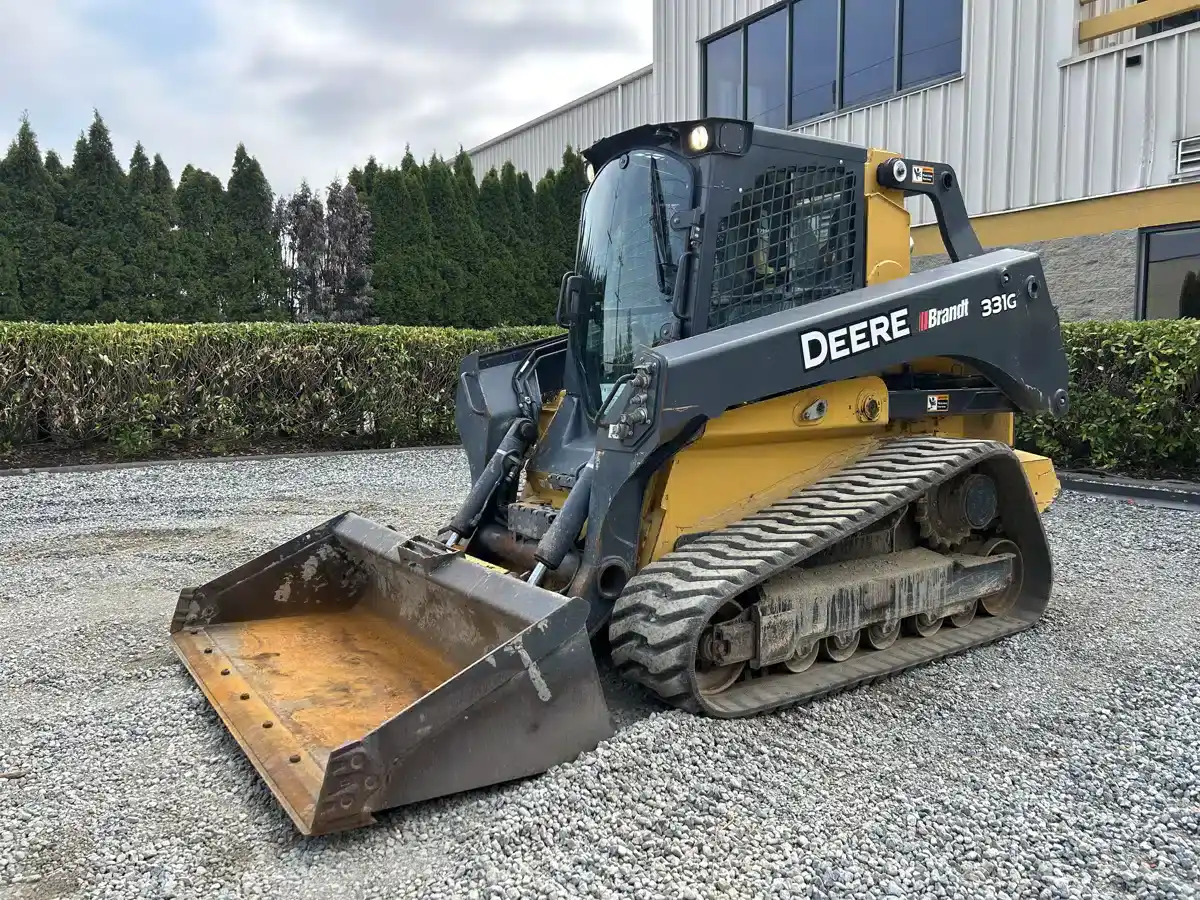
The John Deere 331G is the lower-tier large-frame compact track loader in the G-Series lineup, sitting one step below the flagship 333G and one step above the mid-frame 325G. With 91 horsepower from a Yanmar 4TNV94FHT diesel, vertical-lift geometry, the Tri-Cool™ cooling system, and a 3,100 lb rated operating capacity, it earned a strong reputation in Canadian construction, landscape, and snow contracts from its 2017 launch through its replacement by the new 331 P-Tier in June 2024.
That status — “recently discontinued, well-supported, abundant in the used market” — is exactly why this page exists. The 331G isn’t being built new anymore, but the parts pipeline is healthy, the dealer network covers Canada coast-to-coast, and used pricing has settled into a sweet spot. For a Canadian buyer who wants real large-frame capability without paying P-Tier money, the 331G is one of the strongest used CTL buys on the market right now.
This guide is built for that buyer. You’ll find the full spec sheet, real Canadian used pricing from MarketBook Canada and AgDealer, owner feedback from Heavy Equipment Forums and AgTalk, common problems from speceps.com and Consort Design teardowns, and a direct head-to-head against both the new 331 P-Tier replacement and the current Bobcat T76, Cat 289D3, and Kubota SVL97-3 competitors.
Aglist quick take: The 331G is the “value pick” in large-frame CTLs as of 2026. Tri-Cool cooling, 91 HP Yanmar diesel, and 3,100 lb ROC for $20,000–$30,000 less than an equivalent new 331 P-Tier. Strongest issues to watch: hydraulic system maintenance (filter and contamination care), fuel injector carbon build-up on neglected machines, and Final Tier 4 DEF/SCR sensor codes. None are platform-killers — all are documented and fixable.
On This Page
ToggleQuick Verdict — Who the 331G Is For
Buy a used 331G if: you’re a Canadian owner-operator or small contractor who wants real large-frame CTL capability — high-flow attachment runs, heavy lift, vertical-lift truck loading — without paying for a new P-Tier sealed cab and Surround View camera you don’t need. You’re comfortable with a 1,500–4,000 hour used machine, you have a John Deere dealer within reasonable distance for parts and service, and you want a platform with a proven 7+ years of field history.
Skip it if: you need brand-new factory warranty on a new machine (you’re now buying 331 P-Tier instead), you do daily forestry mulching and want the absolute newest cooling and aftertreatment package, or you don’t have a Deere dealer within 200 km — parts logistics matter on this size of machine.
1. Full John Deere 331G Specifications
Below is the consolidated spec sheet for the 331G, sourced from John Deere’s 331G brochure (DKAGCTL331) and the G-Series Compact Track Loaders 325G/331G/333G technical guide (DKAGCTLL).
| Category | Spec | Value |
|---|---|---|
| Equipment type | Compact track loader | Large-frame G-Series |
| Model designation | 331G | |
| Production status | Replaced by 331 P-Tier in June 2024 | |
| Engine | Manufacturer / Model | Yanmar 4TNV94FHT |
| Configuration | 3.1L turbocharged, intercooled, 4-cylinder diesel | |
| Emissions | EPA Final Tier 4 / EU Stage IV | |
| Gross horsepower (SAE J1995) | 91.2 HP (68.0 kW) | |
| Net horsepower (SAE J1349) | 88.5 HP (66.0 kW) | |
| Loader performance | Rated operating capacity (35%) | 3,100 lb (1,407 kg) |
| Rated operating capacity (50%) | 4,425 lb (2,007 kg) | |
| Lift path | Vertical | |
| Lift height (to hinge pin) | ~129 in (3.28 m / 10 ft 9 in) | |
| Hydraulics | Standard auxiliary flow | 23.5 gpm (80 L/min) |
| High-flow auxiliary | 36.5 gpm (138 L/min) | |
| System pressure | 3,450 psi (23,787 kPa) | |
| Hydraulic HP (standard) | 47 HP | |
| Hydraulic HP (high-flow) | 74 HP | |
| Travel | Drivetrain | Hydrostatic, two-speed standard |
| Top travel speed | 8 mph (12.9 km/h) | |
| Tractive effort | 11,500 lbf (5,221 kgf) | |
| Undercarriage | Track rollers per side | 5 triple-flange smooth-ride all-steel |
| Track idlers per side | 2 double-flange smooth-ride all-steel | |
| Bearings/seals | Heavy-duty journal bearings, metal face seals | |
| Cooling | System | Tri-Cool™ (large-frame G-Series only) |
| Width | Standard | 78.9 in (with 18″ tracks: 80.7 in) |
| Weight | Operating weight | 11,900 lb (5,403 kg) |
| Controls | Standard | Hand controls or EH joystick |
| Optional | EH ISO/H switchable Joystick Performance Package | |
| Warranty (original new) | Basic | 24 months / 2,000 hours |
Source: John Deere 331G product brochure (DKAGCTL331), G-Series Compact Track Loaders technical guide (DKAGCTLL), Compact Equipment Magazine spec guides. Configuration of any used machine should be confirmed against the specific PIN/serial — Deere made running changes to the cooling package on large-frame G-Series during production, and dealer parts lookup will confirm which package is in any specific unit.
2. Owner Reviews & Ratings on Aglist
The 331G has been on the market since 2017, with strong fleet penetration in Canadian construction, landscape, and snow contracting. As Canadian owners share their experience on Aglist, the rating system tracks:
- Reliability — uptime in real Canadian conditions, dealer warranty experience, fault-code patterns
- Performance — lift confidence, attachment performance under sustained load, push power
- Comfort — sealed cab effectiveness, HVAC, seat over 10-hour shifts
- Value for money — used pricing vs. capability vs. new 331 P-Tier alternative
- Ease of maintenance — Tri-Cool serviceability, in-boom hydraulic access, cab tilt
Real Canadian operator feedback is what makes Aglist different from a brochure aggregator. If you own or operate a 331G, please leave a star rating and a short note in the form below — your feedback helps the next Canadian buyer make a smarter call on a used purchase.
3. John Deere 331G vs Competitors and vs 331 P-Tier
The 331G sits in the 3,001–3,300 lb ROC class in John Deere’s published rental-class comparison. The right comparison set in 2026 is both the new 331 P-Tier (its direct successor), the current competitor large-frame CTLs, and used machines from competing manufacturers.
331G vs 331 P-Tier (predecessor vs successor)
| Spec | 331G | 331 P-Tier |
|---|---|---|
| Production | 2017–2024 | June 2024–present |
| Gross HP | 91.2 | ~98 |
| ROC (35%) | 3,100 lb | ~3,300 lb |
| Hydraulic flow (high-flow) | 36.5 gpm | ~38 gpm |
| Cab | Sealed and pressurized | One-piece sealed and pressurized (new design) |
| Display | LCD analog cluster | Larger touchscreen with Surround View 270° camera option |
| Joysticks | EH Joystick Performance Package (optional) | New ergonomic EH joysticks with rollers (standard) |
| Quick-Tatch | Universal Quik-Tatch | Redesigned Quik-Tatch coupler |
| Telematics | JDLink (optional) | JDLink standard |
| New price (Canada, 2026) | n/a (used only) | ~CAD $145,000–$170,000+ |
| Used price (Canada, 2025–2026) | CAD $45,000–$110,000 | n/a (too new) |
331G vs current direct competitors (used market)
| Spec | 331G | Bobcat T76 | Cat 289D3 | Kubota SVL97-3 | Takeuchi TL12V2 |
|---|---|---|---|---|---|
| Gross HP | 91.2 | 74 | 74.3 | 96.4 | 113.5 |
| ROC (35%) | 3,100 lb | 2,900 lb | 2,890 lb | 3,459 lb | 3,860 lb |
| Lift path | Vertical | Vertical | Vertical | Vertical | Vertical |
| Std. aux. flow | 23.5 gpm | 23 gpm | 23 gpm | 23.8 gpm | 22 gpm |
| High-flow aux. | 36.5 gpm | 36.6 gpm | 30.5 gpm | 41.2 gpm | 32 gpm |
| Operating weight | 11,900 lb | 10,250 lb | 10,668 lb | 11,929 lb | 12,500 lb |
| Cooling | Tri-Cool | Standard | Standard | Standard | Standard |
| Suspension | Rigid | 5-Link torsion (opt) | Torsion axle | KSR (newest gen) | Rigid |
Where the 331G wins: Tri-Cool cooling system is genuinely a class advantage in dust- and debris-heavy work (mulching, hot dry summers, dense brush). 91 HP Yanmar diesel has earned a strong reliability reputation across 7 years of field service. In the used market, the 331G typically sells for less than equivalent-hours T76 or 289D3 due to Bobcat and Cat brand premium — same capability for less money.
Where it loses:
- Bobcat T76 ride quality with 5-Link torsion suspension remains the class benchmark
- Cat 289D3 fuel efficiency is widely regarded as best in class
- Kubota SVL97-3 outlifts it (3,459 vs 3,100 lb ROC) and has more high-flow (41.2 vs 36.5 gpm)
- The new 331 P-Tier has a meaningfully better cab, larger touchscreen, and Surround View — if those matter, you’re buying P-Tier
Real-world picking guide (used-market):
- Tri-Cool cooling for forestry/mulching/brush work, lowest used price in class → 331G
- Best ride + premium feel → Bobcat T76
- Maximum fuel efficiency, Cat ecosystem → Cat 289D3
- Maximum lift in same weight class → Kubota SVL97-3
4. Real-World Performance
Lift Path & Loader Work
The 331G uses a vertical-lift boom with a hinge-pin height of ~129 inches — enough to easily clear high-sidewall dump trucks, feed mixers, hoppers, and roll-off bins. ROC of 3,100 lb at 35% tipping load handles a full pallet of pavers, large bale stacks, and material moves up to 4,400 lb in 50% tipping configuration.
The Performance Package — factory-installed on EH-equipped machines — adds four meaningful productivity features: Return to Dig (auto-set bucket to ready-to-work position), Return to Carry (joystick detents reset boom to ready-to-carry), Boom Height Kickout (operator pre-sets a height for repeatable truck/hopper loading), and Electronic Self-Level(self-level on boom up and down, unlike hydraulic self-level which only works on boom up). For repetitive truck-loading work, ESL alone saves real time over a 10-hour shift.
Hydraulics & Attachment Capability
Standard 23.5 gpm aux flow at 3,450 psi covers the typical large-frame attachment list. Optional high-flow at 36.5 gpm extends it to:
- Forestry mulchers (drum and disc heads, mid-class)
- Cold planers (18-inch and up)
- Snow blowers (commercial-class)
- Stump grinders
- Rotary brush cutters and flail mowers
- Tilt-rotators and large grapples
Auxiliary couplers are mounted internally, sleeve-protected — a meaningful durability advantage over external-coupler designs in dirty work. In-boom hydraulic and wiring routing protects lines from external damage in forestry and brush work.
Cab & Operator Experience
The large-frame G-Series cab is sealed and pressurized. Switchable controls let operators pick ISO, H-pattern, foot controls, or ISO + foot controls — useful on rental fleets where multiple operators with different preferences run the machine. Continuous footwell with extra room for foot repositioning. Optional air-ride heated cloth seat for cold Canadian shifts.
The cab tilts up in under five minutes for full drivetrain access. Removable side panels with handles. Footwell removes via six bolts for full cleanout. Serviceability is one of the genuinely strong points of the large-frame G-Series.
The newer 331 P-Tier cab is a one-piece pressurized design with a redesigned ergonomic layout and larger touchscreen — meaningfully better for full-time operators. But for owner-operators running 500–1,000 hours a year, the 331G cab is adequate for the work and the savings are real.
Undercarriage & Cooling
Tri-Cool™ cooling system is the headline differentiator on the 331G (and 333G) vs the rest of the G-Series and most competitors. Three coolers in a triangular arrangement handle high-heat work — hot-day mulching, dust-heavy demo, sustained high-flow attachment running — that pushes standard cooling packages into thermal limit. Optional reversible fan for quick core cleanout in high-debris applications.
The undercarriage uses 5 triple-flange smooth-ride steel rollers and 2 double-flange idlers per side, with longer track length and wider rollers/idlers compared to the mid-frame 325G — Deere optimized roller spacing for track life. Heavy-duty journal bearings with metal face seals. No torsion suspension (rigid frame), so on rough ground at speed you’ll feel more bucket-bouncing than on Bobcat T76 with optional 5-Link.
5. Common Problems & Reliability Notes
Transparency note: the items below are aggregated from operator forum threads (Heavy Equipment Forums, AgTalk, JustAnswer), problem-focused trade content (speceps.com, Consort Design), and dealer service experience. These are not “every 331G has these” — they’re “if a 331G is going to have a problem, these are the most-reported categories.”
Hydraulic system care. The 331G’s hydraulic system is the most-discussed maintenance area in operator threads. Specific watch-points: (a) maintain hydraulic fluid level — low fluid causes overheating and lubrication starvation, (b) inspect for leaks at couplers and hose connections regularly, (c) follow filter replacement intervals strictly, (d) avoid contaminated hydraulic oil. None of this is unique to the 331G — it’s just that its hydraulic system is doing more work than smaller-frame machines, so neglect shows up faster. Properly maintained, the system has earned a strong reliability reputation.
Fuel injector carbon build-up. Multiple sources document carbon build-up on injectors as a recurring issue on 331Gs that have been run on lower-quality fuel or with skipped fuel-filter intervals. Symptoms: power loss, increased emissions, engine misfires, fuel efficiency degradation. Mitigation: high-quality diesel fuel only, fuel additives that target injector cleanliness, strict adherence to fuel filter replacement intervals, professional injector cleaning every 2,000 hours on hard-use machines. Caught early, this is straightforward; ignored, it can lead to injector replacement costs.
Premature diesel fuel filter wear. Some 331G owners have reported fuel filters wearing out faster than the recommended interval. Most-cited causes: low-quality fuel without sufficient lubricity, water contamination in the fuel tank. Fix: use high-quality fuel, professionally clean the fuel tank if water is suspected, replace filters more frequently than the recommended interval on high-hour machines.
DEF / SCR fault codes (generic Final Tier 4 issue). Like every Final Tier 4 machine, the 331G runs DEF aftertreatment, and DEF level sensors, regen interruptions, and SCR faults all show up. Not 331G-specific. Mitigation: never run DEF tank fully empty, store DEF properly (it degrades), pull fault history during used inspection, use only ISO-22241-compliant DEF.
Idle / throttle behavior on used machines. Documented case (JustAnswer 2016 331G): machine “won’t idle down.” Diagnostic path: throttle control pedal sticking, throttle position sensor in pedal assembly, wiring harness/connector corrosion, return fuel restrictions. Most of these are inspection-and-cleaning fixes, not parts replacements. Rarely a software issue requiring dealer Service Advisor reflash.
Battery/electrical wear on high-hour machines. Standard wear-out on machines past 2,000 hours: corroded battery terminals, loose wire connections, defective electrical terminal connectors, worn alternator belt. Standard preventative service items, not platform-specific defects.
Travel function issues (rare). A specific failure mode reported in operator forums: machine runs but won’t move in forward or reverse. Most-cited causes: insufficient hydraulic oil, blocked or damaged undercarriage tracks, relief valve issues, plugged suction line/hydraulic filter, faulty hand or foot controls, damaged drive pump or motor. This is the most expensive failure mode if it traces to drive pump/motor — pre-purchase functional test under load is essential.
Cooling temp watch on hot-weather work. Heavy Equipment Forums discussion: hydraulic temp should not exceed 194°F or travel speed will be limited; engine temp depends on which thermostat (160°F or 180°F) is in your specific unit (Deere made running changes during production). Reversible fan option is a real productivity boost in dust and high-debris environments — worth confirming presence on used inspection.
Verifiability: all of the above is sourced from publicly accessible operator forum threads, problem-focused dealer service content, and trade press. Always confirm specific machine condition with a Deere dealer pre-purchase inspection, and run a JDLink history pull if available.
6. Used Price Range in Canada (2025–2026)
Real Canadian pricing collected from MarketBook Canada and AgDealer listings. Treat as reference bands — final price depends on hours, year, configuration (cab/HVAC/EH/high-flow/two-speed/wide tracks), attachment package, and remaining warranty.
MarketBook Canada (large data sample): average sale price CAD $81,913 for 331G compact track loaders. Machinery Trader’s broader market range runs USD $21,900 – $105,630, which translates to roughly CAD $30,000–$145,000 depending on exchange and condition.
| Year / Hours | Typical Canadian Used Price (CAD) |
|---|---|
| 2017–2018, 2,500–4,500 hrs, cab/HVAC | $45,000 – $65,000 |
| 2019–2020, 1,500–3,000 hrs, cab/HVAC, EH | $60,000 – $85,000 |
| 2021–2022, 800–2,000 hrs, full-spec | $80,000 – $105,000 |
| 2023–2024, low hours, full-spec | $95,000 – $130,000 |
Why now is a good time to buy used: the June 2024 launch of the 331 P-Tier means dealer trade-in volume on 331G has stepped up, putting more inventory into the used market and softening prices on equivalent machines. The 331G platform is well-supported on parts and is unlikely to see significant additional depreciation in the near term — the used floor is forming now.
Largest Canadian dealers with 331G used inventory: Brandt Tractor (Western Canada and Ontario locations including Stoney Creek, Surrey, Red Deer, Regina, Winnipeg, Saskatoon — by far the largest 331G inventory in Canada based on MarketBook listings), Premier Equipment, Huron Tractor, C&B Operations, Green Tractors, Working Dirt Machinery, Agritex Group.
7. Best Use Cases in Canadian Conditions
Forestry mulching and brush clearing (with appropriate head sizing). Tri-Cool cooling is the differentiator that makes the 331G stand out from Bobcat T76 and Cat 289D3 in sustained-load mulching work. Pair with a 60–66″ mulching head and high-flow hydraulics for serious land-clearing work. Daily engine-bay cleanout is non-negotiable on this kind of duty — debris loads the cooling package fast even with Tri-Cool. Reversible fan option earns its keep here.
Heavy commercial snow removal. Cab/HVAC/heated air-ride seat + two-speed travel + 91 HP + high-flow for large snow blowers and pushers makes the 331G a strong choice for municipal and commercial snow contractors in Ontario, Quebec, the Prairies, and the Maritimes. Vertical lift loads salt and snow over high-sidewall dump trucks.
Demolition and site prep. 11,900 lb operating weight gives stable push power on tear-down work. Vertical lift loads debris into roll-off bins. 91 HP and 36.5 gpm high-flow runs hydraulic hammers, breakers, and shears effectively.
Heavy farm and feedlot work. Large bale grabs, manure forks, silage buckets — all fit within standard or high-flow hydraulic capability. 5.x psi-class ground pressure on optional wide tracks (verify spec on specific machine) keeps it working on soft pasture and silage pad. Vertical lift over feed mixer side walls.
Construction site material handling. Pallets of pavers, masonry block, retaining wall material — all within ROC. Smooth EH joystick controls preserve material on the move. Power Quik-Tatch (where equipped) saves time on multi-attachment days.
Sub-optimal use cases: if your work is mostly residential landscaping with tight access (the 331G is wider than 78″ — too wide for many residential gates), or if you need maximum cab refinement for full-time owner-operator work (the new 331 P-Tier cab is meaningfully better and worth the new-machine premium). For tight-access work, look at the 325G or 317G.
8. Maintenance & Service Intervals
The 331G follows large-frame G-Series compact construction service intervals. Below is the practical Canadian-climate summary — always check the operator’s manual for the authoritative schedule on your specific year and configuration.
- Every 10 hours (daily): engine oil level, hydraulic oil level, coolant, DEF level, air filter restriction indicator, track tension, undercarriage cleanout, Tri-Cool cooling fin inspection, Quik-Tatch grease zerks
- First 50 hours: initial engine oil and filter change, hydraulic return filter change, hardware torque check
- Every 250 hours: engine oil and filter, fuel filter check, in-cab HVAC filter, Tri-Cool cooling fin cleanout, reversible fan core blow-out (if equipped)
- Every 500 hours: primary and secondary fuel filters, hydraulic return filter, final drive oil check
- Every 1,000 hours: hydraulic oil change (or per fluid analysis), final drive oil change, DPF inspection, track tension reset, full undercarriage roller and idler inspection
- Every 2,000 hours: coolant flush, DEF system inspection, professional fuel injector inspection (especially on machines with any history of run-down maintenance), full hydraulic system pressure test
Estimated operating costs (per industry data): approximately USD $200/month routine maintenance, ~USD $25/hour fuel cost, monthly fuel cost roughly USD $1,000 at typical commercial duty cycles. Canadian operators should budget similar or slightly higher in Canadian dollars depending on regional fuel prices.
Canadian winter add-ons: cold-start kit and block heater (factory option, often present on Canadian-spec machines — look for “110V Water Jacket Heater” in build sheets like the Brandt Winnipeg listings), winter-grade diesel discipline, DEF awareness (DEF freezes at -11°C but thaws in heated tank — never dilute), spare fuel filters on hand for cold-weather gel events.
9. Where to Buy a Used 331G in Canada
The 331G used market in Canada is healthy as of 2026, with the largest concentration of inventory coming through John Deere dealer trade-ins following the 331 P-Tier launch. Major Canadian dealer groups with 331G availability:
- Brandt Tractor — by far the largest 331G used inventory in Canada based on MarketBook listings (locations: Surrey BC, Red Deer AB, Regina SK, Saskatoon SK, Winnipeg MB, Stoney Creek ON, and others)
- Premier Equipment — Ontario
- Huron Tractor — Ontario
- C&B Operations — Western Canada
- Green Tractors — Ontario
- Working Dirt Machinery — Ontario
- Agritex Group — Quebec
- Hyde Brothers Farm Equipment — Ontario
- Delta Power Equipment — Ontario
Beyond Deere dealers, used 331G inventory appears regularly on MarketBook Canada, AgDealer, Supply Post, and major dealer auction networks (Ritchie Bros., IronPlanet) — the auction route can save money on lower-hour machines but eliminates dealer warranty options.
Pre-purchase inspection priorities (used 331G):
- Hydraulic system functional test — full lift cycle under load, aux hydraulics under high-flow, Power Quik-Tatch operation, ride control engagement
- Cooling system inspection — Tri-Cool fin condition, reversible fan operation if equipped, thermostat behavior under load
- Engine/fuel system — cold-start behaviour, blow-by check, fuel filter condition, DEF system fault history
- Undercarriage — track lug height (replacement is CAD $4,500–$8,000 depending on width), roller and idler wear, sprocket wear
- Cab function — HVAC operation, switchgear, monitor function, EH joystick calibration
- Service history / JDLink data pull — fault history, service interval compliance, hours validation
- Confirmed Quik-Tatch type — manual vs Power Quik-Tatch significantly affects daily productivity
- Cooling package version — Deere made running changes; dealer parts lookup confirms which package is in your specific PIN
10. John Deere 331G FAQ
How much horsepower does the John Deere 331G have? 91.2 gross horsepower (68.0 kW) and 88.5 net horsepower (66.0 kW) from the Yanmar 4TNV94FHT 3.1L turbocharged intercooled diesel.
What is the rated operating capacity of the 331G? 3,100 lb (1,407 kg) at 35% tipping load. ROC at 50% tipping load is 4,425 lb.
Is the John Deere 331G still in production? No. The 331G was replaced by the new John Deere 331 P-Tier in June 2024. The 331G is available only on the used market as of 2026 — but parts and dealer support remain strong across Canada.
How much does a used John Deere 331G cost in Canada? MarketBook Canada shows an average used sale price of CAD $81,913 for 331G compact track loaders. Typical Canadian used pricing ranges from CAD $45,000 for 2017–2018 machines with 2,500+ hours up to CAD $130,000 for 2023–2024 low-hour fully-equipped units.
What’s the difference between the 331G and the 331 P-Tier? The 331 P-Tier is the successor model launched June 2024. Improvements: redesigned one-piece sealed pressurized cab, larger touchscreen with optional Surround View 270° camera, new ergonomic EH joysticks with rollers, redesigned Quik-Tatch coupler, more horsepower, slightly higher ROC, JDLink telematics standard. The 331G remains a strong used-market value choice with the proven Tri-Cool cooling system and 7-year track record.
What’s the difference between the 331G and 333G? The 333G is the flagship of the large-frame G-Series — 100 HP, ~3,700 lb ROC, with optional SmartGrade 3D integrated grade control. The 331G is the lower-tier large-frame machine (91 HP, 3,100 lb ROC) without the SmartGrade option. Both share the Tri-Cool cooling system. The 333G outlifts and has more aux flow (41.1 gpm high-flow vs 36.5 gpm on 331G).
Does the 331G have Tri-Cool cooling? Yes. Tri-Cool is one of the headline features of the large-frame G-Series (331G and 333G) — three coolers in a triangular arrangement that handle high-heat work better than the V-plenum cooling on the mid-frame 325G or competitor standard cooling packages. Optional reversible fan adds quick core cleanout for high-debris applications.
What are the most common 331G problems? Most-reported issues from operator forums and dealer service: hydraulic system maintenance care (filter and fluid level discipline), fuel injector carbon build-up on neglected machines (mitigated by quality fuel and filter intervals), premature diesel fuel filter wear from low-quality fuel, generic Final Tier 4 DEF/SCR fault codes, throttle/idle issues on some used machines (usually pedal sensor or wiring), and standard wear items past 2,000 hours.
Is the 331G good for forestry mulching in Canada? Yes, with the right setup. Tri-Cool cooling is the differentiator that makes the 331G a stronger mulching machine than most competitors. Pair with a 60–66″ mulching head, high-flow hydraulics, reversible fan option, and disciplined daily engine-bay cleanout. For full-time forestry contracting, the 333G with more aux flow is the better choice — but the 331G handles mulching work well.
331G vs Bobcat T76 — which used buy is better? The T76 brings Bobcat’s 5-Link torsion suspension (best ride quality in class) and refined cab feel. The 331G has more horsepower (91 vs 74), Tri-Cool cooling (real advantage in dust/heat work), and typically lower used pricing for equivalent hours/year. Choice usually comes down to local dealer support and ride preference.
Where can I read real owner reviews of the 331G? On this page, in the Reviews & Ratings section. Aglist publishes operator-submitted reviews of the 331G from Canadian owners — leave yours below to help the next buyer.
11. Related Models on Aglist
- John Deere 333G — flagship large-frame G-Series, 100 HP with SmartGrade option
- John Deere 325G — mid-frame G-Series CTL, one size down
- John Deere 317G — small-frame G-Series CTL
- John Deere 332G — wheeled skid steer, large-frame, vertical lift
- Bobcat T76 — primary Bobcat competitor
- Cat 289D3 — Caterpillar competitor in the class
- Kubota SVL97-3 — Kubota competitor, larger ROC
- Takeuchi TL12V2 — Takeuchi competitor
- John Deere G-Series series page — full G-Series overview
- John Deere P-Tier series page — successor generation hub
Disclaimer
All specifications sourced from John Deere’s 331G product brochure (DKAGCTL331), G-Series Compact Track Loaders technical guide (DKAGCTLL), Compact Equipment Magazine spec guides, and dealer technical pages (James River Equipment, Dobbs Equipment, Western Equipment, Heritage Tractor). Pricing collected from MarketBook Canada and AgDealer listings between 2025 and 2026; actual transaction prices vary by configuration, hours, condition, and province. Operator-reported issues sourced from publicly accessible threads on Heavy Equipment Forums, AgTalk, JustAnswer, and trade content sites. Reviews on Aglist are written by real users and moderated for spam — opinions are personal. Always confirm critical specifications and service history with your dealer and the operator’s manual before purchase, service, or repair.
12. John Deere 331G Reviews & Ratings
Share your experience
Help other Canadian buyers — leave a quick review for the
John Deere 331G
There are no reviews yet. Be the first one to write one.