Overview & Specs
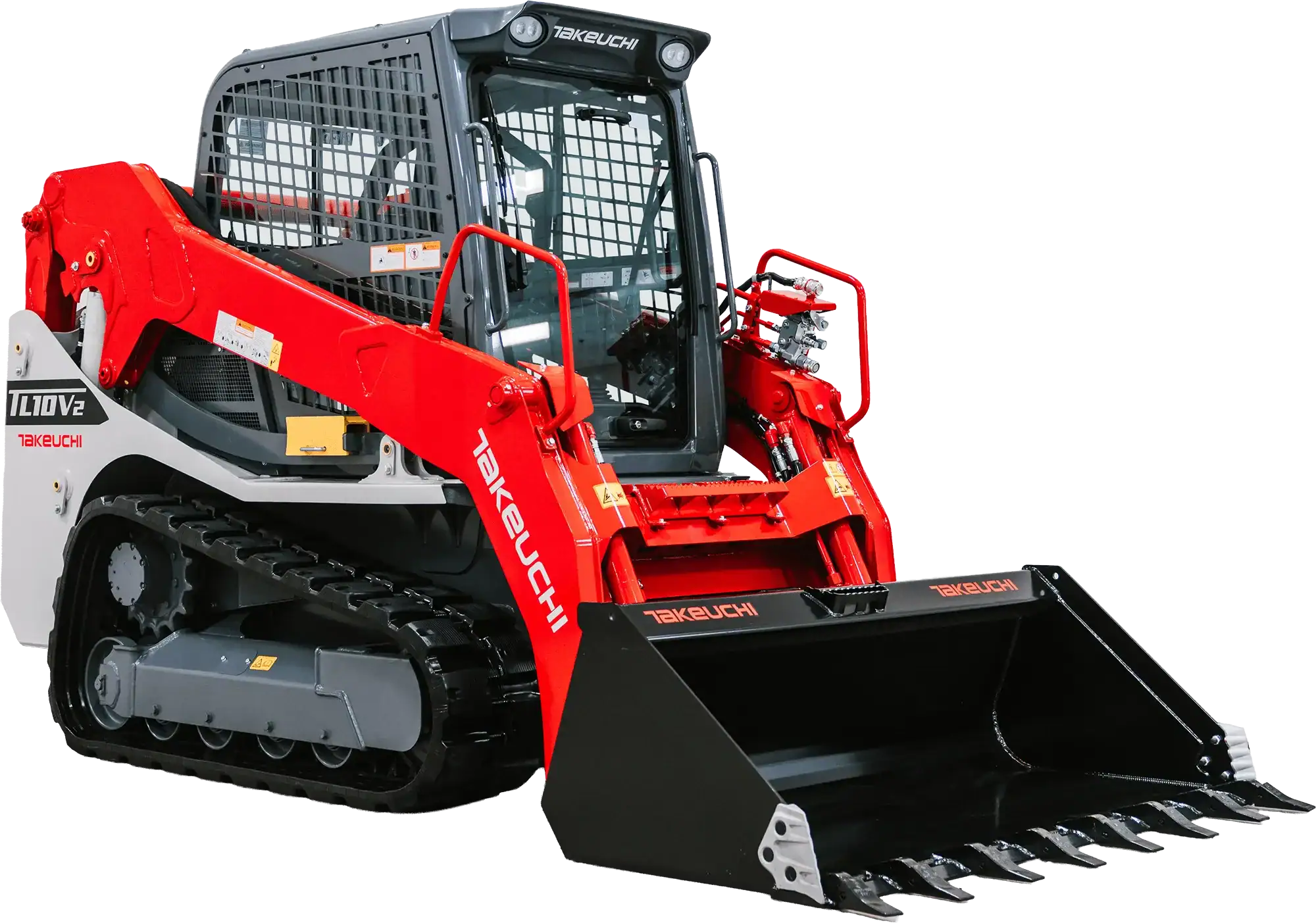
The Takeuchi TL10V2 deserves consideration when repeated loading is a central job and a buyer wants vertical-lift geometry without moving immediately to a much heavier track-loader package. For Canadian landscape contractors, property businesses and farms, its value depends on the receiving vehicle, the material and the route between pickup and discharge. Horsepower alone cannot establish whether that sequence will work.
A useful shortlist should begin at the truck or storage area and work backward. Identify where material must land, how heavy it is and what attachment will carry it. Then compare the TL10V2’s dimensions and applicable ratings with those requirements. This approach is more revealing than choosing a loader because its bucket pin rises above a particular height.
On This Page
ToggleDocumented North American TL10V2 specifications
Takeuchi’s current TL10V2 page links an August 2019 brochure. The table follows that brochure’s configuration and rounding. TL10V2 and TL10V-2 refer to this designation; the older TL10 requires its own specifications.
| Specification | Brochure value |
|---|---|
| Engine power | 74.3 hp at 2,600 rpm |
| Operating weight, canopy / cab | 4,515 / 4,660 kg |
| ROC, 35% basis | 1,145 kg / 2,522 lb |
| Width without bucket | 1,740 mm |
| Bucket-pin height | 3,169 mm |
| Dump height / reach, fully raised | 2,435 / 950 mm |
| Primary / optional high flow | 71.2 / 124 L/min |
The brochure specifies vertical lift, hydraulic pilot controls and DOC plus DPF aftertreatment. The current page highlights no DEF. That does not mean the machine has no exhaust-treatment system or maintenance obligations.
Start with the receiving vehicle
A truck-loading purchase has at least three geometric questions. Can the bucket clear the receiving edge? Can it reach a useful discharge position? Is there room for the machine to approach and leave within the intended site arrangement? A single maximum-height figure answers none of those completely.
Take measurements from the actual receiver. Include side height, edge shape and the part of the body where material needs to land. Relative ground elevations matter as well. A favourable demonstration on a level yard may not represent a site where the truck and loader stand at different elevations.
Use the intended bucket rather than an arbitrary demonstration tool. Bucket geometry affects the cutting-edge position, discharge behaviour and retained material. If the quotation includes more than one bucket, establish which one the loading assessment covers.
A practical acceptance demonstration should show a complete suitable cycle, including discharge and withdrawal. Merely lifting an empty bucket above the side of a truck can conceal limited useful reach or an awkward approach. Keep people clear of the operating area and use a competent operator following the applicable instructions.
Why vertical lift is relevant, but not decisive
Vertical-lift geometry is worth evaluating where the upper part of the lift path matters frequently. It does not make every task superior to a radial-lift alternative. A contractor primarily shaping and moving material near ground level should still compare the whole working method.
The buyer’s question is how often the geometry solves a recurring constraint. If the receiver is loaded several times each day, a better fit may have substantial value. If high loading happens twice a season, another arrangement or occasional hired equipment may solve the problem without defining the entire purchase.
Aglist’s radial versus vertical lift guide develops that comparison. Apply it to actual tasks rather than assigning a universal ranking to the two arm designs.
Rated capacity and fork work are separate checks
The brochure labels its operating rating on the 35% basis. Keep that basis consistent when comparing another CTL. A larger 50% reference in a specification sheet does not independently authorize carrying that load in ordinary work.
Fork work introduces the mass of the fork frame and the position of the load. A long pallet can place material farther forward than a bucket. A tall or uneven load may also have a different centre of gravity from its outward shape. Obtain the applicable machine-and-attachment information for the intended placement task.
Build a load list from actual labels, weighing information or other reliable records. Include packaging and pallets rather than recording only the product quantity. If the heaviest regular task does not fit the approved arrangement, use a different machine or handling method; do not turn a low-height trial into a capacity test.
The Aglist ROC guide explains why tipping load, breakout force and rated capacity are different measures. The TL10V2 should pass the required load assessment before convenience features or price decide the purchase.
Balance bucket size against the whole cycle
The useful bucket is the one that moves the required material within the machine’s limits and produces the desired finish. Capacity by volume can be misleading when comparing light mulch with dense soil or aggregate. A bigger bucket can increase unnecessary excavation or encourage an unsuitable fill.
Also consider retention during approved travel and the required dump position. A bucket that appears efficient at pickup may create spillage and cleanup elsewhere. That cleanup is part of the job cost even if it occurs after the demonstration ends.
For a landscape contractor, one tool may suit bulk transfer while another suits final surface work. Price those roles separately. Do not assume that a universal bucket package is automatically cheaper once additional passes and rehandling are included.
Look for waiting time before buying more output
A loader may be able to complete its part of the cycle faster than the receiving system can accept material. Truck availability, route congestion or another operation can limit the completed job. Buying a more capable loader will not necessarily remove those delays.
For example, suppose a hypothetical job has 40 cycles. Reducing each active loading cycle by 15 seconds saves ten minutes. If the same job contains 45 minutes waiting for a receiver, the active-cycle improvement addresses only a small part of the lost time. These are illustrative figures, not a TL10V2 performance claim.
During a trial, record pickup, loaded movement, discharge, empty return and waiting separately. Use the same material and receiver when comparing machines. A change in truck layout can otherwise be mistaken for a machine advantage.
This record can support a better investment decision. A revised receiving arrangement or another transport resource may offer more benefit than another loader option. The most useful package is the one that improves completed work, including the surrounding process.
Standard or high-flow hydraulics?
The optional hydraulic package should be selected for a named attachment. Obtain its accepted flow and pressure ranges, return restrictions, any case drain and its control requirements. Confirm the actual installed circuit rather than relying on the existence of auxiliary couplers.
For an owner whose work is predominantly bucket and fork handling, high flow may be a secondary consideration. For a business with a regularly used powered tool, it can be essential. The distinction comes from the attachment specification and workload, not from a general belief that more flow improves every operation.
Include installation, electrical compatibility, guarding and commissioning in the comparison. Aglist’s hydraulic attachment guide explains the broader selection method. A complete usable package is the price that matters.
The no-DEF distinction for a used buyer
The manufacturer’s no-DEF description can simplify one part of the ownership discussion, but it should not be expanded into “no emissions maintenance.” The linked brochure documents a DPF. A used buyer still needs the proper operating guidance and a review of maintenance and warning history.
Ask for records and have unresolved warnings diagnosed before purchase. Avoid accepting a verbal claim that a removed or disabled system makes the machine more desirable. The correct comparison is between properly functioning, documented configurations.
Match the engine identification and serial number to the relevant manual. Do not borrow maintenance intervals or fluid instructions from another Takeuchi model solely because its power rating is similar. The guide’s role is to identify the purchasing questions; the serial-specific documentation supplies the operating procedures.
Access, tracks and the work surface
The width without a bucket is only the starting point for an access survey. Check the actual tool, route turns, overhead constraints and the space around the receiving vehicle. If an attachment or accessory changes the envelope, record that change in the equipment list.
Tracks do not eliminate ground assessment. Loaded movement and steering can disturb a surface even when nominal ground pressure looks favourable. A proposed job on finished landscaping, soft soil or a deteriorating yard needs a method suited to those conditions.
For a used machine, inspect the running gear as a system. Track rubber, rollers, sprockets and idlers can have different remaining service lives. Have condition assessed and repairs priced instead of using an attractive tread appearance as evidence that the whole undercarriage is fresh.
Operator environment and repetitive work
Loading can occupy much of an operator’s day, so test the view of the bucket, receiver and route with the intended tools. Seat adjustment and control preference should be evaluated through representative work, not only by sitting in a stationary machine.
For Canadian work extending into cold or wet periods, check the actual enclosure and installed climate functions. A cab label does not prove that heating, defrosting, seals and glazing are in good condition. Include these items in a used inspection and repair estimate.
Arrange service access before the machine becomes essential to booked work. Identify where routine maintenance and diagnosis will occur and how parts will reach the operation. Those logistics can matter more than a small difference between advertised specifications.
Transport and ownership frequency
Establish the configured machine’s weight basis and account for the tools and other cargo being moved. Do not add an attachment twice if it is already included in the documented figure. Evaluate actual loaded dimensions, payload and the complete hauling combination.
A loader that stays at one property has a different cost structure from one moved between several jobs every week. Include loading, travel and unloading time in the comparison. Professional delivery can be a useful alternative for occasional movements.
Ownership should also be tested against the expected working calendar. A machine sized for a large temporary project can become an expensive asset after that project ends. Compare longer-term recurring use with rental or contractor options for the exceptional work.
A focused inspection and comparison list
- Verify full model, serial, enclosure, hydraulic options and included attachments.
- Have loader pivots, linkage, structure, coupler locks and hydraulics assessed.
- Review the running gear and obtain estimates for identified wear or damage.
- Observe appropriate cold-start and warmed-up representative operation.
- Confirm the approved load and discharge arrangement with the intended tools.
The John Deere 325G and Kubota SVL75-3 are useful catalogue starting points for alternatives. Compare exact versions and delivered packages. This inspection list does not imply a recurring defect pattern for any model.
Frequently asked questions
Does no DEF mean no DPF?
No. The cited TL10V2 brochure specifies DOC and DPF aftertreatment. The two descriptions address different parts of the emissions arrangement.
Can bucket-pin height establish truck compatibility?
No. Check dump clearance, useful reach and the full approach and discharge path with the actual bucket and receiver.
Is the TL10V2 the same as the older TL10?
Use documentation for the complete designation and serial. Do not merge earlier-model specifications into a TL10V2 comparison.
Should every loading business buy high flow?
Only when a verified powered-attachment requirement and expected use justify it. Bucket loading itself does not establish that need.
What would make this machine the right size?
It must satisfy the normal load, receiver and access requirements while keeping transport and ownership practical. A higher maximum specification is useful only when it improves that complete method.
Share your experience
Help other Canadian buyers — leave a quick review for the
Takeuchi TL10V2
There are no reviews yet. Be the first one to write one.