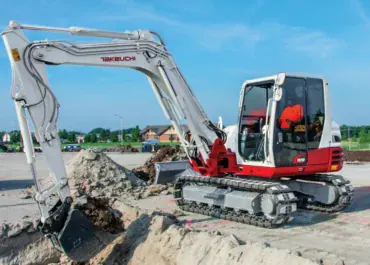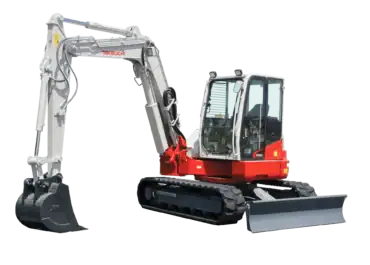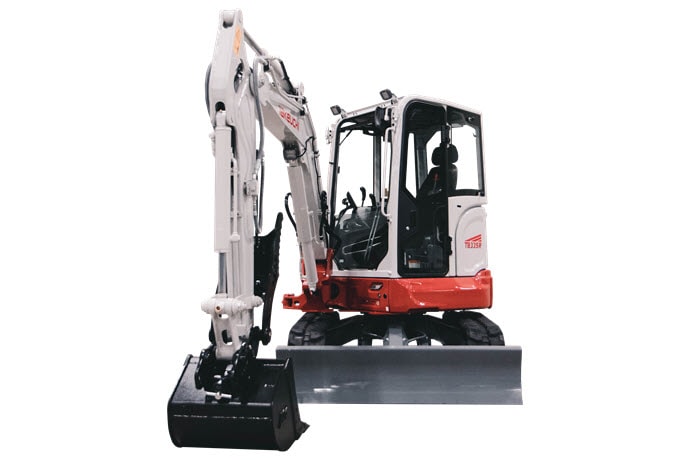
Overview & Specs
The Takeuchi TB335R is a useful candidate when the excavator’s rear repeatedly gets in the way of property work. Its short-tail layout addresses rotation space, while its published 1,740 mm undercarriage width still demands a proper access route. Those are different buying questions. A machine can be convenient beside an obstruction once positioned yet remain too wide for the entrance that leads to the job.
For Canadian acreage owners and landscape contractors, the strongest reason to consider this model is a recurring combination of limited working space and ordinary excavation. Start with those constraints, then evaluate the bucket, enclosure and transport package. Buying from a short-tail label alone leaves too much of the actual job unresolved.
On This Page
ToggleTB335R specification basis
This guide uses Takeuchi’s North American product page and its linked October 2022 brochure. The table retains the brochure’s metric configuration references. These describe that documented package, not every used machine or later quotation carrying the same model name.
| Reference | Brochure value | Buying use |
|---|---|---|
| Engine output | 24.4 hp at 2,300 rpm | Keep separate from tool capability |
| Operating mass, canopy / cab | 3,615 / 3,770 kg | Identify enclosure and equipped weight |
| Undercarriage width / rear radius | 1,740 / 950 mm | Separate entry width from rotation |
| Maximum depth / ground-level reach | 3,205 / 5,305 mm | Use the full working-range drawing |
| Primary auxiliary flow | 64.4 L/min | Initial powered-tool screening |
The brochure cover gives a different weight from its detailed cab table, and published web summaries disagree with the brochure on some force figures. This guide identifies its weight basis explicitly and does not use the disputed breakout figure to rank the machine. Confirm the serial-specific data if a purchase depends on one of those entries.
Short tail does not mean zero clearance
A compact rear radius can make positioning easier where the counterweight would otherwise interrupt the working cycle. The benefit is most relevant when the excavation, material destination and machine position can all be arranged usefully within the available space. It is less valuable when access, spoil removal or a large attachment remains the real limitation.
Draw the required rotation on a site sketch before comparing machines. Include the rear, cab, boom, bucket, hoses and the space occupied by material. An empty bucket tucked close to the machine does not describe the envelope of a working tool extended toward the excavation. Neither does a brochure illustration establish clearance from a building, fence or another person.
For a property contractor, review the jobs that caused repeated repositioning during the last season. Separate rear-clearance delays from waiting for a truck, changing buckets or moving spoil. Only the first category directly supports paying for a different tail arrangement. A compact design cannot solve every delay simply by being easier to rotate.
The Aglist tail-swing guide explains the layout categories. For the TB335R, use that background to frame a practical demonstration: can the configured machine complete the intended cycle from an appropriate position without the rear becoming the recurring constraint?
Make the access survey wider than the gate
The 1,740 mm undercarriage dimension is a useful first filter, but the route must accommodate the actual machine. Check the fitted blade, attachment, turns, overhanging objects and changes in surface. A straight opening measured at one height is not a complete access assessment.
Consider a hypothetical 1,850 mm opening. Subtracting the cited undercarriage width leaves only 110 mm in total, or 55 mm on each side if perfectly centred. That arithmetic is not an acceptable-clearance recommendation. It shows why a seemingly comfortable rounded description such as “about six feet wide” is a poor purchasing measurement.
Look beyond entry to the place where the machine must turn, unload attachments and begin work. On established properties, surface restoration can become part of the equipment cost. A smaller carrier might take longer digging but reduce access preparation; a larger one might justify a different delivery route. Compare the complete project rather than assuming that passing the entrance decides suitability.
What useful digging range looks like
The maximum depth is one point in the working envelope. The ground-level reach is another. They cannot be combined into a rectangular area that the bucket can excavate equally well. The job needs a continuous movement: enter the material, fill, extract, swing and place it where it belongs.
For a farmyard drainage repair, record the required excavation profile and the proposed standing level. Then identify where the material will go. If the receiving position forces awkward swings or extra travel, a machine that reaches the bottom may still be inefficient for the whole operation. Establish appropriate machine positions through the site plan before assessing reach from them.
Use the intended bucket and coupler when evaluating the geometry. A different connection can change the front-end arrangement. It is especially important to avoid borrowing a maximum figure from a bare specification drawing while demonstrating a heavier or differently shaped tool.
The depth and reach guide provides a worksheet for this comparison. If the essential task sits near the envelope boundary, a representative demonstration or a different equipment solution is more informative than another small rounding adjustment to the quoted depth.
Choose the tool package before buying extra buckets
A compact excavator often arrives with an appealing bundle of attachments. Count their jobs, not just their number. A compatible digging bucket and a finishing bucket that solve different recurring tasks may be more useful than several similar widths that rarely leave storage.
Identify each bucket’s mounting, mass and purpose. A wide finishing tool is not automatically suitable for resistant excavation, and a narrow tool is not automatically the right choice for every trench. The finished project requirements determine the cut; bucket choice follows them. Unnecessary excavation creates more spoil, replacement material and restoration.
If a thumb is important, assess contact with the actual bucket and clearance through the allowed working and stowed positions. A mounting provision on the arm does not establish that every thumb and coupler combination will work together. Record the complete arrangement on the purchase sheet so later additions can be checked against it.
Lifting remains a separate assessment using the applicable load chart and approved equipment. Neither engine horsepower nor breakout force describes what the machine may lift at a particular radius. A tool that can grip an object has not, by that fact alone, established a permitted handling operation.
Hydraulic flow is a starting point, not an attachment approval
The primary circuit figure is the relevant starting reference for a tool supplied by that circuit. Do not select an attachment from combined system flow. Match the tool’s accepted flow range, pressure, return arrangement, controls and mounting to the actual installation.
The brochure distinguishes enclosure-related equipment, including a cab-only quick-hitch circuit. Treat that as a reason to identify the offered package carefully. A canopy machine and a cab machine with the same model badge need not provide identical controls or plumbing. Photographs of hose ends do not fully describe the circuit behind them.
For an auger or breaker central to the buying decision, request a quote that includes installation and commissioning. The useful comparison is between complete working systems. An attachment-only offer can look cheaper because the necessary hoses, controls or setup work are absent from its price.
During acceptance, use an approved tool under representative conditions and observe the transitions back to digging. Record settings with the attachment identity. That is more useful than relying on an unexplained preset left by a previous owner or assuming that the maximum available flow is always desirable.
Cab or canopy for the Canadian work calendar?
The operator station should follow the hours and seasons of intended use. A machine working intermittently on summer property projects has a different enclosure case from one expected to support shoulder-season contracting. List the actual work calendar before deciding whether the cab premium solves a recurring problem.
The cited brochure gives the canopy a 4.3-inch display and the cab a 7-inch touchscreen, and lists heating and air conditioning with the cab. Those details should be checked on the offered machine rather than assumed from a general advertisement. On used equipment, test visibility, controls and climate functions as part of the purchase assessment.
Cold-weather use also involves the correct fuel, fluids, starting and warm-up procedures from the operating manual. An enclosed operator station does not make frozen material equivalent to summer soil. Separate comfort and machine preparation from the suitability of the excavation task and attachment.
Compare against a conventional machine honestly
The existing Takeuchi TB235-2 and TB240 guides provide useful alternative questions. Compare the exact configurations on the same access route and work sequence. Do not award the TB335R an automatic advantage because the rear is compact, or penalize a conventional layout where the site has ample room.
Suppose, purely for planning, a compact rear arrangement removes six repositioning interruptions of three minutes each on a typical relevant job. That would save 18 minutes. If the same package adds 15 minutes elsewhere through loading or attachment handling, the net difference is only three minutes. These assumptions are not measured TB335R results; they illustrate why the whole sequence matters.
Also count how often the constrained job occurs. A feature used every week deserves different weight from one needed on a single project. Renting a suitable machine for an exceptional task can leave the regular purchase better matched to ordinary work.
Used-machine inspection and ownership costs
Start a used inspection with identity: serial number, enclosure, arm, tracks, blade, coupler and hydraulic equipment. Resolve mismatches between the listing and the machine before comparing value. A low hour reading does not identify its configuration or establish condition.
A competent inspection should assess undercarriage wear, linkage movement, structural repairs, hydraulic leaks and the operation of the fitted controls. Pay particular attention to contact damage around the compact rear and to attachment plumbing, without assuming those areas represent a model-specific failure pattern. Price actual findings rather than importing repair rumours from another machine.
Build the delivered cost from purchase, required repairs, initial service, useful attachments and transport. Keep optional improvements separate from essential corrections. This makes an incomplete low-priced package comparable with a ready-to-work alternative instead of hiding missing equipment in future expenses.
For hauling, establish the actual loaded mass and what the reference weight includes. Separately carried buckets, securement equipment and other cargo still belong in the transport assessment. Trailer length or a truck’s informal size class does not determine the suitability of the complete combination.
Questions worth settling before purchase
Will the TB335R fit through my property entrance?
Begin with the published width, then measure the widest fitted component and the entire route. Turns, overhead restrictions and working space after entry can change the answer.
Does short tail eliminate the need to watch the rear?
No. It changes the geometry. The complete machine and tool still require an appropriate operating envelope and site arrangement.
Should a canopy quote be compared directly with a cab quote?
Compare their equipment line by line. Enclosure, displays, plumbing and actual transport mass can differ, so a price difference may represent more than weather protection.
Is the largest included bucket the most valuable?
Only if it is compatible and useful for recurring work. An attachment that widens the cut unnecessarily or cannot travel conveniently may add less value than a smaller, well-matched tool.
What would justify choosing another excavator?
A failed essential access, range, attachment or transport requirement. Keep those as pass-or-fail conditions before scoring comfort, convenience and price. The TB335R earns its place when the compact rear solves a real constraint within an otherwise workable equipment package.
Share your experience
Help other Canadian buyers — leave a quick review for the
Takeuchi TB335R
There are no reviews yet. Be the first one to write one.