Overview & Specs
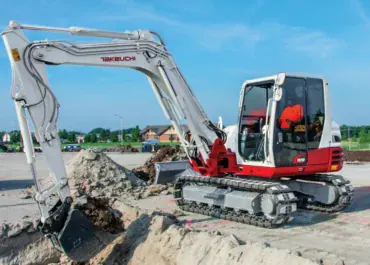
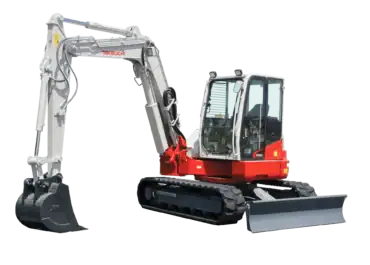
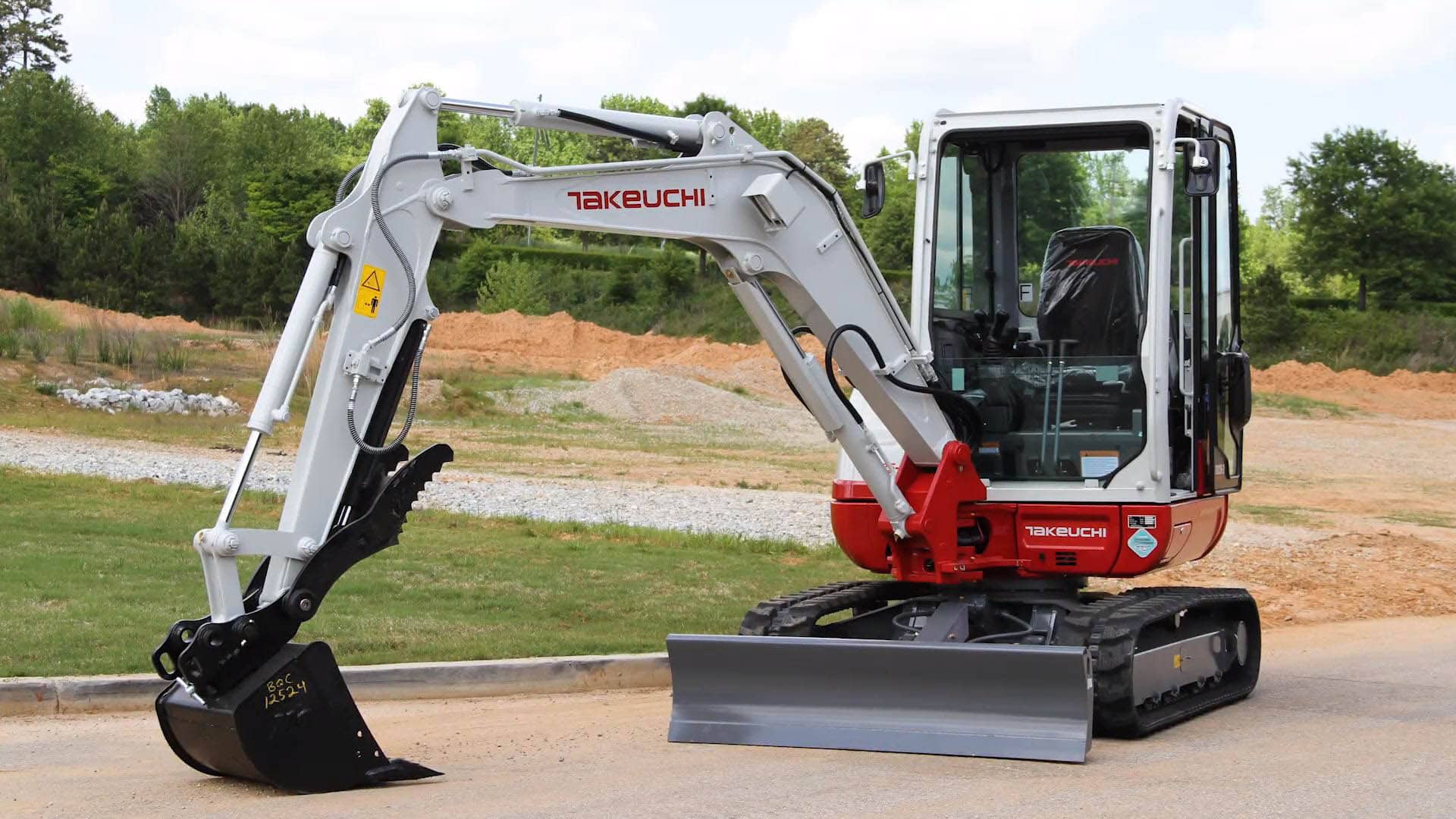
The Takeuchi TB235-2 is a conventional-tail compact excavator to assess when excavation becomes regular work and the complete digging cycle matters more than fitting the smallest possible entrance. Its package combines a relatively narrow fixed undercarriage, a choice of operator enclosure and adjustable attachment hydraulics. For a Canadian owner or small contractor, the useful question is whether those features fit the recurring site layout and tool requirements.
It should not be selected on the assumption that conventional tail swing automatically produces a better lifting machine, or that an engine without a diesel particulate filter eliminates maintenance. Those are separate questions. Compare the actual configured machine, working-range drawing, applicable load chart and ownership schedule.
On This Page
ToggleIdentify the model and the documented configuration
This guide concerns the TB235-2, retaining the suffix rather than substituting information for an earlier TB235. Sources are the North American product page and its linked August 2018 brochure. The brochure is useful configuration evidence, but its date is not the manufacturing year of every machine offered for sale.
| Item | Brochure reference | Practical meaning |
|---|---|---|
| Engine output | 24.4 hp at 2,400 rpm | Keep separate from hydraulic tool performance |
| Operating mass, canopy / cab | 3,365 / 3,465 kg | Compare the enclosure actually quoted |
| Undercarriage width | 1,580 mm | One access measurement |
| Tail radius | 1,330 mm | Check the rear movement at the destination |
| Maximum depth / ground reach | 3,245 / 5,130 mm | Different points in the range diagram |
| Primary auxiliary flow | 60 L/min | Use for initial circuit matching |
The current page and brochure differ slightly in their rounded imperial weight entries. Preserve the metric reference and source date, then establish the actual equipment on the sale machine. Avoid interpreting small conversion differences as evidence of a different performance class.
When conventional rear geometry is acceptable
The TB235-2 needs room behind the tracks during rotation. On an open farm or property excavation, that space may be available without compromising the work arrangement. On a restricted site, the same rear movement may limit useful positions even if the machine can travel through the entrance.
Using the brochure dimensions, half the 1,580 mm width is 790 mm. Comparing that with the 1,330 mm tail radius gives a simplified rear projection of 540 mm. This is a geometric illustration, not a prescribed operating clearance. The complete fitted machine and every relevant moving component still need assessment.
Separate the approach route from the working area on the site sketch. Include the excavation, discharge destination and supporting equipment. The strongest reason to choose a different tail layout is a recurring restriction in that complete cycle, not a general belief that one category is always superior.
For occasional confined work, include rental of suitable equipment in the ownership comparison. A machine that fits the normal workload can be preferable to configuring every purchase around a rare job. The opposite is true when rear clearance constrains most assignments.
Useful digging range, not just maximum depth
The cited package has a 1,445 mm arm. The published depth and reach help screen jobs, but they do not form a rectangular working area. Ground-level reach does not describe horizontal reach at maximum depth, and the bucket must follow a workable path between cutting and discharge.
Mark the points used repeatedly in your typical excavation. Then compare the correct range drawing for the fitted bucket and linkage arrangement. If the most important work lies near the outer envelope, arrange a representative demonstration instead of assuming that a maximum number promises comfortable production.
The digging-depth and reach guide helps interpret those labels. Suitable machine positions and excavation design must be established independently. Equipment geometry cannot determine whether a standing position or excavation edge is appropriate.
Where truck loading forms part of the job, examine the discharge path too. A bucket may clear the near side yet remain awkward for distributing material. Include the receiving vehicle’s position and elevation in the demonstration, as well as the return movement toward the excavation.
Cab or canopy: decide from the actual schedule
The documented cab reference adds 100 kg to the canopy operating mass. That is one measurable difference, but it is not the whole enclosure decision. Work duration, seasonal exposure, visibility and installed climate equipment affect the usefulness of each package.
A contractor with long shoulder-season days may value an enclosed operator environment differently from an acreage owner who schedules short sessions around the weather. Inspect the actual heating, ventilation, glazing and controls. A cab badge does not prove that every feature is present or serviceable on a used machine.
Have the regular operator adjust the seat and assess visibility toward the bucket and both sides of the machine. Include entry, exit and reading the display. The demonstration should reveal whether the operator can maintain a comfortable, informed working routine, rather than merely confirming that the cab looks spacious.
If several people share the excavator, establish a consistent handover process for attachments and settings. A well-documented machine can save confusion even when no physical component changes. Keep each approved tool’s requirements with its identification.
No DPF is a specific feature, not a maintenance forecast
The brochure identifies the TB235-2 engine as meeting its stated emissions standard without a diesel particulate filter. This is a model-specific description. It should not be extended to other Takeuchi excavators merely because they appear nearby in the lineup.
The practical buying question is what service the actual engine and machine require, and how that fits the work schedule. Filters, fluids, cooling-system care and routine inspections still matter. Absence of one emissions component does not prove a lower total repair bill or a particular service life.
For Canadian cold-season use, follow the applicable instructions for fuel, lubricants, starting and warm-up. Frozen material is also a different excavation task. Do not assign a winter productivity guarantee from engine output or ordinary digging specifications.
Hydraulic tools: distinguish circuit capability from total flow
The brochure lists 108.4 L/min total hydraulic flow and 60 L/min for the primary auxiliary circuit. Selecting an attachment against the larger combined figure would confuse two different specifications. Begin with the circuit that actually feeds the intended tool.
Match the tool’s flow range, pressure and return requirements, controls, mounting and carrier suitability. An advertised hydraulic option is not evidence that it is installed on a particular machine. Include plumbing and commissioning in the written quote where they are needed.
The TB235-2 brochure describes adjustable flow and attachment presets. These can help make an approved setup repeatable, but they do not establish compatibility by themselves. A saved setting should be traceable to a named tool and the appropriate documentation.
For a thumb package, evaluate the bucket and coupler together. The thumb guide explains why mounting, useful contact and stowed clearance are separate checks. A gripping demonstration is not a lifting-capacity test.
Bucket selection and repeated production
A recurring excavation business should evaluate useful material moved per complete cycle, not simply the apparent speed of the boom. Bucket width, material behaviour, fill and discharge all influence the result. A fast empty movement tells little about finished job time.
Suppose a hypothetical task requires 240 equivalent cycles. A five-second difference per cycle is 1,200 seconds, or 20 minutes. If an unsuitable bucket adds 30 minutes of finishing or material cleanup, the faster active cycle does not deliver the faster completed job. These assumptions illustrate a comparison method; they are not measured TB235-2 performance.
Use comparable material, operator and attachment arrangements when possible. Record interruptions and the amount of useful work completed. If one demonstration moves less material per cycle, identical cycle counts cannot be assumed.
A useful initial bucket set has a defined role for each tool. Price used attachments according to verified compatibility and condition. Multiple unidentified or worn buckets should not be valued as a complete ready-to-work package.
Lifting and transport need their own evidence
Conventional rear geometry does not establish a lifting rating. Use the applicable manufacturer chart for the exact configuration, radius, height, direction and blade conditions. Account for attachment mass according to the chart’s basis rather than subtracting from an unlabelled headline number.
For transport, establish the actual equipped mass and separately carried tools. Determine what the reference weight already includes to prevent omissions or double counting. Then assess the complete vehicle, trailer, loading and securement arrangement against its ratings and applicable requirements.
Move frequency can change the ownership decision. Delivery may be attractive for a machine that remains at one property, while a contractor moving several times a week needs to count loading and travel time. Use realistic quotations and your own schedule.
Inspecting a used TB235-2
Confirm serial identity, enclosure, arm, tracks, blade and installed hydraulics before comparing prices. Obtain service records and investigate undocumented configuration changes. The model suffix and equipment list should match the documents used for the buying decision.
Have a competent inspector assess undercarriage wear, joints, structure, cylinders, hoses and repair quality. Observe representative operation after appropriate checks and warm-up. An unusual symptom should trigger investigation, not an unsupported claim about a known model defect.
Check service access with the equipment in its normal arrangement. Open the hoods, identify routine inspection points and establish how the machine will be cleaned and maintained at its working location. Ease of maintenance in a brochure is useful only if the real ownership arrangement supports it.
Obtain estimates for repairs, missing components, delivery and initial service. A complete, documented attachment installation can be more valuable than an attractive asking price on a machine needing substantial preparation. No universal annual repair cost is assumed here.
Cross-shopping and the acceptance brief
The Bobcat E35 and Kubota KX033-4 guides offer other comparison starting points. Verify their exact manufacturer configurations, then compare the same access route, excavation and material-removal sequence.
Before signing, define the result expected from the demonstration: useful working positions, satisfactory tool operation, practical operator accommodation and a complete transport or delivery plan. Keep unresolved essential requirements visible. A favourable price should not silently convert them into assumed capability.
Frequently asked questions
Is the TB235-2 a zero-tail-swing model?
The cited machine uses a conventional rear layout. Check the complete rotating envelope separately from travel width.
Does no DPF mean there is no emissions or engine maintenance?
No. Follow the exact engine and machine documentation. The feature describes one component choice, not the entire ownership workload.
Can a larger system-flow number justify a hydraulic attachment?
Use the auxiliary circuit and the tool’s complete requirements. Total flow is not automatically available at the tool connections.
What is most useful to record during a trial?
Configuration, material, bucket, useful output, interruptions and finishing time. Those records explain a result more clearly than a single cycle-speed claim.
When does the cab make sense?
When its verified equipment and condition support the actual season and working hours enough to justify the complete package cost. The answer differs between a seasonal owner and a full-time contractor.
Share your experience
Help other Canadian buyers — leave a quick review for the
Takeuchi TB235-2
There are no reviews yet. Be the first one to write one.