Overview & Specs
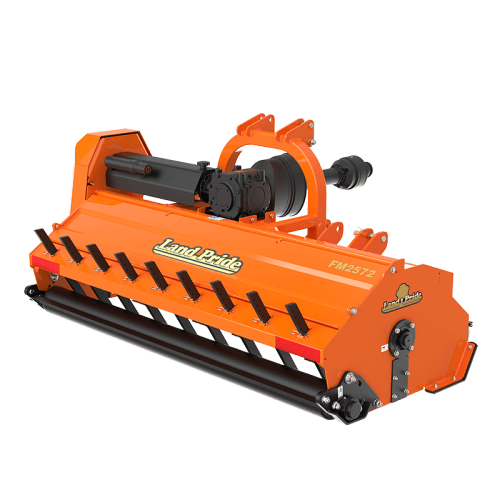
The Land Pride FM2560 is a five-foot flail mower whose usefulness depends strongly on the installed rotor and knives. It is worth considering for a Canadian property with recurring vegetation-management or shredding work that fits the documented blade package. Buying it simply as a “heavy mower” misses the most important choice: the same model can be configured around a finer grass finish or more demanding permitted material.
The other easily missed detail is its physical size. A 60-inch cut does not mean a 60-inch-wide attachment, and a five-foot flail should not inherit the tractor approval of another five-foot mower. This guide uses the July 1, 2024 FM25 operator manual and distinguishes that configuration from older promotional figures.
On This Page
ToggleRead the rotor package before the price
The FM25 manual lists three FM2560 rotor choices: ducksfoot, heavy-duty Y and hammer. The respective documented vegetation capacities are one inch, one and a half inches, and two inches. Those are model-specific limits; the names alone are not universal ratings for all flail mowers.
Ask the quotation to identify the complete fitted system. A hammer-equipped demonstration does not establish the performance of a ducksfoot machine offered for sale. Likewise, photographs of several blade choices do not mean all are included or that changing between them is a simple owner-level blade swap.
Start with two written descriptions: what is growing, and what should remain after the pass. Include representative stem diameter, density, grass condition and desired residue appearance. A finer turf-like result and more intensive processing of permitted prunings are different acceptance tests. Selecting the package becomes easier once those tests are explicit.
Key dimensions and the newer weight figure
| Item | Documented FM2560 value |
|---|---|
| Working / overall width | 60 / 72 inches |
| Standard unit with ducksfoot rotor | 965 lb |
| Tractor horsepower range | 33–80 hp |
| Hitch / PTO | Category 1 / 540 rpm |
| Offset positions | Centred or 8 inches right |
| Mechanical cutting-height range | 0–6 inches |
The 965-lb figure belongs to the cited manual’s ducksfoot configuration. Older literature lists a different weight, so this guide does not combine the older number with current package information. Obtain the equipped weight for the actual rotor and accessories being purchased. A mechanical height range also does not prescribe an appropriate mowing height for a particular site.
Five feet of cut requires a six-foot access check
The difference between working and overall width affects gates, storage and narrow passages. Measure the tightest usable route, including clearance for alignment and uneven ground. Do not buy from a gate measurement that merely equals the advertised cutting width.
The complete tractor-and-mower path is more important than either width separately. Around orchard rows or a shelterbelt, record where the tractor must travel and how the attachment follows. A suitable open strip can be quite different from a narrow end turn between trees. Include the final turn into the storage space in the inspection.
Offset can help position the cut relative to the tractor, but the eight-inch right position is not a hydraulic side-shift range or a boom reach. It does not make an inaccessible strip accessible from any tractor position. Compare the intended edge work with the actual approved arrangement, and keep the tractor on suitable ground.
Why more aggressive shredding can take longer
A flail purchase should distinguish shortening growth from reducing residue to the desired condition. The first visible pass may cut everything while still leaving material that needs more processing. Conversely, a very finely processed result may be unnecessary for the property’s purpose.
The manual relates the working result to travel speed, material load and the fitted cutting equipment. For purchase planning, this means a demonstration should show the required end result, not simply the fastest forward movement. More time spent processing material is not automatically a failure if that processing is the reason for choosing the flail.
Suppose one permitted setup completes an area in 50 minutes but needs a further 25-minute pass to achieve the agreed residue condition. Another takes 65 minutes in one pass. Under those invented assumptions, the slower first pass produces the finished job ten minutes sooner. Do not compare the 50-minute number alone with the 65-minute number.
That example also helps specify a service quotation. If a contractor prices cutting only and you expect finer shredding, the scope needs clarification before comparing ownership with contracted work. Neither the machine category nor the word “mulching” establishes the exact finish being supplied.
Tractor matching goes beyond the lower horsepower number
The 33–80-hp tractor range is only one screen. The tractor also needs the correct hitch, driveline arrangement, carrying ability and approved ballast configuration. A rear implement approaching half a tonne in the documented setup can pose a handling question even when engine output appears comfortably within range.
Keep rating labels intact. An engine-power advertisement, PTO output and gearbox rating describe different things. The PTO horsepower guide explains that distinction. Do not relabel the FM2560’s tractor range as a guarantee of available PTO power or identical performance across all vegetation.
Travel control deserves a separate trial. The tractor must support the appropriate forward pace while operating the mower as prescribed. If the work requires slow progress, evaluate the actual transmission and range choices rather than assuming an engine-speed reduction is the solution. Handling, visibility and operator comfort during repeated rearward checks matter too.
The rotor is a system, not a collection of spare knives
Before buying used, establish which rotor and attachment hardware are installed. A box of loose blades supplied with the sale is not proof that they belong on that rotor. Record part identification and ask whether any replacement or modification has occurred.
Have the rotor, knives, mounts, bearings, belt drive, rear roller and guarding inspected under the prescribed secured procedure. Wear should be assessed across the assembly, not just at the easiest blade to see. Missing, damaged or incorrect components require proper evaluation before a powered trial.
Unexplained vibration should end a demonstration, not become an accepted characteristic of a used flail. The buyer needs a diagnosis and a repair scope. These are general inspection priorities, not a claim that the FM2560 has a recurring defect or a particular expected service life.
Where service is needed, compare the full return-to-service cost with a ready machine. Include transport to the workshop and the possibility that the proposed mowing date must change. A lower purchase price can be less useful if it buys an unidentified rotor project just before the working season.
Compare with a grooming mower or rotary cutter honestly
A flail should earn its place through its result and suitability, not a presumption that it is superior to every rotary design. A property with regularly maintained open lawn may be well served by a grooming mower. A different property focused on rough vegetation control may favour a rotary cutter within its specified duty.
The FDR1660 guide describes another five-foot tool with a different mowing architecture and turf role. The RCR1260 guide provides a rough-cutting comparison. Their nominal widths do not make weights, tractor requirements or results interchangeable.
For mixed properties, identify the dominant recurring task and the occasional exception. It may make sense to own the mower used frequently and arrange another method for an infrequent clearing job. Buying around the hardest one-time task can leave the regular mowing routine unnecessarily compromised.
A useful demonstration has a defined finish
Select an inspected, suitable area representative of the intended work. Record the tractor, rotor package, starting vegetation and desired end condition. Have the machine operated according to the manual; hidden obstacles are not a legitimate durability test.
Look at missed growth, residue size and distribution, edge access, turns and follow-up work. Record how much of the plot is actually complete when the operator stops. A favourable pass through short grass does not establish performance in the material that motivated the purchase.
If two packages are being compared, avoid changing several conditions at once. A different tractor, recently cut demonstration strip and different finish expectation make the results difficult to interpret. Ask what part of the apparent difference comes from the implement and what part comes from the test.
Estimate coverage without promising productivity
For an illustrative calculation, assume an effective swath of 1.4 metres, a suitable travel pace of 3 km/h and 60% field efficiency. Coverage is 1.4 × 3,000 × 0.60 = 2,520 square metres per hour. A 5,000-square-metre area would take about two working hours for one such pass.
Those are hypothetical inputs, not a tested FM2560 output or recommended operating speed. At 40% efficiency on a more interrupted route, the same calculation becomes 1,680 square metres per hour and almost three hours. A required second pass increases the work again.
Add connection, inspection, travel, cleanup and any separate trimming. For a seasonal implement, those tasks may represent a significant share of a small project. Improving the route or defining a less demanding but acceptable residue result may change the economics more than a small increase in nominal width.
Budget for the chosen package
Obtain a complete price for the rotor configuration, approved tractor setup, delivery and any required service. Keep optional equipment separate so you can explain what each item contributes to the recurring job. Do not treat an accessory pictured on a product page as included automatically.
Estimate annual use honestly. An invented CAD 600 annual ownership allocation represents CAD 60 across ten suitable sessions but CAD 300 across two, before tractor operation and labour. These figures are an arithmetic example, not a retail price, maintenance forecast or resale estimate.
Canadian seasonal planning should include a pre-use inspection before vegetation control becomes urgent. Arrange parts and service around the intended season rather than assuming availability on the day the mower is first connected. Where work is rare, compare a complete service or rental arrangement on the same finish standard.
Frequently asked questions
Does every FM2560 have a two-inch capacity?
No. The cited manual assigns different capacities to the fitted knife systems. Identify the rotor package before applying the hammer configuration’s limit.
Can a five-foot gate accommodate it?
The documented overall width is 72 inches. Cutting width cannot be used as the complete access dimension, and practical clearance needs additional assessment.
Is the offset hydraulically adjustable while working?
The cited specification describes centred or eight-inch-right hitch positions. It should not be advertised as a powered side-shift capability.
Will the highest cutting-capacity package give the best lawn?
Not necessarily. Vegetation capacity and finish quality answer different questions. Compare the approved packages against the actual grass result you need.
Who should shortlist the FM2560?
An owner with a verified tractor, a suitable route and recurring work that benefits from the selected flail system. Its strongest case is a demonstrable finished result, supported by an identified configuration and manageable service routine.
Share your experience
Help other Canadian buyers — leave a quick review for the
Land Pride FM2560
There are no reviews yet. Be the first one to write one.