Overview & Specs
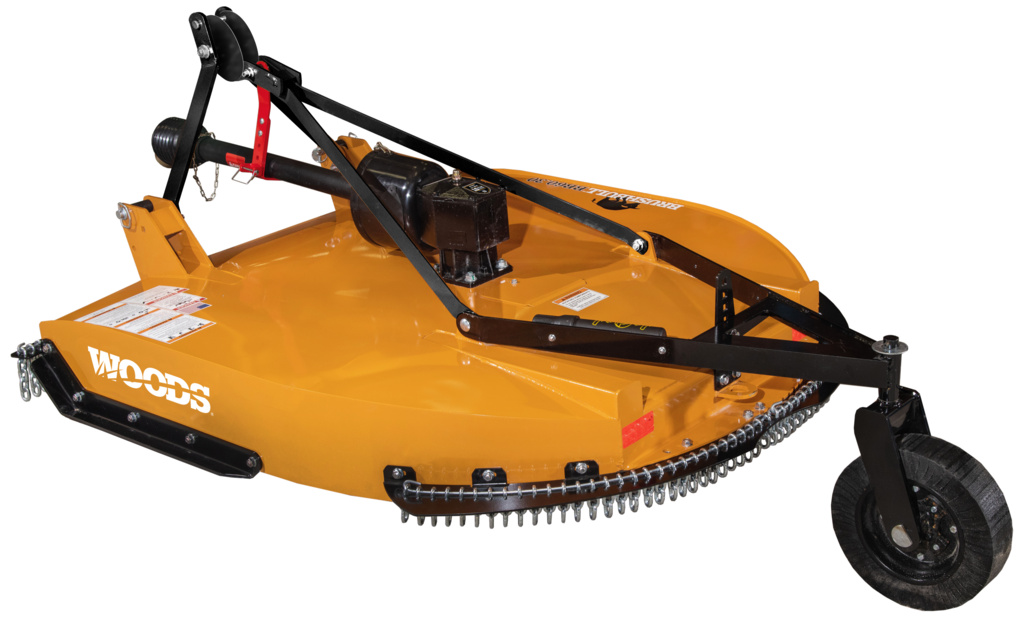
The Woods BB60.30 belongs on the shortlist when a compatible tractor must keep grass, weeds and permitted brush under control across an acreage. It provides a five-foot cutting swath, but its purchase case is less about that familiar dimension than about the vegetation you encounter, the weight your tractor can carry and the room available behind it. A five-foot brush cutter and a five-foot lawn mower solve different problems.
For a Canadian property owner, start by separating regular maintenance from first-time clearing. The BB60.30 can be considered for a known, inspected area within its documented duty. A neglected corner containing unknown debris needs assessment before any claim about cutting diameter becomes useful. Buying a stronger-looking deck does not remove that preparation work.
On This Page
ToggleThe configuration behind the model name
The Woods BB60.30 product specification, checked October 31, 2026, labels the tractor range as 25–50 PTO horsepower at 540 rpm. It lists a 60-inch cut, two-inch cutting-capacity diameter, Category 1 clevis hitch and 728-lb weight with chain shielding. These figures describe different aspects of suitability; none approves the entire tractor combination alone.
| Buying dimension | Documented value | What to check |
|---|---|---|
| Working width | 60 inches | Useful coverage after overlap |
| Transport width | 67.3 inches on the product page | Outside clearance through entrances |
| Maximum overall length | 99 inches in MAN1289 | Rear sweep and parking space |
| Cutting-height adjustment | 1–9 inches | Suitable clearance for the actual surface |
| Configured weight | 728 lb with chain shielding | Carrying geometry and complete tractor setup |
The April 13, 2026 operator manual, MAN1289, rounds overall width to 67 inches. Treat the page’s 67.3-inch value and an actual measurement as more useful for tight clearance than rounding the machine down to its cutting width. The manual covers several BrushBull models, so use the BB60.30 column rather than borrowing a wider model’s details.
Two-inch capacity is a boundary, not a production forecast
A capacity statement helps screen the vegetation, but it says little about how quickly your particular field will be completed. An occasional permitted stem in grass is a different workload from dense growth at the top of the stated diameter. Distribution, height, density and the desired finish still influence the job.
Before shopping, walk the intended area where it is safe to do so and divide it into meaningful sections. Record the regularly maintained grass, the brush patches and the locations whose contents are uncertain. Mark immovable obstacles and areas requiring another process. This produces a more useful purchase brief than simply saying that the property has several acres.
Do not use the two-inch figure as a reason to deliberately seek the largest stems the machine might cut. It is also not an authorization to mow stumps, wire or stones. A protective carrier and a substantial deck cannot turn unidentified ground into a suitable demonstration site.
Where initial reclamation is the exceptional task, compare paying for that work separately and owning a maintenance tool afterward. Where demanding brush recurs, compare equipment specifically documented for that duty. The recurring workload should determine ownership, rather than one difficult afternoon distorting the entire purchase.
PTO power, lifting ability and traction are separate questions
The page’s PTO label matters. Compare it with the tractor’s actual shaft rating, not simply the engine figure used in its model advertising. Aglist’s PTO versus engine horsepower guide explains the distinction. A tractor described informally as a certain horsepower may not supply that amount at the rear shaft.
Once the power screen is satisfied, assess the mounted load. The cutter extends well behind the hitch. A lift rating measured at the linkage is not a promise that any equally heavy attachment can be carried comfortably at a different centre of gravity. Include the actual hitch equipment, required ballast and the tractor manufacturer’s implement guidance.
A quick hitch makes connection more convenient only when the complete geometry works. Check the permitted driveline movement and clearances through the specified operating and transport positions. The three-point quick-hitch guide provides a useful framework for that review.
Finally, consider the surface supporting the tractor. Available shaft power does not establish suitable traction or trafficability. If the tractor leaves unacceptable rutting, completing the cutting may create a repair project. Judge the resulting condition of the property as well as the shortened vegetation.
Why the long rear footprint changes the route
The manual’s 99-inch maximum overall length deserves attention near trees, fences and stored equipment. The tractor’s front wheels do not trace the path of the cutter’s rear extremities. A turn that clears at the front can still bring the attachment close to an obstacle behind.
Draw the access route before arranging delivery. Include the gate approach, the turn beyond it, the working area and the final parking location. A straight opening wide enough for the cutter does not necessarily offer enough room to manoeuvre the entire combination.
On a property with long open margins, a five-foot swath may be easy to use effectively. On several disconnected strips, repositioning can become a larger part of the session than cutting. Measure those delays rather than assuming all land with the same total area requires the same machine.
Storage should also allow an orderly connection routine. If reaching the parked cutter requires moving other equipment every time, record that as recurring work. An attachment that is technically stored under cover but rarely convenient to connect can be a poor ownership fit.
Look for a finished result during a demonstration
Choose a representative, permitted section and agree on what counts as acceptable before starting. Record the conditions, tractor and setup. Compare the completed area, not the fastest straight-line pass or the sound of the engine under an unusually easy load.
The manual specifies 540-rpm PTO operation and adapting ground speed to material and terrain. Those are separate controls. Reducing forward travel to improve the result is not the same as running the cutting assembly at an arbitrary lower shaft speed.
Watch for uncut strips, flattened vegetation that remains standing afterward and areas needing another pass. A fast first pass followed by extensive recutting may take longer overall than a more suitable initial pace. Include the second pass in the measured job, rather than treating it as an unrelated finishing task.
For illustration only, suppose a trial section takes 24 minutes to cut and another eight minutes to correct missed areas. Its completed time is 32 minutes. An alternative suitable setup taking 29 minutes with no corrections is faster for that result, even though its first traversal is slower. These invented numbers are a comparison method, not BB60.30 performance data.
Blade access and clutch readiness affect ownership
Woods identifies an EZ-Change blade system and a large access opening on the product page. Convenient access is valuable when it encourages timely inspection, but it does not replace the shutdown, support and servicing instructions. Do not inspect beneath a raised cutter supported only by tractor hydraulics.
The manual identifies slip-clutch protection. For an attachment that may remain parked through a Canadian winter, service readiness should be planned before the first mowing window. The presence of a clutch is not evidence that it is correctly maintained or will respond as intended.
Use the instructions for the fitted driveline rather than transferring adjustment values from another cutter. Aglist’s shear-bolt and slip-clutch comparison discusses the ownership differences without treating either arrangement as permission to overload an implement.
Build the purchase around the complete seasonal routine: inspection, correct consumables, lubrication, cleaning, protected storage and access to replacement parts. Low annual hours can make preparation a large proportion of total effort. That does not make the implement unsuitable; it makes readiness part of its real cost.
A used BB60.30: inspect the expensive uncertainties first
Confirm identification and the applicable documentation, then inventory the supplied driveline, guards, tailwheel and connection hardware. A seller’s model name does not establish that all original equipment remains present. Missing components should be identified and priced before comparing the asking price with a complete machine.
Have a competent inspection assess the rotating assembly, blade attachment, carrier, gearbox mounting and deck structure. Distinguish normal surface wear from deformation or questionable repairs. Fresh paint is neither proof of soundness nor proof of a problem; the underlying condition matters.
The tailwheel and its mounting deserve attention because they contribute to the working arrangement. Check movement and wear under the prescribed stopped inspection procedure. Include damaged adjustment hardware and missing retainers in the estimate instead of considering only blade replacement.
During a correctly arranged demonstration, abnormal vibration or noise requires diagnosis. Do not normalize it as something every rough-cutting implement does. These are general inspection priorities, not claims of characteristic BB60.30 failures or a substitute for an equipment technician’s assessment.
Compare alternatives by job and complete cost
The Land Pride RCR1260 guide provides another five-foot rough-maintenance reference. Compare the documented duty and equipped package, not the width alone. Different shielding, protection and mounting arrangements can make two similarly advertised offers quite different purchases.
If the main requirement is a regularly maintained lawn around the home, read the rotary cutter versus finish mower guide before buying. Producing short vegetation is not necessarily the same as producing the lawn appearance you want.
For infrequent work, obtain actual local rental or service quotes and check availability during your likely working period. For ownership, include delivery, setup and identified restoration. Do not invent a resale premium or assume a fixed service life to make one option appear cheaper.
Keep the demonstration notes with the written offer. Record the shielding, driveline, tractor and attachment equipment actually used, so that a later change in the supplied package is visible. If the delivered configuration differs, revisit the affected fitment checks rather than assuming the earlier trial approved every version carrying the same model decal. This is particularly useful when comparing new stock with a used example whose shaft or hitch parts have been replaced.
Questions worth settling before purchase
Does 60 inches describe the entire width?
No. It describes the cutting swath. The product page lists 67.3 inches for transport, and the complete route also needs turning clearance.
Can spare tractor power compensate for heavier brush?
No. Tractor matching and the implement’s documented vegetation duty remain separate limits. More power does not enlarge the permitted cutting-capacity diameter.
Is the 728-lb figure a bare-deck weight?
No. The cited specification expressly includes chain shielding. Verify the equipment actually supplied and use its complete configuration for carrying and hauling assessments.
Will the lowest height produce the best result?
Not necessarily. Surface irregularities and required clearance matter. The adjustment range is mechanical capability, not a universal recommendation for your field.
What would make this a convincing purchase?
A documented tractor match, recurring vegetation inside the intended duty, manageable access and a representative trial producing an acceptable completed result. Those observations are stronger evidence than a broad “heavy-duty” description.
Share your experience
Help other Canadian buyers — leave a quick review for the
Woods BB60.30
There are no reviews yet. Be the first one to write one.