Overview & Specs
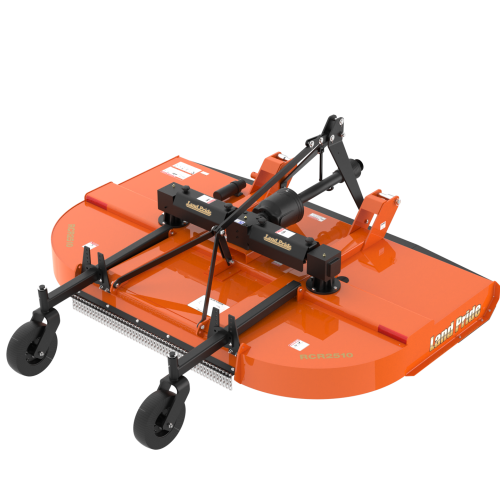
The Land Pride RCR2510 is a wide rotary cutter whose most important buying choice is the hitch configuration. Its mounted and pull-type versions offer the same documented cutting width but create different carrying, turning and transport requirements. A buyer should decide how the complete tractor-and-cutter combination will move around the property before treating width as a productivity advantage.
This guide uses the North American RCR2510 in manual 312-753M dated September 2, 2026. Older search results associate the same manual number with RCR2596 and RCR2510 together; the downloaded current edition identifies RCR2510. Specifications below come from its model table, not a mixture of old family columns.
On This Page
ToggleA broad cutter for identified maintenance work
Start with a property map separating open maintained areas from confined corners, unknown vegetation and routes between fields. A wide cutter is attractive where the working area allows long useful passes. That benefit can disappear where gates, trees, tight headlands or frequent disconnected patches dominate the session.
Define the desired result as well. Controlling rough grass and suitable regrowth is different from maintaining a lawn appearance. The documented vegetation capacity does not authorize using the cutter to discover hidden wire, stones or other obstacles. Site inspection and any necessary initial clearing remain separate work.
For a Canadian acreage expanding into larger maintenance areas, this distinction can prevent an expensive mismatch. The question is not merely whether the tractor can turn a wider cutter. It is whether the property has enough suitable work, accessible at useful times, to justify the whole arrangement.
Keep the two hitch versions distinct
| September 2026 manual | Lift-type | Pull-type |
|---|---|---|
| Weight with front and rear chain shields | 1,750 lb | 2,035 lb |
| Tractor power range | 60–110 hp | 50–110 hp |
| Connection | Category 2 and 3; quick-hitch adaptable | Towed arrangement with dual level rods |
| Overall length | 9 feet | 12 feet 9½ inches |
The table gives a 9-foot-10-inch cutting width, approximately 3.00 metres, and an overall width of 10 feet 3½ inches. PTO speed is 540 rpm and documented vegetation cutting capacity is 1½ inches. The pull-type tongue-weight figure is 872 lb. These ratings belong to the identified configuration; none alone approves a tractor match.
A used listing may identify only “RCR2510, ten foot.” Ask which hitch arrangement is actually supplied, what guarding is fitted and which driveline belongs to it. A photograph of the deck cannot establish the complete package, and a lower asking price may reflect omitted equipment rather than equivalent value.
Mounted: consider the raised condition
With the mounted version, the tractor carries the rear implement through its linkage. Assess the tractor’s applicable capacity and ballast instructions at the relevant geometry, including any quick hitch. The cutter’s scale weight is useful, but the rearward position of that weight also affects the complete combination.
Do not use an unloaded lift demonstration as the only acceptance test. The assessment must include clearance through the prescribed movement, the permitted transport position and the tractor’s ability to remain controlled. A machine within the stated horsepower range may still be an unsuitable host for another reason.
A mounted arrangement can be attractive where the prescribed handling method suits repeated repositioning. However, it does not make the attachment’s overhang disappear. Trace the whole machine through the headland and storage approach; the path of the tractor’s front wheels is not the path of the cutter’s rear.
Pull-type: total weight is not tongue load
The pull-type configuration introduces a different connection and following path. Its total machine weight and tongue-weight figure answer different questions. The tractor’s towing and drawbar requirements must be checked for the actual assembly rather than assuming that a towed cutter places negligible load on the tractor.
A longer combination also changes route planning. Identify room for the permitted turns, the approach to field openings and places where reversing would otherwise be needed. A wide open rectangle may suit the arrangement well, while a fragmented property may make manoeuvring a substantial part of the day.
Compare this version with the mounted version using the same property route. Do not conclude that the lower minimum horsepower makes it the universal small-tractor solution. Power, hitch loading, movement, braking and operating requirements remain distinct parts of compatibility.
The actual width matters at more than the gate
The specified cut is slightly less than the rounded ten-foot class name, while overall width is greater. Use working width for coverage planning and overall dimensions for access screening. Neither should be substituted for a measured safe manoeuvring envelope with the chosen tractor.
Check the approach angle to an opening and the space immediately beyond it. A combination that can pass straight through may not be able to make the required next turn comfortably. Buildings, parked machinery and seasonal storage can change that route even when the gate itself remains unchanged.
Transport between properties deserves its own assessment, including the relevant route and applicable requirements. This guide does not establish road-use approval or a universal provincial width rule. Resolve the actual transport arrangement before buying equipment that can work at the destination but cannot be moved there as planned.
Calculate completed work, including repeat passes
Consider an illustrative 30,000-square-metre maintenance area. Assume an effective swath of 2.8 metres after overlap, a suitable observed pace of 4 km/h and 65% field efficiency. The calculated rate is 2.8 × 4,000 × 0.65, or 7,280 square metres per hour. One pass would take about 4.1 hours.
Those are invented planning inputs, not measured RCR2510 output or a recommended operating speed. At 45% efficiency, the same assumptions give 5,040 square metres per hour and about six hours. Turning, interrupted areas and the need to revisit missed sections can matter as much as the nominal width.
Keep setup, travel from storage and cleanup separate if they are not already included in the efficiency allowance. If part of the area needs another pass for the required result, add that work explicitly. Do not count an attractive first pass as a finished job when the owner expects more.
A useful demonstration therefore records both time and finish. If the result is unacceptable, a fast rate has little purchasing value. Conversely, a slower arrangement that completes the job without repeated correction may suit the property better than a wider alternative.
Power delivery and protection remain separate
The manual documents a Category 4 driveline with equal-angle or constant-velocity joint choices and a four-plate slip clutch. Identify the supplied assembly and follow its specific setup and maintenance requirements. Protection components do not increase the permitted vegetation duty or make obstacle impacts harmless.
For a used machine, establish the shaft’s identity and condition rather than assuming that any shaft which reaches is correct. Length, overlap, operating angles and guards must suit the tractor and hitch arrangement through the prescribed range of movement. Changing tractors can change that assessment.
The RCF2060 guide offers context for a much narrower cutter. It illustrates why width, duty and configured equipment need separate comparison. The RCR2510 should not inherit another cutter’s brush rating simply because it is larger.
Resolve the cutting-height discrepancy conservatively
The current manual’s introductory application text refers to a 2–12-inch cutting range, while its RCR2510 specification table gives 2–10½ inches. These statements are not identical. This guide does not combine them into an asserted universal adjustment range.
If a particular upper cutting height is essential, obtain clarification for the exact machine and hitch configuration before purchase. For general selection, retain the documented discrepancy and use the applicable setup instructions. A conflicting summary should not be turned into permission to operate beyond an established configuration.
This is especially relevant when comparing older advertisements. A familiar model name and unchanged manual number do not prove that every statement belongs to the same edition. Keep the downloaded document date with the purchase record and identify the individual cutter by serial number.
A Canadian season is more than one mowing visit
Estimate the recurring maintained area and the number of occasions when it actually needs work. Separate those from an initial reclamation project. Buying a broad maintenance cutter for one exceptional clearing job can leave the owner with an awkward machine for the following years.
Check the route after winter or prolonged inactivity. Property work can introduce debris or change access, and vegetation can conceal earlier observations. The fact that an area was cut last season is not evidence that it is ready without inspection this season.
Coordinate the tractor’s other jobs as well. A shared farm tractor may be committed during the useful maintenance window. Include changeover, parking and access to the attachment when comparing ownership with contracted work. Availability at the right time can matter more than a theoretical hourly advantage.
Used inspection: examine the complete system
Record model and serial identity, hitch type, driveline, guarding and wheel equipment. Have the deck, hitch structure, rotating assemblies, gearboxes and support components inspected under the correct shutdown and support procedure. Look for damage, questionable repairs, leakage or looseness that needs assessment on this particular machine.
These are condition priorities, not claims that the RCR2510 has a known failure pattern. A seller’s report that it “cut last year” does not establish current readiness. Correct replacement parts and a complete guarding arrangement should be priced before deciding whether the offer is economical.
For the pull-type version, include the towing and height-control components in the inspection. For the mounted version, include linkage interfaces and any quick-hitch arrangement. The most expensive missing item may be outside the deck, so do not let fresh paint focus the inspection on appearance.
Build a purchase comparison that can be rejected
Write down requirements before the demonstration: the limiting entrance, representative turning area, desired finish and acceptable complete session. Include tractor fit and all supplied components. A purchase is easier to assess when failure to meet one of those requirements has a clear consequence.
For example, an unresolved transport route should remain unresolved even if the cutter performs well in a seller’s field. A demonstrated finish on easy grass should not settle performance on a different identified vegetation task. Record what the trial actually establishes and what it leaves open.
Compare ready-to-work costs using real quotations for delivery, setup and repairs. No current Canadian price, guaranteed component life or assumed resale premium is supplied here. The useful choice is the complete configuration that meets the recurring work requirement with acceptable uncertainty.
Frequently asked questions
Are both hitch versions the same weight?
No. The manual lists separate configured weights. Keep the shielding condition and hitch version with the figure.
Does the ten-foot name mean ten feet of actual cut?
The cited table specifies 9 feet 10 inches. Overall width is larger still, so use the appropriate dimension for each calculation.
Is the pull-type version automatically easier on a smaller tractor?
No. Its power range is only one requirement. Tongue loading, towing suitability and the complete operating arrangement must also fit.
Can RCR2596 specifications be taken from this current manual?
The downloaded September 2026 edition identifies RCR2510. An older RCR2596 needs its own applicable documentation.
What should decide between mounted and pull-type?
The verified tractor match and the whole property route, including carrying or towing, headlands, access and storage.
Primary reference
Land Pride manual 312-753M, September 2, 2026, checked November 13, 2026. The cutting-height inconsistency is disclosed above; coverage examples are hypothetical calculations.
Share your experience
Help other Canadian buyers — leave a quick review for the
Land Pride RCR2510
There are no reviews yet. Be the first one to write one.